School Business BLAST
NEW REPORTS from NCDPI (JHA Replacements) - All PSUs
As most everyone is aware NCDPI systems are migrating off the main-frame old “green screen” to a new platform driven primarily by the PSU datafiles. As such all the old familiar reports that started with “JHA….” no longer are available for the new fiscal year. Those reports are still viable and available for the prior fiscal years using the XCLOUD system you were using.
Our new reports are currently being developed in Tableau. Eventually each PSU will be able to sign-on to the platform directly to see your reports. Until that is ready, we will be publishing to our website and issuing unique Codes for each LEA Finance Officer and Charter School Director to view your reports.
The KEY REPORT right now is the INVALID CODE REPORT. This report will let you know all the codes that are not valid from the past datafile period. Please get these corrected before the end of September. As you are aware, we are not able to provide any cash to a PSU for any expenditures reported to an invalid code. This includes federal grant expenditures not reflected in the appropriate grant year.
Please review the PRCs and Grant years that end September 30th and concentrate your efforts to ensuring that those federal grants that are ending have the correct coding before you close September. We do not want anyone reverting federal funds.
GRANTS ENDING 9/30/24: https://www.dpi.nc.gov/documents/fbs/resources/grant-year-chartending93024pdf/download?attachment
The reports being provided are in development and we welcome your feedback. All of the reports may be downloaded in excel. These are reports being provided at this time. We will add CASH reports next month.
- PSU MFR View:
This report provides the full MFR details including the YTD expenditures, MTD expenditures, encumbrances, the PSU budget as reported in the latest month's MFR and the calculated remaining PSU MFR budget balance. The report includes PSU number, Fund, Grant Year, PRC, Purpose, and Object. This data is pulled from the MFR as submitted by PSUs. The remaining budget is calculated by subtracting the local budget entered in the MFR by the YTD expenditures and the encumbrances.
- Invalid Codes:
This report provides the list of any invalid codes reported in this month's MFR. Invalid codes may be a result of the reported codes not matching the chart of accounts or due to a missing grant year.
**PSUs do not receive cash for any invalid code expenditures.
- Calculated Remaining Allotment Balance:
This report provides the remaining allotment balance as calculated by subtracting the allotment by the YTD expenditures and the encumbrances.
- Overspent PRCs:
This report provides a list of any PRCs where the YTD expenditures are greater than the allotment amount. For Federal grants that is reflected PRC and grant year.
- PSU Budget vs. Allotment:
This report provides a comparison between the local budget reported in the MFR and the allotment provided. The difference in the allotment minus the local budget is calculated in the view. Eventually, the goal will be to include data from CCIP to provide a 3rd comparison factor. Budgets are not required for UERS reporting but we hope the PSUs will find this report and data useful.
To get your data please follow these instructions:
Today, anyone listed in EDDIE as the Financial Officer of an LEA or a Charter School Director will receive an email with an access code that is unique to the PSU. Enter this code on the home page of the PSU MFR Dashboard to gain access to your data. This code may be shared internally by the CFO with other members of the PSU as needed. The data may take a few seconds to load as the query is searching thousands of rows of data.
To access the reports: https://bi.nc.gov/t/DPI-FinancialBusinessServices/views/PSU-MFRDashboard/HOME
In the workbook you will click on the blue navigation links on the right to visit the different reports available in this workbook. There is also a navigation bar at the top of your screen. All these reports may be downloaded into excel by the PSU.
Nominate Your School’s Leader for the Wells Fargo Principal of the Year Program!
Do you have an extraordinary principal leading your charter school? Now’s your chance to recognize their dedication, innovation, and the impact they’ve made on your students and staff by nominating them for the prestigious Wells Fargo Principal of the Year (POY) Program!
This program, overseen by the North Carolina Department of Public Instruction, celebrates exceptional leadership across the state. By participating, your school’s principal could join the ranks of those honored for their passionate commitment to education and positive contributions to school culture. You can learn more about the program and last year’s regional finalists and state winners by clicking here and here.
Eligibility Criteria:
- Must be a principal of a North Carolina public school.
- Have a minimum of four years of administrative experience (including assistant principal, principal, or central office roles).
- Lead a school with 100+ students in Average Daily Membership (ADM) or seven or more full-time, state-allotted teachers.
- Be employed as a practicing principal throughout the local, regional, and state selection process.
- Hold a valid principal’s license.
If you are interested in nominating a principal from your charter school, please ensure they meet these criteria and submit their information via the 2025 North Carolina Principal of the Year Nomination.
Once nominated, our POY Coordinator will contact your nominee with portfolio submission guidelines. The portfolio is due by October 25, 2024. We’ll ensure all documentation is submitted on time, and after submission, the regional and state teams will take over the selection process. You can access the complete selection timeline here.
Candidates will complete their portfolio as a Google Doc, which they can easily copy and edit. Once finalized, the document should be submitted as a single PDF file with all required signatures. 2025 North Carolina Principal of the Year Portfolio
If you have any questions or need further assistance, please don’t hesitate to reach out to Elizabeth Santamour at elizabeth.santamour@dpi.nc.gov. Let’s take this opportunity to celebrate and elevate the exceptional leadership in our charter schools!
Beginning Teacher of the Year Nominations
As a reminder, all nominations for the NCCAT 2025 Burroughs Wellcome Fund NC Beginning Teacher of the Year selection process are due by Tuesday, October 1st. If you have not already, please submit your nominee at this link. For award guidelines, the portfolio application, and other information you may visit www.nccat.org/btoy or contact Emily Langdon at emily.langdon@nccat.org with any questions.
Additionally, attached you will find a blank press release that you can use when announcing your BTOY nominee and the process for communicating with NCCAT’s Public Information Officer. We love being able to share your social media posts so please reach out to Todd Vinyard and todd.vinyard@nccat.org if you have any questions regarding social media. We will share an additional press release for the 27 finalists once they are announced in December.
 Beginning Teacher Badge at NCCAT Cullowhee: Beginning Teacher Badge at NCCAT Cullowhee:
Beginning teachers can earn an NCCAT Beginning Teacher Badge by completing all 4 sessions in the series. Please visit www.nccat.org to register. Dates: September 16 -19, 2024.
SRP/SRM Workshop
The Center for Safer Schools will host a Standard Response Protocol (SRP) and Standard Reunification Method (SRM) Train the Trainer Workshop on Wednesday, Oct. 16. The training, held in partnership with the I Love U Guys Foundation, will be held from 8 a.m.-4 p.m. at the James Garner Center, 211 Burnette St., Troy, N.C.
The SRP is used when responding to critical incidents. The SRM is a coordinated effort to reunite families following a crisis or critical incident. The Train the Trainer Workshop introduces participants to the history, concepts and functionality of SRP and SRM and how to train the programs internally.
After learning about the five actions of the Standard Response Protocol, and their associated directives, participants will be able to implement the program and enhance their school safety plans.
Participants also will gain an understanding of the methods for planning, practicing and achieving a successful reunification using the Standard Reunification Method. They will have the ability to organize a reunification team in their school and create a reunification plan.
The workshop is open to school safety directors and support staff. Safety directors and their respective “think partners” (school administrators, law enforcement, etc.) are encouraged to attend together.
Click here to register. The registration deadline is Monday, Oct. 7. If you have questions, send an email to cfss@dpi.nc.gov. -
REMINDER: BTAM Office Hours
Center for Safer Schools Assistant Director-Behavioral Health Dr. Stephanie Ellis is holding BTAM Office Hours from 9-10:30 a.m. on Friday, Sept. 27.
BTAM Office Hours are held to provide technical assistance and implementation strategies. Resources and implementation strategies will be shared at the beginning of each session. Public school units can ask questions about the topic discussed, discuss cases or ask other implementation questions.
BTAM Office Hours is recommended as a follow-up to Behavioral Threat Assessment and Management Training, which was held during the summer of 2024. However, BTAM team members who did not receive the training are welcome to register.
For more information on Behavioral Threat Assessment and Management Training or BTAM Office Hours, send an email to CFSS Assistant Director-Behavioral Health Dr. Stephanie Ellis.
2024-2025 School Safety Grants
The application for the 2024-2025 School Safety Grants is now live in CCIP. The Center for Safer Schools will award a total of $30 million in funding to North Carolina public school units for Safety Equipment, Services for Students in Crisis and Training to Increase School Safety.
The application deadline is Monday, Oct. 14 at 11:59 p.m. The grant – titled “Equipment, Services for Students in Crisis, and Training to Increase School Safety” – can be found under CCIP, FY 2025.
Due to the amount of funding available, there will be a limit on awards to PSUs in each grant category:
School Districts
- Safety Equipment: $500,000
- Services for Students in Crisis: $350,000
- Training to Increase School Safety: $350,000
Charter Schools
- Safety Equipment: $250,000
- Services for Students in Crisis: $350,000
- Training to Increase School Safety: $350,000
The Center for Safer Schools will conduct virtual School Safety Grant trainings from 11 a.m.-12:30 p.m. on Thursday, Sept. 26 and Tuesday, Oct. 1. Both sessions are the same.
Register for the trainings at these links: Sept. 26, Oct. 1. Due to limited space, public school units are allowed only one registration per session.
Please note that if a PSU’s staff does not attend the training and its application is incorrect, it might affect funding. If you have questions, send an email to schoolsafetygrants@dpi.nc.gov.
Immigrant Headcount
An immigrant headcount refers to the process of accurately counting and documenting the number of immigrant students in your Public School Unit (PSU). For the purposes of education, the federal definition of an immigrant student is specific:
An immigrant student is defined as an individual who:
- Is aged 3 through 21
- Was not born in any State of the United States
- Has not been attending one or more schools in any one or more States for more than 3 full academic years
Conducting an immigrant headcount is crucial for several reasons:
-
Resource Allocation: It helps schools and districts determine the resources needed to support immigrant students.
-
Program Planning: Accurate data allows for the development of targeted programs and services.
-
Funding: Many educational funding opportunities are based on the number of immigrant students served.
-
Compliance: It ensures schools meet federal and state requirements for serving immigrant students
Immigrant Headcounts must be submitted by October 7th. We are offering Immigrant Headcount Review sessions.
The sessions will be recorded and made available by September 20, 2024.
School Business - September 19, 2024
|
|
|
The FBS website continues to be updated with information related to School Business and our ongoing operations. Please check the FBS homepage regularly for updates. Please review the upcoming deadlines for due dates.
|
|
Reminder: Federal Grants Ending on or Before Sept 30, 2024
Please be reminded that there are several federal grants that are now allocated and must be accounted for by grant year whose period of performance ends on or before September 30, 2024. The list of grants has also been posted to our What's New page. ESSER related funds must be encumbered (committed) by September 30, 2024 (contract/purchase order issued/recorded in the system); cash must be expended no later than December 30, 2024. After September 30, no ESSER related funds will be available for encumbering, and after December 30, 2024, funds that had been encumbered will not be available for payment.
Please review your federal allotments to ensure you have expended those funds before those grants end. This includes ensuring you have recorded all expenditures and if needed eligible encumbrances to the appropriate grant year in your system. Reminder grant year reporting means that expenditures and cash drawn are all accounted by grant year for the federal grant funds. These must align. Please work with your software vendors if you are still unclear how to appropriately account for these funds using the new grant year code segment in the Chart of Accounts (COA).
Federal Grants - Fiscal Obligations, Liquidations and Reversions FAQ
Guidance for Federal Reversions has been updated to ensure compliance with Federal requirements and ensure efficient processing is in place. A Federal Grants - Fiscal Obligations, Liquidations and Reversions FAQ can be found on the What's New page.
As a reminder:
- Encumbrances in object code 312 are allowable, except for participant travel costs, which would not be an allowable encumbrance under the Federal regulations. The PSU is responsible for complying with the allowable obligations.
- Indirect costs, that correspond to expenses encumbered, will also need to be encumbered.
- Only eligible obligations may be encumbered, payroll expenses and travel are not eligible and that other object codes may be excluded from allowable encumbrances based on the definition of an obligation outlined in U.S. Department of Education requirements in 34 C.F.R. 76.707.
- During the liquidation period, if any expenditures are reported to NC DPI outside of the specific account codes that were used to set up encumbrances reported at the end of the period of performance they will be flagged as unallowable costs and those funds will be pulled in the final reversion process.
- The account code related to the encumbrance cannot be changed during the liquidation period.
Required Annual Reporting Due October 31, 2024
The SS200 (All PSUs) and SS300 (LEAs only) reports are due by October 31, 2024 and will be available by the end of September on the Financial and Business Services website under “What’s New” or by accessing https://schools.nc.gov/ss200 and https://schools.nc.gov/ss300 directly.
An annual subscription (request to access) is required to access the reports. The individual submitting the report will need an active North Carolina Identity Management Identification (NCID) to access the reports. If you (or your staff) need an NCID, or it has expired, you must contact your NCID administrator to set up an account for you. A directory of the LEA NCID administrators is available on NCDIT's website, as well as a directory of IPS/Charter NCID administrators. DPI cannot assign an NCID or reset NCID passwords. Please share this information with other staff that may be involved with data collection and reporting of either of these reports. If you have questions related to the SS200 or SS300, please contact david.cauthorn@dpi.nc.gov.
SS200 Full-Time Personnel Report – All PSUs
The SS200 Full-Time Personnel Report is an online system that collects race/ethnicity, gender and fund source of full-time personnel employed through October 1 of the current school year. A Full Time Employee is defined as a person employed to fill a vacancy whose regular work week is the number of hours established as full-time for the class of work assigned, but not less than 30 hours per week. All Public-School Units (PSUs) and Independent Public Schools (Charters, Regional, UNC Lab Schools) must complete this report.
Reminder About Inclement Weather Closures
In response to your questions about instructional days and inclement weather, please note the following. Additional information is in the SASA, which has been posted to our What's New page.
School Closings and Instructional Time
Be sure to follow your PSU's Inclement Weather policies in addition to these reminders.
If school is closed in advance of inclement weather (school closed the day before), follow your PSU's plan for making up missed days.
If school is closed early due to inclement weather, the day and the scheduled amount of instructional hours count toward the required minimum number of days and instructional hours.
If school buses are in route to schools when school is canceled for the day, then the day and instructional hours scheduled for that day will count toward the required minimum.
The NCSIS team has provided refreshers on updating these changes in the SIS.
- How to Adjust an Instructional Day in NCSIS
- Inclement Weather/Emergency Closure
- How to Adjust an Instructional Day in PowerSchool
- PS QRD: Calendar Changes Document
Staff and Teacher Leave
PSUs may not forgive time not worked by staff due to inclement weather. If school is closed to both employees and students, a teacher shall work on the scheduled make up days. If students are not required to attend school during inclement weather but employees are required to report for a workday, a teacher may take an annual vacation day or make up the day by the end of the fiscal year. For more information, please see the Benefits and Employment Policy Manual and G.S. 115C-302.1(c).
From the Office of Federal Programs
Pre-payment and ESSER Funds
In making a determination on the use of ESSER Funds to pre-pay services, please find the Frequently Asked Questions document issued by USDE on allowable uses of federal ESSER and GEER funding provided under the Coronavirus Aid, Relief, and Economic Security (CARES) Act and the Coronavirus Response and Relief Supplemental Appropriations (CRRSA) Act, and federal ESSER funding provided under the American Rescue Plan (ARP) Act.
See question E-3.d. “How long may ESSER or GEER-funded activities continue after the liquidation period?”
Generally, it is not good stewardship of Federal funds or prudent business practice to prepay for services that will extend many years into the future. However, under limited circumstances where a grantee or subgrantee timely obligates ESSER or GEER funds, ESSER- or GEER-funded activities may continue for a reasonable time beyond the liquidation period (including an approved late liquidation period).
Factors impacting how long ESSER- or GEER-funded activities may extend past the liquidation period include:
- Whether the funds were properly obligated and liquidated in a timely manner;
- Whether the activities would be allowed to extend beyond the liquidation period under applicable State and local procurement rules (i.e., a State or LEA must follow the same policies and procedures it uses for procurements from its non-Federal funds) (see 2 CFR §§ 200.317 through 200.327, 200.403(c));
- Whether the extended activities constitute a reasonable and necessary use of Federal funds; and
- Whether prudent business practices (2 CFR § 200.404(b) & (d)) and internal controls (which generally limit prepayment) would support the continued activities for the length of time proposed.
Grantees and subgrantees must obligate funds by each program’s deadline, which means that if a grantee or subgrantee enters into a contract for activities that continue past the date of obligation and the contractor does not provide the services, the grantee or subgrantee may not enter into a new contract or obligate those funds for a different allowable use. Instead, those funds that were obligated for services that were not delivered will remain unused and will be returned to the U.S. Treasury.
Because ESSER and GEER are State-administered programs, the SEA or Governor determines whether activities extending past the liquidation period are allowable under the circumstances. For example, an SEA may determine that it is reasonable and necessary under 2 CFR §§ 200.403-200.404 for an LEA to enter into a multi-year software licensing contract with a vendor during the period of availability of ARP ESSER funds and to pay for the entirety of the software license within the liquidation period. However, under the contract, the vendor would continue to provide the services (i.e., software and technical support) for some time after the funds had been liquidated.
Specific questions should be addressed to your Office of Federal Programs contact.
|
|
Deadline Reminders
ALL PSUs
|
DUE DATE
|
TOPIC
|
NEWSLETTER
|
|
09/30/2024
|
Athletic Funds Survey
|
08/29/2024
|
|
11/01/2024
|
Cleaner Classrooms for Carolina Kids Enrollment
|
01/05/2024
|
|
|
OCR_CRDC SY2324 Getting Started – Canvas Course
Note: PSUs that were not open in the school year 2023-24 are not required to participate in this collection.
NC CRDC SY 23-24 Canvas Course – Now Open
The NC CRDC SY 2023-24 Canvas Course is now open. The previous course was closed on Monday, September 9, 2024. Previous enrollees have been migrated to the new course, and an invitation was sent to each participant via the Canvas system.
The new course is divided into modules that build concepts step by step. It outlines the responsibilities of PSUs and explains how NCDPI assists with pre-populating data. The course must be completed in order during the first access, but afterward, users can navigate freely between modules. Quizzes are included to reinforce understanding and serve as verification—there are no penalties, but they help ensure participants stay on track.
Course Announcements will provide a less formal communication method, while official messages from NCDPI will still be sent directly to CRDC Coordinators.
NC-specific documentation for the CRDC process will be housed within the course. Examples include the CRDC Collection By Entity Excel document, which informs CRDC Coordinators and designees of the data NCDPI will pre-populate when the submission window opens, as well as presentations used during face-to-face and webinar sessions. Webinar recordings will also be available in the course. Additionally, the CRDC SY 2023-24 course provides more information on the error resolution process within the Federal Submission Tool and includes references to relevant federal source documentation for each topic.
A course calendar is available and will list key events such as conferences, webinar invites and the submission window time frame. Check the calendar frequently for updates.
SY2023-24 CRDC Federal Submission Window
The OCR has announced that the Federal Submission Tool will be open from December 9, 2024, through March 7, 2025. These dates are subject to change. The 2023-24 LEA and School forms have been published. For more information, visit the Civil Rights Data Collection Resource Center.
CRDC Support
Immunization and Health Assessment Compliance Reporting
Each year, all schools are required to report the immunization status of their kindergarten, 7th grade and 12th grade students, according to G.S. 130A-155(c) and G.S. 130A-440. The purpose of these reports is to ensure that all children enrolled in North Carolina schools are protected against vaccine-preventable diseases and to determine the number of children who meet state immunization requirements. Additionally, all North Carolina public and public charter schools are required annually to report on the status of Health Assessments for those students who are enrolling for the first time in a North Carolina public or public charter school (G.S. 130A-441(c)).
Report submission can take place after the 30th calendar day from the school’s official first day. A combined compliance report is available this year, by school name, and must be completed on-line at this link: 2024-2025 Annual K-12 Health Assessment and Immunization Report. . You may use the link to access instructions as well as worksheets to gather your responses prior to entering the online report. Compliance reports are due no later than November 1, 2024 but may be completed at any time prior to that date. Important Resources for Charter Schools: (Please Read)
Please click on each link.
Charter School Epinephrine Memo
Charter School Diabetes Memo
K-12 Math Standards Release
The K-12 Math team launched our All-stakeholder surveys for the Math standards review. I've linked both the message from the listserv I sent out and a link to a Google doc with the specific links to each all-stakeholder survey and the introduction for each.
Could you run this in any/all of the charter school newsletters you might have? Feel free to tweak the wording as you think best. The surveys will stay open until Oct. 21st.
North Carolina Foster Care Education Program
Updating Contact Information for Foster Care Point of Contact
The Every Student Succeeds Act (ESSA) requires all LEAs to appoint a local foster care point of contact (POC) to support the educational needs of their students in foster care. To ensure that your charter’s foster care POC is receiving communications from our office please review the NC Foster Care Local POC Directory. If the contact information is incorrect, the NC Foster Care Local POC Form should be completed as soon as possible.
New State Coordinator for the Foster Care Education Program
Join us in congratulating Dr. Yatisha Q. Blythe as she begins her new position as North Carolina’s State Coordinator for the Education of Children and Youth in Foster Care. Dr. Blythe’s 20-year career in education has been dedicated to supporting and advocating for children, youth, and families experiencing homelessness and involvement with child welfare agencies.
Serving as the state technical assistance center, the NCFCEP remains steadfast in its commitment to ensuring state policies align with federal law. This is manifested through our provision of comprehensive technical assistance and guidance to local foster care education POCs, and efforts to disseminate informational and awareness materials to educators and various community stakeholders across North Carolina. For any inquiries, suggestions, or feedback, please contact Dr. Blythe at yqblythe@serve.org.
NC Virtual Public School (NCVPS) is offering free Digital Transition professional development webinars for educators during the month of September:
-
September 24th at 7:00 pm - WORLD LANGUAGE: Building Cultural Competence in the World Language Classroom
-
September 26th at 4:00 pm - Personalized Learning in Canvas
-
September 30th at 5:00 pm - CTE SERIES: Behavior Management in Career & Technical Education
CEUs are available. Visit the NCVPS Digital Transitions website for registration links and archived recordings of sessions!
Edvantage Tutoring will be offered in the following curriculum areas:
• 6th, 7th & 8th Grade ELA
• Middle School ELA: Writing Lab (asynchronous assistance in ELA)
• 6th, 7th & 8th Grade Math
• 6th, 7th & 8th Grade Science
• 8th Grade Math I
• High School Math I
• High School Math II
• High School Math III
• High School Biology
• High School Chemistry
• High School English: Writing Lab (asynchronous assistance in English)
• Spanish I - IV
*General MS/HS Asynchronous Support (asynchronous assistance is also available in ALL curriculum areas listed)
Tutoring will be available Monday-Thursday, 4:00 PM-7:30 PM nightly September 23, 2024 through May 22, 2025. Daytime tutoring is also available per school/district request and may be utilized for students who are in ISS, suspended, homebound, absent, and/or working from home, McKinney-Vento, athletes needing extra support, etc.
There is a flat fee of $35/hour for tutoring. And, all tutoring slots are available in 30-minute increments. Please keep in mind that any unused purchased minutes automatically roll over to the next school year! Enroll today or send an email to request more information.
Request Tech Support for NCSIS and Other Applications
Need technical support? View NCDPI Technology Services’ new one-page reference sheet for frequently used support links and contact information. Please note that there are now two options for submitting support tickets related to NCSIS powered by Infinite Campus.
- For Infinite Campus application issues and general technical support, visit support.infinitecampus.com.
- For other NCSIS issues (duplicate students, amplify/missing students, etc.), visit go.ncdpi.gov/help and choose “Something is Broken,” then “NCSIS – Powered by Infinite Campus.”
Honors regional PD opportunities open to all PSUs
In this session, participants will delve into the components of the new honors policy and learn how to evaluate current honors-level courses to ensure they meet the required depth and complexity. They will explore the Honors Level Course Development and Evaluation Tool and other resources while receiving guidance on policy implementation. Additionally, participants will deepen their knowledge of advanced learning indicators and engage with best-practice instructional strategies that support honors-level coursework.
Bring a team of 4-5 people who are involved with overseeing honors implementation in the district. Consider the roles of CAOs, Instructional coaches, high school principals and APs, lead teachers, etc. This PD is a “train-the-trainer” model.
Flyer & Registration Link:
New Homeless Liaison Training
The North Carolina Homeless Education Program (NCHEP) will be hosting the New Homeless Liaison Training for Charter Schools on Wednesday, September 25, 2024. This training will be held in-person on the UNCG campus in the Elliott University Center. Homeless liaisons with two-years or less experience should attend this required training.
Prerequisites for Participation:
Note: It is vital for this resource to be reviewed otherwise, effective participation in the training session will be limited.
Registration for the training is required. REGISTER HERE
If you have questions about registration or this training, please contact their EHCY Program Administrator, Savannah Gay.
NCDPI Master Data Calendar for 2024-25
The Master Data Calendar for the 2024-25 school year is a valuable resource to have on hand. The calendar outlines all data due dates for the 2024-25 school year.
NCDPI Master Data Calendar for 2024-25
Academic Standards Statewide Supports for 2024-25
NCDPI's Office of Academic Standards Statewide Supports for 2024-25 is now online! The professional development calendar offers a year-long overview of upcoming webinars, resources and leaders’ meetings for each content area. Be sure to check the calendar regularly for updates.
Find professional learning opportunities, registration information and more.
NCSIS Implementation Check-In Calls
Regular check-in calls are instrumental in resolving issues and providing timely support to PSUs. Superintendents, leadership teams, technical leads and SIS coordinators are strongly encouraged to participate. Moving forward, these calls will transition to a bi-weekly schedule. To ensure your questions are addressed, please submit them in advance.
Use this link to register and submit questions.
New Pilot Program – NC College Connect – Launches to Increase College Access for North Carolina Students
Today, the University of North Carolina System introduced NC College Connect, a simplified college application process for North Carolina public high school students in their senior year. The new program will enable qualifying students to bypass the traditional application process into participating colleges.
NC College Connect creates a simple, easy way for students to apply to participating UNC System and North Carolina Community College System institutions across the state. North Carolina public high school students who close their junior year with a weighted GPA of 2.8 or above will qualify for the pilot program. Qualifying students must maintain a weighted GPA of 2.8 or above throughout their senior year, in addition to meeting the state’s graduation requirements as set by the North Carolina Department of Public Instruction, and UNC System minimum requirements. ...
'It’s well known that one of the major barriers to students pursuing college is the application process,' said State Superintendent of Public Instruction Catherine Truitt. 'NC College Connect removes this hurdle, offering a streamlined and simplified way for our state’s future workforce to pursue their degree.'”
Read the full press release to learn more.
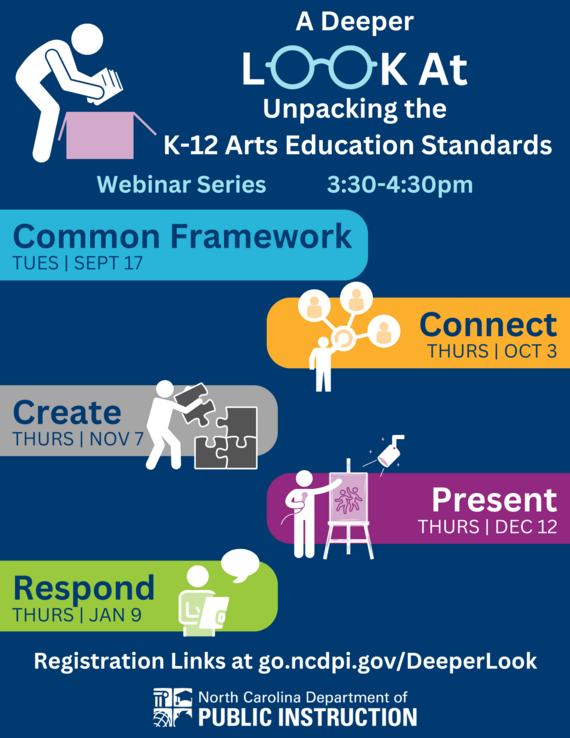
*NEW* 24-25 Office of Academic Standards Statewide Supports Document
The Office of Academic Standards is excited to share a yearlong look of upcoming webinars, resources, and leaders’ meetings. This link will stay live and will be periodically updated. The date in the footer will indicate the latest update. Please share!
Regional Standards PD/Direct Admissions Dates and Registration
A new school year is on the horizon and wishing each of you a successful 2024-25 school year as you lead school counselors in their work! Below you will find the registration links for the regional professional development sessions for the new NC Student Success Standards. Again, we will train district leadership and/or designated appointees by the districts, utilizing a "train the trainer" model. We ask that all districts send one designated designee for each grade level (elementary, middle, and high school) who will be responsible for training their district school counselors for that level. District leaders are also able to join this session if you are not already the designee. Please sign up for dates that are for your region due to limited facility capacities.
In addition, we will provide afternoon sessions for the new admission initiative for NC that will begin its roll out phase in the fall on the same day. Be prepared for a full day, from 9-3pm of training.
|
DATE
|
REGION
|
LOCATION
|
|
September 25th
|
Piedmont-Triad
|
JB & Claire Davis Corporate Training Center at Randolph Community College
413 Industrial Park Ave, Asheboro, NC 27205
|
|
October 1st
|
Northcentral
|
North Carolina Department Public Instruction
301 N. Wilmington Street, Raleigh NC
Room 150
|
|
October 2nd
|
Southeast
|
Spencer Board Room
New Hanover County Schools
Dale K. Spencer Building
1802 South 15th Street
Wilmington, NC 28401
|
Continue have a wonderful week!
Kisha Bryant, Ed.D.
School Counseling Consultant
Healthy Schools and Specialized Instructional Support
Office of Academic Standards
NC Department of Public Instruction
P: (984) 236-2820
kisha.bryant@dpi.nc.gov
North Carolina Public Schools Exceptional Children Information for Parents Update
Human Capital Monthly Webinars held by the Office of Licensure and Educator Preparation
Hosted by Dr. Tom Tomberlin, Senior Director, Educator Preparation, Licensure, and Performance, NCDPI
Dates:
October 4
November 8
December 6
Time: 10:30-11:30am
Virtual Link:
Kim Evans' Personal Room
Important MEMOs:
|