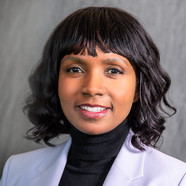
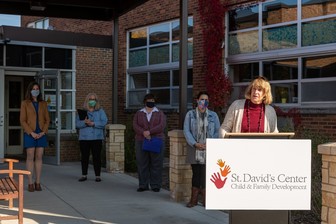
 The commissioner and Lieutenant Governor Peggy Flanagan announced a $3 million investment in mental health services for children and families at St. David’s Center for Child and Family Development in Minnetonka, Oct. 8.
DHS, in collaboration with the Children’s Cabinet and the Minnesota Department of Education, is making a $3 million investment to support the mental health needs of children, youth, and families during the COVID-19 pandemic. Funding is from the Coronavirus Relief Fund, part of the federal Coronavirus Aid, Relief, and Economic Security (CARES) Act.
The funds will be distributed to school-linked mental health providers and other mental health providers who serve children and families with young children. The funds may be used to mitigate service interruptions and prioritize in-person services, purchase critical care supplies, cover public health-related training costs, and address the behavioral health needs of communities of color and Native communities related to the COVID-19 public health emergency. Funds are expected to be awarded to eligible applicants by the end of November 2020.
More grant application information will be made available soon, and funding is expected to be available by the end of November.
Read the press release.
DHS will be hosting two virtual events at the end of October to discuss the upcoming request for proposals for the next round of State Opioid Response (SOR) grants.
Minnesota has received $11,225,707 for 2020 and $11,225,707 for 2021 from the Substance Abuse and Mental Health Services Administration (SAMHSA) to help address the opioid crisis by:
- Increase access to medication-assisted treatment (MAT)
- Increase targeted outreach to culturally specific opioid use disorder clinics and prescribers to reach those most at risk
- Increase evidence based prevention, treatment and recovery services
This is the next round of SOR grants, building on the work that is currently underway. However, new and smaller providers are especially encouraged to apply.
There will be two virtual events:
- Greater Minnesota, Wednesday October 28, 4-6 P.M.
- Metro area, Thursday, October 29, 4-6 P.M.
Find out more
Behavioral health providers are eligible to apply for Phase 3, Provider Relief Funding to help offset financial losses and changes in operating expenses caused by the coronavirus.
Previously ineligible providers, such as those who began practicing in 2020, are also invited to apply, and an expanded group of behavioral health providers confronting increased mental health and substance use issues exacerbated by the pandemic are also eligible for relief payments.
Applications will be accepted through November 6, 2020. See the Trump Administration Announces $20 Billion in New Phase 3 Provider Relief Funding news release on the HHS website for more information about Phase 3 and the Provider Relief Fund.
For more information, see MHCP provider news and updates.
Providers of residential services can now request short-term emergency temporary staffing if they’re experiencing a staffing shortage due to an outbreak of COVID-19 at their facility. All providers offering residential services may apply for temporary replacement staff for up to 14 days through December 2020.
If deemed eligible, the organization will receive temporary replacement staff for up to 14 days from a third-party staffing agency selected by the State of Minnesota at no cost to the provider.
Eligible facilities include, but is not limited to:
- Residential behavioral health facilities treating substance use and mental illness
- those providing Long-term Services and Supports
- Home care providers/assisted living intermediate care facilities for persons with developmental disabilities
- Adult Foster Care
- Boarding Care Homes
- Board and Lodge Homes
Find out more.
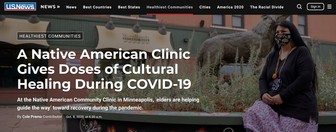 The October 8 issue of U.S. News and World Report featured a story about the Native American Community Clinic in Minneapolis and traditional healing. The clinic is one of 14 Traditional Healing grantees across the state managed by the Behavioral Health Division.
Traditional healing is an approach to mental health and substance use disorder treatment designed and delivered by American Indians, for American Indians. Research has found that traditional healing practices to be very successful, having outcomes equivalent to conventional treatment for non-American Indians.
Find out more about Traditional Healing grants.
The Behavioral Health Monthly newsletter comes from the Behavioral Health Division at the Minnesota Department of Human Services. We welcome your feedback!
For more information about Behavioral Health Services in Minnesota, visit: Children’s mental health / Adult mental health / Substance use disorder
Change what emails you receive from DHS
|