|
The Drug Medi-Cal Organized Delivery System (DMC-ODS) is a program for the delivery of substance use disorder (SUD) treatment services to eligible Medi-Cal members with SUDs by providing a continuum of care for SUD treatment services. Below are 5 major CalAIM implementations our AOD team have worked tirelessly to implement!
1. Early Intervention Services (ASAM 0.5)
ASAM (American Society of Addiction Medicine) is a society founded in 1954 to help addiction professionals improve the quality of addiction treatment and education about addiction. ASAM developed a set of criteria that treatment providers can use in the assessment of a person to help determine the most appropriate level of care.
BHRS has implemented ASAM criteria level 0.5, Early Intervention, which is covered for members under the age of 21. Early Intervention services can consist of assessment and education for people at risk of developing a substance use disorder, or programs like DUI classes for people arrested for driving under the influence. The goal of 0.5 services is to intervene before a person develops a substance use disorder.
|
BHRS Implementation Efforts
|
Status
|
|
Develop and communicate the policy with providers
|
Complete!
|
|
Train staff and providers
|
Complete!
|
|
Monitor implementation
|
Complete!
|
2. Expanded MAT Access
Medication Assisted Treatment (MAT) is a proven, comprehensive treatment approach, which combines FDA-approved medications for substance use disorders, with counseling and other lifestyle/behavioral therapies to support treatment and recovery. Under CalAIM, there has been significant MAT access expansion.
|
BHRS Implementation Efforts
|
Status
|
|
Staffing Added
|
Complete!
|
|
- IMAT: 2 Case Management/Assessment Specialists
- IMAT: 1 Psychiatric Social Worker
- Senior Community Health Planner
- BHRS Psychiatric Residents at Correctional Health
|
|
|
Infrastructure
|
In progress
|
|
- Horizon Palm Ave Detox Incidental Medical Services: Add medical oversight and increased monitoring of clients entering Palm Ave to prevent overdose death, promote retention by easing withdrawal experience and linking to MAT services
- Naloxone vending machines: Installation at BHRS clinics and jails. A machine has been added at Maguire Correctional Facility, other BHRS clinics to come!
|
|
|
Harm Reduction Campaigns & Resource Distribution
|
Complete!
|
|
- Emergency Medical Services Buprenorphine Program: As of 04/01/2024 – every American Medical Response (AMR) ambulance unit in SMC carries and is trained in using buprenorphine to aid in opioid withdrawal and overdose prevention.
- Outreach and education media campaigns coming soon! Including health care provider, youth and public / community focused campaigns.
- IMAT client engagement/retention expenses, such as medications, hygiene supplies, transportation and other treatment related costs.
|
|
|
Evaluation/Administrative
|
Complete!
|
|
- BHRS consultant to provide clinical training, SUD provider consultation and quality assurance support.
- American Institutes of Research evaluation of Opioid Settlement Funds Program.
|
|
3. Certified Peer Support Specialist/Peer Support Service Added as Reimbursement in DMC ODS Service
Medi-Cal Peer Support Services are defined as “culturally competent individual and group services that promote recovery, resiliency, engagement, socialization, self-sufficiency, self-advocacy, development of natural supports, and identification of strengths through structured activities such as group and individual coaching to set recovery goals and identify steps to reach the goals. Services aim to prevent relapse, empower Medi-Cal members through strength-based coaching, support linkages to community resources, and educate members and their families about their conditions and the process of recovery.” These services can now be reimbursed under CalAIM!
|
BHRS Implementation Efforts
|
Status
|
|
Incorporate Peer Requirements into DMC ODS contract templates
|
Complete!
|
|
Develop Peer Support framework and supervisor training for BHRS staff and CBOs
|
Complete!
|
|
Train providers and AOD staff on Peer Support Specialist benefits and requirements
|
In Progress
|
|
Set up Avatar codes and billing system for DMC ODS
|
In Progress
|
|
Developing Peer Recovery Specialist monitoring tools and protocols for DMC ODS
|
Coming up
|
4. Evidence Based Practice Requirements
DMC-ODS plans ensure that providers implement at least two of the following evidenced-based treatment practices (EBPs). The EBPs are:
1. Motivational Interviewing – A person-centered, empathic, but directive counseling strategy designed to explore and reduce a person’s ambivalence toward treatment. This approach frequently includes other problem-solving or solution-focused strategies that build on members’ past successes.
2. Cognitive-Behavioral Therapy – Based on the theory that most emotional and behavioral reactions are learned and that new ways of reacting and behaving can be learned.
3. Relapse Prevention – A behavioral self-control program that teaches individuals with SUD how to anticipate and cope with the potential for relapse. Relapse prevention can be used as a stand-alone substance use treatment program or as a recovery services program to sustain gains achieved during initial SUD treatment.
4. Trauma-Informed Treatment – Services must take into account an understanding of trauma, and place priority on trauma survivors’ safety, choice, and control.
5. Psychoeducation – Psychoeducation is designed to educate members about substance abuse and related behaviors and consequences. Psychoeducation provides information designed to have a direct application to persons’ lives, to instill self-awareness, suggest options for growth and change, identify community resources that can assist members in recovery, develop an understanding of the process of recovery, and prompt people using substances to act on their own behalf.
|
BHRS Implementation Efforts
|
Status
|
|
Communicate policy to providers
|
Complete!
|
|
Train staff via periodic trainings throughout the year
|
Complete!
|
|
Develop monitoring tools
|
Complete!
|
|
Monitor CBO providers and track compliance
|
On-going
|
5. Contingency Management Recovery Incentive Pilot
Contingency Management (CM) is an evidence-based treatment that provides motivational incentives to treat individuals living with stimulant use disorder and support their path to recovery. It recognizes and reinforces individual positive behavioral change, as evidenced by drug tests that are negative for stimulants. CM is the only treatment that has demonstrated robust outcomes for individuals living with stimulant use disorder, including reduction or cessation of drug use and longer retention in treatment.
Eligible Medi-Cal members will participate in a structured 24-week outpatient CM service, followed by six or more months of additional treatment and recovery support services without incentives. The initial 12 weeks of CM consists of a series of incentives for meeting treatment goals, specifically abstinence from stimulants objectively verified by urine drug tests (UDTs) negative for stimulant drugs (e.g., cocaine, amphetamine, and methamphetamine). The incentives consist of cash-equivalents (e.g., gift cards), consistent with evidence-based clinical research for treating SUD. Once the initial 24-weeks of CM treatment is complete, the beneficiary can receive CM continuing care of six months or more, with treatment services to support ongoing recovery (e.g., counseling and peer support services).
|
BHRS Implementation Efforts
|
Status
|
|
Two contractors pilot the program. Our Common Ground started July 1 and El Centro de Libertad will be starting soon!
|
Complete!
|
|
Set up Avatar codes and billing
|
Complete!
|
|
Develop outreach materials and community outreach/education/communication plan
|
Complete!
|
|
Quarterly monitoring, data and performance monitoring, outcome monitoring and DHCS monitoring
|
On-going
|
The CalAIM Service Codes Training took place on August 15. The next training, Progress Notes Training, will be on September 19! Please note that these trainings are mandatory, but in case you miss a training, they will be posted to LMS the following week.
Have feedback on the trainings so far? Leave feedback at the link here!
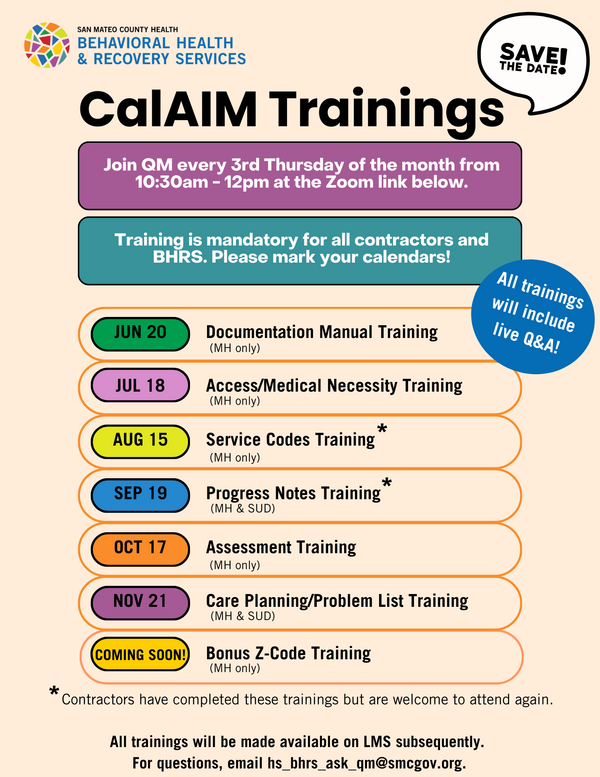 Attend trainings at the Zoom link here:
Be sure to check out the QM lightbulb which comes out the Friday before the Leadership meeting, which occurs on the third Wednesday of the month.
Please email Caprice Scott, CalAIM Project Manager, at cscott1@smcgov.org for any CalAIM questions.
For questions, feedback or to join this mailing list and receive this newsletter, please email Audrey Davis, BHRS Communication Specialist, at adavis2@smcgov.org.
|