|
So far we've been looking at policies under the Behavioral Health Initiative (ie. No Wrong Door, Medical Necessity), but what else is being done to build a more coordinated, person-centered and equitable health system for Medi-Cal recipients?
Under CalAIM, members will have access to new and improved services and receive well-rounded care that goes beyond the doctor's office or hospital and addresses all of their physical and mental health needs. These bold changes include 11 initiatives that are part of the CalAIM waiver. Read about them below:
|
Behavioral Health Initiative
Strengthening mental health and substance use disorder services and better integrating them with physical health care.
|
Community Supports
Helps members address unmet basic needs that can impact their health, whether they're clinical or non-clinical. These include support to secure and maintain housing and access to medically tailored meals to support short term recovery.
|
Dental Initiative
Expanding dental benefits for children and those with conditions that are more likely to lead to dental disease.
|
|
Enhanced Care Management (ECM)
Providing high-need members with in-person care where they live.
|
Incentive Payment Program
Medi-Cal is supporting the implementation of ECM, Community Supports and other initiatives to Medi-Cal managed care plans to invest in improving the quality of care, reducing health disparities, and promoting health equity.
|
Integrated Care for Dual Eligible Members
Better integrating care for members who are dually enrolled in both Medicare and Medi-Cal.
|
|
Justice-Involved Initiative
Providing services to justice-involved adults and youth while they are incarcerated, and as they re-enter their communities.
|
Population Health Management
Medi-Cal is requiring managed care plans to use a concentrated approach to improving the health outcomes of a group of individuals.
|
Providing Access and Transforming Health (PATH)
PATH funds are an investment in the capacity and infrastructure of local community-based organizations to provide services to Medi-Cal members in their communities.
|
|
Statewide Managed Long-Term Care
Introducing a better way to coordinate care for those with very complex or long-term care needs.
|
Supporting Health and Opportunity for Children and Families
Improving the health of children in California, supporting their families, reducing disparities in care, and strengthening accountability and oversight of children's services.
|
|
Lets take a closer look at the Justice Involved Initiative...
Why is the Justice-Involved Initiative important?
Justice-involved individuals - people who are now, or have spent time, in jails, youth correctional facilities, or prisons - are at higher risk for injury and death than the general public. They face disproportionate risk of violence, overdose, and suicide.
- Incarcerated individuals in California jails with an active mental health case rose by 63% over the last decade.
- 66% percent of Californians in jails or prisons have moderate or high need for substance use disorder treatment.
-
Overdose is the leading cause of death for people recently released from incarceration, and people in California jails or prisons have a drug overdose death rate more than 3x that of incarcerated people nationwide.
- In California, nearly 29% of incarcerated men are Black, while Black men make up only 5.6 percent of the state’s total population.
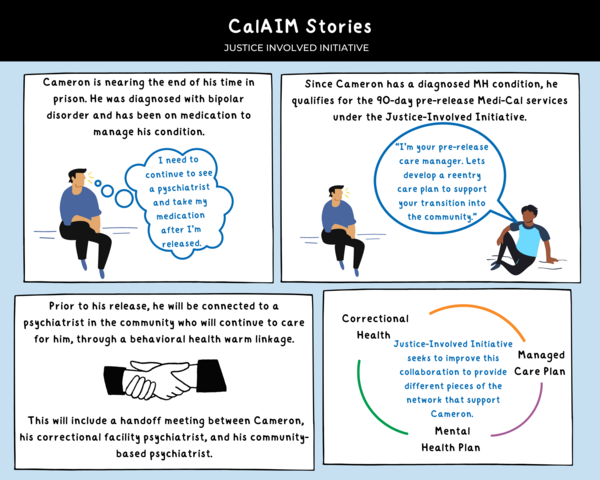
On January 26, 2023, California became the first state in the nation approved to offer a targeted set of Medicaid services to youth and eligible adults in state prisons, county jails, and youth correctional facilities for up to 90 days prior to release.
How will this initiative help current and new clients?
The Justice-Involved Initiative allows eligible Californians who are incarcerated to enroll in Medi-Cal and receive a targeted set of services in the 90 days before their release. This initiative aims to ensure continuity of health care coverage and services between the time they are incarcerated and when they are released. It also provides people who are reentering the community with the prescribed medications and durable medical equipment (DME) they need, and access to programs and services to support this important transition.
 What is BHRS involvement?
- San Mateo County was able to obtain PATH funding for Justice-Involved Initiative!
- BHRS is partnering with Probation and Correctional Health Services and meets weekly to determine operational processes that will serve as the foundation for implementing this important initiative.
We hope this newsletter will be a continued resource to learn about all CalAIM initiatives available to Medi-Cal recipients.
Be sure to check out the QM lightbulb, now coming out the Friday before the Leadership meeting, which occurs on the third Wednesday of the month. Thank you for reading.
Please email Caprice Scott, CalAIM Project Manager, at cscott1@smcgov.org for any CalAIM questions. For questions or feedback about this newsletter, please email Audrey Davis, Communication Specialist, at adavis2@smcgov.org.

|