- The Access Call Center has begun to use the screening tool as of March 4! Congrats on this milestone! Access is the only team currently using the screening tool - clinics will jump on board later this year.
-
The screening tool determines whether an individual should be referred to the Managed Care Plan delivery system or to the Mental Health Plan delivery system for a clinical assessment and ensures that individuals have timely access to the appropriate mental health delivery system.
- QM is hosting a CalAIM Service Code Training for MH contract agencies on March 29 from 10:00am - 11:00am via Zoom. The training will also be recorded and available here. If you are a MH contract agency and did not receive an invitation for this training, please reach out to hs_bhrs_ask_qm@smcgov.org.
- QM is currently working on the same training for BHRS staff - more info to come!
-
AOD had a service code training on March 7 at their monthly AOD Treatment Provider meeting. This training will be ongoing as changes arise.
- Service codes, or CPT (Current Procedural Terminology) codes, provide a uniform nomenclature for coding services provided. CPT codes are part of the payment reform initiative and there are CPT codes for MH and AOD services.
- The QM team attended the CalQIC conference this week, which covered topics such as compliance and quality improvement practices. They learned about best practices for implementation of regulatory requirements, SUD/MH integration, Performance Improvement Projects, and collaboration with other systems.
 |
Pictured above: Betty Ortiz-Gallardo and Eri Tsujii at CalQIC, after participating in a BHIN (Behavioral Health Information Notice) competition!
What else is being done to build a more coordinated, person-centered and equitable health system for Medi-Cal recipients?
Under CalAIM, members will have access to new and improved services and receive well-rounded care that goes beyond the doctor's office or hospital and addresses all of their physical and mental health needs. These bold changes include 11 initiatives that are part of the CalAIM waiver. Read about them below:
|
Behavioral Health Initiative
Strengthening mental health and substance abuse use disorder services and better integrating them with physical health care.
|
Community Supports
Helps members address unmet basic needs that can impact their health, whether they're clinical or non-clinical. These include support to secure and maintain housing and access to medically tailored meals to support short term recovery.
|
Dental Initiative
Expanding dental benefits for children and those with conditions that are more likely to lead to dental disease.
|
|
Enhanced Care Management (ECM)
Providing high-need members with in-person care where they live.
|
Incentive Payment Program
Medi-Cal is supporting the implementation of ECM, Community Supports and other initiatives to Medi-Cal managed care plans to invest in improving the quality of care, reducing health disparities, and promoting health equity.
|
Integrated Care for Dual Eligible Members
Better integrating care for members who are dually enrolled in both Medicare and Medi-Cal.
|
|
Justice-Involved Initiative
Providing services to justice-involved adults and youth while they are incarcerated, and as they re-enter their communities.
|
Population Health Management
Medi-Cal is requiring managed care plans (MCPs) to use a concentrated approach to improving the health outcomes of a group of individuals.
|
Providing Access and Transforming Health (PATH)
PATH funds are an investment in the capacity and infrastructure of local community-based organizations to provide services to Medi-Cal members in their communities.
|
|
Statewide Managed Long-Term Care
Introducing a better way to coordinate care for those with very complex or long-term care needs.
|
Supporting Health and Opportunity for Children and Families
Improving the health of children in California, supporting their families, reducing disparities in care, and strengthening accountability and oversight of children's services.
|
|
Lets take a closer look at the Supporting Health and Opportunity for Children and Families Initiative...
What is this initiative about?
Medi-Cal’s Strategy to Support Health and Opportunity for Children and Families is a forward-looking policy agenda for children and families enrolled in Medi-Cal. This Medi-Cal strategy will unify the common threads of existing and newly proposed child and family health initiatives, and will solidify DHCS’ accountability and oversight of children’s services. Providing a comprehensive vision of children’s health investments, Medi-Cal’s Strategy to Support Health and Opportunity for Children and Families outlines key policy developments and how they fit together, and new strategies to establish greater accountability for the care provided to children.
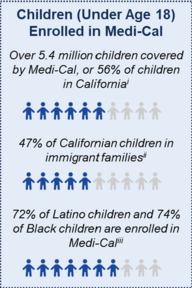
In shaping Medi-Cal’s Strategy to Support Health and Opportunity for Children and Families, DHCS was guided by the following principles and considerations:
- Addressing health disparities and advancing health equity
- Implementing a whole-child, preventative approach informed by famines
- Providing family and community-based care
- Promoting integrated care
- Improving accountability and oversight
- Looking beyond Medi-Cal
|
What is the strategy to support this initiative?
As summarized in the table below, the Medi-Cal strategy details the steps and key action points that DHCS is taking in eight key areas to support children and families. Read more about each area here.
|
(1) Implement a new leadership structure and engagement approach:
- Identify a DHCS child health champion who will be accountable for strengthening Medi-Cal’s role in serving children and overseeing implementation of Medi-Cal’s Strategy to Support Health and Opportunity for Children and Families (new)
- Engage with stakeholders to ensure that family voices help shape policy
- Create a new DHCS Consumer Advisory Committee (new)
|
|
(2) Strengthen the coverage base for California’s children:
- Reduce Medi-Cal premiums to zero for families to make coverage more accessible (new)
- Expand presumptive eligibility to make it easier for children to be quickly and efficiently enrolled in Medi-Cal (new)
|
|
(3) Fortify the pediatric preventive and primary care foundation:
- Design and implement a new population health management strategy to establish clear, enforceable requirements for plans to identify and serve children in need of care coordination (new)
- Conduct an education and outreach campaign regarding Early and Periodic Screening, Diagnostic and Treatment for enrollees, providers, and managed care plans (MCPs) to support families (new)
- Implement changes to improve the criteria and procedures used to determine when children will receive behavioral health services, including specialty mental health and substance use disorder treatment (new)
|
|
(4) Strengthen access to pediatric vaccinations:
- Develop a Vaccines For Children (VFC) Strategic Plan with CDPH to ensure that there is a comprehensive effort to maximize the catch up of vaccinations, distribute vaccines, and support family engagement (new)
- Increase vaccination of pregnant individuals enrolled in Medi-Cal (new)
|
|
(5) Enhance accountability for high-quality and equitable care for children:
- Support MCP and local education agency partnerships in delivering a statewide continuum of care by requiring MCPs to provide Medi-Cal services, including preventive services and adolescent health services provided in schools or by school-affiliated health providers (new)
- Enhance and sustain payments to pediatric providers to increase use of key preventive and screening services for children and families (new)
- Streamline DHCS pediatric dashboards to enhance transparency and increase usability (new)
|
|
(6) Apply a family-centered approach:
- Clarify family therapy as a behavioral health benefit
- Develop a strategic plan with CDPH and CDSS partners to maximize enrollment of eligible Medi-Cal children and families into the CalFresh program and the Special Supplemental Nutrition Program for Women, Infants, and Children (WIC) (new)
- Partner with DDS to better support children who have both an intellectual developmental disability (IDD) diagnosis and behavioral health need (new)
|
|
(7) Address the child and adolescent behavioral health crisis:
Children and Youth Behavioral Health Initiative (CYBHI)
- Provide grants to expand evidence-based, community-defined behavioral health programs and practices for children and youth. Also provide direct grants to build infrastructure partnerships and capacity statements to increase school-based behavioral health services
- Implement the Behavioral Health Continuum Infrastructure Program, which includes expanding treatment facilities for children and families
- Launch pediatric primary care training for managing behavioral health conditions, including targeted strategies for adolescent behavioral health conditions
- Conduct a public education campaign that is culturally and linguistically appropriate to reduce stigma surrounding the use of behavioral health services (implemented by CDPH and the Office of the Surgeon General)
- Implement a Medi-Cal managed care incentive program to increase access to preventive, early intervention, and behavioral health services provided by school affiliated health providers
|
|
(8) Next steps on the foster care model of care:
- Continue to work with California Department of Social Services and stakeholders to develop a new model of care centered on establishing an accountability framework across systems, advancing equity, and integrating services and care
|
We hope this newsletter will be a continued resource to learn about all CalAIM initiatives available to Medi-Cal recipients.
Be sure to check out the QM lightbulb, now coming out the Friday before the Leadership meeting, which occurs on the third Wednesday of the month.
Please email Caprice Scott, CalAIM Project Manager, at cscott1@smcgov.org for any CalAIM questions.
For questions, feedback or to join this mailing list and receive this newsletter, please email Audrey Davis, Communication Specialist, at adavis2@smcgov.org.

|