|
November 2018
This
quarterly newsletter will provide tips and resources about health coaching to
help you keep patients engaged in their care.
 This newsletter is the last in the three-part series of Stages of Change.
As discussed in the Part I and Part II Stages of Change newsletters, the stages of change are relevant to most physical and mental health-related behaviors. We must keep in mind that the stages are variable, and people may move back and forth between them for many months or years before the desired behavior change becomes second nature. Successful behavior change can increase when the individual and coach work together. Coaches can help the individual express how they will benefit from change, and identify the difficulties to change and actions to take to overcome those difficulties.
The five stages to changing lifestyle behaviors defined by Prochaska and DiClemente are:
- Pre-contemplation
- Contemplation
- Readiness for action or preparation
- Action
- Maintenance with or without relapse
|
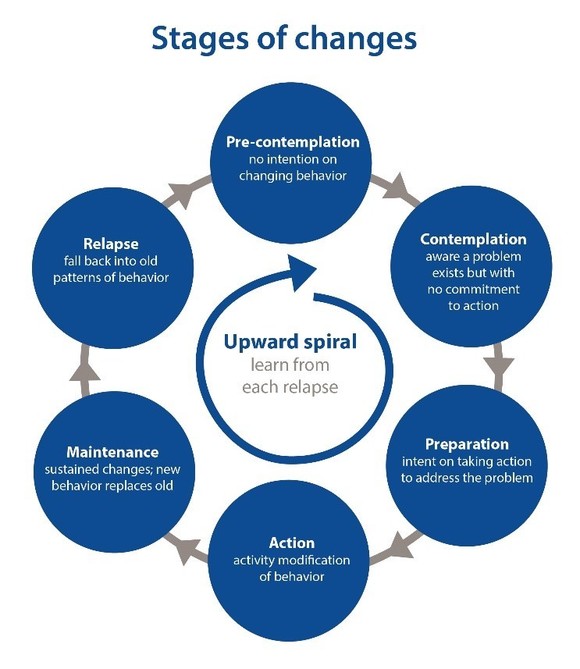 Understanding the stages of change will help coaches know how best to interact with individuals and move them along the continuum. In the two previous newsletters, pre-contemplation, contemplation, readiness for action/preparation, and action were discussed. In this issue of the newsletter, we will discuss maintenance and relapse.
Stage five: maintenance and relapse
Prochaska and DiClemente validated that after six months of consistently being in action, the individual moves to maintenance. Maintenance involves successfully managing temptations that would cause a relapse. After six months, the individual has gained greater confidence and capacity to sustain the desired behavior. The new behavior is becoming more a part of their life, and their risk of relapse is much lower than when they began.
The goal of the maintenance stage is to maintain the new behavior. People in this stage remind themselves of how much progress they have made. People in maintenance are acquiring new skills to deal with life and avoid relapse. They are aware of the situations in which a relapse could occur and can prepare coping measures in advance. They recognize that what they are striving for is personally worthwhile and meaningful. They are learning to be patient with themselves and recognize that it often takes a while to let go of old behavior patterns and practice new ones until they are second nature. Even though they may have thoughts of returning to their old bad habits, they resist the temptation and stay on track.
It is important to note that it is normal to relapse but not necessarily inevitable. Situations that can trigger a relapse could be stress, crisis, apathy, boredom, a loss of support, or a frustrating plateau in progress. Major life events such as a job change, romantic breakup, location change, or birth or death in the family can also trigger a relapse. Coaches can offer support and empathy during these times and encourage the individual to think about the longer-term goal and revisit the action plan.
Virginia Tech Continuing Education
Source: http://www.cpe.vt.edu/gttc/presentations/8eStagesofChange.pdf
Health coach approach for maintenance and preventing relapse
Stage 5: Maintenance and preventing relapse
The health coach can:
- congratulate accomplishments
- reaffirm self-worth
- review long-term goals
- recap how success was achieved and being maintained
- promote expanding life skills
- encourage connecting with a support person to stay motivated
An example of a conversation with a patient—maintenance with relapse
Coach: Hello Ms. Johnson. I’m calling to follow-up with you on your smoking. When you were in the clinic a few weeks ago, you were planning to cut back on your smoking. How is that going?
Ms. Johnson: Hello! Thanks for your call. It’s been going pretty well. I’m actually proud that I’ve cut down from 20 to seven cigarettes a day. But there are times during the day when it’s hard for me to manage the urge to smoke. I admit I’ve given into those urges.
Coach: That’s great that you are smoking less! Congratulations on your progress! We can talk about a plan for how you can manage those urges. Now that you’ve cut back, I’m wondering where you want to go from here. Setting a quit date is the next short step. What do you think about that?
Ms. Johnson: Yes. I should set a quit date. The hardest time for me is just after work. If it’s been a busy or stressful day, I’ve always enjoyed having a cigarette to relax.
Coach: That is understandable. Can you think of some ways to manage that time? What could you do to help you relax other than smoking?
Ms. Johnson: Well, I can do a few things. I’ll remove cigarettes from my car so I can’t smoke on my drive home. I’ll also try to find an entertaining radio station to take my mind off smoking.
Coach: That sounds like a good plan. What do you think about planning something when you get home?
Ms. Johnson: I know exercise is good. I don’t know if I have time every day, but maybe I could plan to walk a few days. I’ll have to have a different strategy for when I can’t walk.
Coach: That would be great. Do you want to talk more about your plan to cope with those urges?
Ms. Johnson: Yes, I think having a specific plan will help me.
Coach: Great! Let’s do that. Now, what about a quit date?
Ms. Johnson: I’ll set my quit date for 2 weeks from this Monday.
Coach: Perfect! I’ll call you on that day to offer support and help trouble shoot any other situations you anticipate that will be challenging to not smoke. And I’ll let your doctor know your plan.
Ms. Johnson: Sounds good. Your support is very helpful!
Question
Smoking is a difficult behavior to change. As a coach, what’s a good approach to help someone who quit smoking for a short time and then returned to his or her old habit?
Answer
In this Preventing Relapse slide presentation, Jennifer S.B. Moran, MA, TTS from Mayo Clinic outlines key elements in assisting patients with their tobacco cessation efforts. It is well worth your time to review this presentation. You will learn:
- relapse is common, but not certain
- relapse prevention begins at the initial assessment
- components of a prevention plan
- prevention has behavioral, cognitive, and (usually) medication components
- early follow-up is key as most relapse occurs in the first few days after quitting
- and much more
If you are interested in learning more about the training curriculum or want to schedule a full day training or one-hour refresher session, please contact Renee Gust at renee.gust@hennepin.us. We offer our one-hour refresher via Skype for Business or GoToMeeting for the convenience of staying in your own location.
Stages of change
https://experiencelife.com/article/the-stages-of-change/
Summer 2018:
Part II -- Stages of Change -- Meeting the patient where they are
Spring 2018:
Stages of Change -- Meeting the patient where they are
Winter 2018:
Action plans -- patients active in their care
Fall 2017:
Setting the agenda — eliminating wasted clinic visits
Summer 2017:
Helping patients remember their care plan — closing the loop/teach back
Spring 2017:
MOTIVATING PATIENTS through participation
Take this quick survey to provide your feedback on this newsletter.

|