|
July 2017
This
quarterly newsletter will provide tips and resources about health coaching to
help you keep patients engaged in their care.
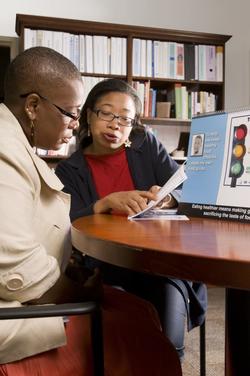 Closing the loop, also known as teach back, is
a health coaching intervention that should be used with all patients. Research
has suggested that patients remember and understand as little as 50 percent of
what the provider says. Regardless of a patient's health literacy level,
it is important that staff ensures that patients understand the information
they have been given.
What
is closing the loop?
This method involves asking patients to retell, in their own words, the
information you provided regarding what they need to know or do about their
health. It is a way to confirm
that you have explained things in a way your patients understand. The approach
is to use the Ask-Tell-Ask health
coaching technique, which was the topic of the previous Health Coach
newsletter, to check—re-explain—and check again the patient’s understanding of
the information you provided. Using open-ended
questions rather than yes/no is key to confirming the patient’s understanding
of his/her care plan (see example below).
Additionally, once you are certain the
patient correctly understands the information provided, it is important to
assess whether the patient agrees with the information and is confident in
doing the new behavior. The care team needs to be know if the patient has
barriers to following through with the care plan. Asking the patient on a scale
of 1-10 how confident he/she is in doing
the new behavior is a way to identify potential barriers. The rule of thumb is
that a confidence level less than seven is indicative of barriers that need to be
explored.
Although primary care clinic staff has
limited time for additional work, health coach experts highly recommend a
follow-up call to patients to check how things are going with the new behavior.
The call is an opportunity to address patient concerns that may prevent them
from following the plan, adjust medications, and schedule clinic follow-up
visits, if needed.
Closing the loop should
be done in a way that patients don’t feel they are being tested or quizzed on
the information provided.
The following phrases are suggestions for beginning
the conversation of closing the loop:
- “Just to make sure we
are on the same page, can you tell me …”
- “I want to make certain
I was clear, can you tell me …”
- “So I know that I made sense, can you tell me …”
Overall,
closing the loop will help:
- Improve patient
understanding and adherence, especially with medications
- Decrease call backs and
cancelled appointments
- Improve patient
satisfaction and outcomes
An example of
closing the loop:
-
Coach: Mrs. Jones, you have
been making progress to improve your diet and exercise and your HbA1c has come
down from 10 to 8.5. We would like your HbA1c to be 7 or below. Dr. Smith
thinks adding a new medication should bring your HbA1c down to where we’d like
it. What do you think?
-
Mrs. Jones: I’m willing to try the new
medication.
-
Coach: Great. Did Dr. Smith
explain how to take the new medication, Metformin?
-
Mrs. Jones: Yes.
-
Coach: Just to make sure we are on the same page, can you tell me
how you will take the Metformin? (open-ended question)
-
Mrs. Jones: Starting tonight,
I’m going to take it twice a day.
-
Coach: And when will you
take it?
-
Mrs. Jones: After breakfast and dinner.
-
Coach: Yes, that’s correct.
What will you do if you have problems with your stomach or bowels? (open-ended
question)
-
Mrs. Jones: Oh, I almost forgot.
I’ll take only 1 a day for a week. After breakfast?
-
Coach: Yes. Then go back
to 2 a day, 1 after breakfast and 1 after dinner, and see how things go. Can I
call you in a week to see how you are doing?
-
Mrs. Jones: Please do.
Back to top
|
Question
Do
all patients need a health coach?
Answer
No,
not all patients need a health coach, and most primary care clinics have
limited time and resources to incorporate health coaching into their daily
workload. However, the principles and practices presented in the health coach
training are designed to promote better patient outcomes and improve clinic
efficiencies. Gradually implementing health coaching into the clinic work flow
can be a good approach. Start small and build your caseload as your competency
grows.
Below are suggestions for initiating health coaching in your daily
schedule by targeting certain patient populations or limiting the number of
patients:
- Patients with chronic conditions—focus on patients the
clinic is currently targeting for quality of care projects. (example: patients
with diabetes, asthma, hypertension, obesity)
- High-risk patients—focus on patients at risk for
hospital readmission or ER visits.
- Eager and willing patients—building your
skills with this group will give you confidence to work with more challenging
patients.
Back to top
 The Hennepin County health coach trainers
offer a one-hour refresher session
to review highlights of the training curriculum and talk about how you and your
clinic are using health coaching techniques with your patients. With a small group of clinic staff, the
refresher session is an opportunity to share your successes and challenges and
brainstorm solutions to any challenges.
The refresher session can also be an introduction to health coaching. Schedule a refresher for your clinic to learn
about the training curriculum and decide if the full-day training session is
something that would be valuable for your patients. Some of the clinic staff or
the entire care team can learn how to better engage patients in self managing
their health concerns.
The following is the health coach refresher agenda. The agenda can be tailored to meet
your needs:
Introductions
Review
health coach principles
- Ask-Tell-Ask (open-ended questions, the four questions)
- Closing
the Loop
- Setting
the agenda
- Action
planning—patient centered action plans
Scenario
practice
How
and when to document goals
Successes
and challenges
Back to top
|
Please
click on the links below for more information on the benefits of health
coaching, a staff tip sheet for Closing the Loop, and the complete AHRQ toolkit
for promoting patient self-management.
The case for health coaching
One page tip sheet for
staff—10 elements of competency for Closing the Loop/Teach Back. Post it in your
clinic for staff to reference.
AHRQ—Health Literacy Universal
Precautions Toolkit, 2nd Edition
Use the Teach-Back
Method: Tool #5
Back to top
If
you missed the May 2017 newsletter, here is MOTIVATING PATIENTS through participation.
Back to top
Take this quick survey to provide your feedback on this newsletter.
Back to top

|