|
July 2018
This
quarterly newsletter will provide tips and resources about health coaching to
help you keep patients engaged in their care.
 Health
coaching is a patient-centered approach to care. Our role as coaches is to help
people take steps to improve lifestyle behaviors that impact their health and
well-being. Lasting change must be internally motivated. Individuals decide for
themselves to change a behavior. People
may fluctuate back and forth between the various stages of change for many
months or years before they achieve long-lasting change in their behavior. The
opportunity for change can increase when the individual and coach work to
resolve ambivalence and barriers to progress.
The stages of change are applicable to
physical and mental health-related behaviors.
The behavior can be smoking, substance abuse, gambling, unsafe sex,
unhealthy diet, lack of physical activity, or poor medication adherence. As
coaches, you assist people in moving along the stages of change continuum. Being
non-judgmental and supportive along this journey of change is important in
developing a trusting relationship with your client/patient.
The
transtheoretical model (TTM) also known as stages of change was developed in
the 1970’s by James Prochaska and Carlo Di Clemente. Originally the model was
developed to study how smokers quit. Since then, the model has been applied to
many health conditions and to changing high-risk behaviors. The research determined that change is a
process of identifiable stages that people pass through.
The five
stages to changing lifestyle
behavior in order to
achieve positive, lasting changes in
one’s life are:
- Pre-contemplation
- Contemplation
- Ready for action or preparation
- Action
- Maintenance
|
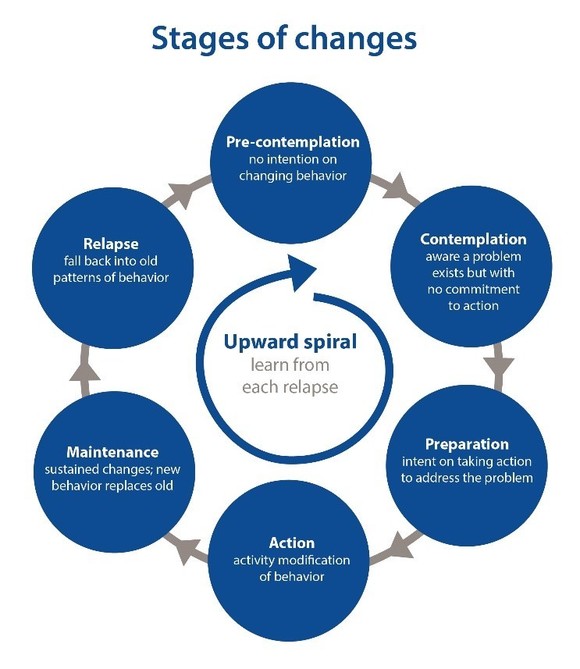 Understanding
the stages of change will help coaches know how best to interact with patients
and move them along the continuum. The stages are not static, and people can
move back and forth between the stages. There is no set length of time for each stage, and the patient can relapse in
the decision-making process.
In
a previous Health Coach newsletter, pre-contemplation and contemplation were
discussed. In this issue of the newsletter, we will discuss ready for action/preparation and action.
Stage 3: Ready for action/preparation
In the
preparation stage, people have made a commitment to make a change. Their
motivation for changing is reflected by statements such as: “I’ve got to do
something about this — this is serious.” “Something has to change. What can I
do?” In the preparation stage, people are researching and gaining an understanding
of what is involved in making a sincere commitment. People may call their
provider to find out what strategies and resources are available to help them
in their attempt to change. They are now
taking small steps toward behavior change. Too often people skip this stage and
try to move directly from contemplation into action. They then fail because
they haven’t adequately researched or accepted what it is going to take to make
this major lifestyle change.
Stage 4: Action
This is the
stage where people believe they have the ability to change their behavior and
are actively involved in taking steps to change their behavior by using a
variety of different techniques. The amount of time people spend in action
varies. It generally lasts about six months, but it can literally be as short
as one hour! This is a stage when people most depend on their own willpower.
They are making overt efforts to change the behavior and are at greatest risk
for relapse.
Mentally, they
review their commitment to themselves and develop plans to deal with both
personal and external pressures that may lead to slips. They may use short-term
rewards to sustain their motivation, and analyze their behavior change efforts
in a way that enhances their self-confidence. People in this stage also tend to
be open to receiving help and are likely to seek support from others. Health
coaches play an important role during this phase by offering support and
helping patients identify an action plan for obstacles that surface.
Health coach approach for ready for
action/preparation and action
Stage 3: Read for action or preparation
The health
coach can:
- Assist
in identifying potential obstacles to success
- Help
the patient identify social support(s)
- Encourage
small steps towards the goal
- Confirm
that the patient has the skills for behavior change
Stage 4: Action
The health
coach can:
- Bolster
patient confidence for dealing with obstacles
- Encourage
the patient to focus on restructuring cues that could result in relapse
- Promote
social support
- Help
the patient resist feelings of loss and focus on long-term benefits
(Stage descriptions
and approaches from Virginia Tech—Continuing and Professional Education)
An example of a conversation with a patient -- preparation stage
Coach: Hello Ms. Johnson. It’s nice to see
you again. How are you doing? At your last visit, we talked a little about your
smoking. Would you be willing to talk more about that today?
Ms. Johnson: I guess. I haven’t done anything
about it, but I’m starting to see how short of breath I get just walking up the
stairs. I want to be more active but don’t seem to have the energy. I’m wondering
if I should try quitting again, even though I’ve been unsuccessful in my past
attempts?
Coach: I’m so glad to hear you are
thinking about it again. Just being willing to talk about it is a huge step!
Tell me more about your past attempts.
Ms. Johnson: I just stopped smoking, or at least
tried. After a few days, I couldn’t resist the urge to smoke.
Coach: Yes, quitting is difficult for
everyone. There are some things we can do to help you deal with the urge to
smoke. Tell me what you think you need in order to quit?
Ms. Johnson: Well, how do I deal with the urges
to smoke? I find I can’t resist these urges.
Coach: Yes, most people can’t quit on
their own and need help. There are great medications we can provide you to help
deal with the withdrawal symptoms and cravings. Also, let’s talk about the
situations when you feel the urge the most. What’s typically going on?
Ms. Johnson: Yes, I think taking some medication
will help. The hardest time for me is around dinnertime. After a busy day, I
look forward to relaxing with a cigarette. Having one leads to another and then
I just give up.
Coach: I appreciate that the end of the
day is a challenging time. It’s great that you are able to not smoke during the
day. That is an accomplishment. Would you like to start with a plan to cut back?
Ms. Johnson: I haven’t considered quitting on a
gradual basis. In the past, when I started smoking after quitting for a few
days, I felt I had failed and just went back to my old habits. I like the idea
of cutting back.
Coach: Great! Let’s start you on nicotine
replacement, develop a plan to cut back, and look at some strategies for you to
use at times you feel the urge to smoke. Can I follow up with you to see how
things are going?
Ms. Johnson: Sounds good! Thank you for your
help.
Back to top
Question
What’s a
good approach when the person is discouraged by past attempts that have failed?
Answer
When
the person seems discouraged by past attempts, help them identify their
strengths and past and current successes. Asking open-ended questions such as,
“Tell me about a difficult change that you have been able to make.” Help the
patient verbalize their strategies that can lead to success. Then help the
patient develop an action plan using those strategies.
Back to top
The
Hennepin County health coach trainers offer a one-hour refresher session to review highlights of the training
curriculum and talk about how you and your clinic are using health coaching
techniques with your patients. The refresher session is an opportunity to share
your successes and challenges and brainstorm solutions to any challenges.
The
refresher session can also be an introduction
to health coaching. Schedule a refresher with fellow staff to learn about
the training curriculum and decide if the full-day training session is
something that would be valuable for your clients or patients. Learn how to
engage the people you serve, helping them self-manage their health conditions.
The
following is the health coach refresher
agenda. The agenda can be tailored to meet your needs:
I. Introductions
II. Review
health coach principles
- Ask-Tell-Ask (includes open-ended questions and the four questions)
- Closing
the loop
- Setting
the agenda
- Action
planning—patient-centered action plans
III. Scenario
practice
IV. How
to document goals in EPIC
V. Successes
and challenges
New venue — stay
in your own location, grab your lunch, and join us for a one-hour refresher via
Skype for Business or GoToMeeting. Contact Renee Gust at renee.gust@hennepin.us.
Back to top
The Stages
of Change
http://www.cpe.vt.edu/gttc/presentations/8eStagesofChange.pdf
The
Transtheoretical Model (Stages of Change)
http://sphweb.bumc.bu.edu/otlt/MPH-Modules/SB/BehavioralChangeTheories/BehavioralChangeTheories6.html
Tobacco
cessation guide
http://www.smokefreeoregon.com/wp-content/uploads/2011/01/LEG-Community-Health-Report-Inside-Final-10-11-13.pdf
Back to top
Spring 2018:
Stages of Change -- meeting the patient where they are
Winter 2018:
Action plans -- patients active in their care
Fall 2017:
Setting the agenda — eliminating wasted clinic visits
Summer 2017:
Helping patients remember their care plan — closing the loop/teach back
Spring 2017:
MOTIVATING PATIENTS through participation
Back to top
Take this quick survey to provide your feedback on this newsletter.
Back to top

|