|
March 2017
This
quarterly newsletter will provide tips and resources about health coaching to
help you keep patients engaged in their care.
 Health coaching
is a patient-centered approach to care. Our role as coaches is to help patients
take steps to improve lifestyle behaviors that affect their health and
well-being. Behavior change is difficult. People may fluctuate back and forth between the various stages
of change for many months or years before they achieve long-lasting change in
their behavior.
The stages of change initially focused on
risky behaviors such as excessive smoking, drinking, drugs, gambling, or
engaging in unsafe sexual practices. However, stages of change can also be
applicable to self-management of chronic conditions, such as diet, physical
activity, and medication adherence.
The
Transtheoretical Model (TTM) also known as the stages of change was developed
in the late 1970s by James Prochaska and Carlo Di Clemente and colleagues on
the basis of research that was published in peer-reviewed journals and
books. The research determined that there are five stages to changing lifestyle behavior in order to achieve
positive, lasting changes in
one’s life:
- Pre-contemplation
- Contemplation
- Ready for action or preparation
- Action
- Maintenance
|
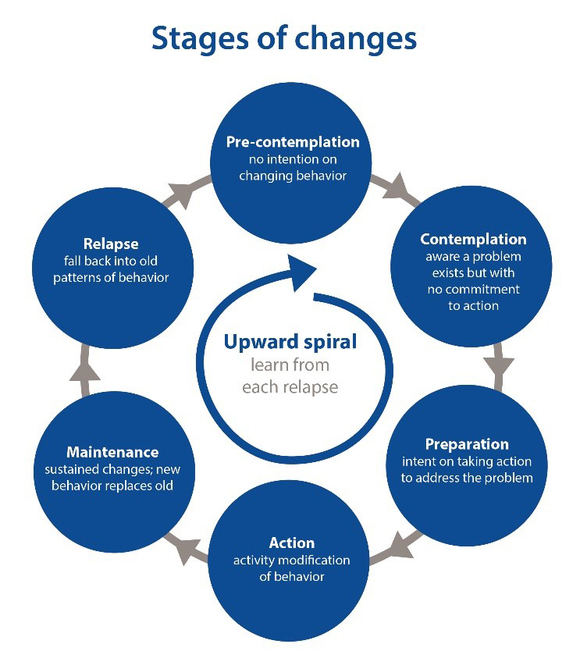 Understanding
the stages of change can be helpful in the health coach’s approach to move
patients along the continuum. Of note, the stages are dynamic. This means that the
lines between the stages are arbitrary. There is no set length of time for each stage, and the patient can relapse in
the decision-making process.
In this issue
of the newsletter, we will discuss pre-contemplation and contemplation.
Stage 1: Pre-contemplation
In the pre-contemplation
stage, people do not think seriously about changing and are not interested in getting
help. People in this stage tend to defend their current behaviors and do not
feel it is a problem. They may be defensive when others pressure them to change.
Stage 2: Contemplation
In the contemplation
stage, people acknowledge the health consequences of their lifestyle
behavior(s), and they spend time thinking about making a change. Although they
are able to consider the possibility of changing, they can be ambivalent about
it. In this stage, people are on a teeter-totter, weighing the pros and cons of
modifying their behavior. Although they think about the negative aspects of
their lifestyle and the positives associated with making change, they may doubt
that the long-term benefits will outweigh the short-term challenges.
It might
take as little as a couple weeks or as long as a lifetime to get through the
contemplation stage. In fact, some people think and think and think about making
a change and may die never having gotten beyond this stage. On the plus side,
people at this stage are more open to receiving information about how to
improve their lifestyle, and are more likely to actually use educational
interventions and reflect on their own feelings and thoughts concerning their
lifestyle behaviors.
Health coach approach for pre-contemplation
and contemplation
Stage 1: Pre-contemplation
The health
coach can:
- Recognize
and validate the patient’s lack of readiness to commit to a behavior change
- Clarify
that the decision is the patient’s and not a directive of the care team
- Encourage
the patient to evaluate their current behavior and personalize the risks
Stage 2:
Contemplation
The health
coach can:
- Recognize
and validate the patient’s present lack of readiness for change
- Clarify
that the decision is the patient’s
- Encourage
evaluation of pros and cons of a behavior change
- Help
the patient identify their positive health outcome expectations
(Stage descriptions
and approaches from Virginia Tech—Continuing and Professional Education)
An example of a conversation with a patient—contemplation
stage
Coach: Hello Ms. Johnson. As part of your
preventive visit today, we will gather information regarding your health. One
question is tobacco use. Can you tell me about your tobacco use history?
Ms. Johnson: I have smoked cigarettes for many
years. I know, you’re going to tell me I should quit. I am getting a little
more winded when I do my housecleaning. It’s so hard to quit, though. I’ve tried many times.
Coach: Yes, smoking can make it harder to
breathe when you move. You say you’ve tried to quit before. Can you tell me
more about that?
Ms. Jones: I’ve tried cold turkey many times,
but can’t go past three days without a cigarette.
Coach: Quitting is hard for anybody. Would
you like to hear about some ideas on how we can help?
Ms. Johnson: I guess so. I want to be around for
my grandbabies.
Coach: That’s a great motivation for you! I
can support you along the way when you decide. In addition, nicotine
replacements, medications, and other interventions are available to help you
quit [use teaching materials to explain all the resources available for smoking
cessation]. What are your thoughts about what I’ve said?
Ms. Johnson: Maybe I do need more help with the
medications to help me get past the three-day wall I hit. I’ll think about it.
Coach: Great! Call the clinic if you
decide to quit, and we’ll help you get started, or we can talk more at your
next visit. I appreciate your willingness to talk about this, Ms. Johnson. It
says a lot about you!
Ms. Johnson: Thank you. I’ll let you know.
Back to top
Question
What if my
patients never want to change?
Answer
As a coach,
it can be discouraging if patients do not want to make positive changes to
improve their health and well-being. It’s important to recognize that some
people never move out of pre-contemplation. In spite of our best efforts, the
decision to make lifestyle changes rests with the patient. As coaches, we can
educate patients and offer support. Talking about these situations with your co-workers
can be an opportunity to explore other approaches and/or get your co-workers’ support
and encouragement for your work. It’s important for coaches and all health care
professionals to practice good self-care to keep from burning out.
Back to top
The stages of change
http://www.cpe.vt.edu/gttc/presentations/8eStagesofChange.pdf
The Transtheoretical Model (stages of change)
http://sphweb.bumc.bu.edu/otlt/MPH-Modules/SB/BehavioralChangeTheories/BehavioralChangeTheories6.html
Tobacco
cessation guide
http://www.smokefreeoregon.com/wp-content/uploads/2011/01/LEG-Community-Health-Report-Inside-Final-10-11-13.pdf
Back to top
Winter 2017:
Action plan -- patients active in their care
Fall 2017:
Setting the agenda — eliminating wasted clinic visits
Summer 2017:
Helping patients remember their care plan — closing the loop/teach back
Spring 2017:
Back to top

|