|
FutureReady Initiative Moves into Phase II - Starts Recommendation Development |
|
|
The State Board of Education is excited to announce that the FutureReady Initiative has completed Phase I and is now entering Phase II. Phase I focused on creating a vision for how Washington’s high school diploma should prepare students for a changing world and identifying gaps in the current system. Phase II will build on this work by developing concrete recommendations to address those gaps and update graduation requirements.
FutureReady is the Board's initiative to update high school graduation requirements to better prepare students for the future.
The Board launched FutureReady in Summer 2024. From the start, the Board recognized that meaningful change would only be possible with strong engagement of partners. The Board convened a cross-sector task force representing students and families, community-based organizations, K–12 and postsecondary education, employers, and policymakers. The Task Force was launched in January 2025.
Since then, the Board and Task Force have worked together to develop a shared vision for the high school diploma, identify where current graduation requirements fall short, and outline key topics needing further exploration.
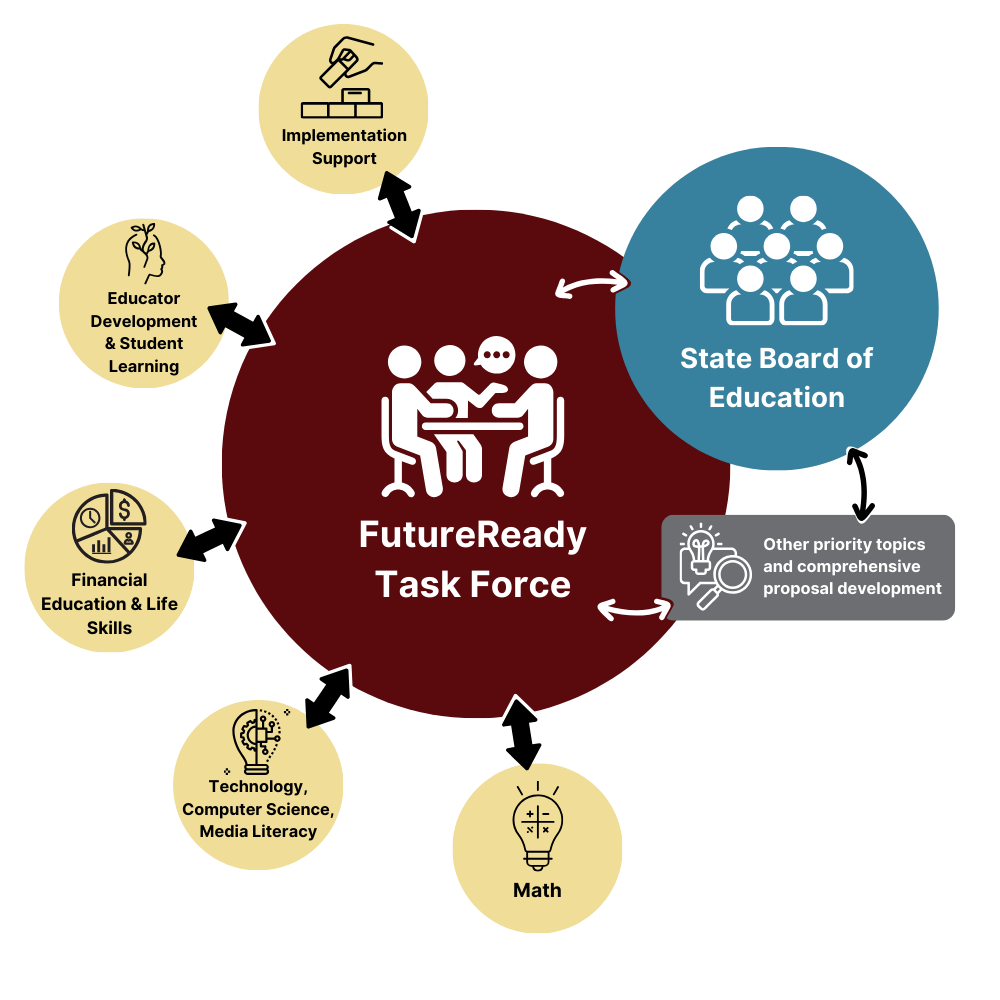
Click the image to view a full-sized version.
Now that the Board and Task Force have identified gaps in the current graduation requirements, they will begin the process of developing recommendations to address those gaps.
Core Work Ahead
At the heart of this effort, the Board and Task force are reimagining Washington’s high school graduation requirements. They will be exploring a wide range of topics, with a focus on tackling big-picture questions like:
- What knowledge and skills do all students need to succeed in a changing world?
- How can those fit into a limited set of requirements?
- What balance of consistency and flexibility will best serve student needs and interests?
The work will evolve as the Board and Task Force consider what may need more emphasis, what can be scaled back, and how to create space for priorities.
Supporting Work
Some issues require more time or subject-matter expertise, so the Board is setting up subcommittees to take a closer look. These subcommittees may be convened in partnership with existing organizations already involved in related areas. Their input will feed into the larger conversations between the Task Force and the Board, helping to shape the overall direction of the work. As new needs emerge, subcommittees may be added or adjusted over time.
-
Implementation Supports: This group will look at the nuts and bolts needed to put the Task Force’s ideas into practice—things like staffing, scheduling, resources, and timelines that could affect how schools carry out the recommendations.
-
Educator Development & Student Learning Experience: This group will explore professional development and supports that educators may need to effectively carry out the Task Force’s recommendations.
-
Financial Education & Life Skills: This group will explore the skills students need to be prepared for life after high school, with a particular emphasis on financial education.
-
Technology, Computer Science, and Media Literacy: This group will examine how we can prepare students to understand, use, and critically engage with emerging technology and digital media.
-
Math: This group will consider the math knowledge and skills students need for success beyond high school and may explore opportunities to strengthen alignment in expectations across middle school, high school, and postsecondary pathways.
These groups will add a layer of additional expertise on key issues to inform the work of the Board and the Task Force as they develop recommendations to update the high school graduation requirements.
The Board expects to release draft recommendations for public input in early 2026 with a legislative proposal anticipated for the 2027 session.
-
The Board is always accepting public comments to guide our work. You can provide a comment using this webpage. Responses to this form will be shared with the Board and may be publicly posted.
-
Newsletter: FutureReady Task Force's May Meeting Recap At this meeting, Task Force members developed a shared consensus on a vision that guides the work of the initiative. The Task Force also started a gap analysis to understand how current graduation requirements may fall short of their shared vision.
-
Newsletter: FutureReady Task Force's March Meeting Recap During this meeting, the Task Force develop a shared vision for the high school diploma by unpacking what “ready for success” means and built consensus around the ideal qualities of future graduation requirements. This work served as a foundation for developing and evaluating policy recommendations.
|
|
|
|