|
OSSI’s monthly newsletter provides accessible resources and connects readers to best practices at the state, regional, and local level that are improving student outcomes. Do you have a story to share? Let us know about it!
Welcome to the Office of System and School Improvement Newsletter!
FOCUS: School Climate
 The pep talk we all need, courtesy of Kid Superintendent, Reading School District, Reading, Pa.
 |
|
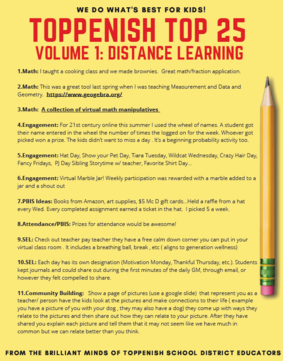
The Toppenish Top 25 represents ideas, advice, tips, and tricks for distance learning straight from Toppenish School District elementary educators. Volume 1 was gathered during an optional professional development day over the summer. "The hope is for this to continue throughout the school year as a way to gather the knowledge and expertise from our own school district"
Provided by Kathryn Page, Continuous Improvement Coordinator, Toppenish School District
View full size here
|

 |
|
Nice White Parents from Serial Productions and the New York Times. A 5-part podcast series that illustrates the powerful force of white parents and how they have and continue to shape public education. |
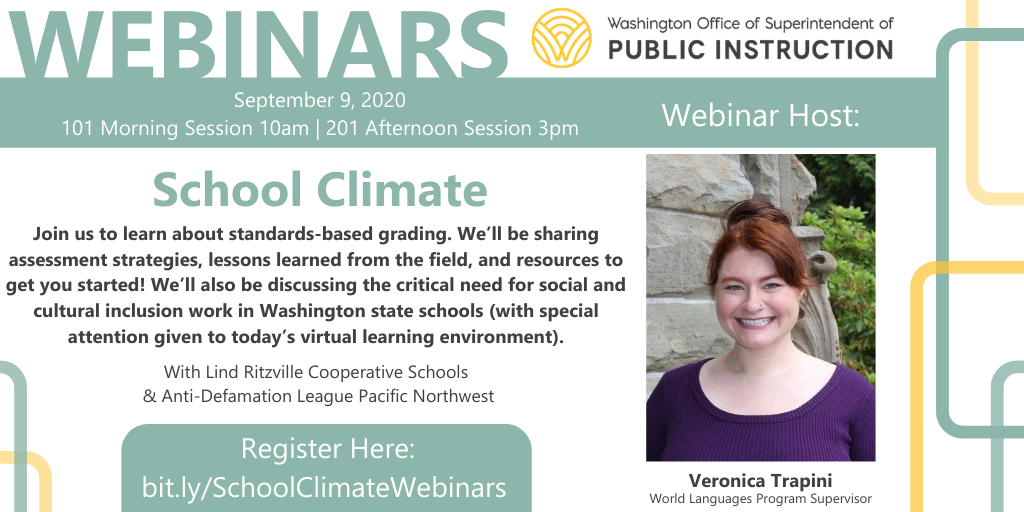 September GATE Equity Webinar on School Climate and Cultural Inclusion

Ask me about No Place for Hate and A World of Difference training for your school or organization.
Scotland Nash, EdD, Director of Education, Antidefamation League, Pacific Northwest
For September, we will be exploring how cultural inclusion efforts can improve school climate. Akiva Erezim, of Continuous Improvement at OSPI, will help to frame our understandings around the power of institutions and sociocultural agents to curate individual experiences, as well as the critical need for social and cultural inclusion work in Washington state schools (with special attention given to today’s virtual learning environment).
We will be joined by Scotland Nash, EdD, Executive Director of Education of the Anti-Defamation League (ADL) Pacific Northwest, who will highlight the work of the “No Place for Hate” School Climate Initiative: “a student led school climate initiative for K-12 schools committed to create sustainable change that leads to improved school climate. Participating schools are able to incorporate anti-bias and anti-bullying resources within their existing programming to form one powerful message that all students have a place to belong. Since the program was launched in 1999, over 1,700 schools across the country have joined the No Place for Hate movement nationwide.”
Read this blog post by Scotland Nash "Lead with Empathy, Teach with Anti-Bias"
|
FREE Virtual Series on Equitably Expanding Dual Credit Programs
In lieu of an in-person Summit, the WA Dual Credit Steering Committee is hosting the Washington Dual Credit Summit Webinar Series
Wednesdays 12-1pm , September 30th - November 18th
Check out the Series One-Pager for weekly session descriptions and list of presenters.
For questions contact Jason Boatwright or visit the Dual Credit Program webpage

WCHSCR Fall Counselor Workshops
Join us this fall for WCHSCR’s first-ever virtual workshops, which will bring school counselors important updates from OSPI, the WA Student Achievement Council, and the 2-/4-year college systems’ organizations.
Participants will also get to hear recorded presentations from public and private colleges and network with fellow school counselors via live Q&A sessions.
Go to https://washingtoncouncil.org/ for more information and a link to the registration for either event, which will be held on Sept. 15 and Sept. 17, 2020.
|
OSPI-WSAC Wednesday Webinar
September 23rd from 1:30-3:00pm
Supporting Seniors’ Financial Aid Awareness
Click here to register | 2 FREE clock hours available
Join staff from the WA Student Achievement Council (WSAC) in exploring resources to help seniors understand and apply for financial aid opportunities that fit their goals and citizenship status, and their family’s economic circumstances. Also learn about to leverage the new Financial Aid Advising Day and required Financial Aid components in the High School and Beyond Plan to best serve students furthest from educational justice and economic opportunity.
|
2020 Virtual Washington State Becca Conference
Save the Dates: October 19 – 23
Request for conference presenters is open now. Submit your proposal here.
For more information, contact Becca@ccyj.org
|
|
 |

How to Be an Antiracist
In How to Be an Antiracist, Kendi takes readers through a widening circle of antiracist ideas—from the most basic concepts to visionary possibilities—that will help readers see all forms of racism clearly, understand their poisonous consequences, and work to oppose them in our systems and in ourselves. Kendi weaves an electrifying combination of ethics, history, law, and science with his own personal story of awakening to antiracism. This is an essential work for anyone who wants to go beyond the awareness of racism to the next step: contributing to the formation of a just and equitable society.
|
White Fragility: Why it’s so hard for white people to talk about racism – by Robin DiAngelo
The Distance Learning Playbook – by Douglas Fisher, Nancy Frey, & John Hattie.
Leading for Powerful Learning by Angela Breidenstein et al.
Recorded Webinars & Videos:
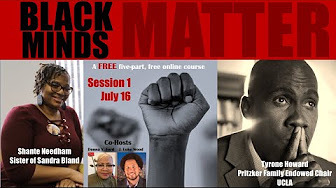
Black Minds Matter is a public series that is designed to raise the national consciousness about issues facing Black students in education. The series intentionally addresses the pervasive undervaluing and criminalization of Black minds. Tangible solutions for promoting the learning, development, and success of Black students are offered. Black Minds Matter Public Syllabus
|

Resilience and Supporting Native American Indigenous Students This important discussion has thought leaders and field experts discussing what resilience means to indigenous populations as well as sharing some practical strategies to help educators everywhere learn to be able to connect better with and support the Native American/Indigenous students that you serve!
|
 |

The Framework for Remote Learning was just released by the Danielson Group. It provides a thoughtful, practical, culturally responsive approach to developing virtual learning, and addresses both synchronous and asynchronous instruction. The document is a tool for support (not evaluation). While based on the Danielson Framework for Teaching, districts using the CEL 5D+ and Marzano instructional frameworks will also find it to be helpful.
As this document advises, this is not the year for full-on evaluation processes for most teachers. OSPI has released guidance on Comprehensive evaluations for the 20-21 school year, available here. Further information on choosing a single student growth goal (criterion 3 or 6) for teachers on a modified Comprehensive evaluation will be forthcoming.
|

Coming Back to Climate: How Principals Use School Climate Data to Lead Improvement
The Aspen Institute Education & Society Program. This brief provides practical guidance for school leaders to use climate data to draw in stakeholders to the work of continuous improvement and building equitable outcomes for students.
"The immediate impact of COVID-19, school reopening challenges, distance learning, and renewed attention to racism in our society touches everyone, especially our students. School climates that are safe and nurturing are essential to help students navigate the history they are living. "
|
Teaching Tolerance self-guided professional development offers a multitude of resources about building a positive school climate. There is a large range of available topics, from assessing school climate to building relationships to white privilege and anti-racism. There is something for everyone!
Did you know that school counselors are ethically called to work toward a positive school climate? The American School Counselor Association Ethical Standard B.3.k: “Work toward a school climate that embraces diversity and promotes academic, career and social/emotional development for all students.” Read the American School Counselor Association’s Standards in Practice Brief on the role of the school counselor in eliminating racism and bias in schools.
The COVID-19 Diversity, Equity, and Inclusion Crisis Action Strategy Guide Dr. Damon A. Williams, Chief Catalyst, Center for Strategic Diversity Leadership and Social Inclusion, 2020 | published by: National Inclusive Excellence Leadership Academy and the Center for Strategic Diversity Leadership & Social Innovation.
“This paper presents the COVID-19 DEI Crisis Action Framework as a model for taking action and includes dozens of ideas and tips for on-the-ground implementation, plus resources from around the country. Its goal is to help structure your leadership, decision-making and approach to managing this crisis for the weeks and months ahead in a way that includes all community members as we shift quickly to distance learning/ working to ensure everyone’s safety.”
SEL and Equity – 2 Reports from CASEL to Guide this Critical Work
CASEL has recently published two new reports with concrete strategies to help districts address the inequities being amplified by our current public health crisis and the nationwide fight for racial justice.
- “Social, Emotional and Academic Development Through an Equity Lens”. This report highlights 6 key recommendations that shift the focus away from “fixing kids” and toward addressing the adult mindsets, as well as school and district policies, that create a safe, equitable and caring learning environment.
- “Advancing SEL as a Lever for Equity and Excellence – Emerging Insights”. This report shares 5 emerging insights from contributing districts’ efforts to implement high quality SEL, including how SEL can be better leveraged to support broader goals around educational equity.
The No Place for Hate School Climate Initiative is a student led school climate initiative for K-12 schools committed to create sustainable change that leads to improved school climate. Participating schools are able to incorporate anti-bias and anti-bullying resources within their existing programming to form one powerful message that all students have a place to belong. Since the program was launched in 1999, over 1,700 schools across the country have joined the No Place for Hate movement nationwide. Please, join us in September for the GATE 201 Equity Webinar Series, when Scotland Nash, EdD – Executive Director of Education for the Anti-Defamation League (ADL) Pacific Northwest – will highlight this initiative, its mobilization in the virtual world, as well as resources and opportunities for schools to become more actively involved in creating an inclusive environment for students of every background.
Positive School Climates and Diverse Populations Kristin Grayson, Ph.D., IDRA Newsletter, August 2016
This is an article from Kristin Grayson with the Intercultural Development Research Association (IDRA) which examines the importance of “cultural competencies [and] intercultural proficiencies” in creating a positive school climate. “Administrators and teachers must know about their diverse students and their cultures, and through the spirit of empathy, recognize that they are valuable learners. These aspects of knowledge and belief must be in place even before teachers and administrators begin to “do” their daily jobs of teaching in the classroom and directing the campus.”
NSCC Brief on Inclusion and School Climate Clement Coulston and Kaitlyn Smith, National School Climate Center, February 2013
This brief from the National School Climate Center (NSCC) helps to define “inclusion” and it’s important role in creating a positive school climate for every student. It is critical in such times of change to center ourselves on evidenced-based strategies and to incorporate them in the constantly-evolving school landscape.
The Problem of Othering: Towards Inclusiveness and Belonging John A. Powell and Stephen Menendian, Othering & Belonging Institute – UC Berkeley, June 2017
An article from the Othering and Belonging Institute at UC Berkeley, which addresses the broader concept of “othering,” as well as it’s reaching implications across sectors. Addressing “othering” in institutions can help to foster an environment of inclusion and belonging. “Othering and Belonging is a pithy and accessible framework by which we might more productively discuss and develop a range of inclusive responses to group-based marginalization and inequality.”
This Student Voice Continuum provides multiple strategies for valuing student voice, with examples of what ideal implementation looks like (and what poor implementation looks like).
Check out this compilation of connection strategies gathered from teachers, school counselors and other educators on the West Coast (Washington, Oregon, Alaska, and California) who have successfully connected with students during the virtual learning environment in 2020.
Building Relationships with Students: Quick Conversations Starters- Click here for simple strategies and a set of possible questions to initiate 5-minute one-on-one check-ins with students. Using these open-ended questions can build connections and help educators and student support staff respond to students’ needs.
This one-page graphic reminder shows 3 steps (Regulate - Relate – Reason) that help a vulnerable child move from a fight/flight/freeze reaction to a ready-to-learn state of mind and body.
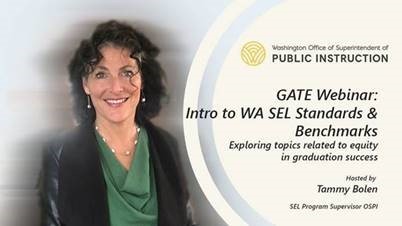
What are the Washington SEL Benchmarks?
Want to learn more about Washington’s SEL Standards Benchmarks?
Check out the video on OSPI’s YouTube Channel here.
For more related SEL resources visit: http://soundsupportsk12.com/resources/
|
|