|
Happy Spring from the King County On-site Sewage/Septic System (OSS) Program!
This edition of Septic Matters includes:
As always, please don't hesitate to reach out if you have questions or comments.
Si tiene alguna pregunta, comuníquese con nosotros a la siguiente dirección de correo electrónico mejackson@kingcounty.gov o llame al 206.263.0547.
|
|
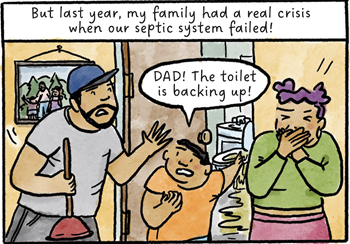
 News from the Field highlights real-life septic situations from King County community members and the OSS Program.
Converting from a septic system to the public sewer line is a complex process, so we sat down with Corrina Marote, who manages the Equitable Wastewater Futures Program in King County, to learn more about the process.
How long do septic systems last?
Typically, a septic system lasts 30 to 50 years. We care about the lifespans of septic systems because as the systems get older, they become more vulnerable to failure, which means they stop working.
What does this issue look like in King County?
There are more than 85,000 septic systems in King County. More than 40% are in urban King County, and many of these systems are passed their intended lifespans and are vulnerable to failure.
Why are septic systems in urban areas important?
Required space is the big limiting factor for urban septic systems that need to be replaced. When you replace a septic system, it can't just go in the exact same location. Smaller urban lots can only replace their systems so many times, so replacement is not a sustainable option in the long-term. Additionally, remodeling or building on the property can be more viable if it's connected to sewer.
What happens if a septic system in an urban area fails?
When a septic system in an urban area fails, it is either replaced with a new system, or decommissioned and connected to a public sewer. The Equitable Wastewater Futures (EWF) program helps septic owners to start this process in King County.
What do I need to do to start the sewer conversion process?
Sewer conversion is a big project, and it can take up a lot of resources. It is best to know available resources and start planning for it for at least 2to 5 years in advance.
Some first steps include:
-
Find out if your property is zoned urban and within a sewer utility: www.kingcounty.gov/SepticRecords
-
Talk to your neighbors to understand needs of the neighborhood. It’s better to connect multiple properties at a time, as extending main sewer line is quite expensive.
-
Obtain financial and technical resources from the EWF program and your sewer utility.
Where can I learn more about this process?
Feel free to contact Corrina Marote at cmarote@kingcounty.gov for more information.
|

People in King County love gardening. And property owners with a septic system may see the drainfield area as a viable place to plant vegetables. Can your drainfield area serve as a garden bed? NO!
A King County resident, Adria, recalls the first year she moved into her property with a septic system. With no septic records or “as-built,” she wasn’t sure where her septic system was. Oh well! It’s underground, so she went ahead and installed a garden bed for her veggies over her drainfield. That was the year when Adria's garden had the biggest potatoes she'd ever seen.
“I learned that it was because of all the nutrients built up from the drainfield, which was processing the wastewater from our house. We didn’t eat the potatoes after knowing how they got the nutrients—the wastewater from our house!”
Most wastewater treatment occurs in the soil as the effluent from septic tanks flows through the small spaces in soil underground. Because of this, you shouldn’t use your drainfield as a garden bed.
Tips to protect your drainfield area:
|
-
Landscape with grass or low-water, low-maintenance plants (List of plants).
-
When hiring a landscaper, it is critical to let them know where the drainfield is so that they can avoid driving over or putting heavy machinery over it.
- Do not till up the area as it can disturb the soil where wastewater is filtered and treated, and it damages subsurface drip wastewater systems.
- Treat other areas, such as a flat area over the “Mound System,” the same and leave as-is.
-
Divert additional water, such as the runoff from the roof and irrigation, away from the drainfield.
This spring, refresh on the basics of septic system work and maintenance:
Public Health has a short series of videos featuring community partners on Vashon Island. See all the videos: Septic Matters videos.
|
|
 |

Do you live in Maple Valley or nearby? Join the OSS program and other partners for an Earth Day event at the Lake Wilderness Arboretum in Maple Valley!
-
Date: April 18 (Saturday)
-
Time: 10AM - 2PM
-
Location: Lake Wilderness Arboretum, 22520 SE 248th St
-
Event information: Maple Valley Earth Day Fair
OSS staff will share tips on septic maintenance and answer questions. We look forward to seeing you there!
|
|
|
Are you planning septic system maintenance, repairs, or replacement? Are you getting connected to a public sewer system after your septic system stops working? There are many low-interest loans or grants available for different projects – see highlights below!
-
Craft3 Clean Water Loans: Loans to allow homeowners to borrow the entire cost of eligible design, permitting and installation of septic systems. Lower interest rates may be available for qualified lower-income borrowers, and there are no upfront loan fees or pre-payment penalties.
-
Winter 2025: Septic alarms, preparing for more people in the house, videos about community septic team, new permit system
-
Fall 2025: Septic record search, types of septic repairs and replacements, septic podcast
-
Summer 2025: Selling properties with septic systems, Is it okay to build a deck over my septic system?
-
Spring 2025: What do the code changes mean for you? Resources about the code revisions
|
|
|
|
|