All-HVSA Virtual Spring Meeting: May 3 and 4, 9 a.m. to Noon
“Grounding and Growing Together”
Registration will go out soon
May 4 – Home Visitors are Encouraged to Attend!
There are a number of funding opportunities emerging from the Strengthening Families Washington and Home Visiting Teams at DCYF including :
- 2022 HVSA Spring Expansion: General Home Visiting Expansion Application is out, applicants must have submitted an LOI by March 11 at noon to be able to apply.
- Tribal Home Visiting Expansion Application (to be released in early April).
- Perinatal Mental Health community capacity building, due April 12.
- Community Based Child Abuse Prevention Program Applications are out, and Letters of Intent to Apply are due on April 15, at 5 p.m.
The best place to learn about these is the new DCYF HV Funding Opportunities webpage. We anticipate releasing several more funding opportunities this year related to families and supports.
DCYF will have updated masking guidance for programs early next week. Supervisors, please keep an eye on your inbox for this new guidance, and as always, thanks for you continued patience as we navigate the ongoing COVID-19 pandemic.
Identifying potential caregiver mental health issues and providing services and referrals is a key role for home visitors. Caregiver depression is a serious and widespread condition that not only affects the caregiver, but may have a lasting, detrimental impact on the child’s health. Past research has shown that children of caregivers who are struggling with depression are at increased risk of attachment issues, child abuse and neglect, and developmental delays (Earls, 2010). Caregiver depression screening and treatment is an important tool to protect the children from the potential adverse effects of caregiver depression.
Measuring Performance
Home visiting model best practices encourage multiple screenings and referrals depending on the situation of the family and caregiver. To uniformly assess screening across the HVSA, we have defined an aligned screening measure to meet a minimum requirement.
 To assess referrals provided and completed by caregivers with a positive screen, the HVSA follows the MIECHV performance measure 17, below, for MIECHV clients. This measure requires that the positive screen is completed during the 3-month window defined above. The HVSA also agreed that a positive screen requiring additional mental health services or referral would be a PHQ9 score of at least 10 and/or noted suicidal thoughts.
 In SFY 2019, depression screenings and referrals were added as Performance Milestones in an effort to elevate the importance of timely screening. The goal of the depression screening performance award was to incentivize screening for all newly enrolled caregivers within three months of enrollment or three months following the birth of their child if the caregiver enrolled prenatally. The depression referral performance award is designed to incentivize appropriate follow-up and connection to services for caregivers who screen positive or disclose depressive symptoms. This may include making a new referral for mental health services, completing a referral, or confirming the caregiver is receiving the recommended services and documenting the work.
How are we doing?
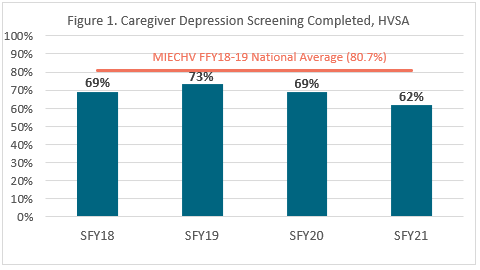
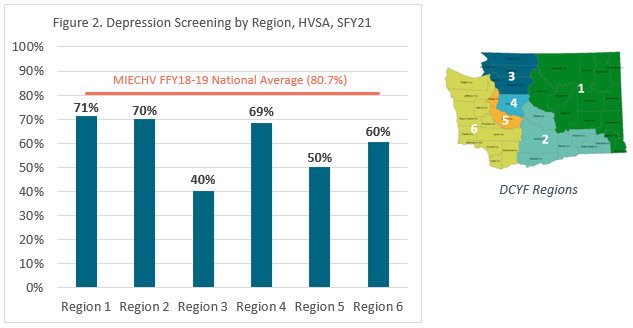
Depression screening and referral were especially relevant during the pandemic when many caregivers struggled with mental and emotional health issues. However, depression screening rate for the HVSA declined from 73% in SFY19 to 62% in SFY21 (Figure 1), which may be associated with stressful situations families and home visitors faced during the pandemic and the challenges administering screenings during remote and virtual home visiting. In SFY21, there was regional variation in screening rates from 40% to 71%, which suggests there may be room for improvement (Figure 2).
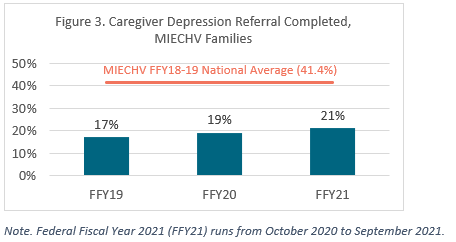
  The MIECHV performance measure for depression referral completion is monitored among MIECHV clients for all positive screens completed during the 3-month window. The rate of caregiver depression referral completed increased from 17% in federal fiscal year 2019 (FFY19) to 21% in FFY 21 (Figure 3).
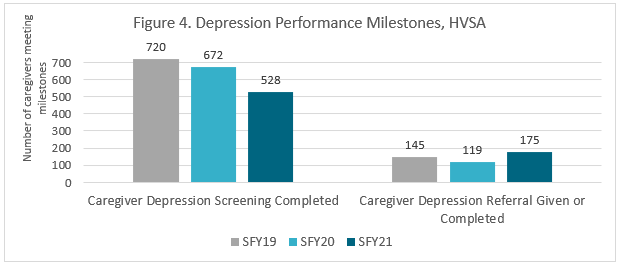
 For SFY 2021, LIAs received incentive awards for the 528 caregivers screened for depression during the screening window in the fiscal year (down from 720 caregivers and 672 caregivers in SFY 2019 and SFY 2020, respectively). While depression screening was conducted less often, more caregivers were referred for needed mental health services in SFY 2021, despite the fact fewer caregivers were enrolled in SFY 2021 (Figure 4).
 There is still time to complete your data entry!
The Performance Payments for Depression Screening and Services will be processed once at the end of the state fiscal year. Please be sure to have all of your data entered into your respective data systems no later than July 5, 2022.
Need a refresher on how to enter in VisitTracker and on which Forms to use for FLO? Please follow these links for step-by-step instructions for VisitTracker and FLO.
Parent-Centered ASQ Screening and Referrals: Click here to register for this training, which will take place over two sessions on April 12 and 19 from 12-4 p.m.
Perinatal Mental Health for Home Visitors: SAVE THE DATE for the next training, which will take place from 12-4:30 p.m. on Wednesdays from May 11 through June 22. Registration information will be available in the April monthly email, and PSWA will also provide more information about what to expect from the training during the March CQI webinar.
Start Early HUB believes in the power of ‘peers interacting with peers’ when it comes to those who make a difference with families through home visiting. We’ve heard from those that provide direct services to families that it’s been the most beneficial to have opportunities to interact, seek mentorship, and share experiences, challenges, and successes with each other. To achieve this, three virtual communities of practice (COP) are being launched this spring. Each COP is limited to 15 members to encourage trust, meaningful interaction, and give space for rich dialog that results in a productive, positive group experience. Consistent attendance (at least five of the six 90-minute sessions) is required of those who register for a COP. A staff member of Start Early HUB supports each COP with facilitation and resources.
What is a Community of Practice and what makes it different than attending training? “A community of practice (CoP) is a group of people who share a common concern, a set of problems, or an interest in a topic and who come together to fulfill both individual and group goals. Communities of practice often focus on sharing best practices and creating new knowledge to advance a domain of professional practice.” https://www.communityofpractice.ca/background/what-is-a-community-of-practice/
Community of Practice – Substance Abuse in Home Visiting
Description: What impact does substance abuse in a family have on the relationship and focus of visits you have with them as a Home Visitor? This community of practice is a forum for Home Visitors (and anyone who provides direct services to families) to explore shared experiences and encourage each other given the realities they encounter with families experiencing substance abuse. Bring your examples, challenges, questions, and strategies to share with home visiting peers who see similar situations and dynamics in their work with families related to substance abuse. Specific topics of most interest will be determined by COP members in the first two meetings.
Dates: Every other Tuesday from 9:30-11 a.m.
April 5
April 19
May 3
May 17
May 31
June 14
Registration closes when we reach 15 participants
Register Here: Community of Practice – Substance Abuse in Home Visiting
Home Visiting Supervisors Community of Practice
Description: Are you interested in connecting with other Home Visiting Supervisors in Washington who face many of the same challenges you do in staff relationships and program operations? A community of practice is being launched to create a forum specifically for Supervisors of Home Visitors who are willing to share their wisdom, experiences, resources, and strategies in a safe environment of peer-to-peer discussion, reflection, and support. Specific session topics will be determined by COP members in the first two meetings. Examples of topics could include self-care, recruitment and onboarding new Home Visitors, virtual supervision & team building, dealing with conflict, etc.
Dates: Every other Wednesday from 9:30-11am
May 4
May 18
June 1
June 15
June 29
July 11
Registration closes when we reach 15 participants
Register Here: Supervisor Community of Practice
Home Visitor Community of Practice
Description: Are you interested in connecting with other Home Visitors in Washington who face many of the same challenges you do in working with families? A community of practice is being launched to create a forum specifically for Home Visitors who are willing to share their wisdom, experiences, resources, and strategies in a safe environment of peer-to-peer discussion, reflection, and support. Specific session topics will be determined by COP members in the first two meetings. Examples of topics could include self-care, balancing my work and family responsibilities, challenges in virtual visits with families, screenings & assessment issues, etc.
Dates: Every other Friday from 9:30-11am
June 3
June 17
July 1
July 15
July 29
August 12
Registration closes when we reach 15 participants
Register Here: Home Visitor Community of Practice
Below, you’ll find a link to a short survey where we hope you share feedback on a new date and time as well as thoughts on future topics you are interested in. Please feel free to forward this to any colleagues with an active home visiting caseload that may be interested in connecting with other Home Visitors.
Home Visitor Peer Connection Feedback Survey
CQI Monthly Webinars - every fourth Wednesday of the month from 1:30-2:30 p.m.
Upcoming topics include:
- March 23: Mental Health and Depression Resources
- April 27: Family Engagement
- May 25: Sustaining Gaines
- June 22: HVSA FY23 CQI Updates
For new supervisors or new CQI team members that need to be added to the calendar invite or Basecamp resources, please reach out to rcontreras@startearly.org
Each month, DCYF ESIT Tribal Program Consultant Brian Frisina will provide a key topic to help support us all in getting to know our Tribal Nations partners better.
United Nations Declaration on the Rights of Indigenous Peoples
"Although we are in different boats, you in your boat and we in our canoe, we share the same river of life.” – Oren Lyons, Onondaga
"The United Nations Declaration on the Rights of Indigenous Peoples (UNDRIP) was adopted by the General Assembly on Thursday, 13 September 2007, by a majority of 144 states in favour, 4 votes against (Australia, Canada, New Zealand and the United States) and 11 abstentions (Azerbaijan, Bangladesh, Bhutan, Burundi, Colombia, Georgia, Kenya, Nigeria, Russian Federation, Samoa and Ukraine).Click here to view the voting record.
Years later the four countries that voted against have reversed their position and now support the UN Declaration. Today the Declaration is the most comprehensive international instrument on the rights of indigenous peoples. It establishes a universal framework of minimum standards for the survival, dignity and well-being of the indigenous peoples of the world and it elaborates on existing human rights standards and fundamental freedoms as they apply to the specific situation of indigenous peoples."
Are Indigenous Peoples a Racial Minority?
"Indigenous peoples are frequently classified as a racial minority. However, it is important to understand that “Native American” or “American Indian” are not strictly racial categories. Being a member of a tribal nation provides a membership status. Because of tribes’ status as sovereign nations, Indigenous peoples/tribes are political entities. Whether an individual is a member of a federally recognized Indian tribe depends on the membership rules of each individual tribe. Those requirements usually have some basis in “blood quantum” ancestry, however, other criteria may also be used. A DNA test cannot tell you that you are Native American, because that status is defined by belonging to a tribal nation or community. “Native American” or “American Indian” thus differs from racial minority groups because it entails membership and that membership connotes a distinct historical and political relationship with the federal government."
Learn More
"Racism, Native American Human Rights and the UN was a presentation by Oren Lyons . It was held on September 11, 2006 as part of the year-long educational series Onondaga Land Rights & Our Common Future." Watch full video here (30:24):
Sources
Native American and Indigenous Peoples FAQs. UCLA Equity, Diversity and Inclusion. © 2022 UC REGENTS.
Oren Lyons-1: Racism, Native American Human Rights and the UN. Uploaded to YouTube by SyracusePeaceCouncil. March 2020.
The power of Expectations: In this beautiful animation from Invisibilia’s season one episode “How to Become Batman,” the show explores whether your private thoughts and expectations can influence how well a rat runs a maze, and how those expectations can have a profound impact on our own lives.
Native American Heritage Month Resources: In celebration of American Indian Heritage Month, November 2021, DCYF ESIT Tribal Support Specialist Brian Frisina compiled a collection of educational materials to help us learn more about Native American history, culture, storytelling, media, and much more, available on DCYF's website.
Billy Frank Jr. Pacific Salmon Summit: "The Summit’s aim was to Inspire, Enlighten and Ignite the salmon recovery community through presentations about treaty rights, the status of salmon and its habitat, and critical policy issues." For more information and a comprehensive archive of past Summits, visit the Salmon Defense home page.
Chief Arvol Looking Horse and wife talk about the pandemic and what the Lakota elders say: listen as Chief Arvol Looking Horse shares their story, insights and perspective.
-
Bright by Text, is a text messaging program that provide information on child development and resources to parents and caregivers. Find out more here.
-
Commerce awards nearly $19 million in infrastructure funding to boost affordable housing development in seven counties. Read the full list here.
|