All-HVSA Virtual Spring Meeting: May 3 and 4, 9 a.m. to Noon
“Grounding and Growing Together”
Registration will go out soon
May 4 – Home Visitors are Encouraged to Attend!
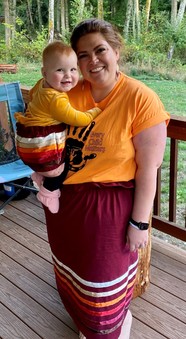
Welcome Ashley Utz Cook to the Home Visiting Program as the new Home Visiting Program Specialist with a Tribal focus. In her new role, she will help to build deeper relationships with tribal partners, support efforts to expand home visiting to serve tribal families and communities, and guide our work across the state to improve existing home visiting services to tribal members.
Osiyo!
My name is Ashley Utz Cook. I am a DCYF Home Visiting Program Specialist with a tribal focus.
I am an enrolled member of the Cherokee Nation of Oklahoma of the Wolf clan.
I live on beautiful Camano Island with my husband Steven, daughter Lillian, and our two German Shepherds, Kimber and Koda.
|
For the last 10 years, I have worked for the Tulalip Tribes’ Justice System, working to combat substance use disorder within Indian Country. Since 2019, I served as the Program Manager for the Tulalip Healing to Wellness Court and Tulalip Family Wellness Court programs. Under my direction, the Tulalip Healing to Wellness Court was named a National Mentor Court for the National Association of Drug Court Professionals—the second Tribe to be so honored. During my time with Tulalip, I graduated from the University of Washington with my Bachelors in Law, Societies and Justice and continued my studies at Arizona State University to receive my Masters in Criminal Justice.
I am so excited to join DCYF and the Prevention Services team as a Home Visiting Program Specialist! I am extremely passionate about our tribal communities and their children and cannot wait to collaborate with our tribal partners and organizations. I am looking forward to being a part of DCYF’s commitment to build relationships with tribal partners and expand home visiting services to our Washington State tribal communities!
Wado (thank you), Ashley U. Cook
Gov. Jay Inslee proclaimed February as Parent Recognition Month to honor the extraordinary parents, caregivers, guardians and community members across our state. Each year we celebrate our community for Parent Recognition Month through our Unsung Heroes campaign. These unsung heroes are honored for their roles they have taken with their families, schools, and communities. You can read their stories here.
Public Health Connection shares how you can now use your SNAP benefits to buy groceries online at Safeway.com for pickup or home delivery.
HVSA Data Requirements Trainings
Thank you to all those who attended the Feb. 2 HVSA data requirements training. We had more than 90 attendees and covered contract requirements for data reporting, aligned measures, and performance-based contracting measures. We hope to provide these trainings more routinely and would appreciate your feedback on February’s training. Please take five minutes and complete this survey: https://forms.office.com/g/NzhfUE36hk
A full recording of the training will be available soon. Please look for link in next HVSA Monthly email communication.
For questions or to make training requests to DOH, please email HomeVisiting@doh.wa.gov.
Home Visiting Data System Planning
DOH, on behalf of the HVSA, has engaged BlueSky NW to take our next big step in data system planning. In 2019-20, we completed initial documentation of the system, identification of gaps, and recommendations for next steps. This work set the stage for both short-term activities and long-term planning to improve the tools, processes and system(s) for managing data for the HVSA. BlueSky NW will lead efforts to 1) prioritize key data system functions with HVSA stakeholders; 2) complete research on solutions employed by other home visiting programs nationwide; and 3) complete more in-depth analysis of a few selected potential solutions. Potential solutions will consider the prioritized system functions as well as other factors, such as configurability, functional/technical requirements, cyber security, costs, and feasibility of adoption, to assess the best possible alternatives for a future HVSA ecosystem.
BlueSky NW is a new PNW IT Consulting firm whose two owners have 50+ years of combined IT experience. In their words:
“We are very excited to be working on this project and believe our work, experience, approach, and collaboration with stakeholders as well as steering committee will highlight the best possible alternatives for a future home visiting data ecosystem that can tackle existing data system challenges and opportunities as well as meet the ever-changing HVSA program and reporting needs.”
For more information, please feel free to contact:
Sergio Palma, BlueSky NW – sergio@bluesky-nw.com
Steve Zimmerman, BlueSky NW – steve@bluesky-nw.com
Martha Skiles, DOH – martha.skiles@doh.wa.gov
The PICCOLO in Practice
Wednesdays from 1-3 p.m., March 2-23
Register at https://events.eventzilla.net/e/spring-piccolo-virtual-training-2138819960
Healthy Families Parenting Index (HFPI)
Thursday, March 17, from 9-11 a.m. (Participants will need to complete a pre-recorded webinar prior to the live training)
Register at https://events.eventzilla.net/e/hfpi-training-2138819966
Start Early is pleased to announce funding to offer NEAR@Home Facilitated Learning to home visitors across Washington. NEAR@Home Facilitated Learning offers home visitors experiential, reflective learning, and support in developing the capacity and skills needed to safely, respectfully, and effectively talk about ACEs, trauma, and other hard things with parents and caregivers.
Below you’ll find a link to a short survey where we hope you share feedback on a new date and time as well as thoughts on future topics you are interested in. Please feel free to forward this to any colleagues with an active home visiting caseload that may be interested in connecting with other Home Visitors.
Home Visitor Peer Connection Feedback Survey
Upcoming topics include:
- Feb. 23: Data Overview with DOH
- March 23: Mental Health and Depression Resources
- April 27: Family Engagement
- May 25: Sustaining Gaines
- June 22: HVSA FY23 CQI Updates
For new supervisors or new CQI team members that need to be added to the calendar invite or Basecamp resources please reach out to rcontreras@startearly.org.
Each month, DCYF ESIT Tribal Program Consultant Brian Frisina will provide a key topic to help support us all in getting to know our Tribal Nations partners better.
United Nations Declaration on the Rights of Indigenous Peoples
"Although we are in different boats, you in your boat and we in our canoe, we share the same river of life.” – Oren Lyons, Onondaga
"The United Nations Declaration on the Rights of Indigenous Peoples (UNDRIP) was adopted by the General Assembly on Thursday, 13 September 2007, by a majority of 144 states in favour, 4 votes against (Australia, Canada, New Zealand and the United States) and 11 abstentions (Azerbaijan, Bangladesh, Bhutan, Burundi, Colombia, Georgia, Kenya, Nigeria, Russian Federation, Samoa and Ukraine).Click here to view the voting record.
Years later the four countries that voted against have reversed their position and now support the UN Declaration. Today the Declaration is the most comprehensive international instrument on the rights of indigenous peoples. It establishes a universal framework of minimum standards for the survival, dignity and well-being of the indigenous peoples of the world and it elaborates on existing human rights standards and fundamental freedoms as they apply to the specific situation of indigenous peoples."
Are Indigenous Peoples a Racial Minority?
"Indigenous peoples are frequently classified as a racial minority. However, it is important to understand that “Native American” or “American Indian” are not strictly racial categories. Being a member of a tribal nation provides a membership status. Because of tribes’ status as sovereign nations, Indigenous peoples/tribes are political entities. Whether an individual is a member of a federally recognized Indian tribe depends on the membership rules of each individual tribe. Those requirements usually have some basis in “blood quantum” ancestry, however, other criteria may also be used. A DNA test cannot tell you that you are Native American, because that status is defined by belonging to a tribal nation or community. “Native American” or “American Indian” thus differs from racial minority groups because it entails membership and that membership connotes a distinct historical and political relationship with the federal government."
Learn More
"Racism, Native American Human Rights and the UN was a presentation by Oren Lyons . It was held on September 11, 2006 as part of the year-long educational series Onondaga Land Rights & Our Common Future." Watch full video here (30:24):
Sources
Native American and Indigenous Peoples FAQs. UCLA Equity, Diversity and Inclusion. © 2022 UC REGENTS.
Oren Lyons-1: Racism, Native American Human Rights and the UN. Uploaded to YouTube by SyracusePeaceCouncil. March 2020.
Heroes of Public Health
17 African American Public Health Heroes You Need To Know | NYU School of Global Public Health
The ABC’s of Racial Literacy
Racial Justice | Sesame Street in Communities - Sesame Street in Communities
The Civil Rights Movement
"The civil rights movement was a struggle for social justice that took place mainly during the 1950s and 1960s for blacks to gain equal rights under the law in the United States. The Civil War had officially abolished slavery, but it didn’t end discrimination against blacks—they continued to endure the devastating effects of racism, especially in the South." Continue reading from the History Channel. Watch a Crash Course in U.S. History: Civil Rights and the 1950s: Crash Course US History #39
Implicit Bias: Peanut Butter, Jelly, and Racism
"What is implicit bias? Saleem Reshamwala unscrews the lid on the unfair effects of our subconscious." Watch here (2m 26s): Implicit Bias
Reading List
Pierce County Libraries has put together a great list of children's books for African American History Month. You can find that here.
-
Get Connected Through Lifeline. This Federal program offers a monthly discount on phone, internet, or bundled package bills to qualified low-income people, that can give them the tools to access services like telehealth. Customers living on Tribal lands can receive an additional benefit.
-
Commerce awards nearly $19 million in infrastructure funding to boost affordable housing development in seven counties. Read the full list here.
|