|
November 6, 2025
Comprehensive Plan Update Project: Guiding Principle Spotlight
Today, we’re diving into the final two American Planning Association guiding principles: Resilient Economy and Responsible Regionalism
A thriving Arlington depends on a strong local economy and smart collaboration with our neighbors. How do we build resilience and work as a region?
Resilient Economy
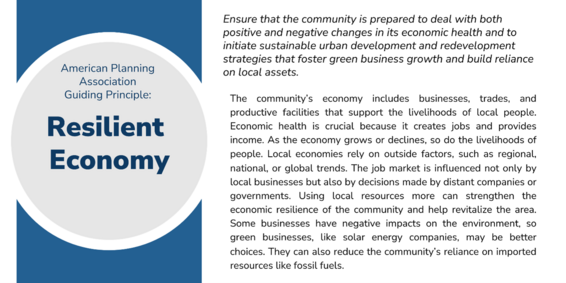 Economic resilience means building an economy that adapts to challenges and opportunities—whether from market shifts, climate change, or public health emergencies. Resilient communities with diverse local economies and opportunities for all can better manage stressful events and reduce long-term harm to residents and businesses.
Arlington’s economy is strong and diverse, supported by strategic planning, strong transit, a highly-educated community, skilled workforce, and thriving commercial corridors with support for small businesses, but faces pressure from high living costs, economic inequality, office vacancies, and limited authority granted by the state (i.e., the Dillon Rule). Future success will depend on diversifying industries, expanding tourism, reusing office space, and balancing growth with housing affordability and sustainable, lasting, and equitable economic outcomes for everyone.
In Arlington, a resilient economy could be achieved through:
- Supporting small businesses and entrepreneurs, especially in underserved areas
- Workforce development and job access
- Affordable, stable housing to prevent displacement
- Strengthening social safety nets
- Helping businesses stay open and recover after an incident or disaster
Responsible Regionalism
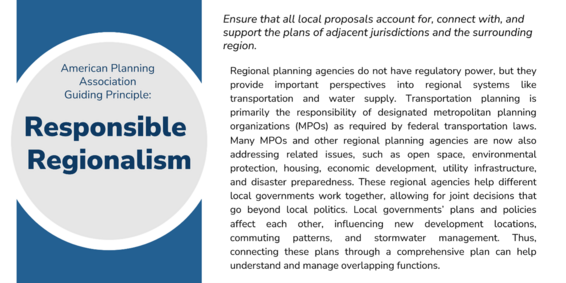 Responsible regionalism recognizes that our success depends on collaboration with neighboring jurisdictions in the region. People, jobs, and ecosystems cross jurisdictional boundaries. Coordinating with neighboring areas can help address shared challenges, including traffic congestion, housing, and economic development. It is also helpful for regional infrastructure like transit, water systems, and natural resources.
Arlington is a regional leader, collaborating across jurisdictions to advance housing, transit, environmental goals, workforce development, health services, and emergency response, while achieving affordable housing targets and advancing smart growth and sustainability initiatives. However, Arlington’s reliance on external agencies, limited data sharing, interjurisdictional competition, fragmented social service coordination, and demographic shifts that threaten workforce retention pose challenges. Future success will depend on expanding partnerships, regional housing solutions, coordinated infrastructure investments, shared data systems, and leveraging innovation in areas like AI, green infrastructure, and biophilic design. Strong partnerships with the Metropolitan Washington Council of Governments (MWCOG), neighboring jurisdictions, federal agencies, and private institutions strengthen the region’s economy, infrastructure, and quality of life.
In Arlington, responsible regionalism could be achieved through:
- Participating in MWCOG and Northern Virginia Transportation Authority (NVTA)
- Aligning land use and transportation with regional transit investments
- Adopting affordable housing policies to address regional housing targets
- Coordinating on emergency preparedness, water management, and environmental protection
Your voice will help shape the introductory chapter of the Comprehensive Plan! We want to hear your thoughts, ideas, and concerns.
Share your input here now.
Please provide input by Sunday, November 16.
Join us at the virtual community meeting this evening to learn more and ask questions!
|