|

|

|
USDA AMS Specialty Crops Program Newsletter - Sept 2020
|
A Message to Our Industry Partners
Sonia Jimenez, Deputy Administrator, Specialty Crops Programs
SCP Is Excited for a Busy Fall Season!

The USDA AMS Specialty Crops Program (SCP) will be exhibiting at this year’s Produce Marketing Association (PMA) being hosted digitally October 13-15, 2020. USDA AMS is excited to be part of this virtual event. We’ll focus on multiple areas, including:
- SCP’s Specialty Crops Integrated Operating Network (SCION), which will empower users to deliver fact-based, data-driven information to the diverse specialty crops industry.
- Through a cooperative agreement between USDA & Michigan State University, a survey this fall will explore Buyer Acceptance of the USDA Good Agricultural Practices Program, including GroupGAP as well as other 3rd party group certification programs.
- We will discuss the USDA Farmers to Families Food Box program as it wraps up its efforts. The AMS Commodity Procurement Program (CPP) will discuss how you may become a vendor for future specialty crop bidding opportunities.
- AMS Market News will update our Market Analysis & Reporting Services (MARS) MARS allows for more data availability, better analysis, and improved information access sooner.
- Leaders from PACA and COOL will be available to address your questions/comments regarding fair trade practices in the produce industry.
COVID-19 challenges all of us to develop creative ways to conduct the agricultural industry’s business. We’re looking forward to interacting with industry stakeholders in this unique venue, outlining successes of the past year while extolling the bright future that lies ahead for our industry, USDA, and the Specialty Crops Program.
This issue of the SCP industry Newsletter highlights diverse areas, such as the FDA requesting information from the public, and how USDA is reopening the comment period for U.S Domestic Hemp Production Interim Final Rule. You’ll learn how SCP worked in cooperation with industry and our state partners in establishing record levels in grape inspections and get details of AMS’s Transportation & Marketing Program’s involvement in local food systems response to COVID-19. I encourage you to work with us in continuing to drive the agricultural industry forward and contact any SCP employee who may assist your efforts.
|
|
|
|
USDA Reopens Comment Period for U.S. Domestic Hemp Production Program Interim Final Rule
Jeffrey Davis, Business Development, Specialty Crops Program
Interested in Additional Commodities Now Eligible In CFAP?

The U.S. Department of Agriculture (USDA) is reopening the comment period to the interim final rule that was published on Oct. 31, 2019 and established the U.S. Domestic Hemp Production Program. The reopening will provide an additional 30 days for interested persons to comment on the IFR.
All stakeholders are invited to provide comments, especially those who were subject to the regulatory requirements of the IFR during the 2020 production cycle. The Agricultural Marketing Service (AMS) is interested in all additional input for all aspects of the U.S. Domestic Hemp Production Program.
Notice of this extension is currently available for viewing in the Federal Register and was published Sept. 8, 2020. Additionally, on August 21st, the Drug Enforcement Administration published an Interim Final Rule impacting certain aspects of the U.S. hemp industry. We encourage you to read the Rule and submit a comment prior to the October 20, 2020, deadline. To review the DEA rule, please click here. Comments must be received by Oct. 8, 2020.
William Richmond, Branch Chief, U.S. Domestic Hemp Production Program says, “We are excited to reopen the comment period to gain additional insight from hemp industry stakeholders. We have identified several potential policy options for the Final Rule, and we need data from the industry from the 2020 growing season to help determine future program requirements.” Written comments should be submitted via the Federal eRulemaking portal at www.regulations.gov. Comments may also be sent via email to farmbill.hemp@usda.gov or sent by postal mail to USDA/AMS/Specialty Crops Program Hemp Branch, 470 L’Enfant Plaza SW, PO Box 23192, Washington DC 20026.
More information about the provisions of the interim final rule is available on AMS’s Hemp Production webpage.
|
Specialty Crops Inspections Shine During the 2020 Mexican Table Grape Season
Tony Sousa, Assistant Branch Chief USDA AMS SCP Specialty Crops Inspection Division
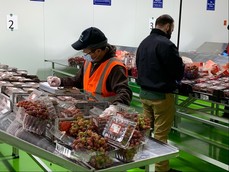
The industry’s 2020 Mexican Table Grape season’s inspection of imported table grapes from Mexico demonstrated the USDA’s Specialty Crops inspection Division and our state partners with the Arizona Department of Agricultural (AZDA) rose to the challenge to meet the needs of the Mexican importers and the California Desert Grape Administrative Committee on whose behalf the table grape inspections are performed.
The Nogales area office provided inspections for 33 applicants at 32 warehouses during the 2020 Mexican Table Grape season. The total packages inspected this season were 19,563,267 of which 11,159 certificates were issued for a total of 13,680 lots. Simultaneously, for the period of April 4 thru July 15 of the Tomato Suspension Agreement, 14,588,267 packages were issued of which 9,087 certificates were issued for a total of 11,762 lots.
Discover how great working relationships between federal & state cooperators yield great benefits for the agricultural industry!
|
On August 6 the FDA launched a Request for Information (RFI) from the public on produce with no or low reported consumption. The FSMA Produce Safety Rule includes a list of produce which is “rarely consumed raw” (RCR) and therefore exempt from the Produce Safety Rule. The FDA is considering expanding this list, and is looking for “commodity-specific data that would indicate whether that particular fruit or vegetable is consumed cooked by almost all consumers across the United States at this time”. This list was originally developed using consumption data to identify commodities which are almost always cooked prior to consumption; however, there were commodities where consumption data was too low in survey respondents to determine whether or not they met the criteria for rarely consumed raw.
The FDA is now requesting information on produce that could not be effectively classified as RCR because of low reported consumption in the United States in order to determine if these commodities need to be added to the RCR list. The data request includes consumer or market data which can demonstrate the proportion of the population which consumes the commodity in its raw/uncooked form. Additional submissions could include “data indicating that a commodity cannot safely be consumed uncooked, e.g. because in its uncooked state it contains toxic properties” or “information on any kill steps other than cooking (e.g. fermentation that adequately reduces microorganisms of public health significance).”
A direct link to the Federal Register docket may be found here, with additional details and instructions to provide formal submissions. The comment period ends November 9, 2020.
|
|
Local Food Systems Response to COVID-19
USDA AMS Transportation & Marketing Is Working With Industry & Academia

Tricia Kovacs, Deputy Administrator of AMS Transportation & Marketing says, “USDA has partnered with three universities and sixteen national organizations to develop a user-friendly Resource Hub that is guided by the voices of the local and regional food sector and designed to best serve them. Through this cross-sector collaboration, our team has been able to amplify the great work being done across the nation and illustrate and support the resiliency of local food systems.”
|
|
|