Issue 40 | October 2025
Welcome to the October edition of Pass It On News.
A bi-monthly newsletter bringing you the headlines and new policies, procedures and guidance from your West Sussex Safeguarding Adults Board.
In this newsletter


In September, the Board met for an in-person Board meeting to discuss the work completed during the last three months.
The agenda included:
- an overview of the recent Care Quality Commission (CQC) inspection of West Sussex Adult Services;
- a discussion around risks associated with the rising cost-of-living;
- an overview of the work and achievements of the Learning and Policy subgroup; and
- updates from Public Health, the Department of Work and Pensions (DWP), and the West Sussex County Council Commissioning service.
The next meeting of the full Board will take place in December 2025.
|
Colin was a 77-year-old man who lived in his own home with his wife, Doreen, their son, and Doreen’s mother. In October 2022 Colin was admitted to hospital. He died 18 days later, with a recorded cause of death of sepsis and multiple infected pressure sores.
At the time Colin was admitted to hospital, he was physically disabled following a stroke, with limited mobility. He was diabetic and had an increased risk for pressure ulcers. The primary issue recorded in the Safeguarding Adults Review referral was the deterioration of Colin’s physical health in relation to pressure ulcers, in the wider context of self-neglect.
Please do share these resources within your networks, including our special edition Support for Carers newsletter, which includes information about how we might identify a carer; where carers can access support; and what support is available to them.
Key documents:
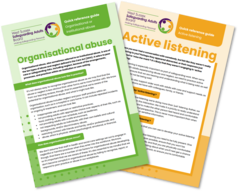
We have recently published two new quick reference guides, on organisational abuse and active listening.
Organisational abuse, also sometimes referred to as institutional abuse, is one of the ten types of abuse and neglect defined in the Care Act (2014). It refers to poor care or safeguarding risks, including neglect, because of the arrangements, processes, and practices within an institution or care setting.
Read our factsheet for information about what organisational abuse looks like in practice; how it may occur; how we can mitigate against the risks of organisational abuse; and what you should do if you are concerned about organisational abuse.
Key documents:
Have you ever had a conversation with somebody, but felt like they weren’t really listening to you? Perhaps they appeared distracted, or their responses just seemed to ‘miss the mark’? It’s likely that they weren’t engaging in ‘active listening’.
Active listening is especially important as part of safeguarding work. When we’re working with adults experiencing abuse and neglect, we need to practice active listening to ensure that we are hearing and understanding what is being said, as well as what might not be being said.
Key documents:
|
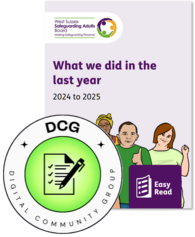
This year, we have once again worked with Easy Read Online and Burnside Day Opportunities Hub Digital Community Group on our Easy Read Annual Report 2024/25.
The Easy Read version uses easier words and supporting pictures. Some people might find it easier to understand than the main version.
Please do share this document widely within your networks, to support us with sharing the work of the Board.
Key documents:
Supporting documents:
|
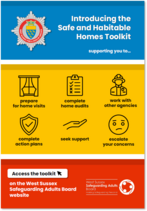
We are pleased to share that the long-awaited and much-anticipated Safe and Habitable Homes Toolkit has now been published on the West Sussex Safeguarding Adults Board website.
Produced by the West Sussex Fire & Rescue Service, this toolkit has been highly regarded by staff across the partnership for some time. We are therefore so pleased to be able to make this toolkit available to staff across West Sussex via our website. The toolkit is designed to support staff to:
- prepare for home visits
- complete home audits
- work with other agencies
- complete action plans
- seek support
- and escalate your concerns
Please do share this toolkit widely within your networks. We have produced a promotional poster to support you with this.
Access the toolkit:
|
We have now published a new webpage dedicated to family, friends, and carers.
This page has been written to provide families, friends, and carers with information about adult safeguarding. It provides information about what to do if you are concerned about the safety or wellbeing of an adult with care and support needs, or if you would just like to know more about adult safeguarding and the work of the Safeguarding Adults Board.
Please do share this webpage with any family, friend, or carer groups that you work with.
Access the webpage:
Our summary guidance on the Mental Capacity Act (2005) has been updated to include more information about assessing capacity; fluctuating, decisional and executive capacity; and making 'unwise' decisions.
The Mental Capacity Act (2005) is a legal framework for people over the age of 16 who may lack the mental capacity to make specific decisions, on a permanent or temporary basis.
Please refer to the Mental Capacity Act summary guidance and podcast to learn more about what may affect someone's mental capacity; how capacity should be assessed; and what happens after a capacity assessment.
Read the updated guidance:
Following a scheduled review, we are pleased to share that we have now published an updated Safeguarding Young People 17.5+ Protocol.
The Safeguarding Young People 17.5+ Protocol is our first joint protocol, with the West Sussex Safeguarding Children's Partnership. The protocol is for Safeguarding Young People who are aged 17.5 and above and provides details of the practice required and process to be followed, by all in West Sussex, for safeguarding our transitional young people.
Access the protocol:
|
You may have noticed that we've had quite a lot to say this year.
That's why, in-between these bi-monthly newsletters, we've been sharing special edition newsletters focussed on key adult safeguarding topics.
So far this year, we've shared newsletters focussing on the Mental Capacity Act, multi-agency working, support for carers, and what we've learned from Tom Somerset-How, who experienced neglect and emotional/psychological abuse by his then-wife and paid carer.
We hope that these explorations of key safeguarding topics, delivered directly to your inbox, are a helpful reminder and resource pool for your continuing professional development.
Catch-up on the special edition newsletters:
|
|