|
SERV-OR Bulletin 📣 October 2026
|
|
|
Ericka Evans, OHA HSPR Regional Emergency Coordinator.
|
|
Ericka Evans, Tribal Member and Regional Emergency Coordinator | Mark Schorr
For Ericka Evans, the 2020 Labor Day fires were a life-changing experience. Working in a coastal hospital, she saw another hospital “evacuate their facility and transfer their patients to our hospital. We saw years of planning, exercise, training and coordination come into action in real time.”
“It was incredibly impactful to watch those plans come to life and see patients continue to receive care. Before that, I don’t think I fully understood how significant a wildfire could affect a hospital’s operations and regional healthcare delivery. It changed the way I view preparedness, and it also reinforced for me that the work we do before an emergency directly shapes how effectively we can respond when a disaster happens.”
For five years, Ericka has been a Hospital Preparedness Planner / Regional Emergency Coordinator (HPP REC) in the Health Security Preparedness and Response (HSPR) program for the Oregon Health Authority (OHA). Her work focuses on supporting and planning for emergency preparedness and response for hospitals and ... CLICK HERE TO CONTINUE.
|
|
|
Oregon Tribal Preparedness Coalition: Strengthening Emergency Preparedness Through Partnership | Stuart C Vaughters
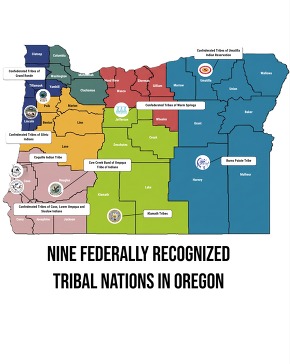
The Oregon Tribal Preparedness Coalition (OTPC) is a collaborative network of representatives from Oregon's nine federally recognized Tribal Nations, who support Tribal preparedness, emergency management and public health. Membership and participation also include state agency Tribal liaisons and preparedness partners. Representatives from FEMA (Federal Emergency Management Association), BIA (Bureau of Indian Affairs) and other agencies participate as needed. Brandy Bishop, Emergency Preparedness Coordinator for The Confederated Tribes of Grand Ronde stated, “The mix of emergency management, public health, state partners, and other Tribal-serving organizations gives us an opportunity to look at preparedness from... CLICK TO CONTINUE.
|
|
|
The insignia for The Confederated Tribes of Grande Ronde.
|
|
Talking to Brandy Bishop, Emergency Preparedness Coordinator for the Confederated Tribes of Grand Ronde | Cayetana Gomez de Soler
For Brandy Bishop, the Emergency Preparedness Coordinator for the Confederated Tribes of Grand Ronde, emergency management is about much more than responding when disaster strikes. It is about preparing people, strengthening relationships, preserving essential services, and building a community capable of caring for one another when normal systems are disrupted.
Since taking on the role in April 2016, Brandy has watched emergency management at Grand Ronde grow significantly. The work now encompasses emergency planning, training and exercises, emergency communications, response coordination, and managing the Emergency Coordination Center when activated. Just as important is helping Tribal departments, employees, volunteers, and community... CLICK HERE TO CONTINUE READING.
|
|
|
Getting to Know Jade Gershen, Multnomah County MRC Unit Coordinator | Jacqueline Felix
Jade Gershen has been the current Medical Reserve Corps (MRC) Unit Coordinator at Multnomah County since July 2026. In this position, Jade manages the volunteer program, which includes volunteer onboarding, tracking of initial training, and annual recertifications. Maintaining communication with the volunteer pool, coordination with Tri-county partners (which includes Clackamas and Washington Counties), and participation in regional, state, and federal MRC meetings are also part of Jade's duties as the MRC Unit Coordinator. Additionally, during emergency declarations, Jade coordinates the activation and deployment of the MRC volunteers.
For Jade, some of the primary goals of focus for the remainder of the year are to “strengthen and clarify MRC activation procedures” as well as getting to “know our current MRC volunteers and the skills and experience they bring to the unit.”
Jade is kept busy performing double duty as the current Continuity of Operations Program (COOP) Coordinator at the Multnomah County Health... CLICK HERE TO CONTINUE READING.
|
 Jade Gershen, Multnomah County MRC Unit Coordinator and Continuity of Operations Program (COOP) Coordinator.
|
|
|
written by Abby Morris & Stuart C Vaughters
In 2023, the federal Administration for Strategic Preparedness and Response (ASPR) program awarded $50 million from the American Rescue Plan to 33 states and jurisdictions across the country. Oregon was one of two states awarded the largest individual award of $2.5 million from the MRC State, Territory and Tribal Nations, Representative Organizations for Next Generation (MRC-STTRONG) grant program. The focus for the use of the funds was to enhance emergency preparedness and response and community capabilities for Medical Reserve Corps (MRC) units across the state. After a no-cost extension, the deadline to use the funds was May 2026. This final report reviews how the funds were used across Oregon’s MRC units during the three-year period.
Enhanced Statewide Response Capacity
Medical supply trailers, medical caches, communications equipment, sanitation kits, shelter supplies, and mission-specific equipment were procured and mobilized across funded regions. Units reported immediate readiness improvements for wildfires, extreme heat, winter storms, landslides, flooding, and medically fragile shelter operations. Multiple counties conducted full-scale and functional exercises, including mass casualty scenarios, shelter activation simulations, ice storm and wildfire tabletop communications drills, and medical surge practice events. CLICK HERE TO CONTINUE READING.
|
|
|
Wildfire Deployment in Klamath County | Anthony Brande
When an emergency strikes, the call for help requires a deeply coordinated network of volunteers and emergency managers usually invisible to the public. This complex workflow provides a rare, behind-the-scenes look at modern disaster response. The recent SERV-OR deployment to Klamath County serves as a perfect example of this coordinated effort.
On Saturday, August 8, Klamath County Emergency Management put in a request through the Oregon Department of Emergency Management (OEM) Operations Center (OpsCenter) for SERV-OR to help support two... CLICK HERE TO CONTINUE READING.
|
|
Call Down Drill Announcement | Abby Morris
On Wednesday, September 23, SERV OR staff launched the first in a new, regularly scheduled series of Call Down Drills. A Call Down Drill alerts volunteers to a hypothetical scenario and provides a simple way for them to indicate whether they could respond by selecting yes or no. These drills help staff gauge real-time availability and identify issues like failed numbers or missing text opt-ins. For this drill, we gave no advance notice to truly test our SMS system. Unfortunately, we only had a 10% response rate. Thank you to everyone who took a moment to reply. Your participation directly strengthens SERV OR’s readiness, and we encourage all volunteers to watch for future drills and respond when possible.
|
|
|
Thank you: Sarah Bates, Susan Becker, Brandy Bishop, Anthony Brande, Danielle Brown, Samantha Buckely, Paul Crase, Adrienne Donner, Ericka Evans, Jacqueline Felix, Jade Gershan, Cayetana Gomez de Soler, Robyn Greenlund, Gloria Hale, Velda Handler, Carissa Heiniege, Eric Missman, Abby Morris, Mojisola Obiako, Carey Palm, Lexi Potter, Amanda Rasdal, Cynthia Rodriguez, Mark Schorr, Dwight Smith, Amy Sturgeon, Stuart C Vaughters, Lila Wickham, and Aidan Zhou.
The individuals named above made this issue of the SERV-OR Bulletin possible. Their energy, skill, and willingness to contribute were vital to getting the October 2026 Edition completed successfully. We hope you find the information contained here useful, informative, and enlightening.
|
|
|
Volunteers Building Strong, Healthy, and Prepared Communities.
Mission
SERV-OR is a ready volunteer network that recruits, trains, and mobilizes qualified volunteers to augment healthcare and public health capacity.
Vision
A ready volunteer health workforce that reduces disaster risk and bolsters whole community health before, during, and after emergencies.
|
|
|
|
|