|
Updates from the Oregon Department of Education
1. FY26 Federal Appropriations: Level Funding for Title I‑C and Title III
News and Resources for Multilingual and Migrant Education
1. Communities
Upcoming Events, Training & Conference Opportunities

1. FY26 Federal Appropriations: Level Funding for Title I‑C and Title III
Congress has finalized FY 2026 appropriations for the U.S. Department of Education as part of a broader federal funding package passed by the House on February 3. This legislation which has been signed into law will fund ED through September 30, 2026, and will provide the allocations used for major formula grant awards on or around July 1, 2026.
For programs serving multilingual learners and migratory students, the FY26 Labor–HHS–Education bill maintains level funding:
- Title I‑C Migrant Education Program: $376 million
- Title III English Language Acquisition: $890 million
These stable investments ensure continued support for states and districts as they deliver supplemental services, language instruction, and educational continuity for migratory children and English learners. Congress also reaffirmed statutory requirements that ED award formula grants on the dates funds become available, an important protection for state planning and program implementation.
Across K–12 education, most programs remain level-funded at FY 2025 levels. Notable increases include:
- ESEA Title I: +$20 million (total $18.427 billion)
- IDEA Part B, Grants to States: +$20 million (total $14.234 billion)
- Rural Education: +$5 million (total $225 million)
Some programs experienced reductions, including Education Innovation and Research (–$24 million), while Head Start and the Child Care Development Block Grant each received $85 million increases.
FY26 appropriations will support formula grants with a 27-month period of availability. Additional details are available in the Penn Hill Group’s FY26 Labor–HHS–Education funding summary.
Questions may be directed to Jessah Walker, CCSSO’s Manager of Federal Relations.
|
2. 2026 State Summer Learning Grant Update: Timeline & Grant Process
The ODE Expanded Learning team has shared updated timelines and key details for the upcoming 2026 Request for Applications (RFA).
Timeline
- RFA Release and Application Opening: Anticipated early February 2026
- Grant Award Announcements: Anticipated early April 2026
About the 2026-28 State Summer Learning Grant
The State Summer Learning Grant is transitioning to a three-year award cycle to support program stability, staffing continuity, stronger partnerships, and long-term planning. Awards will provide funding for summer 2026, summer 2027, and summer 2028*.
To align with statute and stakeholder feedback, ODE is shifting the State Summer Learning Grant to a hybrid grant model that blends formula-based prioritization with competitive application review. This approach ensures that all eligible applicants have a clear pathway to funding while allowing ODE to direct limited state resources to the strongest plans for high-quality, evidence-based summer learning.
*Pending continued legislative appropriation in the 2027-29 biennium
Two-Part Hybrid Grant Process
Part 1: Priority Points (Formula-Based Prioritization)
All eligible entities will receive priority points as follows:
- Percent of Students Proficient in English Language Arts (ELA);
- Number of Students Proficient in ELA;
- Percent of Students Experiencing Poverty;
- Entity Size (prioritizing small entities); and
- Geographic Locale (prioritizing rural entities).
Priority point totals will be calculated and released at the opening of the application period, allowing applicants to see their priority standing before submitting a full proposal.
Part 2: Full Application (Competitive Application Review)
Applicants will submit an application that is peer reviewed for quality, with a clear emphasis on:
- Evidence-based literacy instruction as a core component of the program;
- Enrichment and experiential learning that deepens content knowledge, builds vocabulary, and fosters engagement and belonging; and
- Budget and program scope aligned to proposed student reach and program design.
This model reflects what we heard through statewide engagement: the need for attention to local context, balanced use of data, elevation of high-quality instruction and meaningful enrichment, and predictable, multi-year funding. With $35 million available statewide per summer and demand far exceeding available resources, this structure allows ODE to responsibly steward public funds while maximizing student impact.
For more information visit the State Summer Learning Grant page or contact ODE.SummerLearning@ode.oregon.gov with questions.

Join ZoomGov:
Open At‑Large Position
The Office of Indian Education is accepting applications for an At‑Large seat on the AI/AN Advisory Committee. This role supports statewide guidance, advocacy, and recommendations that advance the academic success and well‑being of AI/AN students. Interested candidates may email Raina.Reece@ode.oregon.gov with a completed and resume. Applications will be forwarded to the committee for review until the position is filled.
Back to top
|

1.Governor Establishes Council to Coordinate Support for Immigrant and Refugee Communities
Governor Tina Kotek issued Executive Order 26‑04, creating an Interagency Council for Immigrant and Refugee Coordination to align state agencies’ efforts in supporting immigrant and refugee communities amid increased federal immigration enforcement. The order follows conversations with community leaders who raised concerns about heightened enforcement activity, increased fear, and disruptions to essential services. The executive order takes effect immediately. Click here to learn more.
|

1.Webinar for Tribal Education Leaders, Feb. 5
NIEA and the Tribal Education Departments National Assembly are hosting a webinar for Tribal education leaders on Feb. 5, 2026, from 11 a.m.–12:15 p.m. The session will help communities prepare for the U.S. Department of Education’s Feb. 10 Tribal Consultation on new Interagency Agreements among ED, Interior, and Labor. Click to learn more and register.
Back to top
|
2. OAESD Spring Conference 2026 – Breakout Session RFP Reminder
Proposals are due Friday, February 6, 2026 for the OAESD Spring Conference 2026, themed Better Together: Aligning for Impact, taking place May 13–15, 2026 at Sunriver Resort. This year’s conference will focus on how ESDs and partners align efforts to strengthen outcomes for students, schools, and communities across Oregon. Proposals should highlight practical strategies, promising practices, and collaborative approaches aligned to one or more conference strands. All breakout sessions will be held on Thursday, May 14. Notification of proposal status will be provided by February 27, 2026.
Submit proposals here: OAESD Spring Conference 2026 Breakout Session Proposal.
Back to top

3. 2026 MEP Youth Institutes, March 7 & 14
Oregon State University and Treasure Valley Community College will host the 2026 MEP Youth Institutes, one‑day events designed to empower migrant high school students through college exploration and career preparation. Students will participate in campus tours, student panels, guest speakers, and workshops focused on academic pathways, campus resources, and preparing for higher education.
Event Details
|
4. Upcoming Heritage Language Workshops
February brings an exciting lineup of professional learning events designed to inspire and support heritage language educators. Whether you’re looking to deepen content expertise or build assessments skills, these events offer fresh insights, practical strategies, and connections with experts across the field.
-
February 19–20: UNC Charlotte will host the Heritage Language Learning Virtual Symposium, bringing together experts in Arabic, Chinese, Italian, Japanese, and Spanish to share current practices and research.
-
February 27-28: UCLA will hold the Fifth International Conference on Heritage/Community Languages. This in‑person event, hosted by the National Heritage Language Resource Center, highlights multidisciplinary research and innovations in heritage language education.
-
February 28: CARLA will offer its Virtual Workshop on Seals of Biliteracy, designed to help educators especially those new to ACTFL standards strengthen their understanding of student proficiency expectations.
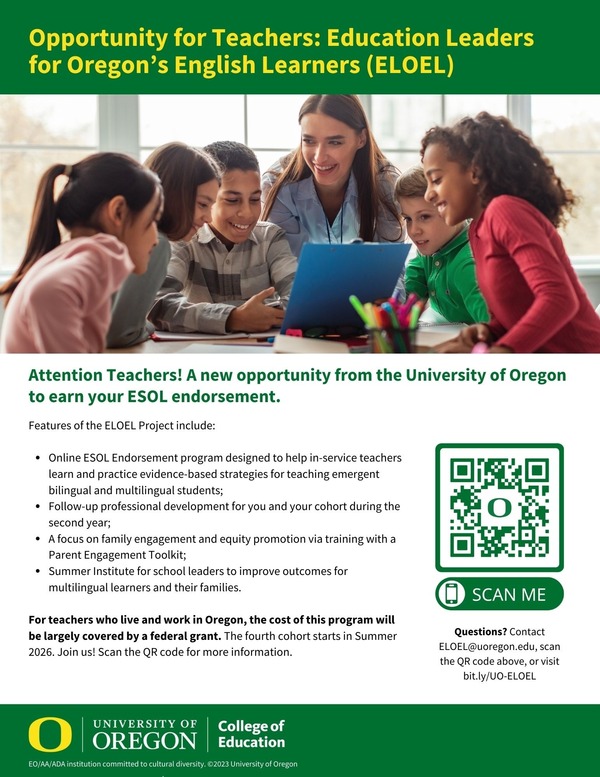
6. Grant for K-8 Teachers: English Speakers of Other Languages Endorsement
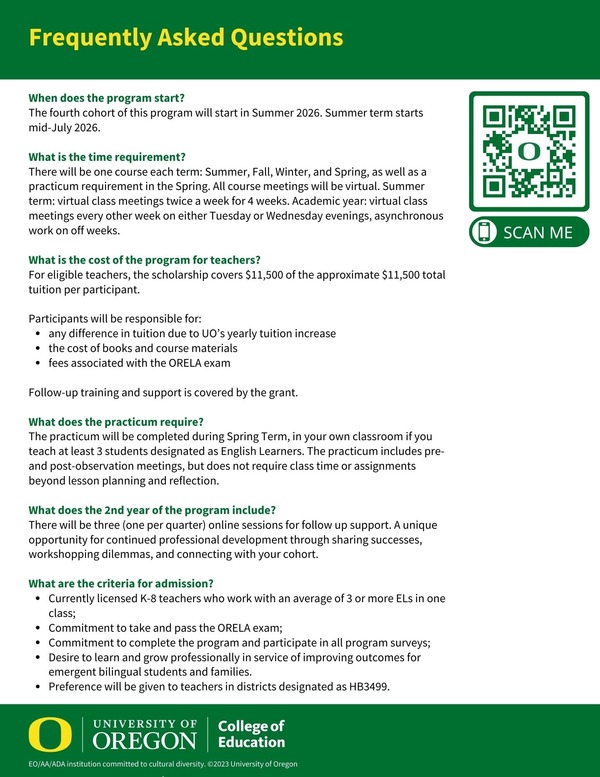
The University of Oregon is offering a grant-funded online ESOL endorsement program called Education Leaders for Oregon’s English Learners (ELOEL). This program, funded by an OELA NPD grant, provides a scholarship-based option for teachers across Oregon to earn their ESOL endorsement through an online program. The scholarship covers up to $11,500 of the approximate $11,500 total tuition per participant.
Applications are now open for the fourth cohort, which begins in Summer 2026. The scholarship is available to fully licensed K-8 teachers currently serving students designated as English Learners.
To learn more and to apply, click here. A flyer with FAQs is attached for easy sharing with educators.
For questions, contact Project Coordinator, Amie Garcia.

7. Save the date: National 2026 Title I, Part C Convocation, Apr. 27-30
NASDME invites you to attend the National 2026 Title I, Part C Convocation, April 27–30, 2026. This reimagined national event will offer high-quality professional development, dynamic general sessions with national leaders, and practical workshops on key migrant education topics. Participants will also have opportunities to connect with colleagues nationwide and engage in collaborative, interactive experiences.
Registration Rates
|
8. Using Improvement Science to Strengthen Systems for Highly Mobile Youth
WestEd’s English Learner and Migrant Education Services team is hosting a webinar designed for districts and education systems serving highly mobile students, communities that face unique and evolving challenges requiring intentional, coordinated, and adaptable approaches. Migratory youth, unhoused youth, and youth in the foster care system often navigate frequent transitions, making it essential for programs and services to work together seamlessly while responding to mobility patterns and shifting funding conditions.
This session invites district and education leaders to explore how improvement science can guide system‑level decision‑making, strengthen cross‑program alignment, and support continuous improvement for highly mobile student populations. Participants will examine how data can inform system design, illuminate gaps, and drive more equitable outcomes.
To ground the conversation, presenters will share California data on highly mobile student enrollment and outcomes, highlighting opportunities for system strengthening and collaborative action.
Date: February 24, 2026
Time: 11:00 a.m.–12:00 p.m. (PT)
Format: Virtual (Zoom)
Register Here
Interested in learning more about WestEd’s English Learner and Migrant Education Services?
Visit WestEd
For questions or additional support, please contact Deb Benitez at dbenite@wested.org

If you have content or stories you’d like featured in our newsletter, we want to hear from you! Whether it’s an article, event, or an inspiring story, your contributions add depth to our discussions. Please send your submissions and ideas to Marisol Rodriguez, Administrative Specialist, and you may see your content in an upcoming publication.
|

For questions or assistance, the Multilingual and Migrant (MME) team is available to support you. Please contact us via email for further information.
|
|
Hector Aguirre, Migrant Education Title IC Specialist
|
|
Diego Contreras-Medrano, Migrant Education Research Analyst
|
|
Jennifer Fontana, Multilingual Education Specialist
|
|
Kelly Kalkofen, English Learner Outcomes Program Education Specialist
|
|
Yuliana Kenfield, Migrant Education Title IC Specialist
|
|
Mary Martinez-Wenzl, Director of Multilingual & Migrant Education Team
|
|
Estephany Membreño, Administrative Specialist II
|
|
Kim Miller, Title III Education Specialist
|
|
Myrna Muñoz, English Learner Outcomes Program Education Specialist
|
|
Reza Norouzian, Multilingual Education Research Analyst
|
|
Natalia Piar, Multilingual & Migrant Education Team Coordinator
|
|
Marisol Rodriguez, Administrative Specialist II
|
You were added to this newsletter if you are part of the Migrant Education Program and/or the Title III English Learner listserv. Migrant Ed and Title III leaders, staff, and interested members of the public may subscribe to this newsletter through ODE's QuickSubscribe portal at any time. We thank you for serving Oregon's multilingual and migrant students.
|