It is with great pleasure that we announce that Paige Kelpine has been hired as the new Director of Elementary Science and Engineering Education and OK Excel Science Specialist at the Oklahoma State Department of Education (OSDE). Paige has been in education for over 17 years. Before accepting this role, she held positions as an Instructional Coach for Mustang Public Schools, a middle school science teacher for Mid-Del Schools, and an elementary teacher for Choctaw-Nicoma Park and Mid-Del Public Schools. During her time as a teacher and instructional coach, Paige provided instructional support for teachers at the local, state, and national levels. She also served on numerous site and district teams, mostly in the areas of science and math, focusing on the implementation of the Oklahoma Academic Standards, choosing high-quality instructional materials, and evaluating grading practices. Additionally, she collaborated with several state and national organizations to write, revise, and implement 3-dimensional curricula. Paige has provided professional learning around 3-dimensional standards and storylines to teachers in several states.
Paige is a member of the Oklahoma Science Teaching Association (OSTA), the National Science Teaching Association (NSTA), and the American Indian Science and Engineering Society (AISES). She earned an A.A. in Liberal Studies from Rose State College, a B.S. in Elementary Education from the University of Central Oklahoma, and is working to complete a M.Ed. in Curriculum & Instruction - Science Education from Southeastern Oklahoma State University.
We have had the honor of collaborating with Paige on different initiatives and know Paige is a passionate science education advocate. She cares about Oklahoma students and educators, and strives to provide the support and guidance needed for all to feel successful. We are excited to welcome her to the OSDE and the Science Team! You can reach Paige at Paige.Kelpine@sde.ok.gov if you have any questions or if you'd just like to introduce yourself and welcome her to her new position.
|

Welcome to August - the start of a new school year! Many of you have already welcomed new students to your classrooms, and others will begin doing this very soon. Some of you may be starting on your very first year of teaching (welcome!) or teaching a specific grade/subject for the first time, or maybe this is the start of your 25th year in education. No matter how you are beginning this school year, one thing we have in common is the desire to provide Oklahoma students meaningful science learning experiences. We hope that our students will be successful in our classrooms, that students will be excited about learning and doing science, that they'll see science as an important piece of understanding our world, and that maybe they'll choose a STEM career path as part of their future endeavors. Building relationships with our students and engaging them in learning experiences connected to their lives are just two ways in which we can try to meet these hopes.
In prior newsletters we've discussed how positive science learning experiences in which students see themselves as important, contributing members of the science community (our classrooms) help shape the perceptions students have of themselves in being able to do and understand science. We've also discussed the importance of building relationships with students at the beginning of the year, along with partnering with families to support student success in our classrooms. In this newsletter we're going to highlight the role of developing classroom norms in supporting learning all year long.
Transforming Classrooms into Learning Communities
Science is a social endeavor in that it requires scientific communities to communicate and collaborate with each other. Students are also very social, however they need guidance on how their daily social skills can be leveraged as a resource to support their learning of academic content. Students are more likely to be engaged when they know that their voices are valued and respected. One strategy that can be used to build this relationship is co-constructing classroom guidelines with your students. These community agreements (i.e., classroom norms) can be referenced throughout learning as a reminder of how students can be active participants in their learning. This example can help educators come up with categories for classroom agreements, then students can use their everyday, informal language to describe what that might look like to them. Educators can also include talk moves to help students carry on productive conversations that require them to both share their own ideas and build on each others thinking. More ideas for building classroom communities can be found in the EngageOK on the Road Recap section of this newsletter.
|
Grades 7-12 PAEMST Applications Now Open!
Recognize a great 7th-12th grade math, science, or computer science teacher by nominating them for the Presidential Award for Excellence in Math and Science Teaching!
The Presidential Award for Excellence in Math and Science Teaching (PAEMST) is the top honor for math, science, and computer science teachers in the nation. National awardees receive $10,000 and a trip to Washington, D.C.
Anyone can nominate a 7th-12th grade teacher at paemst.org; you only need the person's name, school, and email address to nominate them (it takes about 5 minutes). Or, if you are a 7th-12th grade math, science, or computer science teacher who has been teaching for at least 5 years, you can start your application right now at paemst.org.
Completed applications are due February 6, 2023!
Send a message of support and encouragement to a fellow teacher; nominate someone today!
|

Newly Added Instructional Resources!
The Oklahoma State Department of Education (OSDE) is excited about the publication of the new and revised Oklahoma Science Curriculum Framework aligned to the 2020 Oklahoma Academic Standards for Science (OAS-S). With the revision of the OAS-S in Spring 2020, it has been a priority of the OSDE to ensure Oklahoma educators are provided with the opportunity to deeply understand the intent of the standards, while also supporting educators with a vision and resources that promote effective implementation of the standards.
The OSDE collaborated with Oklahoma science educators to revise and add to the existing Oklahoma Science Framework during the 2021-2022 school year. This involved developing instructional resources (units) that would support the bundle analyses developed during the 2020-2021 school year. Instructional resources include examples of essential questions, phenomena, connections to prior learning, evidence of student understanding, and a 3-dimensional narrative for what learning might look like in the classroom. These resources are arranged as sample units, with suggested timelines for implementation. (Note: Such recommendations are not intended as an exhaustive listing of instructional resources but merely represent suggestions from reliable sources in the field of science education.)
|
We are excited to be able to share the Oklahoma Science Curriculum Framework resources with Oklahoma educators but know that navigating through the materials can sometimes feel overwhelming. Join us for a guided, virtual exploration through the frameworks. We will spend time looking at how to leverage the science frameworks to support implementation of the Oklahoma Academic Standards for Science (OAS-S), and learn how these resources can be paired with your current curriculum. This virtual collaboration will be held on Wednesday, August 24th, from 4:00-5:00 pm. Please register here if you plan on attending.
f there are any questions please email Heather.Johnston@sde.ok.gov and/or Paige.Kelpine@sde.ok.gov.
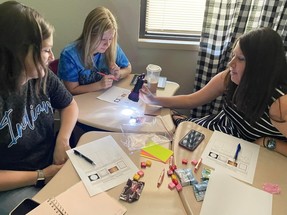
This summer we had the honor of meeting with teachers all across Oklahoma while presenting at EngageOK on the Road. It was so rejuvenating to be talking and collaborating with educators in-person again! Just in case you were not able to attend one of the sessions, the slide decks and handouts used during the sessions are linked below.
PK-12 Science Session
Meaningful Discussions Lead to Sense-Making in the Science Classroom
Imagine a classroom where students are encouraged to share their competing ideas, knowledge, skills, and experiences, to support their learning and mirror what scientists do in the real world. In this session, participants explore strategies to support engaging students in purposeful learning through scientist circles.
Elementary Science Sessions
Transforming Elementary Classrooms into Learning Communities
Establishing an elementary classroom centered around student engagement and collaboration supports varied ways of thinking. In this session, educators examine foundational strategies such as classroom norms and talk moves to support the development of a learning community.
Integrating Elementary Content Areas through Real-World Investigations
When students receive instruction that integrates multiple subject areas, they can connect their learning to the “real world” and develop a deeper understanding of each individual content area. In this session, elementary educators explore ways to integrate math, language arts, and science to engage students and develop foundational understandings.
Using Student Curiosity in Early Childhood Classrooms to Engage in Meaningful Learning
There is strong evidence students benefit from child-directed explorations and curiosity. The Oklahoma Academic Standards for Science require early childhood students to explore curiosities through play, observations, noticings, wonderings, questions, and investigations. This session provides early childhood educators with an opportunity to experience meaningful learning through curiosity.
Secondary Science Sessions
Assessing Student Understanding in Science
Assessing student understanding in science includes tasks that provide students opportunities to show what they know and can do. Learn ways to develop assessment tasks aligned to standards that are accessible to all students and take away assessment strategies and classroom resources.
Engaging Students Using Real-World Science
Using a common learning experience, secondary science educators examine how the Oklahoma Academic Standards for Science can be leveraged to engage students in investigating and explaining the science they see in their world.
Navigating Secondary Science Teaching and Learning Using the Oklahoma Science Framework
Learn how to create a classroom culture at the secondary level that promotes students figuring out phenomena through student-driven science and engineering investigations. Educators in this session explore how to use the new Oklahoma Science Framework to support teaching and learning aligned with the Oklahoma Academic Standards for Science.
|
Back to School Webinar Series
From grading to science notebooks, OpenSciEd, a free and open curriculum, is hosting free webinars to support all the aspects of starting off a successful year of science teaching and learning. Visit the Back to School Webinar Series webpage for registration links and descriptions of the five different sessions happening between August 17, 2022, and September 13, 2022.
|
"Journey to the National American Indian Science and Engineering Fair" Free Webinar Series
The American Indian Society for Engineering and Science (AISES), along with the Oklahoma State University, is hosting "Journey to The National American Indian Science and Engineering Fair (NAISEF)" webinar series. Sessions include: "What is NAISEF" (August 15th), "Hosting a STEM Family Night" (August 29th), "Picking a Research Topic" (September 12th), and many more! The goal is to support science teachers and Indian Education school staff in participating in the NAISEF. The webinars will share information about NAISEF, how teachers can mentor students, and resources for Native American students preparing projects. The webinars will be recorded and made available to all registered attendees. For more information, contact Dr. Cynthia Orona at cynthis.orona@okstate.edu or 1(405)334-5254. You can find a complete list with dates for webinar sessions and/or register using this link.
|
Toshiba America Grant Program for 6-12 Science and Mathematics Educators
Sixth to twelfth grade teachers are invited to apply on-line for a Toshiba America Foundation grant to help bring an innovative project into their own classrooms. Deadline to apply is September 1, 2022. For more information and to access the application visit the Toshiba America Foundation grant website.
|
James Bryant Conant Award in High School Chemistry Teaching
This American Chemical Society (ACS) award recognizes outstanding teachers of high school chemistry in the United States, its possessions or territories, at the national level. The award consists of $5,000 and a certificate. Up to $2,500 for travel expenses to the meeting at which the award will be presented will be reimbursed. Deadline to apply is November 1, 2022. For more information or to apply visit the ACS award webpage.
|
|