Welcome to August - the start of a new school year! Many of you have already welcomed new students to your classrooms, and others will begin doing this very soon. Some of you may be starting on your very first year of teaching (welcome!) or teaching a specific grade/subject for the first time, or maybe this is the start of your 25th year in education. No matter how you are beginning this school year, one thing we have in common is the desire of providing Oklahoma students meaningful science learning experiences. We hope that our students will be successful in our classrooms, that students will be excited about learning and doing science, that they'll see science as an important piece of understanding our world, and that maybe they'll choose a STEM career path as part of their future endeavors. Building relationships with our students and engaging them in learning experiences connected to their lives are just two ways in which we can try to meet these hopes.
In this month's newsletter, we'll take a closer look at how student's perception of their science abilities affects their engagement in science and how educators can create a classroom community that supports students collaboratively engaging in science learning. August's newsletter also highlights programs, grants, and instructional resources that educators can use to support instruction in their classrooms.
|
How many times have you heard "Why do I have to learn this?", "This isn't important to me." or "I'm just not good/don't like science."? There are probably many factors behind student responses like these and often the students that say this are our "struggling" learners. One factor could be that most of these students have self-identified as "not a science person" due to prior personal experiences and/or external influences that have told them they can't do science (e.g., my parents also couldn't do science, no one like me does science, etc.). But why is it important to understand how students identify themselves in science?
Identifying yourself as a science person is not only valuable for students who will eventually become scientists or engineers, but it's important for all our students as "science learning in school leads to citizens with the confidence, ability, and inclination to continue learning about issues that affect their lives and communities," (A Framework for K-12 Science Education). Students that identify as competent science learners are more interested and motivated to continue learning.
So how do educators help shape (or reshape) a student's science identity? We need to engage students in positive science learning experiences in which students see themselves as important, contributing members of the science community, and that school science is connected to not just real-world science, but specifically to their current lives and interests. The experiences students have with science in school shape the perceptions (beliefs) they have of being able to do science, as they'll often compare their own characteristics with perceived characters associated with the topic (Nature of Science Identity).
In previous OKSci Newsletters, we've discussed the importance of using phenomena as a way of connecting classroom learning to real-world, local contexts. We also held a virtual meeting last year that focused on that same topic (webinar recording and slide deck). For August, we are going to focus on how to set up our classrooms so that everyday practices support students with shaping positive science identities.
Student Characteristics and Doing Science
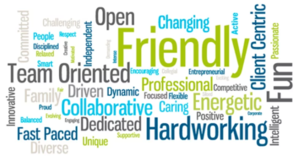
"Learning science depends not only on the accumulation of facts and concepts but also on the development of an identity as a competent learner of science with motivation and interest to learn more," (A Framework for K-12 Science Education). To help students begin developing their science identities we need to connect who they are and what they do to the work of scientists and engineers.
By connecting specific character traits to traits of scientists and engineers, students can begin to see how they fit into the science world. One way to do this is by highlighting different scientists and engineers throughout the school year. Not only connecting the work of that scientist and engineer to the classroom content but also describing possible character traits associated with that scientist or engineer. For example, the character trait "creative" could be connected with Ada Lovelace, the person who is considered to be the first computer programmer. Students that identify as "creative" might begin to see how their creative characteristics could be applied to science and engineering. More connections like this were described in the March 2021 OKSci Newsletter.
|
"If students hold stereotypes that portray scientists as a different 'kind of person' than themselves, those students might conclude they are not 'science people.' This mismatch between a student's personal sense of identity and a science identity can hamper persistence in STEM." - Schinske et al., 2016
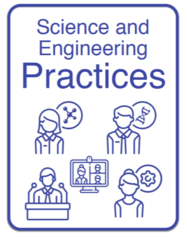
In addition to connecting who students are to scientists and engineers with similar characteristics, we want students to see that they can also do the same things scientists and engineers do. It is so important that students do science, not just read about confirmed science facts in textbooks. This step is so important that our Oklahoma Academic Standards for Science (OAS-S) have a science and engineering practice embedded in every single standard, pre-kindergarten through high school. All humans can do science - not just those considered "smart." Educators can explicitly connect what students are doing in class to what scientists do. For example, when engaging students with the science and engineering practice of modeling, instead of "draw what you see," educators can say, "Scientists have to draw colorful, detailed images to communicate to others what they observe/see." Shifts in how we intentionally engage students with the doing part of science help show students how they, too, are capable of being a scientist or engineer. The student actions in the new/updated Oklahoma Science Frameworks can also support educators with getting students to do science.
|
Understanding the role of science identity involves understanding how people navigate the cultural norms within their communities and in turn become affiliated with or alienated from science (Stets et al. 2017). Student perceptions of how others view them can play a large role in providing a feeling of community and affiliation, which then shapes identity. Just like educators, students want to know that their voices are valued and respected.
Educators can create a classroom community in which students listen carefully to each other, share ideas and experiences, and ask questions of each other and of themselves. A classroom community in which all students feel comfortable contributing to discussions, and that differences in how they contribute are respected, prepares all students for collectively exploring and making sense of phenomena. Establishing norms is one way of ensuring science classrooms are a safe learning environment that values contributions by all students.
|
Classroom Community Norms
Classroom norms are meaningful guidelines developed by students. Engaging students in the development of classroom norms help create student buy-in by collaboratively creating an agreement on how they will treat one another. The Oklahoma Excel Brief #18 "Classroom Norms" provides specific steps, considerations, and resources educators can use to help develop community norms for their classrooms. Additional resources to support establishing classroom norms include:
The Oklahoma State Department of Education (OSDE) is excited to announce the publication of the new and revised Oklahoma Science Curriculum Framework aligned to the 2020 Oklahoma Academic Standards for Science (OAS-S). The Oklahoma Science Curriculum Frameworks provide educators with a vision and resources that promote effective implementation of the OAS-S.
The OSDE began collaborating with Oklahoma educators to revise and add to the existing Oklahoma Science Framework during the 2020-2021 school year (Phase 1). This involved updating the bundle analyses and the development of new Science Frameworks for Pre-Kindergarten, Physics, Environmental Science, and Earth and Space Science. The OSDE will continue to collaborate with Oklahoma educators this fall for Phase 2 of the Oklahoma Science Framework Project. Phase 2 will focus on incorporating instructional resources that support implementation of the new bundle analyses, and the completion of the Environmental Science and Earth and Space Science frameworks.
Check Out the EngageOK Recording
At EngageOK in June 2021, the OSDE Science Team hosted a session called "Navigating Science Learning: Are You Looking for a Map?" This session focused on exploring how to use the updated Science Curriculum Framework as a guide in planning student-driven investigations, including how to incorporate the 3-Dimensional Science Vertical Learning Progressions to address potential unfinished learning. Participants also explored the new student and teacher actions found in each bundle analysis and discussed how leveraging the crosscutting concepts and science and engineering practices in these actions support students with figuring out science ideas. If you missed this session or would like to review what we did, check out the EngageOK session recording and the presentation slide deck.
We will have more sessions on how the Oklahoma Science Framework can support science teaching and learning throughout the 2021-2022 school year. Be sure to keep an eye out for announcements about these opportunities in future OKSci Newsletters and in the #OKSci Facebook group.
Become a Phase 2 Framework Writer
The Oklahoma State Department of Education is seeking science educators to participate in Phase 2 of the Oklahoma Science Framework Project. The Oklahoma Science Framework Project is a three-phase project. Once completed, it will provide educators with information and resources to align instruction to the 2020 Oklahoma Academic Standards for Science (OAS-S).
Phase 2 of the Oklahoma Science Framework Project will begin November 2021, and end May 2022. Phase 2 will focus on incorporating instructional supports and resources that are aligned to the 2020 OAS-S, and support implementation of the new bundle analyses from Phase 1. Possible deliverables may include prior knowledge connections, 3D narrative, and examples of driving and essential questions, phenomena, and evidence of student understanding. Selected writers will be paid a stipend of $500 per month (for 6 months) for completing required deliverables.
Fill out this application if you are interested in becoming a science framework writer. Applications are due Sunday, August 22, 2021. If you have any questions, contact heather.johnston@sde.ok.gov.
|
K-6 PAEMST Applications Available August 1st
Recognize a great K-6th grade math, science, or computer science teacher by nominating them for the Presidential Award for Excellence in Math and Science Teaching!
The Presidential Award for Excellence in Math and Science Teaching (PAEMST) is the top honor for math, science, and computer science teachers in the nation. National awardees receive $10,000 and a trip to Washington, D.C.
Anyone can nominate a K-6th grade teacher at paemst.org; you only need the person's name and email address to nominate them (it takes about 5 minutes). Or, if you are a K-6th grade math, science, or computer science teacher who has been teaching at least 5 years, you can start your application right now at paemst.org.
Nominations opened August 1, 2021, and completed applications are due February 6, 2022.
Send a message of support and encouragement to a fellow teacher; nominate someone today!
|
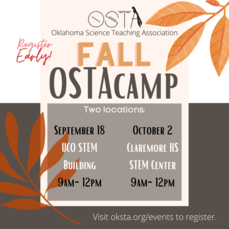
OSTA is Hosting EdCamp-like Learning in September and October
Join the Oklahoma Science Teaching Association (OSTA) on Saturday, September 18th from 9am-12pm at the University of Central Oklahoma's STEM building in Edmond, OK, and/or on Saturday, October 2nd from 9am-12pm at Claremore High School STEM Center in Claremore, OK, for an EdCamp-like event - OSTAcamp! OSTAcamp is professional learning determined and lead by participants. Educators collaboratively determine topics for discussion the day of the event, then break out into different rooms to share and learn together. Sessions can be group discussions where everyone contributes or lead by someone for a more traditional learning experience. Have a topic you want to learn more about or something you want to present? Then you should attend one (or both!) of the OSTAcamps this fall! For more information and/or to register visit the OSTA website.
|
Scholarship for STEM Professional Development
The Tulsa Regional STEM Alliance and Flight Night are honored to announce a grant opportunity for Oklahoma STEM Educators called Science of Flight Scholarship for STEM Profession Development. This grant can be used to fund professional development opportunities in any STEM subject area. The award amount varies but will not exceed $1,500. Applications are due September 12, 2021. For more information visit the link above or contact Kristen Tanner at kristen.tanner@tulsastem.org.
|

Decoding Science: How does science know what it knows?
The National Academies of Science Engineering and Medicine (NASEM) recently launched Decoding Science, an interactive website featuring topics on scientific processes, building scientific knowledge, the role of repetition and consensus, and using science. The site’s content is based on Reproducibility and Replicability in Science, a NASEM consensus report, funded by the Alfred P. Sloan Foundation and the National Science Foundation (NSF,) and vetted by experts in the practice, interpretation, and application of science.
|
NASA TechRise Student Challenge
In August 2021, the NASA TechRise Student Challenge will invite teams of sixth- to 12th-grade students to submit ideas for climate or remote sensing experiments to fly on a high-altitude balloon, and space exploration experiments to fly aboard a suborbital rocket. Teachers are invited to join a NASA TechRise Educator Summer Workshop, which will dive into the basics of electronics, coding, and designing for flight. For challenge details, and to pre-register for the competition, please visit the contest website, or view the YouTube announcement.
|
Oklahoma EPSCoR Programs
OK EPSCoR, in collaboration with partner groups and agencies, is working to foster K-12 student interest in STEM areas through educational opportunities, curriculum, and training for teachers and their students.
For detailed information regarding opportunities available for teachers, access the individual program links on the EPSCoR website. Program opportunities include Native American Student STEM Competition and Teacher Conference, Tinkerfest, and Women in Science Conferences. You may also access the OK EPSCoR outreach program brochure here. For more information, contact Gina Miller, OK EPSCoR outreach coordinator, at 405.744.7645 or email gmiller@okepscor.org.
|
|