|
 by Steven Koczak, PhD, Research Specialist
“Do what you love, the money will follow,” proclaimed Marsha Sinetar in her 1987 self-help book. How well this advice has aged depends on how you interpret it. If you take it to mean that there’s a sure path to riches in any field, then it’s aged poorly. However, if you take it to mean that many fields can lead to a career that’ll meet your basic economic needs and enable you to enjoy meaningful work, then the advice becomes more viable — provided one accepts that “the money” part varies widely across occupations.
“Show Me the Money”
Even within the same jobs category, salaries for specific occupations can vary widely. In New York State, for example, within the “Life, Physical, and Social Science Occupations” group, Physicists average around $178,900 per year and Historians just over $53,000. This salary differential reflects the supply-and-demand dynamics of the labor market.
Different occupations require different types and levels of education and training. Both Physicists and Historians often have doctorates, but each credential confers different knowledge bases, sets of skills and abilities. While the education and training you have may not correlate one-to-one with the career you ultimately pursue (not every History major becomes a Historian), there is likely to be some correlation, especially with more-specialized degrees.
The Georgetown Study
In late 2025, Georgetown University’s Center for Education and the Workforce published a report and some related research products that measured potential earnings, likely employment outcomes, popularity and demography of various Bachelor’s degrees. They also examined whether college education remains economically worthwhile. The study used data from the U.S. Census Bureau’s American Community Survey (ACS) Public Use Microdata Sample, with salaries and unemployment rates as their primary metrics.
Their principal findings for the U.S. labor market include:
- STEM, healthcare and business majors had the highest earnings after graduation, with considerable variation by field.
- More students are opting for degrees in STEM and shifting away from degrees in lower-paying fields, such as humanities and the arts.
- While graduate degrees may offer an earnings premium, the specifics vary.
- The rise in unemployment rates among recent college graduates is adding to new economic concerns about the value of a four-year degree.
- Participation in the most lucrative undergraduate fields does not reflect the nation’s diversity.
Degree Holders in NYS
The results from the Georgetown study were national in scope, but it’s possible to mimic their analysis using New York-specific ACS data, subject to certain limitations. Most of these relate to the fact that, due to a much smaller sample size, statistical reliability is harder to achieve with state-level data than U.S. data. As a result, we:
- Focused more on broader degree categories than individual degree fields, aside from some basic counts.
- Used ACS degree categories, whereas Georgetown developed their own.
- Only analyzed the first degree listed when people possessed multiple degrees.
- Focused on bachelor’s degrees, even when people reported higher degrees.
- Present numbers that are estimates, based on the survey data.
Big Picture NYS Results
Our major “big picture” findings for NYS include:
- In many ways, New York’s results mirrored those of the U.S.
- The “education premium” — defined as the higher earnings potential of college-educated workers compared to high school graduates — remained evident in New York, though the specifics changed a bit between 2010 and 2024.
- The most popular degree category in 2024 was Business, though the most popular individual degree field was Psychology, with Business Management and Administration landing in the #2 spot.
- The categories of majors differed widely in terms of salary.
Education Premium Persists
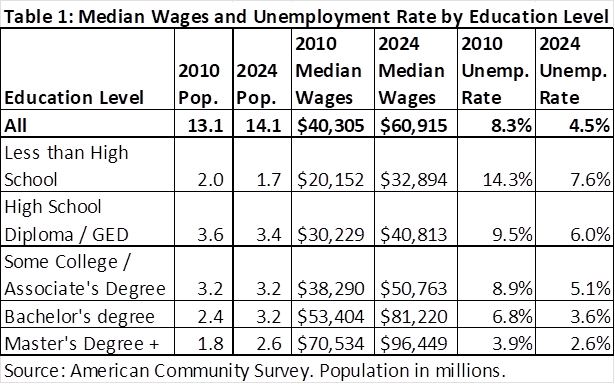
In 2024, the “education premium” was alive and well in New York State. In both 2010 and 2024, higher median wages and lower unemployment rates were associated with more education (see Table 1). The wage difference between the “High School” and “Bachelor’s Degree” categories in both years was extreme, but was even more extreme in 2024, potentially another facet of the K-shaped economy phenomenon highlighted in the March 2026 issue of this newsletter.
Most Popular Degree Fields
The most popular bachelor’s degree fields among New Yorkers age 25+ in 2010 and 2024 (Table 2) were remarkably similar. In fact, 2024’s top 15 list includes 14 of the top 15 degree fields found on 2010’s list.
Psychology (#1) and Business Management & Administration (#2) were the top degree fields in both years. Nursing rose from #7 in 2010 to #3 in 2024, reflecting the growing importance of health care to the New York State economy. It is important to note that Nursing is counted in the “Science and Engineering Related Fields” category in ACS. In the Georgetown study, it was in a customized “Health” category.
Computer Science, which still reflected the post–dot‑com slump in 2010, doubled the number of graduates between 2010 and 2024. The top 15 in 2010 was rounded out by Marketing & Marketing Research, which ranked #16 in 2024.
Degree Categories
Also of note is the similarity between all three metrics — population (i.e., number of graduates), median wages and unemployment rates — in both 2010 and 2024.
Some seemingly odd patterns are noticeable as well. For example, Computers, Mathematics & Statistics majors in 2024 had both the highest median wages and the highest unemployment rate. Education majors had the lowest overall unemployment rate in 2024 (presumably reflecting the “teacher shortage”) but also the third lowest median wage.
Visual & Performing Arts majors (which prepare one for careers that are more often demanding than in demand) in both years had both low median wages and high unemployment rates. Despite, or because of, the popularity of Psychology as a specific major, Psychology as a category of majors does not do that well, with below-average median wages, although the field’s unemployment overall rate is low, beating its fellow Social Science majors by a full percentage point.
There is wide divergence in median wages across majors — those with the highest wages are nearly double the wages of the majors with the lowest wages. This wage gap drives home the disparity also noted by the Georgetown study.
Wage Growth
We also found wide divergence in wage growth across majors in 2010-24. Eight of the 15 broad degree categories saw median salaries grow faster than the overall median. Growth rates ranged from 37% in the Visual & Performing Arts field to 54% in Computers, Mathematics and Statistics. This latter category, despite having the relatively high unemployment rate noted above, greatly exceeded even its closest competitor, Engineering, which grew at 35.2%.
Closing Thoughts
The authors of the Georgetown study note there are many considerations when choosing a major. Potential or likely post-graduation salary is one such consideration. But so is availability of those jobs. Not all high-paying jobs are going to be equally available all the time. And, yes, what you love to do also needs to be considered. A career is not a choice to be made lightly.
With all that in mind, however, it’s a simple fact that not all occupations are treated equally. One’s college major doesn’t determine what one’s career’s going to be, but it does have an impact. Do what you love, and the money will come. The money, however, won’t be equal. But with proper instruction and a bit of luck, it is realistic to think that it could be enough to prosper on.
And of course, as we have discussed elsewhere, opportunities to prosper without any college degree are abundant in our state, though they are harder to find than they once were. To paraphrase the occupational mobility article discussed in our October 2025 newsletter, in New York State there are many paths forward.


|
|
“Central New York is becoming a hub for emerging industries supporting high-growth, high-quality jobs.”
by Diana Pena, Labor Market Analyst, Central New York region
Central New York is becoming a hub for emerging industries that support high-growth, high-quality jobs. The region aligns with New York State’s priority industry sectors identified by the Office of Strategic Workforce Development, including advanced manufacturing, cybersecurity, semiconductors, unmanned systems, smart systems and software and digital media.
The region boasts a broad mix of high-tech industries, from newer firms specializing in advanced manufacturing to long-standing local firms. The region’s businesses are backed by entrepreneurs and a highly educated workforce trained by Syracuse University, SUNY Upstate Medical University, Colgate University and many others. Onondaga County ranks as the third most economically diverse county in New York State and is among the top three percent nationwide, according to Chmura Economics. Central New York’s location, talent, and infrastructure draw new investment opportunities and, along with state and local efforts, support growth in emerging industries.
Semiconductors and Advanced Manufacturing
A major driver of Central New York’s economy is the rapid expansion of semiconductors and other forms of advanced manufacturing. These industries produce microchips and components used in electronics, vehicles, data centers and defense systems, and are among the highest paying jobs in the region.
Micron Technology is investing $100 billion over 20 years to build a massive semiconductor "megafab" campus in Clay (Onondaga County), marking the largest private investment in New York State history. The facility will produce memory chips used in artificial intelligence and data systems, strengthening domestic chip supply and positioning Central New York as a global semiconductor center. The project is expected to support tens of thousands of jobs over many years.
TTM Technologies, a global printed circuit board producer, has invested $130 million in a new plant in DeWitt (Onondaga County). It was supported by Empire State Development tax incentives and a $5 million capital grant from the Upstate Revitalization Initiative, a competition designed to support transformative improvements in a region’s economy.
Helsinki-based Bluefors, formerly Cryomech, also expanded with a $40 million investment supported by the company and the Onondaga County Industrial Development Agency, strengthening local production of ultra-cold systems needed for quantum computing. Bluefors produces the cryogenic systems that create these conditions for quantum computers used in scientific research and advanced technology development.
Homeland Security and Cybersecurity (Including Unmanned Systems)
The Central New York region is growing its homeland security, cybersecurity, and unmanned systems industry cluster. These technologies support the defense industry, communications and critical infrastructure.
JMA Wireless in Syracuse is the only U.S. company producing core 5G network equipment used by major telecom providers and the Department of Defense. A $44 million federal grant supports the expansion of production at its revitalized factory. Specifically, the work supports secure communications, logistics, drones, autonomous vehicles, telemedicine and remote training.
BQP (formerly BosonQ Psi), also in Syracuse, builds software that simulates quantum computing in defense and advanced research. The company secured a $100,000 award from the HUSTLE Defense Accelerator to study quantum solutions for military simulations. BQP is growing as interest in quantum tools increases across the defense industry and homeland security sector.
Central New York also supports a strong concentration of uncrewed aerial systems and defense research with companies like Saab, SRC and Lockheed Martin. It also offers 1,900 square miles of FAA-designated airspace for drone testing through NUAIR and partners. The region is home to GENIUS NY, the world’s largest accelerator for uncrewed systems. This growth is also driven by emerging companies, like Hidden Level. Founded in 2018, Hidden Level develops advanced radio frequency sensor technology for defense companies and critical infrastructure.
Another company powering this industry is SRC in Cicero (Onondaga County), which recently secured a $24 million contract from the Air Force Research Laboratory to advance embedded artificial intelligence and machine learning technologies. This work supports applications across air, ground and space. All these companies and programs strengthen the region’s position in national security, advanced research and next-gen technologies.
Sky-High Economic Opportunity
Local innovation programs bolster these efforts. The Inspyre Innovation Hub in downtown Syracuse, the largest business incubator in New York State, has recently expanded. The growth of this business incubator is a core component of the Syracuse Surge economic development strategy, and will provide additional space, capital and support for early-stage tech companies.
Federal efforts also support the region. The NY SMART I-Corridor Tech Hub designation under the CHIPS and Science Act positions the Syracuse-Rochester-Buffalo corridor as a national center for semiconductor innovation and manufacturing. This designation supports future federal investment focused on workforce development and advanced manufacturing.
Looking Forward
Central New York’s strengths and targeted investments are attracting innovative companies to the region. These investment decisions support long-term economic opportunity and quality jobs. With coordinated investment at all levels, Central New York is becoming a national center for high-tech industries like advanced manufacturing and cybersecurity.
|
|
 by Kevin Jack, Deputy Director
“The key to investing is…determining the competitive advantage of any given company and, above all, the durability of that advantage.”
- Warren Buffett, 1999
Warren Buffett, 95, is a legendary investor who built one of the world's largest personal net worths — estimated at $150 billion in early 2026. In the process, he learned a few things about protecting his money. Buffett served as the CEO of Berkshire Hathaway Inc. for 60 years until he stepped down at the end of 2025. Under his leadership, the company transformed itself from a struggling textile manufacturer into a massive conglomerate. It owns a diverse set of companies, with holdings ranging from insurer GEICO to fast food chain Dairy Queen to battery manufacturer Duracell. Berkshire Hathaway also owns an investment portfolio worth over $670 billion.
In a 1999 article in Fortune magazine, Buffett introduced the concept of “economic moats,” which is “a distinct advantage a company has over its competitors which allows it to protect its market share and profitability.” It is often an advantage that is difficult to mimic or duplicate. The “moat” concept is important for investors because these companies provide superior financial returns over the long term.
Like their original castle namesake, economic moats are defensive measures intended to hold off competitors. Moats raise barriers that lessen threats and make corporate takeovers more difficult. Analysts distinguish between companies that possess a shorter-term competitive advantage (called a “narrow moat”) that might last up to 10 years. Analysts cite online food delivery platform DoorDash and online travel agency Expedia Group as companies with a “narrow moat.”
In contrast, companies with a sustainable, competitive advantage that protects a company’s profits over the long term (typically greater than 10 years) have a “wide moat.” Firms like LVMH, the parent company of luxury brands such as Louis Vuitton, Christian Dior, and Tiffany & Co., and luxury carmaker Ferrari are considered examples of “wide moat” companies with long-term outperformance.
In this article, we examine the five key attributes, identified by investment research firm Morningstar, which can give companies economic moats and provide them with long-term competitive advantages. Many firms possess more than one of these key attributes.
Network Effects: This refers to a situation when a product, service or platform becomes more valuable as more people use it, creating a positive feedback loop. In turn, this boosts the value of the businesses offering the product, service or platform. The Harvard Business School indicates that social media platforms, like Facebook and TikTok, and online marketplaces, like Airbnb, Uber and eBay, benefit from network effects. The network effect also creates a barrier to entry for new firms.
Switching Costs: High financial, procedural and relational costs help to protect a company's market share and profitability by making it too expensive, difficult or risky for customers to switch to a competitor. These barriers increase customer retention and reduce price sensitivity, enabling companies to enjoy high and sustainable profits.
Analysts often cite the example of computer software that’s in widespread use — such as Microsoft Office, Oracle’s database and enterprise software, and Salesforce’s Customer Relationship Management products. The time, effort and training required to switch to a new software product would be prohibitive for many companies.
Cost Advantage: Companies can also develop a moat by competing on cost. There are four typical sources of cost advantages:
- Cheaper processes
- Better locations
- Unique assets
- Economies of scale
Firms that possess a cost advantage can either charge more to increase profits or charge less to take market share. Southwest Airlines has long had one of the lowest cost structures in the industry. This advantage has enabled it to compete aggressively on price.
Among American retailers, warehouse club chain Costco stands out. The company defends its cost advantage by offering a limited selection of high-quality items at a lower price, including its popular in-house product line, Kirkland. As one of the largest retailers in the U.S., the chain buys vast quantities of goods. Thus, Costco can negotiate with suppliers for lower prices.
Intangible Assets: A fourth source of economic moats is intangible assets, referring to things like brand value, patents or regulatory licenses. For example, Taiwan Semiconductor Manufacturing Co. (TSMC), the world’s largest contract chipmaker, holds tens of thousands of patents that protect its proprietary technology and manufacturing processes in an industry with very high R&D and fabrication costs. In addition, TSMC has developed a moat stemming from the large capital spending requirements and years of research and expertise required for a competing company to match its offerings.
Efficient Scale: Moats can also stem from larger production volumes as bigger companies often sell at lower prices due to their ability to spread fixed costs across more sales, resulting in lower average costs per unit as output increases. This “efficient scale” effect helps create bargaining power with suppliers, stronger brand recognition and pricing power. As a result, a market is unable to support more than one or two players profitably, which discourages new market entrants.
Regulated public utilities (e.g., National Grid) are a special example of “efficient scale” moats (also called “natural monopolies”). Because the economies of scale are so large, one utility company can often supply the entire market at a lower average total cost than can two or more firms. Regulated public utilities also benefit from their status as government-sanctioned monopolies. This is the alligator in the moat, because consumers cannot generally shop elsewhere. In many instances, efficient scale moats were established decades ago. Thus, they’re the least relevant to modern businesses. Technological change, however, has created opportunities for new kinds of moats.
Summing Up
Not everyone buys into the moats concept. Buffett’s fellow billionaire Elon Musk — CEO of electric vehicle maker Tesla and space transportation company SpaceX — has said “I think moats are lame…If your only defense against invading armies is a moat, you will not last long. What matters is the pace of innovation.”
In response, Buffett acknowledged that technological change has made moats more vulnerable but not irrelevant. Whatever your opinion of moats, it seems clear that investors who understand how companies can build and maintain competitive advantages are in a better position to identify firms that can grow and prosper over the long term.
|
|
|
Click the button below to become a subscriber to Employment in New York State

|
|
|
|
|