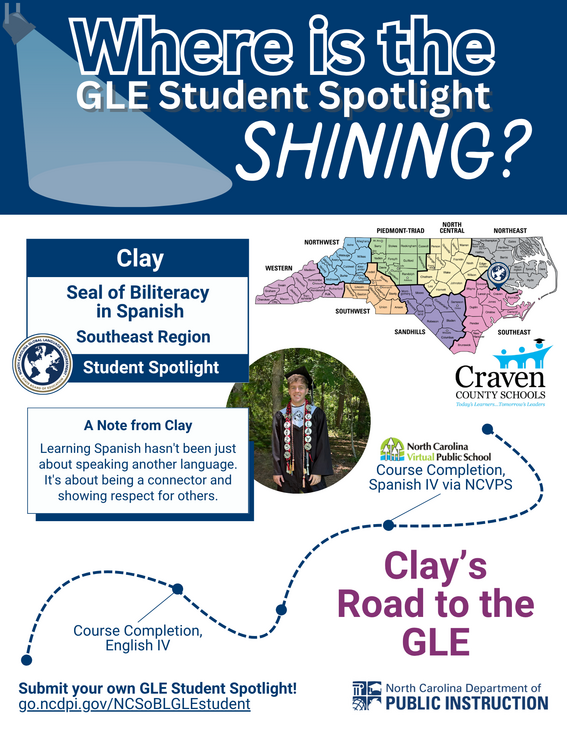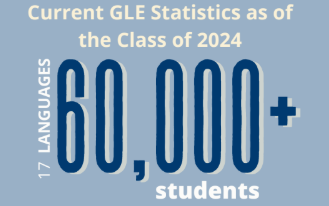
North Carolina's Seal of Biliteracy, the Global Languages Endorsement or GLE, began with the Class of 2015 a decade ago! During the first several years, there were about 1,500 graduates on average who were GLE earners. Once the identification of GLE earners was automated in the Student Information System (SIS), which started with the Class of 2018, statewide data shows that 5-10% of each year's graduates or 5,000-11,500 students earn this distinction annually.
In the GLE's first decade, 60,667 North Carolina high school graduates earned our state's Seal of Biliteracy by meeting requirements in English and in one (or more) of these World Languages: American Sign Language (ASL), Arabic, Chinese, French, German, Greek, Hebrew, Italian, Japanese, Latin, Persian, Pohnpeian, Russian, Spanish, Swahili, Tamil, and Ukrainian.
The World Languages list is cumulative, and members of the Class of 2024 who met the World Language requirement of the GLE for the first time in Greek, Pohnpeian, and Tamil helped grow our list to 17. There were 7,116 graduates total, or 7% of the Class of 2024 statewide, who earned GLEs, and they came from high schools in nearly 75% of our districts and almost 50% of our charter schools. Data for each public school unit (PSU) since 2015, including languages, is available in the GLE section of the Global Education Recognitions webpage at go.ncdpi.gov/NCSoBLGLE. Results for an individual high school within a PSU are part of the North Carolina School Report Card in the Career and College Ready section with numbers for all of the High School Diploma Endorsements.
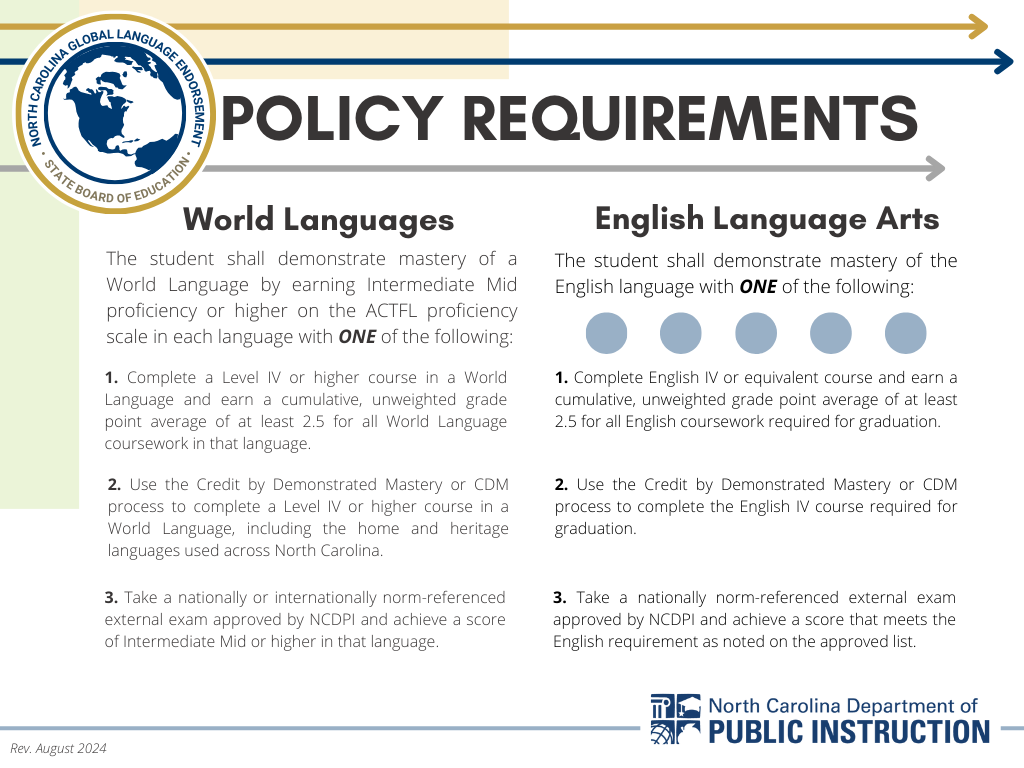
Last summer, several updates were made to the GLE policy, which became effective with the Class of 2025 as part of the second decade of our Seal of Biliteracy. These changes clarified policy language and created three parallel options for students to meet the requirements to earn the GLE, which now include course completion, Credit by Demonstrated Mastery (CDM), and external exams for both languages, English and a World Language. Also, this update raised the minimum proficiency expectation to Intermediate Mid from Intermediate Low.
Please see the GLE Policy Infographic below and/or access the GLE Resources to Reference section beyond that for additional details.
|