|
Summary: The Public Health and Safety Committee unanimously approved the ordinance adding carbon fees to the pollution control annual registration ordinance.
Background: I have been working for over two years to put fees on carbon dioxide emissions through the city’s Pollution Control Annual Registration (PCAR) program. Earlier this year, Council approved adding a fee of $452/ton on carbon emissions to the 2025 Fee Schedule. Mayor Frey vetoed this crucial climate measure. Council stood united and overrode the Mayor’s veto to save carbon fees.
In order to address the last-minute concerns that the Mayor and City Attorney raised about carbon fees, I and my colleagues are taking a number of additional legislative actions. One of those was passing enabling legislation. The City Attorneys and Health Department failed to mention the need for this legislative action for the last two years, but as soon as they made Council aware of the need for this action, my office advanced the recommended ordinance language. This week, the Public Health and Safety Committee held a public hearing on the ordinance. I presented the background on the ordinance prior to the vote passing unanimously.
Key votes: Public Health and Safety Committee unanimously approves ordinance enabling carbon fees to go into effect on July 1, 2025. The full Council will take a final vote on November 14th.
Summary: The Public Health and Safety Committee approves a resolution creating a labor standards board.
Background: Council Vice President Chughtai and Council Members Chowdhury and Cashman are authoring a resolution to create a labor standards board. This advisory body would convene sectoral workgroups that bring together employers, employees, and consumer advocates in a specific industry to work together on creating a proposal for regulations, policies, and programs to improve labor standards in that industry.
This week at Public Health and Safety, Vice President Chughtai presented an overview of the policy. The Committee had a robust discussion, which you can watch here starting at 0:55:30. Council Member Palmisano made a motion to delay taking action on the policy to have a public comment session, which failed 4-2. Though I voted in opposition, I did encourage Council Member Palmisano to follow our legislative processes that all Council Members have been instructed by staff to follow in order to get public comment periods added in advance to committee meetings. The labor standards board resolution was ultimately approved by the Committee 4-2, with Council Members Palmisano and Rainville in opposition.
Key votes: Labor standards board is approved by the Public Health and Safety Committee 4-2. Council Members Palmisano and Rainville voted in opposition. The full Council will vote on November 14th.
Summary: I am researching municipally-owned, co-op, and non-profit grocery stores as ways to address food insecurity and lack of access to healthy, affordable groceries.
Background: Students at the University of Minnesota have consistently faced a lack of access to healthy, affordable groceries and are struggling with food insecurity at alarming rates. Other communities, particularly low-income communities and communities of color in Minneapolis have also struggled with grocery access.
I believe we need to be creative with solutions to grocery access. The private market is clearly not meeting the need, so I authored a staff direction to provide the Council with more data on how food insecurity is impacting both students and residents across the city, and how the city might be able to use innovative approaches like municipal, nonprofit, or co-op grocery stores to expand access and close these gaps. A presentation on this directive will come back to Council next June.
Key votes: Public Health and Safety Committee unanimously approves staff direction for research into municipally-owned grocery stores, co-ops and non-profit grocery stores. The full Council will vote on November 14th.
Summary: The Administration and Enterprise Oversight Committee approved a legislative directive I authored asking the administration to outline how their planned investments in public safety facilities aligns with the City’s long term goals.
Background: The Capital Long-Range Improvement Committee (CLIC) is an appointed body that makes recommendations to Council and the Mayor about how the city should prioritize spending on capital projects like roads, bridges, and city buildings.
In early August, the CLIC presented their annual recommendations to the Council. A key takeaway from this presentation was that the requests by MPD lacked sufficient details, in particular how their proposed capital investments in public safety buildings align with the city’s new model of public safety as outlined in the Safe and Thriving Communities Report, or even clear alignment with the requirements of the Minnesota Department of Human Rights settlement agreement.
Given this, I worked with city staff on a legislative directive regarding the proposed capital projects for public safety facilities. The intention of this directive is to learn how the proposed investments align with the city’s stated long-term goals around comprehensive public safety, racial equity, equitable development, climate, and constitutional policing. The Lake Street Safety Center and the South Minneapolis Community Safety Center are supposed to set a new model for how the city will differentiate its upcoming public safety facility projects from traditional police precincts, but it is not clear how that change is actually being reflected in the city’s 5-year capital improvement program. The legislative directive also requests a presentation on how the proposals relate to the idea of neighborhood-level safety centers, decentralized precinct substations, and/or safety centers that are operated by non-city entities.
I hope this legislative directive can help Mayor Frey’s administration improve their proposals for public safety capital projects, and to get these projects in alignment with the city’s Safe and Thriving Communities action plan, which provides our city with a roadmap on how to create a public safety system that goes beyond policing.
Key votes: The Administration and Enterprise Oversight Committee approves the legislative directive about proposed public safety capital projects. The full Council will vote on November 14th.
Summary: The Office of Community Safety is overdue in reporting back to Council and the public on three important topics.
Background: Over the last few months, I have authored and Council approved three legislative directives that the Office of Community Safety was supposed to report back on in October, but none of those presentations happened.
At this week’s Administration and Enterprise Oversight (AEO) Committee, I brought forward items to request updates by the administration on these overdue reports. As the chair of the AEO Committee, I want to ensure that the public receives an update on the status of these directives. In addition to public transparency, this is also part of how we uphold the standards that the expectation of the administration is to present at the approved timeline, even if it needs to be an initial or partial presentation with a subsequent update later on.
We are waiting on the Frey administration to provide answers for the Council and the public on:
-
Neighborhood Safety Department management updates. Council President Payne and I authored this legislative directive in September after attempting to work with the Frey administration for several months to address pressing concerns regarding the mismanagement of the Neighborhood Safety Department (NSD) and received little to no response from the administration. As the oversight body of the city, the Council needs updates on how the administration is addressing these concerns. The management practices of this department have caused some public doubt about the efficacy of violence prevention work overall, and I want to make it clear to the public that the current management or lack thereof by the current leadership of the Neighborhood Safety Department and Office of Community Safety should not be seen as a reflection of violence prevention as a legitimate and effective praxis. Violence prevention is being used across the country with documented impacts on reducing violence and crime when it is implemented correctly. Violence prevention professionals who are contracted out through NSD are working hard every day using their expertise to de-escalate conflict, and the management challenges in the Neighborhood Safety Department administration should not reflect on the incredibly important and difficult work being provided by those delivering quality and evidenced-based services on the ground.
-
Procurement practices for violence prevention contracts. This legislative directive requests updates from the administration on how they are using best practices for procurement of violence prevention contracts. Violence prevention contract procurement warrants unique considerations and practices in order for them to be effective. Similarly to the previous item, we know that other cities have had success when they have adhered to nationally-recognized standards around procurement for violence prevention contracts. At the time the Council approved this legislative directive at the end of September there were already some concerns around the procurement processes in our Neighborhood Safety Department. Unfortunately, even since the approval of this legislative directive, the administration has continued to make choices that raise public concern and scrutiny around the city’s procurement protocols for violence prevention contracts. This underscores the dire need for a report back on this legislative directive so that the administration and Council can take any needed corrective action.
-
Police Department protest response. This legislative directive reflects questions about MPD’s use of resources and conduct at a protest that occurred in June of this year. Residents reached out to MPD with many of these questions, but MPD declined to answer. Last week, the Council and community had a lot of discussion around MPD’s failure to protect Davis Moturi. This is one of many ongoing conversations about MPD’s practices and how they are not replicating inequitable and problematic behaviors of the past, including their choices when responding to nonviolent protest. This legislative directive inquires about one particular protest that was the subject of resident inquiry which did not receive answers from MPD leadership or the Frey administration. Answering these questions is a way for MPD and more broadly, the city, to demonstrate good faith engagement with the public and a willingness to be transparent.
I will continue to raise the need for the Mayor’s administration to answer these approved directives until Council and the public have the information needed to conduct effective oversight.
Key votes: No votes taken.
Summary: Council received a report from the Racial Equity, Inclusion and Belonging Department that confirms that as a workplace, the City of Minneapolis has serious challenges with systemic racism.
Background: The Racial Equity, Inclusion and Belonging (REIB) Department gave a presentation on their Racial Equity Dividends Index Score. This evaluation was undertaken with the Center for Economic Inclusion and Research in Action, two highly reputable research organizations with Black women leadership. I think it was a prudent decision to bring in support from experts who can provide an external perspective on the city’s operations. We are lucky to have access to expertise on racial equity in local government operations, and I am grateful that we have this report on hand to guide our future work.
The City of Minneapolis received a racial equity index score or 49.3 out of 100. This affirms for me that our city has a long way to go in terms of making good on our stated goals around racial equity here at the City of Minneapolis. Our scores in areas like Leadership, Workforce Development, and Culture, Retention, and Advancement are quite substandard. This is something that Black employees and other employees of color have been raising for several years and have often been dismissed. It’s unfortunate that these lived experiences were not taken seriously when they were raised by city employees, but I hope that now seeing their testimonies be validated by external data can catalyze the Frey administration, who are responsible for day-to-day personnel management and workforce development, to finally take meaningful action.
The report also highlights how participatory budgeting can be one strategy to reduce racial inequity. I am excited to be leading this Council’s participatory budgeting work, and will be receiving an update from the staff direction I authored, and look forward to bringing forward a proposal to advance this type of initiative in the 2025 Budget. This is just one of many actions that I anticipate I and my colleagues will take based on this report in the coming years.
Key votes: No votes taken.
Summary: The I-94 Policy Advisory Committee met and heard reports from MNDOT on air quality and traffic data. I and several other Committee members advocated for MNDOT to include localized air monitoring, reinstate public comment, and establish a more regular schedule and democratic voting process.
Background: The Minnesota Department of Transportation (MNDOT) is reconstructing the I-94 corridor and running a community engagement process called Rethinking I-94.
I-94 runs through the heart of Ward 2. It separates Seward from Riverside, and Prospect Park from East River Road. It brings thousands of vehicles through Ward 2 every day, releasing tons of greenhouse gas and air pollution that give neighboring residents disproportionately high rates of asthma, heart disease, and cancer. I am strongly supportive of removing I-94 and replacing it with an at-grade multimodal boulevard that makes space for cars, efficient public transit, pedestrian and bike transit as well as increased land for housing, business and green space. Earlier this fall, I worked with community members to pass a unanimous resolution supporting at-grade options.
I serve on the Rethinking I-94 Policy Advisory Committee (PAC) along with many other elected officials and stakeholders. Despite being an advisory body to a project that will impact hundreds of thousands of people, the Rethinking I-94 PAC meets irregularly, does not have bylaws, and PAC members have been told that we cannot bring motions or take votes. After seeking out more information about the process into bringing ideas, suggestions, or resolutions, for a vote by the body, the PAC as a whole was given a presentation that was incredibly concerning about the legitimacy of engagement and guidance MNDot is seeking from elected officials who represent hundreds of thousands of residents along the corridor. This week, the PAC met for the first time since February. I and several of my fellow Committee members raised concerns about the role of the PAC as well as avenues for community feedback and how community feedback is or is not being factored into MNDOT’s decision making processes. Many questions were left unanswered, but several elected officials, including myself, stated our commitment to ensuring our residents' voices are heard.
MNDOT used to allow space for public comment at Rethinking I-94 PAC meetings, but discontinued the practice without consulting PAC members. This directly contradicts their stated goal of community engagement. At this week’s PAC meeting, I participated in the virtual meeting with a backdrop of art and comments from residents who wanted to share comments at the PAC meeting but were not able to because MNDOT did not allow it.
Going forward, I plan to work in partnership with community members and my fellow PAC members to reinstate public comment, clarify the operating procedures of the PAC, and use the PAC as an opportunity to meaningfully advise MNDOT rather than rubber stamping their work.
Council Member Wonsley with art from residents supporting highway removal and calling for the reinstatement of public comment at Rethinking I-94 Policy Advisory Committee meetings.
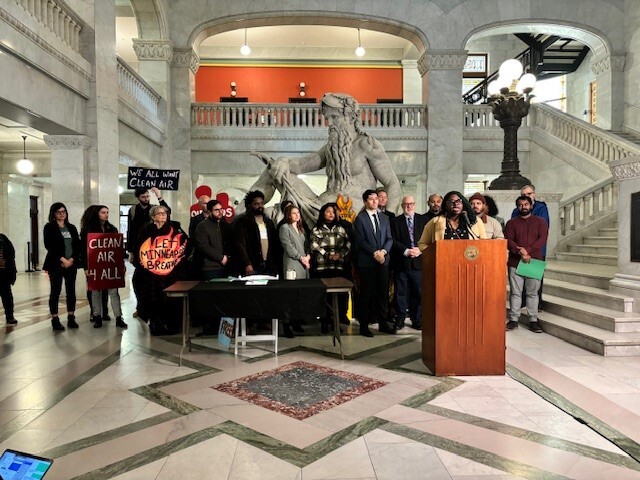
Last week, the Council unanimously approved a resolution I co-authored supporting a closure of the Hennepin Energy Recovery Center (HERC) incinerator by 2027. This week, Mayor Frey signed the Resolution.
In the last few years, Minneapolis residents have made it clear that they expect the City to actually deliver on our stated commitments to sustainability, which means taking bold and sometimes unprecedented action. That has looked like landback and community ownership at the East Phillips Urban Farm. It has looked like passing carbon fees to begin to charge polluters for the cost of emissions reductions. Now, it looks like working with the County to close the HERC, radically reduce our city’s trash output, and transform our waste system. It will take sustained mass movement building by residents to make that a reality, but we know it is possible. I look forward to working with residents, my colleagues, city staff, and other elected officials at the county and state level to close the HERC by 2027.
Council Member Wonsley speaking at the HERC Closure Resolution signing ceremony along with Council leadership and other Council Members, Mayor Frey, and many community advocates.
I attended a community-hosted dinner and meeting to discuss the future of George Floyd Square. Thank you to all the residents who attended and shared your perspectives.
George Floyd Square community meeting.
I spent Election Day on campus at the University of Minnesota Twin Cities doing nonpartisan Get Out The Vote with other community and campus leaders. Thank you to all the students and community members who helped achieve high levels of student voter turnout this year.
Council Member Wonsley with Representative Ilhan Omar doing nonpartisan outreach to increase voter turnout on campus.
Come to a public meeting to hear from Effective Law Enforcement For All as the independent evaluator of the Minnesota Department of Human Rights settlement agreement with the City of Minneapolis. You’ll get updates from Effective Law Enforcement For All about the City of Minneapolis and Minneapolis Police Department’s path to meet the requirements of the settlement agreement.
Effective Law Enforcement For All will present an overview of its role in the settlement agreement, describe its requirements and how compliance is checked, and provide implementation updates related to MPD policies and training.
Each session will follow the same agenda and format.
South Minneapolis public information session6-8 p.m. Wednesday, Nov. 13Sabathani Community Center, 310 E. 38th St., Suite 120
North Minneapolis public information session6-8 p.m. Thursday, Nov. 14North Community High School, 1500 James Ave.
Learn more about the Nov. 13 and 14 information sessions on this flyer.
You can also learn more about the evaluator and its work on this three-page flyer.
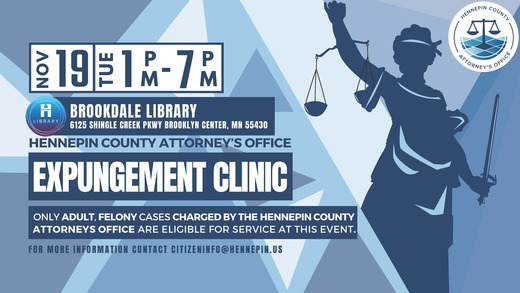
Hennepin County Attorney’s Office Expungement ClinicTuesday, November 19, 20241:00pm – 7:00pmBrookdale Library6125 Shingle Creek Pkwy, Brooklyn Center, MN 55430
Join us for a transformative day at the Hennepin County Expungement Clinic, hosted by the Hennepin County Attorney's office in partnership with the cities of Brooklyn Center and Brooklyn Park. Together, we are committed to providing a crucial opportunity for individuals who have served their sentences to seal eligible records. Expungement plays a vital role in offering a fresh start, and we are here to guide you through the process.
We understand the significance of expungement in fostering rehabilitation and community reintegration. Our prosecutor-led expungement program, supported by our partners, is designed to expedite the process for individuals with adult felony convictions that were charged/prosecuted by the Hennepin County Attorney’s Office. This unique collaborative effort ensures a more streamlined approach to help you move forward. Please help us spread the word for this free & transformative event!
Eligibility Criteria: Please note that only adult felony cases that were charged or prosecuted by the Hennepin County Attorney’s Office are eligible for review, and possible seal, at this event.
Community Fair: In addition to expungement services, we're excited to host a Community Fair with the support of our partners. Various community organizations will be present, providing valuable information and services to help connect our community to available resources and support.
PRE-REGISTER HERE for a 30-minute time slot with an attorney. By registering in advance, you are guaranteed a meeting with an attorney and will skip the line.
*Pre-Registration slots are designated for those with cases to be expunged. If you are a family member, loved one, or coming to support, please do not sign up for a pre-registration slot.
Walk-ins accepted on a first come, first served basis. Because the processing times for expungements vary and we've seen great interest in this free service, please come prepared to wait.
Light refreshments will be provided
Flyer for Hennepin County expungement clinic.
Winter market season begins this month in four farmers markets around the city.
Winter farmers markets offer delicious ingredients including local produce, meats and baked goods. You can also find gifts and other handmade goods such as soap, jewelry and pottery. Shop at the winter farmers markets to pick up grocery staples and artisan goods but also to provide critical support to local producers and makers.
Winter markets
- Mill City Winter Market: Nov. 16 plus select Saturdays December through April.
- Minneapolis Farmers Market: Nov. 16, 23 and 30 plus select Saturdays December through April.
- Neighborhood Roots: Nov. 9, Jan. 11, Feb. 8 and March 8.
- Northeast Farmers Market: Nov. 10 plus one Sunday a month through April.
Learn more about winter farmers markets on the City website.
Leaving leaves in your landscaping and garden beds shelters pollinators for the winter. And mulching leaves on your lawn helps them break down faster and release those nutrients into your soil. Mulching leaves may have the same impact as applying fertilizer. You can do that by running over them with a lawnmower.
Contact Ward 2
Visit: minneapolismn.gov/ward2
Email: ward2@minneapolismn.gov
Phone: 612-673-2202
We've moved while work is being done in City Hall. Our office is in:
Room 100, Public Service Center
250 South 4th St.
Get directions
For reasonable accommodations or alternative format please contact 311. People who are deaf or hard of hearing can use a relay service to call 311 at 612-673-3000. TTY users call 612-263-6850. Para ayuda, llame al 311. Rau kev pab, hu 311. Hadii aad caawimaad u baahantahay, wac 311. |