|
Summary: Council overrode Mayor Frey’s veto of fees on carbon emissions from the city’s biggest polluters.
Background: Last week, Council unanimously approved new fees on carbon emissions as part of the city’s 2025 fee schedule. Mayor Frey vetoed this crucial climate measure. This week, Council stood united and overrode the Mayor’s veto to save carbon fees.
Despite the fact that I have been in consistent collaboration with the Frey administration for nearly three years on policy development around carbon fees, Mayor Frey’s appointed City Attorney identified last-minute concerns at the previous Council meeting. To address these concerns, I and my colleagues worked with Mayor’s executive staff to advance additional legislative actions that will eliminate Mayor Frey’s stated reasons for the veto:
- Immediately following the override of the veto, I along with Council Member Chavez and Vice President Chughtai motioned to amend the 2025 fee schedule to include an implementation date of July 1, 2025 for carbon fees.
- In the coming weeks, I and my colleagues will advance enabling legislation through the Public Health and Safety Committee that will include an implementation date of July 1 to correspond with the effective date for carbon fees on the fee schedule as amended.
- I and my colleagues secured a commitment from the administration to develop the program to be ready for implementation prior to July 1. My office will author a budget amendment for the 2025 Budget allocating resources for the Health Department to develop this program, which Mayor Frey did not include in his recommended 2025 Budget.
- Council approved a legislative directive I authored with Council President Payne and Vice President Chughtai for the administration to complete a fee study of carbon fees by May 1 so that the rate could be updated prior to the implementation of the fee if needed. The directive also asks the administration to do a comprehensive fee study on all of the city’s fees prior to the passage of our 2026 fee schedule in the fall of next year. This will ensure that not only carbon fees, but all fees listed on the fee schedule are accurate and align with the city financial policies and Minnesota state statute.
Taken together, these actions address the concerns that were outlined in Mayor Frey’s veto. It is incredibly poor leadership that the Mayor and his administration withheld and misrepresented crucial information over nearly three years of attempts to collaborate on a policy, and instead chose to veto. That said, the concerns that the Mayor’s appointed attorneys raised during the veto process were all easily addressed, and could have been addressed without a veto if the Mayor had chosen collaboration over theatrics.
This process also raised several concerns about how the administration operates, particularly the nonpartisan role of the city attorneys and Council’s lack of independent legal counsel. Another concern is that the Mayor’s administration presented a thorough report to Council, but after the veto claimed that the content of the report was not usable information, but rather “a thought exercise.” This raises serious questions about the administration’s compliance with government structure and Council’s access to accurate information, beyond the specific issue of carbon fees.
With all the Mayor’s stated concerns being addressed and a clear majority amongst the Council to override, the legislative body of Minneapolis has made clear the need for urgent action on the climate crisis, and has demonstrated unity in advancing common sense solutions despite obstacles created by the administration. This is the third veto Mayor Frey has issued this term, and the third Council overrode. When the Mayor stands in the way of legislative solutions, we will stand by the will of our residents.
Key votes: Council voted 9-2-2 to override the Mayor’s veto of carbon fees. Council Members Vetaw and Jenkins voted to sustain the veto, and Council Members Rainville and Palmisano were absent. Council Member Cashman motioned to replace the current carbon fee estimate of $452/ton with “TBD.” This motion failed 5-6-2, with Council Members Cashman, Koski, Osman, Vetaw, and Jenkins in support. Council then voted 9-2-2 in support of my amendment to add a July 1 implementation date to carbon fees, which are at $452/ton based on the best available information. Lastly, Council voted 9-2-2 in support of the legislative directive for the administration to update the carbon fee rates by May 1, and all fees citywide by August 1, 2025.
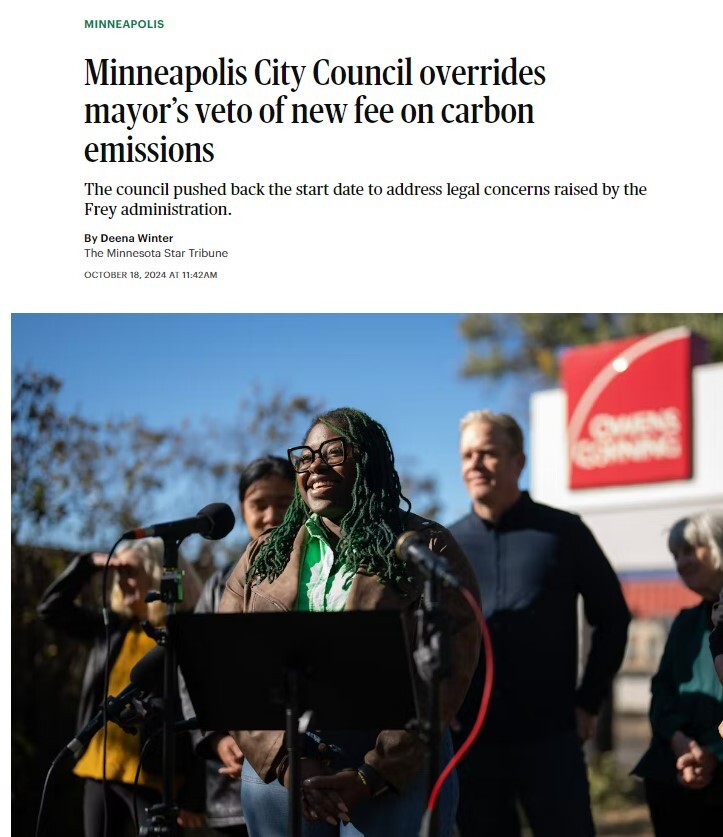
Star Tribune headline “Minneapolis City Council overrides mayor’s veto of new fee on carbon emissions” with a photo of Council Member Wonsley and community leaders.
Summary: Council adopted a policy position opposing the construction of a warehouse at any future development of the former Third Precinct Building, and instead supporting using the space for expanded community use as well as for racial healing and reckoning with MPD’s history of racism.
Background: For the last three years, Council has been urging Mayor Frey to clean up the former Third Precinct building on the corner of Lake and Minnehaha and to invest in a community-focused redevelopment process. Now, the Mayor is proposing putting the city’s Election and Voter Services (EVS) Center in the building, leaving 20% of the building for community space, and constructing a new ballot storage warehouse with a loading dock on the site.
Council received a presentation from the Frey administration about the outcomes of their community engagement on this topic. This included a report from an online survey, as well as a report from in-person community events. It also included a response to a legislative directive authored by myself and Council Member Chavez about options for the city to redevelop the property in a community-centered way, ways to center healing in redevelopment, and other options for the EVS Center.
The presentation that Council received omitted that in April of 2022, Council voted in support of my budget proposal to allocate $100,000 for community engagement on the future of this site. Although Council took this action over 18 months ago to try and move forward development, the administration misspent the funds on a process asking residents if they would rather have the police located at 3000 Minnehaha or building a new building three blocks away. That was a year-long saga where the administration sidestepped meaningful community engagement about the future of this site. Yet even within the completely broken framework that the administration created during this process, the strongest themes of the community engagement was that residents want to see real change to the police and to see the city invest in real truth, reconciliation, and healing.
While truth, healing, and reconciliation remains a top priority for residents, it was surprising to see that the Frey administration only dedicated half a page to this topic in the legislative directive response, which essentially reported that the administration did minimal work in this area. I was dissatisfied to see that the repair harm model, a framework that leadership of the city’s Racial Equity Inclusion and Belonging Department has said will guide our citywide truth, healing, and reconciliation efforts, was only used once throughout the administration’s entire open house series and did not seem to have any meaningful role in the community engagement process.
In the response to the legislative directive, staff also acknowledged that they did not actually look into the possibility of locating the EVS center anywhere but 3000 Minnehaha. This is particularly frustrating given that there are numerous other possible EVS locations that clearly should have been explored, including the new development at 2633 Minnehaha Ave, the Public Service Center which is going to have several vacant floors after next year, the City of Lakes Building which will have empty space after the Third Precinct is relocated to 2633 Minnehaha Ave, and the new development at the former KMart on Nicollet and Lake. These are all buildings that merit exploration, and the fact that the administration didn’t even take the time to assess them is very telling about how seriously they took community engagement on this site.
There is an entire section of the engagement report that focuses on “Community perception of city efforts” with subsections on the lack of genuine engagement by the city, mistrust of the city, and a long process without action. I hope that the Frey administration takes heed of the problematic way they continuously approach community engagement processes that make our residents feel as if the city does not take their expertise, experiences, and feedback seriously. This administration is burning public credibility and that is extremely harmful to our democracy in the long term.
Given the disconnects between what residents and the Council continue to advocate for and the Frey administration’s apparent intentions for the future of the former Third Precinct, I authored two policy position resolutions.
The first resolution I authored with Council Member Chavez calling for 100% community-centered development of the property.
Pages 2 and 3 of the legislative directive report outline that there are multiple ways that the city could move forward with community-centered development, including retaining ownership of the land and facility and leasing the entire property for a community purpose. There is no procedural barrier to community-centered development, there is only a lack of will by the Frey administration. To return this building to the community for the purposes of racial healing and reckoning with the history of the Third Precinct might be uncomfortable for some in the administration who want to talk about the city’s history but are not ready to actually start to shift resources towards a new future of racial equity.
I believe that residents do want to see the city not just talk about racial healing, but actually shift how we allocate resources to honor those priorities. That is something that the city can do by retaining ownership of the building but leasing it out for 100% community-centered development for the purpose of racial healing, which is why I brought forward the amendment with Council Member Chavez. Unfortunately, this position failed 6-7.
The second resolution I co-authored with Council Members Chavez and Chowdhury. It establishes the Council’s position as opposition to construction of a warehouse anywhere on the property, and supports the use of the space for racial healing and reckoning with the history of racism by Third Precinct officers. This resolution passed 8-3-2.
For the past four years, I have heard from residents that our redevelopment efforts at the Third Precinct located at 3000 Minnehaha must not only prioritize racial healing, but these efforts must also acknowledge the fact that many of the Minneapolis police officers stationed at the Third Precinct waged racist and violent actions against residents for decades.
Reckoning with history is a crucial first step to healing from it, and it’s a step that is too often overlooked. Healing doesn’t happen without genuine acknowledgement and genuine and sustained reconciliation. Around the world, places like Germany and South Africa have invested in public memorials that serve as a reminder of the realities of structural racism and violence that took place in their countries. These memorials are accompanied by actions like truth and reconciliation, school curriculum changes, and public processes that help support the population in not shying away from realities of the past, but actually reckoning with them. That is not something this country does well. The United States has a pervasive lack of understanding and reckoning with the history of genocide of native people, with slavery, with Jim Crow, with internment of Japanese residents, and more so many more oppressive tragedies. We have a tendency to whitewash the past, but the reality is that we can’t move forward towards real equity and justice until we actually acknowledge and reckon with the realities of our history, starting with our own history around the shameful and traumatic events that took place at the Third Precinct.
I simply cannot imagine putting a storage warehouse at the site of the former Third Precinct when it is a globally recognized site of a civil uprising against police brutality and racism. I believe we can use the opportunity presented by this redevelopment process to commit to real and meaningful reckoning with our history. The Council has received letters from community groups Longfellow Rising, the Lake Street Council, Seward Redesign, and the 3000 Minnehaha Coalition all expressing opposition to the construction of a warehouse on this corner and explaining that it does not fit within the community vision for this area that has been in development for decades.
Lastly, this resolution makes it clear that this Council is doing everything we can to urge the administration to finally take down the barriers and barbed wire and invest in basic external beautification. We consistently hear from residents that this is a top priority, and it is frankly appalling that the administration continues to drag its feet on this work. I am dedicated to working with my colleagues to get to the bottom of how and why the Mayor’s administration has allowed unpermitted barbed wire to remain in place for four and half years. At the Committee of the Whole meeting, Council secured a verbal commitment from the City Operations Officer to have the barbed wire removed later this fall.
Key votes: At the Committee of the Whole on October 15th, Council voted 6-7 against the resolution supporting 100% community-centered development of the former Third Precinct. Council Members Rainville, Vetaw, Cashman, Jenkins, Koski, Chowdhury, and Palmisano voted in opposition. At the full Council meeting on October 17th, Council approved a resolution establishing a formal policy position of opposition to the construction of a warehouse and support for additional space for racial healing and reckoning with the history of the precinct. The resolution passed 8-3-2. Council Members Vetaw, Jenkins, and Koski were in opposition and two members were absent.
Summary: I am leading Council to take action on implementing fees on MPD off-duty work.
Background: Minneapolis Police officers are allowed to work “off-duty,” meaning they take private security jobs for which they are paid directly by private entities, but use city weapons and cars, wear city uniforms, and carry city liability while doing so. No other city employee does this. City public works workers can’t take city trucks and go fill potholes after hours and get paid in cash for it, but that’s exactly what our MPD officers do.
Everyone from small business owners to the US Department of Justice have recognized Minneapolis’ off-duty system as fundamentally broken and inequitable. Due to a mid-1990s court case, Minneapolis must allow MPD to do off-duty work. However, there has been a lack of political will by the Frey administration to impose regulations or limits on off-duty work within the scope of what is legal.
I have been working for several years to find ways to reign in and regulate MPD’s off-duty work. First, I tried to work with administration directly both through meetings and voluntary collaboration, then through a legislative directive in January of 2023. One year ago, I gave a notice of intent to introduce an ordinance that would allow the city to implement fees for use of city resources. This spring, I authored a staff directive to the Legislative Department which resulted in a report that outlined that an off-duty fee of $19/hour for use of a Ford Explorer squad car would align with the city’s vehicle operations expense rates.
Fees on squad cars are just one of many costs that we can start to quantify and recoup from officers when they work off-duty. Fees will not fully address MPD’s incredibly dangerous and unregulated off-duty system, but they are a strong starting place to ensure that taxpayers are not subsidizing officers when they are working off-duty for personal gain. Administering a fee collection system would also require MPD to adhere to more specific tracking of off-duty work in order to recoup these fees from officers.
Unfortunately, the Frey administration has not been a forthcoming and willing partner on this work. That’s why I bought forward two items this cycle along with my co-author Council President Payne.
One item is a staff direction that directs the City Attorneys to draft the ordinance giving the city the authority to collect off-duty fees. The other is a legislative directive for MPD to do a fee study to calculate accurate costs for use of city vehicles, materials, and administrative costs. This is the first step towards implementing these fees and regulating this incredibly broken system.
Key votes: The Administration and Enterprise Oversight Committee voted 5-1 to draft an ordinance allowing the city to collect fees for off-duty work and a fee study to set the appropriate rate for that fee. Council Member Vetaw was the sole vote of opposition. The full Council voted 9-2-2 for the final approval. Council Members Vetaw and Jenkins voted in opposition, and two members were absent.
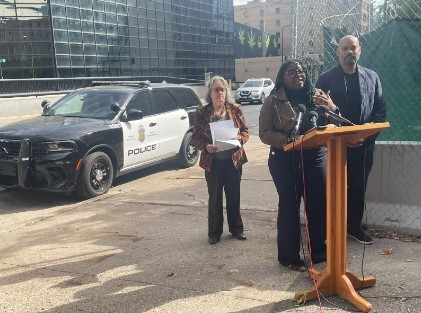
Council Member Wonsley speaking alongside Council President Payne and community leaders about the need for fees on MPD's use of city resources while working off-duty.
Summary: Council approved a legislative directive I authored about housing quality and affordability for elder and senior residents.
Background: I authored a staff direction to learn about how our city is doing at ensuring that all senior and elder residents have access to affordable, suitable housing. This staff direction was based on conversations I have had with Ward 2 residents and property owners about the city’s goal of being an age-friendly city. Affordable housing for seniors and elders is a key part of making sure that Minneapolis residents are able to age with the dignity and comfort that they deserve. This directive asks staff to help us assess how well we are doing in that regard, and what strategies we may be able to invest in to improve high quality affordable housing options for seniors and elders.
Key votes: Key votes: Council voted 11-2 in support of the staff direction (two members were absent).
Summary: Council approved a legislative directive I authored about MPD’s response to a protest on June 6th.
Background: In July of this year, community members emailed the Mayor, City Council, Chief of Police, and leadership of the Office of Community Safety with a series of concerns and questions about MPD officer conduct and city resource use at a protest that occurred on June 6, 2024. I urged MPD leadership to respond to these residents as a sign of good faith and respectful engagement. Unfortunately, MPD declined to respond to the residents, and also declined to respond to my informal inquiries to learn more about some of the questions and concerns that residents raised. Council leadership elevated these concerns to the administration, but there still has not been a response.
So, I authored a legislative directive that reflects some of the resident questions and concerns that have not been addressed. When MPD refuses to engage with the public or with Council Members on basic questions, legislative directives are a tool we have to obtain needed information.
I encourage all residents to reach out if you ever have questions or concerns about police conduct.
Key votes: Council voted 11-2 in support of the legislative directive (two members were absent).
Summary: Council was asked to approve a contract for almost $1 million for compliance services in the Neighborhood Safety Department. Due to many questions, the item was held over for a cycle.
Background: The Administration and Enterprise Oversight Committee was asked to approve a contract for $992,400 with the Black Business Enterprise Fund for capacity building and compliance consulting services.
My colleagues and I had a number of questions about the appropriateness of this contract.
The organization that was selected for the contract, the Black Business Enterprise Fund, did not appear to have any evidence of experience working with violence prevention providers or even nonprofit organizations. Their mission is to “help minorities establish their worth to wealth.” This is an admirable goal, but their clients in this work for the city would be nonprofits and their goal is not to build wealth.
Additionally, the only publicly available information on the Black Business Enterprise Fund is financial records from 2022, when their entire operating budget was $310,000. I am extremely concerned about giving an organization of this size a contract that would more than triple their entire operating budget, especially given that it is for work that is not actually aligned with their mission. In 2022 they had one paid staff member, with this contract they are proposing to hire 17 staff.
In addition to these concerns, I continue to believe that we need to invest in the infrastructure of the Neighborhood Safety Department rather than outsource work via contracts. The Safe and Thriving Communities Plan outlines the importance of building in-house infrastructure at the city, and we need to be investing in a Neighborhood Safety Department that can support the scale of unarmed public safety programs that our residents deserve.
The Administration and Enterprise Oversight Committee will continue discussing this item at our next meeting on October 21st.
Key votes: The Administration and Enterprise Oversight Committee voted 5-0 to hold the contract in committee for one additional cycle. The committee will consider it on October 21st.
Summary: Council received public testimony from dozens of residents about why the city needs to support closure of the HERC incinerator.
Background: The Hennepin Energy Recovery Center (HERC) is a trash incinerator that is located in North Minneapolis. Residents are organizing to demand the closure of the HERC, which contributes to environmental injustice and public health inequities on the North Side. I am co-authoring a resolution supporting closure of the Hennepin Energy Recovery Center (HERC) along with a number of my colleagues.
The Climate and Infrastructure (C&I) Committee held a public hearing on the resolution last week. Dozens of residents testified about their desire to shut down the HERC due to its impacts on local public health and the environment. Thank you to everyone who submitted written testimony or shared testimony in committee. I look forward to adopting the HERC resolution later this month and advancing the city’s zero waste goals.
Key votes: No votes taken. The Climate and Infrastructure Committee will vote on the HERC Closure resolution on October 29th, and the final vote will be at the Council Meeting on October 31st.
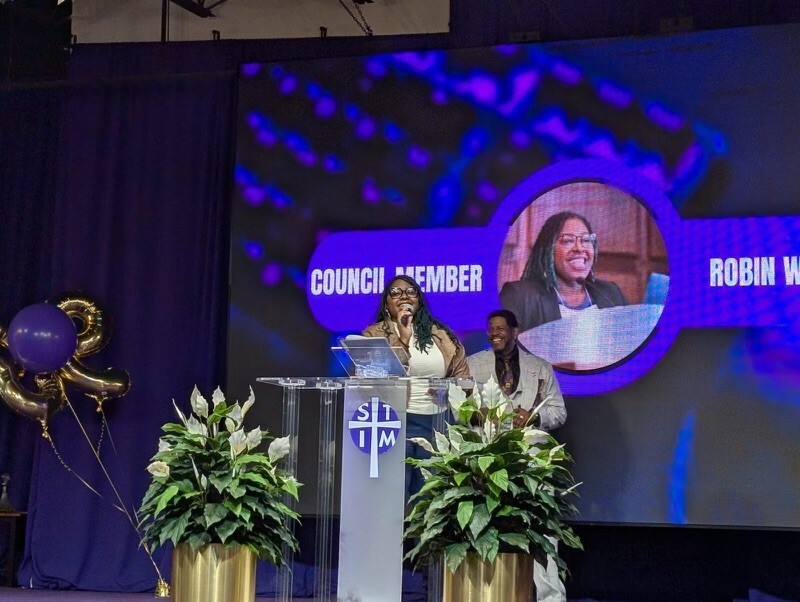
I was honored to speak at the ribbon cutting ceremony for the Shiloh Temple Community Safety Center and Food Shelf. This beautiful event celebrated the opening of a new center that will provide crucial services and resources to the North Minneapolis community. Thank you to Shiloh leadership and the community members who invested so much into making this new center a reality.
Council Member Wonsley speaking alongside Bishop Richard Howell
My office is working with the Carlson Impact Lab at the Carlson School of Management to involve students in some of our priorities for improving Ward 2. Student groups are working to use their business and management skills on addressing the food desert of healthy affordable groceries in Dinkytown, developing resources to help landlords fill vacancy, and helping support small businesses in Dinkytown. I am so excited to see what these students come up with and how we can implement their ideas.
Council Member Wonsley with Carlson Impact Lab students
I have been working to identify ways that the Council can better support immigrants and new arrivals to our city. In June, I worked with Council Member Chavez to organize an Immigration Roundtable about the role of the city, county, state, school system, and nonprofits organizations in supporting new immigrants. As a follow-up to that event, a legal aid nonprofit facilitated a visit for Council Members to observe a session of immigration court to see one piece of the system firsthand. I attended along with Council Members Chavez and Osman, and it was a very eye-opening experience that underscores my commitment to allocating resources to support immigrants in our city.
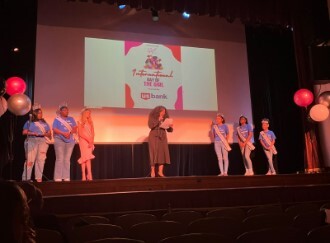
I spoke at the International Day of the Girl event organized by Project Diva International. Project Diva helps Black high school girls develop and execute post high school plans that support their envisioned lifestyles after they graduate. Thank you Project Diva for the work you do every day!
Project Diva International Day of the Girl Event
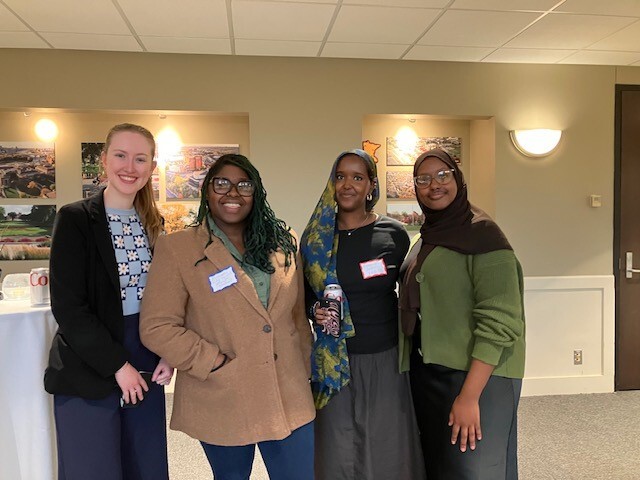
I attended a networking event hosted by the University of Minnesota Undergraduate Student Government. It’s wonderful to connect with these young leaders, discuss their aspirations, and help them learn about local government.
Council Member Wonsley with Government Liaisons at the Undergraduate Student Government Networking Event
I attended a fantastic panel hosted by the Minnesota Urban Studies Student Association about navigating student life. It was a great opportunity to connect with students and discuss how local policy impacts everyday quality of life for students. Thank you to MUSSA for hosting!
Council Member Wonsley speaking with students at Rents to Rights: Navigating Student Life event
Many Ward 2 residents are excited about the vision to extend the Midtown Greenway over the Mississippi River on the Short Line Bridge into Prospect Park and through Saint Paul. I am strongly supportive of this extension.
On October 9th, the Met Council voted unanimously to authorize a contract to provide transportation planning and engineering services for the Midtown Greenway Expansion Study. This study is happening thanks to Sen. Mohamed and Rep. Sencer-Mura's bill passed with 2023 Omnibus Transportation. View the brief Met Council discussion and vote here (timestamp 5:20 - 12:30).
This long awaited critical first step will inform scoping to determine legal parameters of negotiations for a Shared Use Agreement. The transportation planning and engineering study is to be completed by the end of 2025. The Met Council has not determined a deadline for determining the legal parameters to inform negotiations with the railroad.
Map of the proposed Midtown Greenway extension
Fourth Street in Minneapolis has reopened to traffic just west of 10th Avenue SE in Minneapolis after being closed for emergency sewer work this week. Access to I-35W has also reopened. Thanks for your patience during this unexpected disruption.
Crews will continue working on Fourth Street between Oak Street and I-35W through mid-November as part of Hennepin County’s University and Fourth project. Please be alert for project personnel and lane closures.
Attend the Oct. 23 seniors fair with a free ride on Metro Transit. Get your voucher online or by mail:
The seniors fair is tailored for our senior community members and caregivers. The day will feature workshops, an elected officials panel, a resource fair, and a free breakfast and lunch. The workshops will cover yoga and meditation, City services, public safety and connecting with community.
Seniors fair 9 a.m.-2 p.m. Wednesday, Oct. 23 Diamond Lake Lutheran Church, 5760 Portland Ave. S.
Schedule
Raffle with prizes to be announced.
9 a.m. - Welcome and breakfast10 a.m. - Morning workshops: yoga for all – mind and body, City services presented by Public Works and 31111 a.m. - Resource fair and lunchNoon – Panel discussion with local elected officials including Mayor Jacob Frey and City Council Members Andrea Jenkins, Emily Koski and Aurin Chowdhury. More to be announced.1 p.m. - Afternoon workshops: the City’s holistic approach to community safety, a discussion about making community connections through art.
The seniors fair is sponsored by Wards 8, 11 and 12. Watch the video invitation.
Minneapolis residents can visit one of our 11 one-day pop-up early voting locations to cast their ballot. Each of these sites is open one day only between Tuesday, Oct. 22, and Friday, Nov. 1.
Services
- Early in-person voting
- Same-day voter registration
- Language interpretation services
Find pop-up voting locations, dates and other details on the City website.
Other early voting
Voters can still vote at the main Early Vote Center, vote by mail and vote on Election Day.
Ts Madison will headline the 10th Trans Equity Summit Oct. 30. The free summit will feature workshops, speakers and panel discussions at the McNamara Alumni Center.
Madison is known for her candor on LGBTQ+ issues and is the first Black trans woman to star in and produce her own reality series, “The Ts Madison Experience.” She is also a recurring judge on the popular reality tv show, “RuPaul’s Drag Race.” Madison’s lived experiences that led to her advocacy and voice for the trans and gender non-conforming community will be part of her keynote speech, which is designed with a fireside chat feel in mind.
The Trans Equity Summit is an event for trans and gender non-conforming community members to connect to resources and each other, and for all attendees to learn more about issues impacting their communities. Panel and workshop topics during the summit include:
- Combating transphobic violence: intersectional approaches to addressing risk.
- Belonging: building a support system for trans youths and beyond.
- Trans safety beyond the streets: combating violence in housing and the workplace.
- Building a trans-led response to violence: leadership and organizing.
Hosted by the City of Minneapolis, the 2024 Minneapolis Trans Equity Summit is free and open to the public.
Trans Equity Summit: “A Safe and Thriving Trans Community” 10 a.m.-5:30 p.m. Wednesday, Oct. 30 McNamara Alumni Center, Memorial Hall, 200 Oak St. SE
For general questions about the Trans Equity Summit, please email City staff.
Sign up
Sign up now to attend; space is limited.
Crews are preparing to sweep streets across Minneapolis this month and November to clean the streets before winter. Street sweeping helps keep leaves and debris out of the storm drains and from ending up in our lakes and creeks and the Mississippi River.
Sweeping starts in Dinkytown and Marcy Holmes this week– make sure you don’t get ticketed and towed!
Minneapolis Public Works will begin the big task of curb-to-curb street sweeping throughout the city Tuesday, Oct. 22. During the four weeks of the comprehensive fall street sweep, crews will clean about 1,000 miles of city streets. To make sure crews can do the best job possible, temporary hot pink “No Parking” signs will be posted at least 24 hours in advance so streets will be clear of cars when they’re swept. The first signs will be posted Monday, Oct. 21, and sweeping will begin the next day. Anyone who parks on the street will need to follow posted parking rules or their cars may be ticketed and towed.
Ways to stay informed of the parking rules:
- Interactive web feature – The Street Sweeping Schedule Map will be available on the City’s website before street sweeping begins. Visitors to the website will be able to find out which week their street is scheduled to be swept. Then, on the weekend before each of the four weeks, the schedule for the upcoming week will be broken down to show which day of the week streets are scheduled to be swept.
- “No Parking” signs – City crews will post “No Parking” signs at least 24 hours before sweeping any streets. Parking will be banned from 7 a.m. to 4:30 p.m. on the day a street is swept. However, the “No Parking” signs will be removed as soon as possible after a street has been completely swept to allow people to resume parking after the signs are removed. Vehicles not in compliance with “No Parking” signs may be ticketed and towed to the Minneapolis Impound Lot. The sweeping takes several steps, so people should not resume parking until the signs are removed.
- Email and text alerts – You can sign up to get an alert automatically emailed or texted to you at the start of street sweeping.
- Social media – The City will use Facebook and X to post periodic street sweeping updates and information.
- Videos – Street sweeping is explained in English, Spanish, Somali and Hmong on the City’s YouTube channel and on Minneapolis City TV.
Clean streets mean healthier water
Minneapolis streets are swept completely curb to curb with enforcement of parking rules once in the spring and again in the fall. You can do your part by not pushing leaves, grass clippings or other debris into City streets. It’s bad for our lakes and waterways, it can cause safety hazards and it’s against the law.
Leaves that wash into storm drains end up in our lakes and creeks and the Mississippi River. They may quickly begin to break down, creating pollutants that overfertilize lake water and help harmful aquatic plants and algae grow. The murky lake water that results is not good for swimming or fishing. It can also harm wildlife and pets.
Learn more about street sweeping.
Map of street sweeping in Dinkytown and Marcy Holmes
City customers’ garbage day the week of Nov. 25-30 will be their last 2024 pickup of leaves, brush and other yard trimmings.
Minneapolis Solid Waste & Recycling customers can set properly prepared yard waste at their alleys or curb line next to their garbage carts by 6 a.m. on their pickup day. Set yard waste out in a reusable container, in compostable bags (paper or BPI-certified compostable plastic bags – look for the BPI logo) or bundled with string or twine (no wire or tape).
Other requirements
- Reusable containers must be 32-38 gallons in size and at least 26 inches high with sturdy handles. Reusable containers are lifted and emptied by hand; they must be easily managed. Yard waste is not allowed in City-provided containers.
- Any container, bag or bundle must weigh less than 40 pounds.
- Branches must be less than 3 inches in diameter and less than 3 feet long.
Bags marked “biodegradable” or “degradable” do not meet the State law and are not accepted.
Raking leaves into the street is against the law and bad for our lakes, creeks and river.
City customers are encouraged to set out properly prepared yard waste as soon as possible. There will be no additional 2024 yard waste service after the last scheduled pickup.
For questions about leaf and brush pickup, customers can check the City website or call Solid Waste & Recycling at 612-673-2917 Monday-Friday.
Whether sitting around with friends or making s’mores, be prepared whenever you build a backyard fire. Burning wood can affect local air quality by increasing harmful pollutants in the air, which creates health risks for the community.
Be a good neighbor
Wood smoke is especially harmful to older adults, children and anyone with asthma. Follow these steps to be a good neighbor:
-
Let your neighbors know before you start a backyard fire. It’ll give them a chance to close their windows.
-
Limit your number of fires, and consider a different location if your backyard is too close to your neighbors.
Follow the rules to keep everyone safe
· Make sure the fire is 25 feet away from a building and has a barrier around it.
-
Never burn treated or painted wood, cardboard boxes, trash, or debris because the smoke can be toxic.
-
Minneapolis allows outdoor recreational fires from 9 a.m. to 10 p.m.
-
Keep your fires less than 3 feet in diameter and 2 feet high.
-
Fires must be supervised by someone 18 or older.
-
Don’t burn when the air quality is poor. Sign up for air quality notifications.
Learn more about City rules for recreational fires. Fines start at $200. If you think someone is violating the rules, call 311.
Read more on the City website.
Contact Ward 2
Visit: minneapolismn.gov/ward2
Email: ward2@minneapolismn.gov
Phone: 612-673-2202
We've moved while work is being done in City Hall. Our office is in:
Room 100, Public Service Center
250 South 4th St.
Get directions
For reasonable accommodations or alternative format please contact 311. People who are deaf or hard of hearing can use a relay service to call 311 at 612-673-3000. TTY users call 612-263-6850. Para ayuda, llame al 311. Rau kev pab, hu 311. Hadii aad caawimaad u baahantahay, wac 311. |