|
Summary: The Administration and Enterprise Oversight Committee held the first session of presentations by staff, community, and public comment. The second session of discussion and public comment is July 8th at 1:30pm and all are welcome.
Background: The city and the Police Officers Federation of Minneapolis (POFM) reached a tentative collective bargaining agreement for the Minneapolis police contract. I chair the Administration and Enterprise Oversight (AEO) Committee, which includes oversight and approval of all the city's labor contracts.
The police contract is extremely important to many residents because of its impacts on the city’s overall public safety system, police recruitment and retention efforts, police accountability, and budgetary impacts. The city has a history of rubber stamping police contracts without doing community engagement or discussion. I have made it a top priority to change the dynamic and create multiple opportunities for Council Members to discuss the contract with city staff and experts in public, as well as provide accessible opportunities for community members to learn about the contract and share their thoughts.
The first of these opportunities took place this past Tuesday evening. The AEO committee heard a presentation on the contract by city staff and asked questions, followed by a presentation by the Minneapolis for a Better Police Contract coalition. The committee also held a public comment period at which 35 people testified. Following the testimony, I made a motion to continue the discussion at our next Committee meeting, rather than voting on the contract itself at the Council meeting on the 27th. I did this to ensure the council was fulfilling the two public comment periods that we committed to earlier this month, which was unable to be accepted due to a lack of quorum at our June 18th meeting. Council Member Ellison and Council Vice President Chughtai supported this motion, which failed as it required four votes to pass. Council Members Cashman and Palmisano then made motions to forward the contract to Council for a vote without further community engagement. Council Member Vetaw voted in support of these motions, but they also failed without four votes. By default, an item stays in committee until it is affirmatively voted out, which means the contract will remain on our committee agenda for July 8th.
Everyone is welcome to be part of the conversation at the next meeting on July 8th at 1:30pm. There will be presentations by community groups and a public comment period. Everyone can also submit comments in writing to CouncilComment@minneapolismn.gov.
Through the process of community engagement, I have heard several serious concerns with the proposed contract:
- Though the Frey administration has touted major reforms in this contract, there are actually close to no permanent reforms.
- The City would temporarily be allowed more managerial authority on scheduling. There were many provisions in the contract that restricted the city in staffing officers, which hindered MPD’s investigations, resulting in continued lower rates of case closure. However, this flexibility only lasts until the end of 2026, meaning that is a temporary benefit in exchange for permanent raises. Staffing restrictions that are embedded into the police contract are inappropriate and inhibit the city’s public safety efforts, and must be permanently eliminated for MPD to improve their rates of case closure.
- It codifies the practice of coaching as non-public. MPD has numerous documented instances of using non-public coaching to shelter officers with repeated severe misconduct from receiving actual discipline, negatively impacting the public, the department’s operations, and recruitment efforts. Former Council President Paul Ostrow explains why it is crucial that Council reject this contract to try to reign in MPD’s use of coaching.
- It provides a raise for Field Training Officers, without providing clarity on the standards to becoming a field training officer. This has been an area of particular concern since Derek Chauvin was a Field Training Officer, and former interim Police Chief Amelia Huffman promoted several officers with histories of misconduct to be FTOs.
I look forward to the continued public debate and discussion as well as the second day of presentations and public comment to continue to inform my understanding of this contract and its impacts.
Key votes: Motions to affirmatively extend discussion of the police contract or recommend it to full Council for a final vote both fail, by default the item stays in the Administration and Enterprise Oversight (AEO) Committee. AEO will have a second round of public presentations and public comment on July 8th at 1:30pm. The full Council will likely vote on the police contract on July 18th at 9:30am.
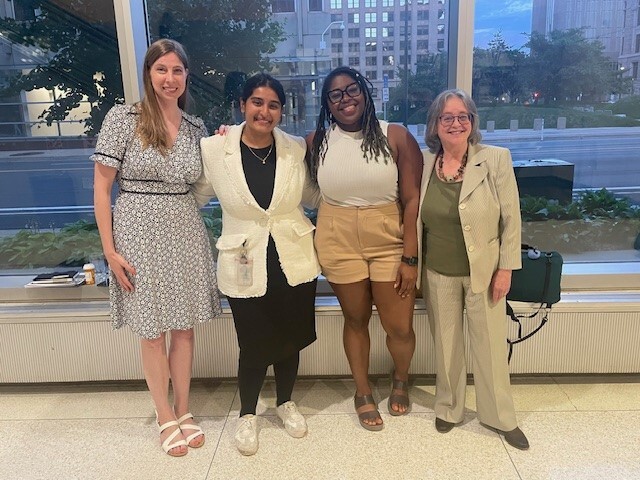
Council Member Wonsley and Council Vice President Chughtai with Minneapolis for a Better Police Contract presenters
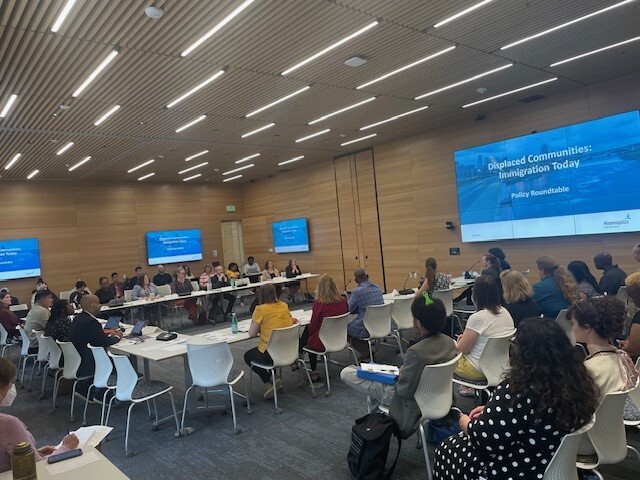
Background: I worked with the city’s Office of Immigrant and Refugee Affairs to host a Policy Roundtable on Immigration where Council Members and the public could learn about what different government agencies and nonprofits are doing to support new arrivals to Minneapolis, so that we can take action to proactively address gaps in service.
Earlier this year, I authored a legislative directive about what the city is doing to support displaced populations who are relocating to Minneapolis, and what we can do to prepare to welcome and support new residents.
There is an unfortunate history of Black residents and other marginalized populations being pitted against immigrants and new residents for scarce resources. I am firmly committed to rejecting this dynamic and I know many of my colleagues are too. All our communities deserve to be fully resourced. My intention with the legislative directive was to bring all critical governmental partners together to understand the situation and help the city be proactive about preparing for an influx of new residents. It’s important that we are best able to ensure that resources are not strained or diverted from existing programs, and that working class residents are not in real or perceived competition for limited resources.
In response to the directive, city staff in the Office of Immigrant and Refugee Affairs (OIRA) organized a Policy Roundtable to offer a high-level overview relating to programs, services and partnerships available to local immigrants in Minneapolis, including newcomer communities. There were presentations by representatives from the state Resettlement Programs Office, Hennepin County, and Minneapolis Public Schools, local nonprofit immigration legal service organizations, and city staff on what their agencies are doing to support the immigrant resident community in Minneapolis.
Over fifty people attended the discussion. Presenters shared incredibly valuable perspectives about the immigration system and its impacts on Minneapolis residents. Some key takeaways for me were:
- The immigration system is set up at the federal level to have very high stakes and no second chances.
- The immigration system is incredibly under-resourced. In Minnesota there are eight federal judges who are working through a backlog of 40,000 immigration cases.
- Legal representation has huge impacts on outcomes for deportation hearings– for example, unaccompanied minors have court outcomes that allow them to lawfully remain in the country 70% of the time when they have legal representation, and 9% of the time when they do not. Despite the fact that they are essentially acting as public defenders, immigration law services have received little to no public funding.
- Homelessness and housing instability are key challenges for thousands of immigrants in Minneapolis, including many children.
- Minneapolis schools are acutely impacted by increases in newly arrived students, and are scaling up academic programming for English learners and social service and wraparound programming for immigrant students and families.
- Thousands of Minneapolis families are experiencing huge amounts of pain and trauma as they undergo immigration proceedings.
There will be a follow-up presentation in the AEO Committee on July 22nd where city staff will present on their departments' roles in supporting new residents in our city.
I am dedicated to using this information to help support our new residents and to be proactive about implementing programs and resources for an influx of new residents. I want to thank city staff in OIRA and my colleagues, particularly Council Member Chavez, Chowdhury, and Council Vice President Chughtai who have been leading on a variety of programs, policies and services to support new residents and immigrants.
Key votes: No votes taken. A city presentation on immigration will be given to the AEO Committee on July 22nd at 1:30pm.
Immigration Policy Roundtable
Summary: Council has recommended budget priorities to the Mayor to help inform his proposed 2025 Budget, which comes out in August. Council Members then amend the proposed budget and vote on final adoption.
Background: Budget Committee Chair Chughtai and Vice Chair Koski have been working to help Council use our full budgetary authority. They invited all Council Members to submit their top priorities for the 2025 Budget to the Mayor for inclusion in his proposed 2025 budget, which he must publish by August 15th. Council then takes the fall to discuss and amend the proposed budget, and then votes to adopt the budget in December.
My top priorities are:
- Permanent housing for unhoused residents in partnership with other governmental agencies - $1.6 million ongoing.
- Traffic Calming: There are over 700 projects that are backlogged due to lack of funding. A response from a legislative directive I authored earlier this year will come forward to the Climate and Infrastructure committee on July 11th.
- Fully fund 2025 elections and mobile voting vans - $2.5 million one-time.
- Dinky After Dark programming to improve public safety in Dinkytown- $350,000 one-time.
- Legislative Department subject matter specialists experts- $1.4 million ongoing.
- Violence Prevention funding- TBD ongoing.
Summarized by theme, it is clear that Community Safety is Council’s top area for investment. Council Members are doing our best to be responsive to the specific concerns of our wards and communities, and unfortunately have to do this through a piecemeal approach because despite continued promises to a new system of comprehensive public safety, we have yet to see a plan from the administration.
Several existing critical public safety programs are being kept alive by Council, with Council Members essentially working very closely with staff to ensure these programs are appropriately implemented and funded. We should have a Neighborhood Safety Department that is coordinating and strengthening these existing programs and creating and supporting new ones, but the administration is not prioritizing making that happen.
In the absence of leadership by the administration, Council Members are stepping up to support these crucial violence prevention programs. Investments in unarmed public safety are part of why we have seen decreases in violent crime over the last year, despite MPD staffing numbers being significantly lower than past years. Violence prevention and violence interruption programs are data-backed, and our residents are telling us that they are a priority.
I would like to see the 2025 budget include substantial investments in violence prevention with a coordinated citywide approach to ensure we are not replicating last year’s mistake of withholding critical infrastructure needed to ensure its success. One key part of that is further conversations with our technical assistance provider John Jay College, and through our $1 million contract with Dr. Oftelie and the NYU policing project on planning and funding sustainable violence prevention programs.
That said, I am really encouraged and excited to vote in support of this package of recommendations. The priorities I am submitting reflect the things that Ward 2 residents consistently share with my office and I can imagine the same is true for my colleagues. Between now and October, I will continue to add priorities that emerge based on conversations with residents and city staff.
As President Payne has said, the fact that we are facing a deficit means we need to be serious about prioritization. The best way to address resident priorities is through the Council offices that are in touch with residents every single day. I hope to see many of these reflected in the Mayor’s recommended budget in August and look forward to advancing them through the budget amendment process if needed.
Key votes: Council votes unanimously to recommend budget priorities to the Mayor.
Summary: Council approved another $600,000 in workers compensation claims to another 5 MPD officers who are leaving the department.
Background: The Administration and Enterprise Oversight (AEO) Committee was asked to approve another five workers compensation claims from MPD officers, totaling another $600,000 of taxpayer money. As I’ve stated before, I vote against these worker compensation cases because Council and the public do not have assurance that the city is doing its full due diligence in challenging cases to ensure that every single claim that comes before Council is legitimate. Council has been asked to approve numerous workers compensation claims to officers with histories of lying on the record. I do not believe in rubber stamping expenditures of taxpayer money, and these workers compensation claims are a major drain on the city budget, costing over $33 million in the past five years. Until there is more clarity that these cases are being fully and robustly vetted, I will continue to oppose them.
Key votes: Council votes 9-3 to approve another 5 MPD workers compensation settlements costing taxpayers another $600,000. Council Member Chavez, Council Vice President Chughtai, and myself were the votes of opposition.
Summary: I am authoring an ordinance to help reduce the number of properties that are vacant and hazardous or condemned. There will be a public hearing on July 9th and you can submit comment to CouncilComment@minneapolismn.gov.
Background: I am authoring an ordinance with Council Member Ellison to change the way the city handles properties that are vacant and hazardous, boarded up, or condemned.
Currently, the city has a program called the Vacant Building Registry (VBR). A building is enrolled in the VBP program if it is condemned, hazardous, and/or has multiple code violations. You can see the map of VBR properties here. There are currently about 300 VBR properties in the city. They are disproportionately located in areas of concentrated poverty and neighborhoods with high proportions of residents of color.
The city offers services to landlords with properties in the VBR portfolio, including monitoring VBR buildings, boarding up structures that are open to trespass, evaluating structures to determine if they meet demolition criteria, enforcing demolition and rehabilitation, and working with property owners to bring the building back into compliance through a Restoration Agreement. For these services, VBR property owners are charged a flat annual fee of $7,087.
Currently, there is no limit on the length of time that a property can be in the VBR program, and many have been vacant for years or even decades. These boarded and hazardous properties are a massive lost opportunity for commercial development, housing, and economic opportunity. The presence of boarded and hazardous properties can contribute to public health and safety dangers and can bring down neighboring property values.
In light of this, Council Member Ellison and I have authored an ordinance limiting a property’s VBR eligibility to 2 years, with an optional 3rd year if the owner applies and the director of regulatory services determines that the owner has made substantial progress towards bringing the building into compliance. After 2 or 3 years, the property will be removed from the VBR program and handled with standard administrative citations for noncompliance, which can cost up to $24,000 in annual citations, rather than the VBR rate of $7,087.
This ordinance would ensure that the benefits of the VBR program are still available to property owners who are working in good faith to receive city assistance in rehabilitating or demolishing buildings within a reasonable window of time, without allowing property owners to abuse the program for years on end.
Key votes: The Business Housing and Zoning (BHZ) Committee will hold a public hearing on limiting VBR eligibility to 2 years on July 9th at 1:30pm. Members of the public can come and testify or submit testimony to CouncilComment@minneapolismn.gov.
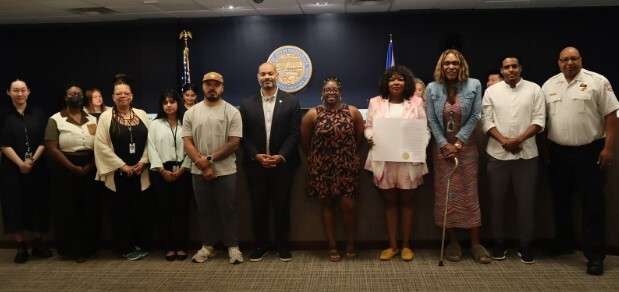
Yesterday, Council passed a Honorary Resolution honoring Juneteenth. It is so important that we take time to formally acknowledge the ongoing struggle for Black liberation and how much we have left to do.
Council Members and staff with Juneteenth honorary resolution.
Beginning Monday, July 1, Fourth Street will be reduced to one lane between Oak Street and 15th Avenue SE. Traffic will be shifted to the south side of Fourth Street while crews work in the two lanes on the north side of the street. This will be in place through mid-August.
The traffic shift and lane reduction will allow crews to prioritize work on Fourth Street near the University of Minnesota’s facilities. By accelerating this area in July, we hope to minimize the traffic impacts for U of M activities and athletic events when the fall semester begins.
On-street parking won't be available in the single lane area between Oak Street and 15th Avenue SE. Plan ahead to park in nearby ramps or on cross streets.
Expect delays when traveling in the construction area. Plan an alternative route or allow extra time.
People walking and biking will be provided with a detour around the work area.
This week my office attended meetings of the Prospect Park Association, Marcy Holmes Neighborhood Association, and Seward Neighborhood group. It is great to connect with these neighborhood leaders who are organizing a wide range of programs to support equity and neighborhood community building.
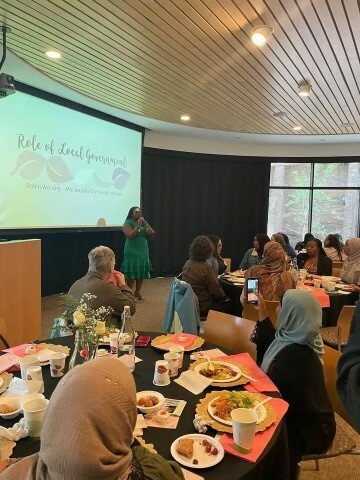
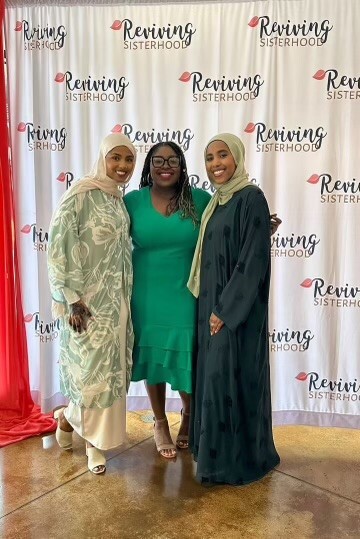
I was honored to attend an Eid dinner hosted by Reviving the Islamic Sisterhood for Empowerment, or RISE. Thank you to RISE for creating joyful and grounded opportunities for spiritual community for women.
Council Member Wonsley speaking at RISE Eid dinner
Council Member Wonsley with RISE leaders
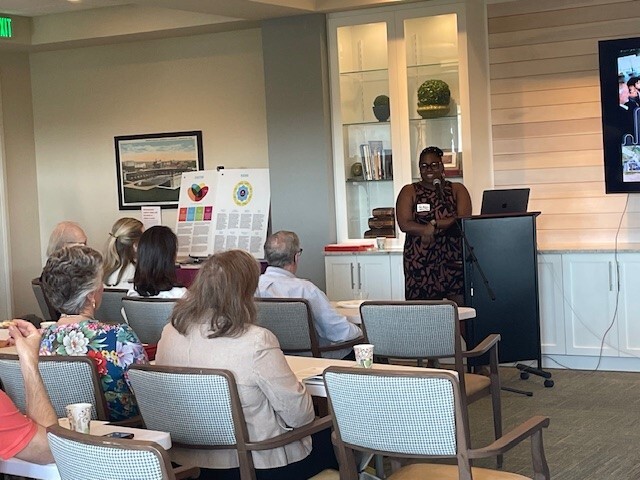
The Towerside Innovation District hosted their Annual Meeting and breakfast. Towerside is one of the fastest growing areas in the entire city, which means that the policy choices and community organizing that happens now makes the different between gentrification that reinforces racial inequity, or development that welcomes renters, people of color, and low-income people and helps us meet our equity climate, transit, and equity goals.
I’ve been excited to see Towerside focus on priorities like District Energy, affordable housing, and expanding bike and pedestrian infrastructure. It’s been great to partner with Towerside over the last two and a half years, and I am really looking forward to continuing our partnership.
Council Member Wonsley speaking at Towerside Annual Meeting and Breakfast
Know before you go: Gymnastics City USA and Pride events
Plan ahead if you’re heading to downtown Minneapolis this weekend to celebrate with the Twin Cities Pride Festival and Gymnastics City USA.
Streets closing for events
- First Avenue between Sixth and Seventh Streets (in front of Target Center) will close Thursday, June 27 to early Monday, July 1, for Gymnastics City USA events. One of the four lanes will remain open.
- From 9 a.m. until around noon Sunday, June 30, the Plymouth Street bridge, down Main Street to Hennepin Avenue will close for the Twin Cities Pride Festival 5K.
- Sunday, June 30, Hennepin Avenue to Spruce Street will close for the Twin Cities Pride Festival Rainbow Dash.
- Sunday, June 30, Hennepin Avenue between Third Street and Spruce Street will close for the Pride Parade.
Transportation
The Minnesota Department of Transportation encourages visitors to check 511 for updates to any closures due to event traffic or any issues related to recent flooding outside of the city.
- Transit options. Avoid driving in traffic and looking for parking. Visit Metro Transit’s website to plan your trip on public transit or look for the Pride Bus while out and about.
- Parking options. There’s parking throughout Downtown. If you’re parking on the street, check signs to be sure of the time limit and hours of enforcement for your parking space. In addition to the many privately run parking facilities downtown, there are several City-owned parking facilities available.
Come early, stay late
Downtown restaurants, bars and other businesses are ready to welcome visitors. Take part in activities, shopping, dining and other entertainment before and after going to events. Enjoy the extra time to experience all each area has to offer and avoid traffic congestion.
Find more details on the City website.
With the State primary election coming up in August, know what you need to do to vote. Early voting begins June 28.
Voters can vote early in person at the Early Vote Center, 980 E. Hennepin Ave. or by mail.
Find more information on the City website.
Contact Ward 2
Visit: minneapolismn.gov/ward2
Email: ward2@minneapolismn.gov
Phone: 612-673-2202
We've moved while work is being done in City Hall. Our office is in:
Room 100, Public Service Center
250 South 4th St.
Get directions
For reasonable accommodations or alternative format please contact 311. People who are deaf or hard of hearing can use a relay service to call 311 at 612-673-3000. TTY users call 612-263-6850. Para ayuda, llame al 311. Rau kev pab, hu 311. Hadii aad caawimaad u baahantahay, wac 311. |