|
June 11, 2026
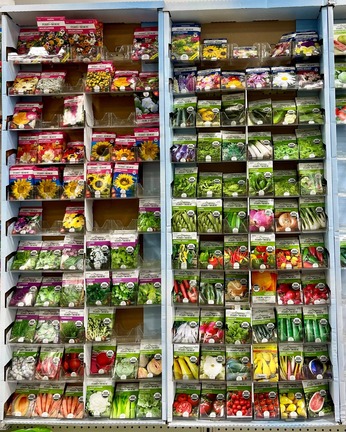
Seed labels help buyers know what they are planting and provide assurance that seed has been tested for quality and unwanted weeds.
What Information Should Be on a Home Garden Seed Packet?
Home garden seed packets must include the following information:
- Kind and variety of seed
- Some exceptions apply to flower seed.
- If the seed is a blend of varieties or a mixture of kinds, it must be identified as such on the label.
- In Minnesota, Cannabis sativa must be labeled as either hemp or cannabis/marijuana depending on the total THC percentage expressed at the adult stage. Seed expected to produce plants with more than 0.3% total THC may be labeled as either cannabis or marijuana.
- Lot number
- Net weight of the contents or the number of seeds in the package
- Date information
- The year the seed was packed for sale must be listed.
- A “sell by” date may be used with or instead of the packed for sale year, but it cannot exceed the test date by more than 12 months, excluding the month of testing.
- If germination falls below the standard, the test date and actual germination percentage must be included.
- Name and address of the labeler
- The address must include the street address or P.O. Box, city, state, and zip code.
- Information about any seed treatments, including a warning not to use treated seed for food, feed, or oil purposes.
Other typical information on seed labels, such as germination, may be omitted if certain conditions are met, such as meeting the minimum germination standard.
Seed Testing Protects Buyers
Seed labeled for home garden use must be tested for:
- Purity
- Minnesota noxious weeds
- Germination
These testing requirements help ensure gardeners receive quality seed and reduce the risk of introducing invasive or prohibited weeds.
Visit the Labeling Seed in Minnesota webpage for more information.
Pathways Survey Helps Protect Minnesota Agriculture Through Early Detection
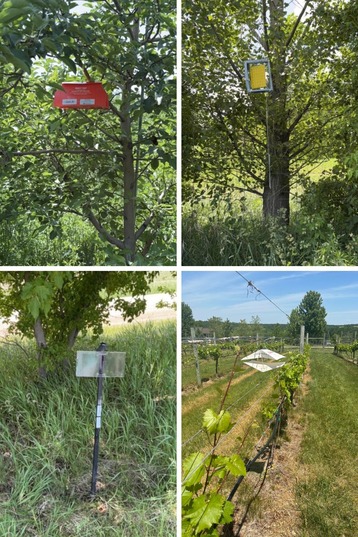
Monitoring traps used in the Pathways Survey: (top left) apple tree trap targeting summer fruit tortrix moth; (top right) maple tree trap targeting samurai wasp, a parasitoid of brown marmorated stink bug (BMSB); (bottom left) BMSB trap; and (bottom right) grape vineyard trap targeting Christmas berry webworm.
Each growing season, the Minnesota Department of Agriculture (MDA) conducts the Pathways Survey for Early Detection of New and Emerging Pests, an important effort to identify invasive pests and plant pathogens before they become widespread in Minnesota.
Since 2014, MDA staff have monitored agricultural sites across the state using pheromone-baited insect traps and visual inspections. Survey sites include community gardens, community-supported agriculture (CSA) farms, small and immigrant-operated farms, orchards, vineyards, and berry farms in both urban and rural areas. Because new pests are often introduced through human activity, special attention is given to population centers.
This year’s survey focuses on orchards, vineyards, and high tunnels and includes monitoring for several high-risk species, including light brown apple moth, summer fruit tortrix moth, Christmas berry webworm, European grapevine moth, brown marmorated stink bug, and samurai wasp, a beneficial parasitoid that attacks brown marmorated stink bug eggs.
Target pests and pathogens are selected in collaboration with the USDA and the University of Minnesota based on factors such as their likelihood of arrival, availability of host plants, and ability to survive Minnesota’s climate. Plants showing signs of disease are sampled and tested in diagnostic laboratories to determine whether target pathogens are present.
Early detection provides the best opportunity to reduce the impacts of invasive species on Minnesota agriculture. When new pests are detected, the MDA works to determine their distribution and assess appropriate response actions, which may range from grower outreach and education to regulatory measures and management efforts.
The Pathways Survey also creates valuable opportunities for MDA staff to connect with growers and community members while building partnerships that help protect Minnesota’s agricultural resources.
If you suspect a new or invasive pest in your garden or operation, visit the MDA Report a Pest page for more information.
New Smarty Plants Episode - Weeding Through Changes
Smarty Plants is a podcast exploring invasive insects and noxious weeds that threaten Minnesota’s natural and agricultural resources.
This year brought changes to the Minnesota Noxious Weed List. Listen to weed experts Emilie Justen from the Minnesota Department of Agriculture and Dr. Jim Calkins from the Minnesota Nursery and Landscape Association and learn what changes to the list mean, how changes are made, and why it continues to evolve.
Subscribe to Smarty Plants today so you don’t miss an episode!
In the Field: Drone Use for Invasive Species Management
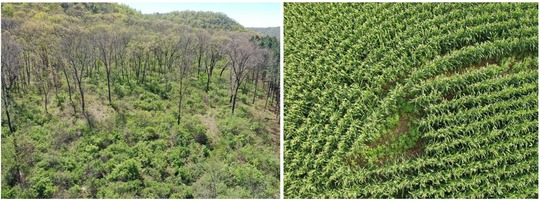 Left: Drones are used to map the spread of invasive honeysuckle in the understory of a southern Minnesota forest. Right: The MDA uses a drone to scout a cornfield for agricultural weeds.
A new approach to invasive species management has taken flight at the Minnesota Department of Agriculture (MDA). Over the past two years, a small drone program has come into its own within the MDA’s Plant Protection Division. The program is finding ways to incorporate this nascent technology into early detection and rapid response efforts for plant pests, diseases, and noxious weeds that threaten Minnesota’s agricultural and natural resources.
Establishing a drone program within a state agency involves a significant learning curve with numerous challenges along the way. As we reach the halfway point of 2026, here are a few examples of projects that are incorporating drones:
- Scouting agricultural fields for Palmer amaranth infestations.
- Mapping and producing high resolution imagery of common buckthorn, honeysuckle species, roundleaf bittersweet, and rowan mountain ash infestations.
- Collecting high-resolution images for outreach purposes that highlight MDA efforts and invasive species management success stories.
- Using a multispectral sensor for early detection of plant disease issues in specialty crops such as apple and grape.
The MDA is committed to integrating new technology into our efforts to protect and enhance Minnesota’s agricultural and environmental resources. Stay tuned for updates on current projects and new endeavors.
June Weed of the Month: Stiltgrass
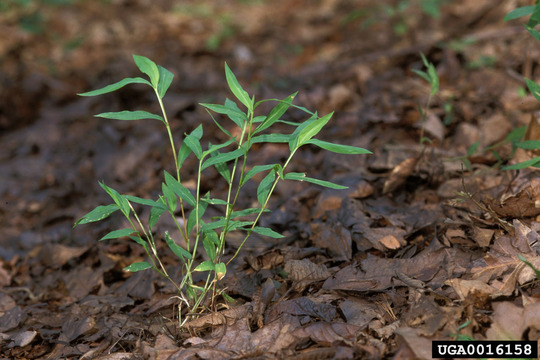 Stiltgrass has long and narrow leaves with smooth edges. James H. Miller & Ted Bodner, Southern Weed Science Society, Bugwood.org
Stiltgrass can be found growing along forest edges, wetlands, and disturbed areas
By Julia Delick, Minnesota Department of Agriculture: Stiltgrass was added to the Minnesota Noxious Weed list in January 2026. It is listed as a Prohibited Eradicate noxious weed, meaning all above and below ground parts of the plant must be destroyed and no transportation, propagation, or sale of this plant is allowed.
Stiltgrass is an annual plant that forms dense tangled mats, usually 1 to 3 feet high. After the growing season, the grass dies back, forming abundant dry thatch. It was originally used as packing material for imported goods from Asia. Stiltgrass was first identified in Tennessee in 1919 and has since spread throughout the eastern United States and westward to Texas. Stiltgrass is not yet reported in Minnesota, but some populations have been found nearby in La Crosse, WI. Read more
Emerald Ash Borer Quarantine Expanding in Kandiyohi County
All of Kandiyohi County will have a quarantine on wood movement
St. Paul, MN: The Minnesota Department of Agriculture (MDA) has confirmed emerald ash borer (EAB) in a new area of Kandiyohi County. The EAB find requires expanding the current county quarantine boundary to include the entire county.
EAB was discovered by a Minnesota Department of Natural Resources Forest Health Specialist in the City of Willmar, which is outside the current quarantine area.
The MDA is enacting an emergency quarantine of the entire county. The quarantine limits the movement of firewood and ash material out of the area. Quarantines are issued for all areas known to have EAB to reduce the risk of further spreading the tree-killing insect. Read more
MDA to Conduct Spongy Moth Aerial Management in Southeast Minnesota
Low flying planes will be used to control spongy moth populations
St. Paul, MN: The Minnesota Department of Agriculture (MDA) is preparing to aerially manage 19 sites in Fillmore, Mower, Olmsted, Wabasha, and Winona counties to slow the spread of spongy moth. Officials likely will conduct the aerial management activities June 24 – July 1, beginning as early as 6:30 a.m. and continuing throughout the day. These dates are dependent on weather conditions in the area. Read more
Help Protect Minnesota Forests from Invasive Pests
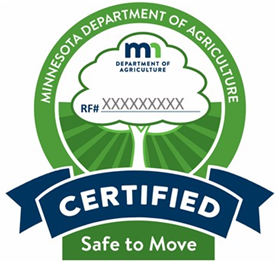
Look for the MDA certified logo.
Moving untreated firewood can spread harmful pests like emerald ash borer, spongy moth, and Asian longhorned beetle, species that have destroyed millions of trees across the United States. Even native pests like carpenter ants and bark beetles can hitch a ride on firewood and cause problems for homeowners.
Help stop the spread:
- Buy firewood where you burn it! Locally sourced wood is less likely to carry invasive pests.
- Use MDA certified firewood with the official seal. View the list of Certified Firewood Producers in Minnesota.
- Avoid transporting hardwood firewood across county or state lines. It is illegal to move hardwood firewood out of Minnesota quarantined counties unless it is MDA certified. Violations can result in fines of up to $7,500 per day.
Visit the MDA's Buying Firewood webpage for more information.
Explore the Minnesota Grown Directory
Planning your garden this season? Start local. The Minnesota Grown Directory connects you with nurseries, garden centers, farmers markets, community supported agriculture (CSA) farms, and more across the state.
Find the plants, seeds, and local expertise you need and support Minnesota growers while you’re at it. Visit minnesotagrown.com to explore the directory and start planning.
|
|