|
Minnesota Housing’s 2026 Multifamily Consolidated Request for Proposals (RFP)/2027 Housing Tax Credit (HTC) Round 1 application deadline is this Thursday! Read on to receive relevant and timely reminders, helpful resources, and to catch up on important information.
In This eNews
In Case You Missed It
FINAL REMINDER: 2026 Multifamily Consolidated RFP/2027 HTC Round 1 Application Deadline is THIS THURSDAY, JULY 9 at noon Central time
The deadline to submit 2026 Multifamily Consolidated RFP/2027 HTC Round 1 applications is this Thursday, July 9 at noon Central time. This deadline includes:
The Multifamily Customer Portal will automatically lock the 2026 Multifamily Consolidated RFP/2027 HTC Round 1 funding round at 12:01 p.m. Central time, and no additional submissions will be allowed.
Thank you to our funding partner, the Metropolitan Council, for continuing to support multifamily affordable housing for Minnesotans.
Questions?
Contact mhfa.consolidated.rfp@state.mn.us.
Withdrawing Your Application
Minnesota Housing provided a brief overview of the estimated deferred loan and HTC resources available for the 2026 Multifamily Consolidated RFP/2027 HTC Round 1 in our April 23 eNews. The estimate included the potential resources that were available at the time but did not include additional appropriations for the Housing Infrastructure Program. The 2026 Minnesota legislative session concluded with a new authorization for $100 million in Housing Infrastructure Bonds. The funding will be made available in the 2026 Consolidated RFP for eligible multifamily, single-family, and manufactured housing uses.
FINAL TIPS: On-Time Application Submission
-
Review application information, materials, and trainings. These can be found on our Multifamily Consolidated Request for Proposals/Housing Tax Credit Funding Rounds webpage.
-
Review Multifamily Customer Portal resources. Visit our Multifamily Customer Portal Resources webpage to learn more about the Multifamily Customer Portal and view trainings to help guide you through the submission process.
-
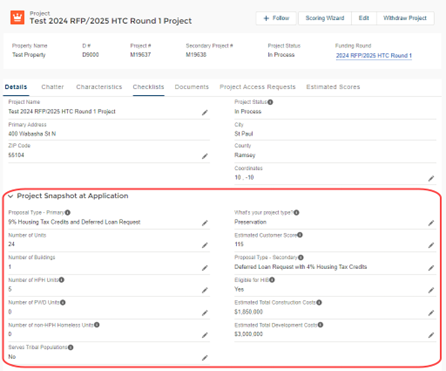
Update the Project Snapshot and Application fields with the latest information. When applicants create a project in the Multifamily Customer Portal, some high-level details about the project, including proposal type(s), number of units, and estimated construction and development costs, are provided. Update these fields under the Details tab to match the current project characteristics.
 |
-
Create Test Scoresheets using the Scoring Wizard. Applicants must submit their Customer Final Version scoresheet in the Scoring Wizard by the application deadline. Applicants may use the Scoring Wizard to create up to four test scoresheets per project to explore different scoring scenarios before finalizing their submission. The Scoring Wizard is the online version of the Self-Scoring Worksheet and is required for all 2026 Multifamily Consolidated RFP/2027 HTC Round 1 applications. When you’re ready, convert your best test version into the Customer Final Version and select Verify and Submit to complete your submission.
-
Use the 2026 Multifamily Workbook. 2026 Multifamily Consolidated RFP/2027 HTC Round 1 applicants must use the 2026 Multifamily Workbook. The workbook version date is located on the Instructions tab and is labeled 2026 03 19 Ver 1.0. Download the latest version from the Multifamily Customer Portal.
-
Include the Property Number (D#) and Project Number(s) (M#) on applicable forms. On many Minnesota Housing forms, applicants are asked to provide a D# and an M#. Refer to the Multifamily Request for Proposals Standards for guidance on D# and M# numbers.
-
Upload files as you go. The Multifamily Customer Portal requires applicants to upload files to their corresponding checklist item. Do not wait until the last minute to upload the documents. The Multifamily Customer Portal and Scoring Wizard will not accept submissions after noon Central time on Thursday, July 9, 2026.
-
Use the Show Items Not Uploaded feature. This feature allows applicants to quickly identify which checklist items still need attention before submission.
-
Select Submit when you are finished with your application checklist. Applicants must complete and submit their customized checklist in the Multifamily Customer Portal; upload all required documents or mark optional items as Opted Out. Once all items show a valid upload status and no errors remain, select Submit. Applicants will be asked to confirm that all materials are signed and to acknowledge the submission. Once submitted, items will be locked, and an email confirmation will be sent automatically.
-
Submit development team qualification forms. All applicants are required to submit the applicable development team qualification forms and supporting documentation. All qualification forms must be submitted to through the Secure Upload Tool. For more information, view our May 26 eNews and visit the Development Team Qualification Forms webpage.
-
Submit the application fee. All applications must submit the $800 application fee per the Multifamily Fee Remittance Form.
-
Include application signatures. Minnesota Housing will accept electronic signatures on application materials. Refer to the Multifamily Request for Proposals Standards for more information.
- Submit the application early if it is complete!
Questions?
Questions regarding the Multifamily Customer Portal, Scoring Wizard, or Secure Upload Tool should be directed to mhfa.app@state.mn.us.
General questions should be directed to mhfa.consolidated.rfp@state.mn.us.
FINAL REMINDER: Metropolitan Council Local Housing Incentives Account Application Deadline is THIS THURSDAY, JULY 9 at noon Central time
The Metropolitan Council approved $3.5 million in Livable Communities Grant Program funding to be made available in the multifamily deferred pool of financing through the 2026 Multifamily Consolidated RFP. Only projects located in Livable Communities participating cities are eligible for these funds. Visit the Livable Communities Development Projects webpage for more information about the program, including matching requirements, eligible uses, and more.
Applications are due with the 2026 Multifamily Consolidated RFP/2027 HTC Round 1 this Thursday, July 9 at noon Central time.
What You Need to Know
- Livable Communities grant funds require that the local government entity (city; county; or housing, economic, redevelopment, or port authority) in which the project is located serve as the grantee for the Livable Communities portion of funding. To confirm the local government is willing and able to serve as the grantee, developers/sponsors are required to submit a signed
- Acknowledgement of Receptivity Form from the City.
- All grants are reimbursement-based. The local government serving as the Livable Communities grantee will enter into a sub-agreement with the project to claim reimbursement from the Metropolitan Council and pass funds on to the project.
- Grantees (local government entity) must match Livable Communities awards made through the Multifamily Consolidated RFP on a dollar-for-dollar basis with a source of funding that is either directly from, or is designated by, the participating city, county, or development authority. Sources include CDBG, HOME, TIF, LAHA, Housing Trust Fund dollars, tax abatements, local housing revenue bonds, and the appraised value of donated land.
- Livable Communities grants support primarily hard costs related to the construction and rehabilitation of affordable housing. Livable Communities grants do not pay for work done before the grant is awarded, except for reimbursement of qualifying land acquisition costs incurred no more than 24 months prior to the date of application.
Steps to be Considered
- Log into the Multifamily Customer Portal and create a project within the 2026 Multifamily Consolidated RFP/2027 HTC Round 1 funding round.
- Go to the Characteristics tab and select the Metropolitan Council Livable Communities This will add General: Met Council Livable Communities Grant to your application checklist. Within the checklist there will be two forms, the Acknowledgement of Receptivity Form and the Livable Communities Supplemental Questionnaire.
- Reach out to the local government entity (city; county; or housing, economic, redevelopment, or port authority) in which the project is located and request that they serve as the grantee for Metropolitan Council Livable Communities funds.
- If they agree, they must complete and sign the Acknowledgement of Receptivity Form.
- Minneapolis-based projects may submit a completed but unsigned Acknowledgement of Receptivity Form. Metropolitan Council staff will coordinate with the project team and City of Minneapolis staff to verify eligibility and have the form signed before awards are made.
- Upload the completed Metropolitan Council Acknowledgement of Receptivity Form and Livable Communities Supplemental Questionnaire to your application checklist prior to your 2026 Multifamily Consolidated RFP/2027 HTC Round 1 application submission. If the checklist items are not submitted, applicants will not be considered for Metropolitan Council’s Livable Communities grant funding.
Questions?
Visit the Metropolitan Council’s Livable Communities Grants webpage or contact Hannah Gary, Program Coordinator, at hannah.gary@metc.state.mn.us.
Application Fees and In-Person Delivery
The preferred method to receive 2026 Multifamily Consolidated RFP/2027 HTC Round 1 application fees is via USPS mail. The Multifamily Fee Remittance Form includes our mailing address, contact information, and fee amounts. Minnesota Housing will accept mailed checks postmarked by the application deadline of July 9, 2026.
The Multifamily Division will also have staff available to accept checks delivered in-person to our office at the following dates and times:
- Wednesday, July 8 between 9 a.m. and 4 p.m. Central time
- Thursday, July 9 between 9 a.m. and noon Central time
To arrange an in-person delivery outside of these dates and times, contact htc.mhfa@state.mn.us.
2026 Multifamily Consolidated RFP/2027 HTC Round 1 Selection Recommendations to the Board of Directors
Minnesota Housing anticipates presenting the 2026 Multifamily Consolidated RFP/2027 HTC Round 1 selection recommendations to the board of directors on Thursday, December 17, 2026.
Board reports are available to the public on the Board of Directors webpage.
Funding partners proposal recommendations will follow their respective approval process.
In Case You Missed It
9% HTC Distribution Estimates Update
The Internal Revenue Service (IRS) provided updated state population estimates in April 2026, resulting in revised 2027 9% HTC distribution estimates for the state of Minnesota. The estimates are based on Minnesota’s population and the per capita credit volume, reflect the current amount of 9% HTCs available for the 2027 program year, and are subject to change.
Any adjustments to these figures will result in corresponding changes to the total credits available for allocation. The updated 2027 Distribution of HTCs in Minnesota are now available on the Housing Tax Credits webpage.
Questions?
Contact htc.mhfa@state.mn.us.
Estimated Deferred Loan Resources – State Legislative Update
Minnesota Housing provided an overview of the estimated deferred loan and federal Low-Income Housing Tax Credit resources available for the 2026 Multifamily Consolidated RFP/2027 HTC Round 1 in our April 23 eNews. Because the 2026 Minnesota legislative session was still underway, the estimated resources did not include any Housing Infrastructure Program funding. We are excited to share that the 2026 Minnesota legislative session concluded with a new authorization for $100 million in Housing Infrastructure Bonds to support multifamily rental, home ownership, and manufactured housing uses! The Housing Infrastructure Program funding will be made available in Minnesota Housing’s 2026 Consolidated RFPs.
Federal Resources
The Home Investment Partnerships (HOME) Program and National Housing Trust Fund (NHTF) Program are key parts of Minnesota Housing’s deferred funding resources. Projects selected to receive HOME Program and/or NHTF Program funds in the 2026 Multifamily Consolidated RFP are subject to several federal cross-cutting requirements, including:
-
Davis-Bacon: Required when the HOME Program funding requires 12 or more HOME assisted units, which are the units in a project subject to the HOME rent and income limits for the duration of the HOME period of affordability. Under certain circumstances, a project may also be subject to state prevailing wage and a dual wage decision. Refer to section 1.11 (Prevailing Wage) of the Multifamily Request for Proposals Standards for more details.
-
U.S. Department of Housing and Urban Development (HUD) Section 3 Rule:
- The labor hour benchmark for Section 3 workers is set at 25% or more of the total number of labor hours worked by all workers on a project.
- The labor hour benchmark for Section 3 targeted workers is set at 5% or more of the total number of labor hours worked by all workers on a project.
- Developers and contractors must follow HUD’s prioritization of effort in directing employment, training, and contracting opportunities to low- and very low-income individuals and businesses that employ them.
-
HUD Environmental Review: Part 58 environmental review is required for HOME Program funding. Projects receiving NHTF Program funds must meet all NHTF environmental provisions. Some NHTF environmental provisions align with the requirements of a Part 58 environmental review, but not all.
-
Build America, Buy America (BABA): BABA requirements will apply to any projects awarded HOME Program and/or NHTF Program funds from Fiscal Year 2024 or later. BABA requires that all iron, steel, manufactured products, and construction materials used in residential new construction and rehabilitation projects funded with federal financial assistance must be produced in the U.S.
-
Uniform Relocation Act (URA): The URA requires that displaced persons or businesses be provided fair, equitable treatment and protection from disproportionate injury by projects designed to benefit the public.
Questions?
Contact Aaron Keniski at aaron.keniski@state.mn.us or Cindy Diel at cindy.diel@state.mn.us.
Amortizing Loan Rates
Applicants requesting or interested in Minnesota Housing’s Low and Moderate Income Rental (LMIR) first mortgage and/or Bridge Loans through the 2026 Multifamily Consolidated RFP/2027 HTC Round 1 are encouraged to use the following rates for initial underwriting purposes.
LMIR Permanent Loans
- 40-year term/amortization – 7.625% (non tax-exempt bond funded)
- 40-year term/amortization – 6.875% (tax-exempt bond funded)
- Plus 0.125% for HUD Risk-Sharing mortgage insurance premium
These rates are only for underwriting/sizing purposes for submissions to the 2026 Multifamily Consolidated RFP/2027 HTC Round 1. Underwriting rates will be revisited during the Multifamily Consolidated RFP review and will vary depending on loan structure (for example, tax-exempt bond funded or not). Rates will continue to float until final Agency approval approximately six months prior to loan closing/commitment.
Bridge Loans Funded with Tax-Exempt Bonds
- 5% interest rate for underwriting/sizing purposes
- Maximum term of 24 months not insured under HUD Risk-Sharing/no mortgage insurance premium
- Actual rate will float and will be based on the price of the bonds + 1.0%
- Bonds will be sold approximately two weeks prior to loan closing
Questions?
Contact Mike Tobias at michael.tobias@state.mn.us with questions regarding LMIR first mortgages.
Contact Susan Thompson at susan.thompson@state.mn.us with questions regarding Bridge Loans.
About Minnesota Housing
Minnesota Housing, the state’s housing finance agency, works to provide access to safe, stable and accessible housing Minnesotans can afford in a community of their choice. In 2025, we distributed $1.8 billion in resources and served 73,000 households. Visit our website to learn more.
Did you get this email from a friend? Stay up to date on Multifamily Consolidated RFP/HTC Round 1 news and updates by signing up for our eNews list!
|