|
There is still time to submit an Intent to Apply for the 2026 Multifamily Consolidated Request for Proposals (RFP)/2027 Housing Tax Credit (HTC) Round 1! Read on to learn more about the Intent to Apply, including requirements and tips, and for important information about the estimated deferred loan and HTC resources available.
Did you get this email from a friend? Stay up to date on Multifamily Consolidated RFP/HTC Round 1 news and updates by signing up for our eNews list!
In this eNews
In Case You Missed It
Application Dates
Important dates for the 2026 Multifamily Consolidated RFP/2027 HTC Round 1 are listed below and on the Multifamily Consolidated Request for Proposals/Housing Tax Credit Funding Rounds webpage.
-
Thursday, May 7 at noon Central time: Deadline to submit Intent to Apply; required for all 2026 Multifamily Consolidated RFP/2027 HTC Round 1 applications
-
Thursday, May 28 at noon Central time: Deadline to submit pre-applications for the HUD Section 811 PRA Program and Innovative Construction Techniques Selection Criterion
-
Thursday, July 9 at noon Central time: Deadline to submit 2026 Multifamily Consolidated RFP/2027 HTC Round 1 applications
-
December: Minnesota Housing board members meeting to approve selection recommendations
Dates are subject to change at Minnesota Housing’s sole discretion.
Questions?
Contact mhfa.consolidated.rfp@state.mn.us.
Reminder: Intent to Apply Deadline is Thursday, May 7, 2026
All 2026 Multifamily Consolidated RFP/2027 HTC Round 1 prospective applicants are required to complete the Intent to Apply (ITA) process in the Multifamily Customer Portal by noon Central time on Thursday, May 7, 2026.
The ITA is the first step to starting a full application and projects that do not complete the ITA or meet this deadline will not be able to submit a full application. There are no checklist items or costs associated with the ITA.
Applicants may change their project’s characteristics up until the full application deadline, noon Central time on Thursday, July 9, 2026. Review our April 8 eNews for more information, including ITA requirements.
Tips for Submitting a Successful Intent to Apply
To ensure a successful ITA submission, here are some helpful tips:
-
Request a Multifamily Customer Portal account. Before you can submit an ITA, you must have access to the Multifamily Customer Portal. To gain access, request an account by completing our online form. Minnesota Housing strongly encourages customers to submit access requests at least two business days before the ITA deadline to prevent possible delays.
-
Watch the newly updated Intent to Apply tutorial. This tutorial provides step‑by‑step guidance on completing the ITA process in the Multifamily Customer Portal. Additional tutorials, including Getting Started, Apply for Funding, and Project Checklists, are available under the How do I use the Portal? section of the Multifamily Customer Portal Resources
-
Create your project before the deadline. Use the Apply for Funding Wizard to create your project in the funding round. You cannot add additional projects after the Intent to Apply deadline.
-
Select your project characteristics. All projects must have at least one proposal type and one construction type selected. Review the Instructions for Setting Up and Changing Project Characteristics in the Multifamily Customer Portal for more information.
-
Confirm the project details match your selected characteristics. Review the fields on the project details tab to confirm they align with your project characteristics. Update the proposal type, project type, and estimated score as needed.
Once the ITA for the project has been created, the primary address, property number (D#), and project number in the Multifamily Customer Portal must match the Multifamily Workbook. These items will be validated during the evaluation period.
Determining Project Type(s)
During the ITA process, applicants will preliminarily identify their project type which will help generate the estimated scores report. Project type(s) help determine funding sources that may be available for the project. Project types include:
-
Preservation: Existing projects in need of rehabilitation. These projects generally meet the Preservation selection criterion requirements outlined in the Self-Scoring Worksheet and meet a risk of loss, have existing project-based rental assistance, or have rent or income restricted units. Preservation projects may also meet other project type definitions.
-
Workforce Housing: Projects with rent or income restricted units. Each resource may have further rent or income restrictions, generally between 30% MTSP and 60% MTSP. Workforce Housing projects generally target a number of different populations, for example, single occupancy, families, individual(s) experiencing homelessness or who are high priority homeless, and/or people with disabilities.
-
Supportive Housing: Projects with at least 50% of the units supporting high priority homeless and/or other homeless households.
-
Senior Housing: Age restricted projects that are intended and operated for occupancy by senior households with at least one household member who is 55 years of age or older.
Minnesota Housing reserves the right to determine the application’s final project type(s). For more details, review the Multifamily Request for Proposals Standards.
Estimated Resources
The estimated deferred loan and HTC resources available through the 2026 Multifamily Consolidated RFP/2027 HTC Round 1 are outlined below. This information does not constitute a commitment or guarantee of funding availability for the 2026 Multifamily Consolidated RFP/2027 HTC Round 1. Minnesota Housing will continue to provide updates as more information becomes available.
Deferred Loan Resources
Deferred loan resources available for the Multifamily Consolidated RFP varies each year based on such factors as:
-
State and federal appropriations: The primary source of funding for deferred loans comes from funding provided by the state and federal budgets.
-
Funding gaps: Providing additional funding to assist previously selected projects with a funding gap reduces the amount of resources available for new selections.
-
Deferred loan repayments: Repaid funds are recycled to support new project selections or fill gaps in previously selected projects.
-
Withdrawn projects: If a selected project cannot proceed, funds may be reallocated to other new or previously selected projects.
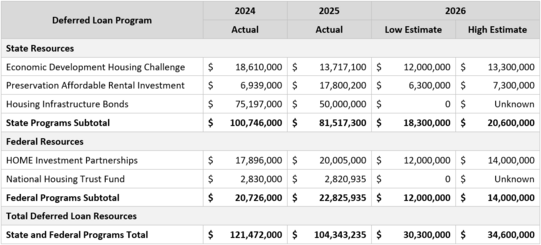
The following chart includes the actual amount of deferred loan funding awarded through the 2024 and 2025 Multifamily Consolidated RFPs as well as an early estimate of the anticipated deferred loan resources for the 2026 Multifamily Consolidated RFP.
The deferred loan estimates for the 2026 Multifamily Consolidated RFP are not final. They are based on base-level appropriations from recent years. Actual amounts available may increase or decrease.
The federal National Housing Trust Fund (NHTF) is primarily funded through contributions from Fannie Mae and Freddie Mac based on their earnings. As of the date of this eNews, the federal government had not provided an estimate on what, if any, NHTF funds will be available in 2026.
Housing Infrastructure Bonds will only be available if approved in the 2026 legislative session. All previous allocations to Minnesota Housing have been fully committed to projects.
9% Housing Tax Credit Resources
The Internal Revenue Service determines the amount of competitive 9% HTCs available for each state based on population. The following chart includes the actual amount of 9% HTCs allocated through the 2024 and 2025 Multifamily Consolidated RFP/2025 and 2026 HTC Round 1 and an estimate of the HTCs anticipated to be available through the 2026 Multifamily Consolidated RFP/2027 HTC Round 1.
The competitive 9% HTC resources available for 2026 are subject to change due to factors such as population updates and returned HTCs.
Technical Assistance is Available
Minnesota Housing offers, and strongly encourages, technical assistance to discuss your project with staff. If you would like technical assistance as you prepare application, complete and submit the Technical Assistance Request Form.
Technical assistance topics may include, but are not limited to:
- Selection criteria in the Self-Scoring Worksheet
- Project feasibility
- Organizational and financial capacity
Technical assistance provided by Minnesota Housing staff is only advisory and does not guarantee that a development will receive points under a particular criterion or be selected for funding. While every effort is made to ensure the accuracy of the technical assistance, such assistance is subject to, and does not modify or override, the requirements of the Qualified Allocation Plan, Self-Scoring Worksheet, Multifamily Request for Proposal Standards, Multifamily Underwriting Standards, Building Standards documents, and other documents related to applications for funding.
In Case You Missed It
Apply for Funding through the Multifamily Customer Portal
The following items are available in the Multifamily Customer Portal:
- Project creation and characteristic configuration to complete the Intent to Apply process
- HUD Section 811 PRA Program Pre-Application Checklist
- Innovative Construction Techniques Selection Criterion Pre-Application Checklist
- 2026 Multifamily Consolidated RFP/2027 HTC Round 1 Application Checklist
- Scoring Wizard
- Application materials for Metropolitan Council’s Livable Communities Grant Program funding
All 2026 Multifamily Consolidated RFP/2027 HTC Round 1 applicants must apply for funding through the Multifamily Customer Portal. To learn more about the Multifamily Customer Portal and to request a user account, visit our Multifamily Customer Portal Resources webpage.
Questions?
Contact mhfa.app@state.mn.us.
Pre-Applications Due Thursday, May 28
The pre-application checklists for the HUD Section 811 PRA Program and the ICT Selection Criterion are available in the Multifamily Customer Portal and are due by noon Central time on Thursday, May 28, 2026.
Pre-applications are optional; however, they are required for each funding round if the applicant is interested in obtaining eligibility for the project-based rental assistance and/or selection criterion. Minnesota Housing will notify applicants of eligibility prior to the full application deadline.
HUD Section 811 Project-Based Rental Assistance Program
The HUD Section 811 Project-Based Rental Assistance (HUD Section 811 PRA) Program is designed to expand the supply of supportive housing that promotes and facilitates community integration for people with significant and long-term disabilities. Pre-application materials include:
For more information, visit Minnesota Housing’s HUD Section 811 PRA Program webpage and review the Amended 2026-2028 Self-Scoring Worksheet.
Innovative Construction Techniques Selection Criterion
Minnesota Housing offers a selection criterion for projects that will use Innovative Construction Techniques (ICT). The ICT Selection Criterion and its requirements are outlined in the ICT Narrative and the Amended 2026-2028 Self-Scoring Worksheet.
Questions?
HUD Section 811 PRA Program questions and technical assistance requests should be directed to Ellie Miller at 651.539.9689 or ellie.miller@state.mn.us.
ICT Selection Criterion questions should be directed to Mike Thomas at 651.276.1170 or mike.thomas@state.mn.us.
Metropolitan Council Livable Communities Grant Funding Applications Due Thursday, July 9
The Metropolitan Council approved $3.5 million in Livable Communities Grant Program funding to be made available in the multifamily deferred pool of financing through the 2026 Multifamily Consolidated RFP. Only projects located in Livable Communities participating cities are eligible for these funds.
Livable Communities grant funding is evaluated based on the Metropolitan Council’s approved scoring criteria, and awards are recommended for the highest-scoring projects with consideration of the full ecosystem of funding and financing available through the Multifamily Consolidated RFP. Livable Communities grants may be awarded without Minnesota Housing funding. However, a complete 2026 Multifamily Consolidated RFP/2027 HTC Round 1 application must be submitted to be considered.
Livable Communities Grant Program funding application materials and the application checklist are available in the Multifamily Customer Portal and are due with 2026 Multifamily Consolidated RFP/2027 HTC Round 1 applications by noon Central time on Thursday, July 9.
More information about the program, including how to apply, matching requirements, eligible uses, and more can be found on the Metropolitan Council’s Livable Communities Development Projects webpage, Minnesota Housing’s Multifamily Consolidated Request for Proposals/Housing Tax Credit Funding Rounds webpage, and in our March 18 eNews.
Questions?
Contact Hannah Gary, Program Coordinator, at hannah.gary@metc.state.mn.us.
Review Current Trainings
The following Minnesota Housing trainings and tutorials are applicable to the 2026 Multifamily Consolidated RFP/2027 HTC Round 1 and are available, along with other training resources, on Minnesota Housing’s Multifamily Consolidated Request for Proposals/Housing Tax Credit Funding Rounds webpage.
Multifamily Consolidated RFP Training Module Series
The training modules below are primarily for applicants who are newer to or revisiting the Multifamily Consolidated RFP processes. Each training provides general information and is subject to change annually based on statutory requirements.
FY2026 Income Limits Delayed by HUD
The U.S. Department of Housing and Urban Development (HUD) bases its median family income estimates on data from the Census Bureau’s American Community Survey (ACS). On November 26, 2025, the Census Bureau announced a delay in its release of ACS data. As a result, HUD has issued a statement announcing a one-month delay in the release of Fiscal Year 2026 median family incomes and income limits, which will now be released on May 1, 2026. Should HUD revise this date, a similar announcement will be posted on HUD’s Income Limits webpage.
These limits are used by the Section 8 Program and the Multifamily Tax Subsidy Projects (MTSP) for Housing Tax Credit (HTC) and Tax-Exempt Bond financed properties. Minnesota Housing uses the HUD published limits to compute income and rent limits for its multifamily loan programs.
Minnesota Housing anticipates this will also delay the release of income and rent limits for the HOME Investment Partnerships (HOME) Program and National Housing Trust Fund (NHTF) Program, though we have not received any official statement from HUD.
Questions?
Compliance related questions regarding HTC, the HOME Program, the NHTF Program, and other deferred loan programs should be directed to Tere Hopponen at 651.539.9923 or tere.hopponen@state.mn.us.
Shopping for a First Mortgage or Thinking About Refinancing?
Minnesota Housing wants to work with you on all your multifamily first mortgage needs! Our Low and Moderate Income Rental (LMIR) first mortgages have terms up to 40 years for new construction or 35 years for rehabilitation or refinance. Our first mortgages are available year-round.
View our current interest rates and terms to learn more about what we offer.
Questions?
Contact Mike Tobias at michael.tobias@state.mn.us.
About Minnesota Housing
Minnesota Housing, the state’s housing finance agency, works to provide access to safe, stable and accessible housing Minnesotans can afford in a community of their choice. In 2025, we distributed $1.8 billion in resources and served 73,000 households. Visit our website to learn more.
|