Long live the sturgeon!
Lake sturgeon lifespans may be even longer than we thought
By EDWARD BAKER, PhD., Marquette Fisheries Research Station manager and MARCEE WARDELL, communications specialist, Fisheries Division, Michigan Department of Natural Resources
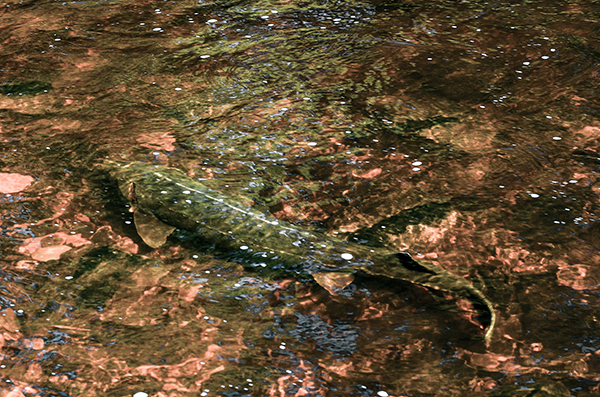
Lake sturgeon: the living fossils.
They’ve earned this moniker not only because they first appeared in the fossil record at least 100 million years ago or because their bony scutes give them a dino-like appearance, but because of their long lives.
According to previous research, lake sturgeon (Acipenser fulvescens) have a lifespan of up to 150 years.
But a new study published by researchers from the Michigan Department of Natural Resources, Michigan State University, Michigan Technological University and the Wisconsin Department of Natural Resources suggests that lake sturgeon may live longer than previously thought — much longer.
Fish age can be estimated using several structures, such as fin spines or otoliths (an ear bone). Like trees, these structures show annual growth rings. The oldest lake trout discovered in the Great Lakes, for example, was estimated to be 62 years old by counting the growth rings in its otolith.
But for fish that grow slowly and live a very long time, like lake sturgeon, estimating their age using growth rings can be difficult — the rings can be so numerous, thin and close together as to be impossible to accurately count. This results in underestimation of the true age of lake sturgeon.
Unlike people, who stop growing taller after reaching maturity, fish continue to grow throughout their lives.
Given that fish will continue to get bigger as they age, scientists can use information about the growth rate and fish size to estimate how old a fish might be, depending on its environmental conditions.
Fish in areas with a lot of food available will grow faster (and therefore, often larger) than fish in nutrient-poor environments.
|
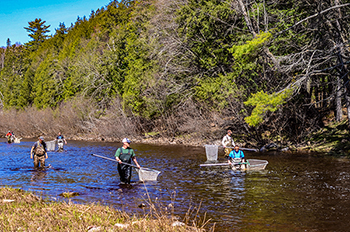
For five populations of Great Lakes lake sturgeon — Black Lake, Michigan (Cheboygan and Presque Isle counties); Sturgeon River, Michigan (Baraga County); Menominee River, Michigan/Wisconsin; St. Clair River (St. Clair County) and Lake Winnebago, Wisconsin — our research team used a novel approach to estimate growth rates using capture-mark-recapture data and used growth rate data to estimate longevity.
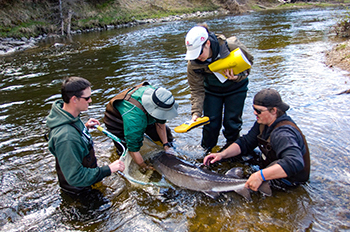
Essentially, the research team would capture fish, measure them, determine the sex, mark the fish with a tag and release them. Then, in future years, the research team would survey again, capturing and marking some new fish, but also recapturing some of the previously tagged fish. The recaptured fish were measured, as well.
With this information, we could look at how much fish grew between the time we first captured them and the subsequent recaptures. This was done over a period of 44 years, giving us ample opportunity to recapture sturgeon we’d measured before, some many years later.
Simply stated, we used this data to estimate lake sturgeon longevity by asking “If a lake sturgeon grows X centimeters per year, then how many years does it take for a lake sturgeon to get to a particular size?”
Using equations that related sturgeon growth rate to the size of the fish, we estimated expected longevity for 160-centimeter (approximately 63-inch) male and 180-centimeter (approximately 71-inch) female lake sturgeon across those five populations.
|
Longevity ranged from 90 to 279 years for males and from 99 to 427 years for females.
That’s up to 277 years older than the oldest lake sturgeon previously recorded! It’s also nearly as long a lifespan as the longest-lived vertebrate on Earth, the Greenland shark, whose longevity has been estimated at 272 to 512 years.
"When I began studying lake sturgeon in the late 1980s, I never thought I'd live to see their success and persistence after being listed as threatened,” said Nancy Auer, emeritus research professor of biological sciences at Michigan Technological University. “Let alone actually handle fish much older than I was — or am now, 30 years later — and that will be here after I am gone.”
Why does it matter how old lake sturgeon live to be?
Understanding how long these fish live can provide biologists insight into survival rates and reproductive opportunities for the species. For a species like lake sturgeon, which is still recovering in Michigan and elsewhere, this information can inform restoration efforts.
According to Michael Donofrio, retired fisheries supervisor at the Peshtigo office of the Wisconsin Department of Natural Resources, this project “brought together a great partnership with very groundbreaking research, which should aid with other North American sturgeon population management."
|
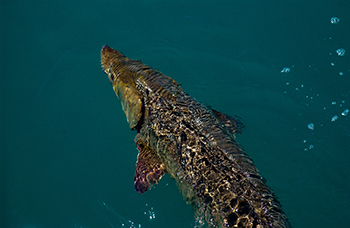
Lake sturgeon annual survival (that is, the probability of surviving from one year into the next) needs to be very high for fish to reach these advanced ages. For many other fish, annual survival probability can be close to 50 percent, but for lake sturgeon it is very high – at least 97%.
This is important for management. In addition to high annual survival and extreme longevity, lake sturgeon are late to mature and produce few offspring per year, all of which means harvest regulations should be very conservative to protect populations from overharvest.
The famous Black Lake sturgeon harvest season, which can last mere minutes, is limited in precisely this way.
Last year, the harvest limit was six lake sturgeon – not per angler, total.
Fisheries managers from state and tribal natural resource agencies gather annually to review data on the sturgeon population and determine the sustainable harvest limit for the season.
“One could assume that there’s a contradiction between restoring a threatened lake sturgeon population while allowing for a small annual winter harvest in Black Lake. I’ve been asked this question quite often during my career,” said Tim Cwalinski, Northern Lake Huron Unit manager for the DNR.
“However, without the publicity that the brief, limited harvest season provides, the public wouldn’t know as much about all the ongoing restoration efforts for Black Lake sturgeon, like research, stocking, the sturgeon guard program, fundraising, and education and outreach. Not only is the harvest important to the anglers and the local community, but these are also the same people investing in ongoing and successful restoration programs.”
|
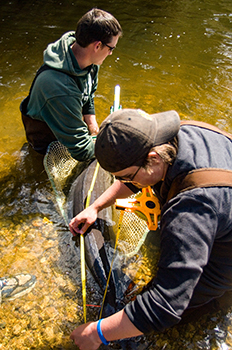
Lake sturgeon are truly unique among Michigan fishes for many reasons, including their extreme longevity. Having better, more accurate, estimates of how long these fish live can help us to conserve and restore this ecologically and culturally important species.
Long live lake sturgeon.
Read the full study in the Journal of Fish Biology. To learn more about lake sturgeon in Michigan, visit Michigan.gov/Sturgeon.
Check out previous Showcasing the DNR stories in our archive at Michigan.gov/DNRStories. To subscribe to upcoming Showcasing articles, sign up for free email delivery at Michigan.gov/DNREmail.
|
Note to editors: Contact: John Pepin, Showcasing the DNR series editor, 906-226-1352. Accompanying photos and a text-only version of this story are available below for download. Caption information follows. Credit Michigan Department of Natural Resources, unless otherwise noted.
Text-only version of this story.
Sturgeon-1: Dr. Edward Baker, Michigan Department of Natural Resources Marquette Fisheries Research Station manager, with a lake sturgeon captured for egg collection and tagging in the Sturgeon River in Baraga County.
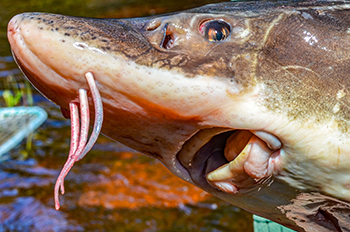
Sturgeon-2: A close-up of a lake sturgeon captured for egg collection and tagging in the Sturgeon River in Baraga County.
Sturgeon-3: A spawning lake sturgeon in the Sturgeon River in Baraga County.
Sturgeon-4: Michigan Department of Natural Resources staff implanting a tag in a lake sturgeon.
Sturgeon-5: A scene from Michigan Department of Natural Resources efforts to capture spring-spawning lake sturgeon for egg collection and tagging in the Sturgeon River in Baraga County.
Sturgeon-6: A lake sturgeon captured during a sturgeon setline survey in the St. Clair River system.
Sturgeon-7: Michigan Department of Natural Resources staff measure a lake sturgeon aboard the Research Vessel Channel Cat.
Sturgeon-8: A metal tag on a lake sturgeon.
Sturgeon-9: A lake sturgeon captured during a survey on the Black River in Cheboygan County.
Sturgeon-10: Researchers measure a lake sturgeon in the Black River in Cheboygan County.
Sturgeon-11: Close-up, underwater view of a lake sturgeon being measured by researchers.
|