IN THIS ISSUE
- Wild year in review
- 2025's top headlines
- Mockingbird mystery
- Right whale calf swap
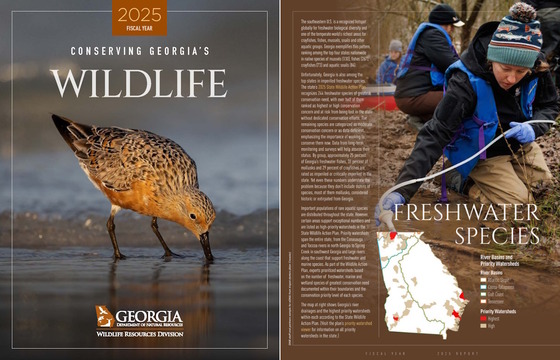 How wild was last year?
Find out in the new annual report from DNR’s Wildlife Conservation Section.
“Conserving Georgia’s Wildlife” covers an amazing breadth of work with nongame in fiscal year 2025. Highlights range from helping the Gopher Tortoise Conservation Initiative reach a milestone – 65 healthy populations permanently protected – to teaming with partners to conserve threatened trispot darters and documenting rare plant species statewide.
Skim the highlights in this summary brochure or dive deep into the details – online or via download – of an 85-page comprehensive report.
For any interested in Georgia wildlife, it’s time well spent.
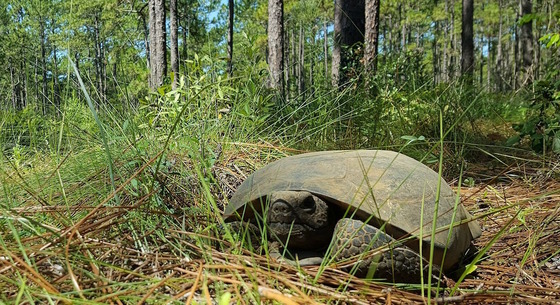 Readers judged protecting 65 Georgia gopher tortoise populations No. 1 for wildlife news (Joe Burnam/DNR)
TOP 'DID YOU HEAR' STORIES
In the previous Georgia Wild, we asked readers to rate the newsletter’s most interesting wildlife stories from 2025. Here are the top five:
-
Gopher tortoise conservation goal reached
- Rescue targets an entangled right whale
- A red knot’s amazing journey
- Georgia’s State Wildlife Action Plan completed
- Familiar indigo snake, but rare find for eggs
GIVE WILDLIFE A CHANCE
The work by DNR’s Wildlife Conservation Section to save and restore Georgia wildlife not fished for or hunted, plus rare plants and natural habitats, depends on fundraisers, grants and contributions. Not state funding.
How can you help?
-
Purchase an eagle or monarch butterfly license plate or renew these or an older design, like the hummingbird tag. Most of the extra $25 fee goes directly to wildlife.
-
Donate to the Georgia Wildlife Conservation Fund at gooutdoorsgeorgia.com. Click Licenses and Permits to create an account or choose Go Outdoors Georgia Shop to see donation options.
-
Contribute through the Wildlife Conservation Fund state income-tax checkoff. Details at georgiawildlife.com/donations.
-
Buy a hunting or fishing license. Each license purchase returns to Georgia wildlife that fee plus as much as $45 in federal excise taxes paid by hunters and anglers. A license also gives you access to wildlife management and public fishing areas statewide.
-
Volunteer with DNR and join conservation organizations such as our friends group, The Environmental Resources Network. Learn more at gooutdoorsgeorgia.com and tern.homestead.com.
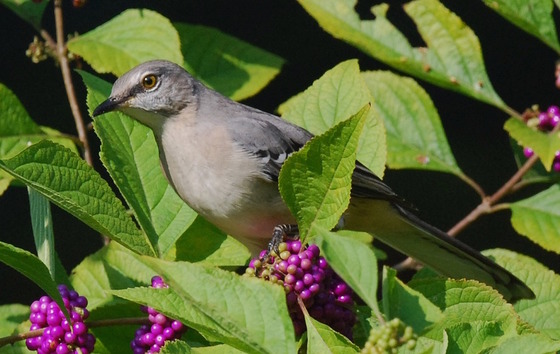 One key to keeping mockingbirds: native food sources, such as American beautyberry (Terry W. Johnson)
By TERRY W. JOHNSON
If you're like me, you are an avid fan of legendary sleuths such as Sherlock Holmes, Hercule Poirot and Jessica Fletcher. When we read about or watch the exploits of these detectives, it is impossible not to try to solve the mystery before they do.
But if you're looking for new mysteries, many are as close as your backyard.
One example is why do mockingbirds leave their spring and summer homes? Many Georgians will admit they want to know why the mockingbirds that inhabit their yards in warmer months simply vanish at the end of summer.
The answer is not shocking, but it is interesting. So is what you can do to help keep mockingbirds at home year-round. …
Read Terry’s column to solve this puzzle!
Terry W. Johnson is a retired DNR program manager and executive director of TERN, friends group of the Wildlife Conservation Section. Check out past columns and his blog. Permission is required to reprint a column.
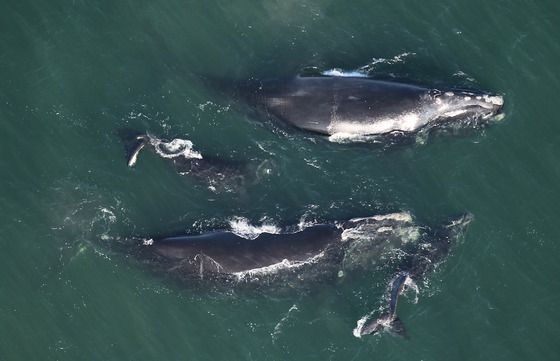 Harmonia, Bocce and calves off Cumberland Island Jan. 6 (CMARI/NOAA permit 26919)
The 2025-2026 calving season for North Atlantic right whales has been encouraging and even amazing.
The most encouraging part is that 22 calves have been spotted – the most since 2011 – and so far none have been lost.
The most amazing? That might be what DNR documented while watching two moms – catalog numbers 3101 (nicknamed Harmonia) and 3860 (Bocce) – and their calves off Cumberland Island on Jan. 6. Researchers were paying close attention because the four whales were often within a body length of each other as they rolled around at the surface. (Think play date for right whales.)
But it wasn’t until reviewing photos afterward that the crew confirmed something seldom seen: Harmonia and Bocce had exchanged calves. At least for that time.
DNR senior wildlife biologist Jessica Thompson, who leads the agency’s work with marine mammals, said calf exchanges are rarely observed in whales and there is little information on such incidents, including why they happen.
“We just don’t know,” Thompson said.
Before Jan. 6, only three calf exchanges involving North Atlantic right whales had been recorded. Two moms swapped calves in 1987 and 1997, and three adult females did so in 2016. (Bocce, interestingly, was one of the three-moms exchange.) As far as scientists know, those calves stayed with their adopted mothers. But the swap last month was temporary, Thompson said.
“We were able to determine that because of the collaborative monitoring in the calving grounds and the quality of photography by vessel and aerial survey teams. We could identify the calves by their different lip shapes and cyamid patterns, even though their callosities hadn’t formed.”
A biopsy sample taken a week later from the calf associated with Bocce could confirm that the calves returned to their moms.
WINTER WHALE UPDATES
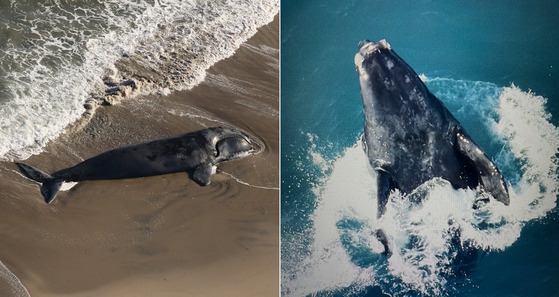 Young whale beached in Virginia; (r) Millipede's calf breaching in Georgia (CMARI/NOAA permits 24359, 26919)
- Right whale No. 3520 (Millipede) and her calf – DNR’s first mom-calf pair this winter, spotted Dec. 4 – were recently seen off Blackbeard Island. Why is that special? Because after the December sighting, the two took a long journey around the tip of Florida and into the Gulf. Boaters reported the pair off western Florida, Texas and the Florida Keys. But by Feb. 10, they were back in Georgia, with the DNR vessel and Clearwater Marine Aquarium Research Institute plane survey teams even catching the calf breaching (photo).
- This month, 18 of the season’s 22 mom-and-calf pairs, as well as eight adult females that could calve, have been seen off Georgia and Florida, the core calving grounds. But all will soon migrate north. Three females reported in the Southeast this winter have already been seen in Cape Cod Bay, Massachusetts.
- A 3-year-old female whale was reported dead on a Virginia beach Feb. 10. The whale was the third calf of right whale No. 3293 (Porcia). All have died, the previous two from entanglement in commercial fishing gear, according to the New England Aquarium. The cause of the latest death is being investigated.
- A right whale partially freed from fishing rope by DNR and partners in December was found floating dead off North Carolina last month. After the rescue attempt, the 4-year-old male known as No. 5217 (Division) swam to New England and then returned south. Monitoring showed its condition declining even as bad weather and distance from shore stymied efforts to remove the remaining gear.
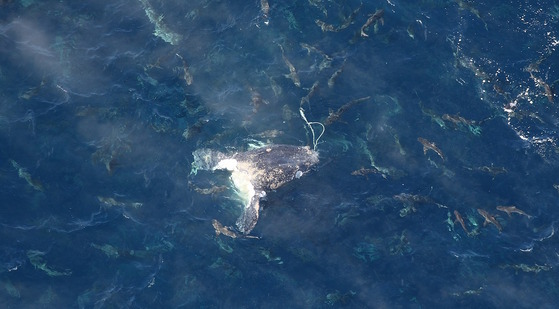 Sharks scavenge what's left of Division off North Carolina Jan. 27 (CMARI/NOAA permit 5217)
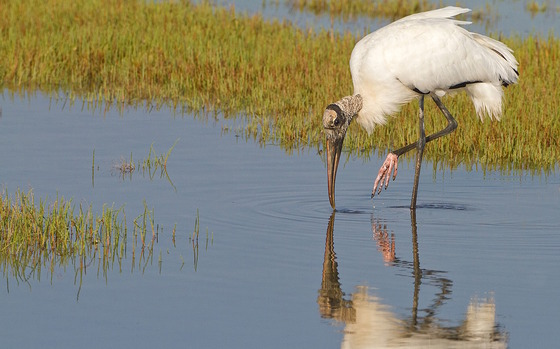 Wood stork on Jekyll Island (Ty Ivey/GNPA)
You can cross wood storks off the Endangered Species Act list. Finalizing a change in the works for years, the U.S. Fish and Wildlife Service announced that the big, gangly birds will be delisted March 9.
Wood storks were classified as endangered in 1984, after their population had shrunk by over 75 percent since the 1930s – largely due to habitat loss. Estimates now range from 10,000-14,000 nesting pairs, a four-fold increase. The breeding range of the nation’s only nesting stork also has expanded across Florida and into Georgia and the Carolinas. The species was downlisted to threatened in 2014.
Last year, DNR’s wood stork nest survey in Georgia – home to a fifth of the birds' nesting population – yielded a state record of 2,988 nests and 29 colonies. The DNR Wildlife Conservation Section supported delisting. But it also recommended continuing robust monitoring for at least 10 years, citing concerns about climate change impacts on wood stork colonies and the loss of protection on private lands.
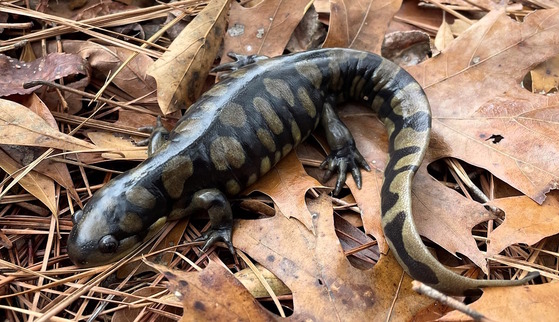 Gordon County's first recorded eastern tiger salamander -- a gravid female (Thomas Floyd/DNR)
Make that two eastern tiger salamanders found in Gordon County. A resident alerted DNR to first a female and then weeks later a male tiger salamander, both from the same area and both the only accounts from Gordon (and just the fifth from northwest Georgia) of the State Wildlife Action Plan species of greatest conservation need. (The sightings were made to DNR’s portal for reporting giant salamanders. Learn more about sending details on targeted species.)
When a bat infestation temporarily closed an elementary school in St. Marys last month, DNR’s Wildlife Conservation Section worked with the Camden County school superintendent and others such as the state Public Health Department to hold an online community meeting to address concerns. Program Manager Trina Morris, a lead bat biologist for DNR, said she felt it was important to provide information about native bats, including why they would seek refuge in the school.
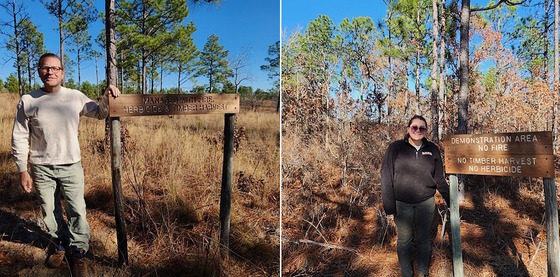 Sandhills West tracts for comparison: left, managed; right, unmanaged (DNR)
Seeing is believing, right? DNR’s west-central Georgia prescribed fire crew has left a small tract of Sandhills West Wildlife Management Area in Taylor County unburned, and posted signage about that scrubby site and adjacent land where burns and other work have restored the biologically rich sandhills habitat.
Registration is open for Georgia's 20th Youth Birding Competition. Scheduled for April 10-18, this free, fun event will feature teams of kindergarteners to high-schoolers and a prize-packed awards banquet. Sign up now.
More than 470 sooty-banded darters collected by DNR’s Stream Survey Team and the U.S. Fish and Wildlife Service will be used as host fish to help raise Ochlockonee moccasinshell mussels at the Warm Springs National Fish Hatchery. The goal: Reintroduce these endangered mussels, plus a sister species, into streams in its previous range in north Florida and south Georgia.
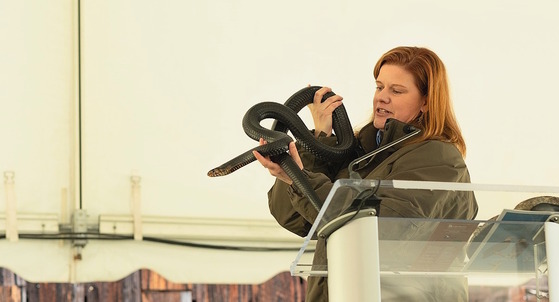 DNR's Linda May shows an eastern indigo snake: Both will be at the upcoming rattlesnake festivals (DNR)
Quick hits:
- It’s time to shake, rattle and go as Georgia’s two rattlesnake and wildlife festivals – Whigham on March 7 and Claxton March 14-15 – showcase native wildlife (including rattlers and other snakes), plus festival entertainment from car shows to live music and food.
- The Georgia Native Plant Society is urging lawmakers to pass House Bill 955, which would change the state flower from invasive Cherokee rose to native sweetbay magnolia and designate April as Native Plant Month.
- Track wildlife-related bills in this year’s Georgia General Assembly – such as legislation to extend the Georgia Outdoor Stewardship Program – through the Georgia Conservancy and Georgia Wildlife Federation’s Camo Coalition.
- Wildlife Conservation Section staff have added three Motus stations on Georgia Forestry Commission fire towers near the Okefenokee National Wildlife Refuge, boosting the statewide network of antennas used to track migrating birds, bats and insects (“Antennas Up,” September 2025).
-
Sea turtle strandings on Georgia’s coast last year underscored a 37-year decline in dead loggerheads – the state’s primary nesting sea turtle – but also noted an increase in green turtle strandings.
- Join a monthly volunteer workday to help restore a formal garden at Altama Plantation Wildlife Management Area near Brunswick (contact).
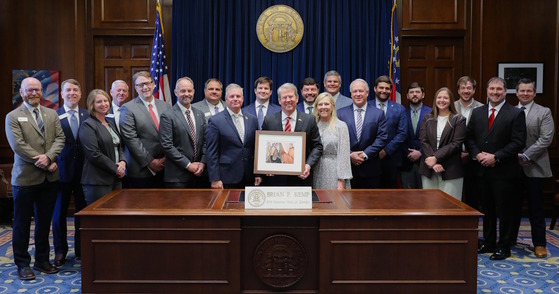 Announcing DNR's 2026 Forestry for Wildlife partners at the Capitol (Office of the Governor)
Names in the news: Gov. Brian and First Lady Marty Kemp recently joined DNR leaders in recognizing four corporate forest landowners for stewardship and land management practices benefiting Georgia’s wildlife. Weyerhaeuser, Forest Investment Associates, Georgia Power and PotlatchDeltic – now called Rayonier since the two merged – were named 2026 Forestry for Wildlife partners at the state Capitol. The governor and first lady also proclaimed the first week of February as Prescribed Fire Awareness Week, highlighting how fire restores forestlands, benefits wildlife and reduces wildfire risks. University of Georgia PhD student Emma Briggs has documented wooly oil-digger bee, a specialist bee that collects floral oils instead of pollen, for the first time in Georgia. DNR Program Manager Dr. Bob Sargent helped author a recent paper in Scientific Reports exploring the spread of highly pathogenic avian influenza in black vultures.
WHAT YOU MISSED ...
In the previous Georgia Wild:
- Tracking monarchs like never before
- Why cavities are critical for birds in winter
- Drama at sea: whale rescue, calving news
- Add this WMA for state's rarest woodpeckers
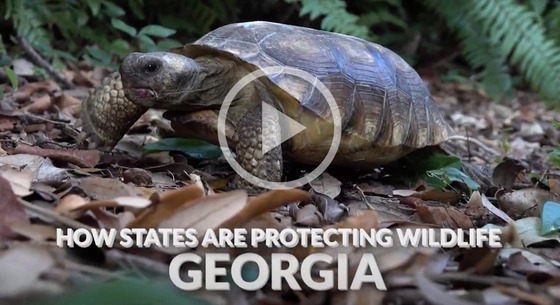 "Georgia: How States Are Protecting Wildlife," Environment America
Leatherback sea turtles off Georgia's coast, DNR
"Georgia Low Impact Solar," The Nature Conservancy
"Wood stork removed from federal endangered wildlife list," CBS News and others
"Ga. youth invited to sign up for 20th Youth Birding Competition," Grice Connect
"Bid for state's first World Heritage site in home stretch," The Atlanta-Journal Constitution
"Over 10,000 acres secured for Ga., Ala. sportsmen," Georgia Outdoor News
"Glynn Co. brings turtle-friendly lighting plan to residents," The Current
(+audio) "Rare woodpecker released to new home in south Ga.," GPB
"A right whale baby boom is on: But the species remains at risk," Wired
"Right whale 'Division' found dead after entanglement in Ga.," Savannah Morning News. Also: Canadian Broadcasting Corp.
"Messaging mariners in real time to reduce right whale vessel strikes," NOAA
"Scientists use ‘torpedo’ in effort to save rare whales from boat collisions," The State (Columbia, S.C.)
"Gov., DNR announce 2026 Forestry for Wildlife partners," Bryan County News. Also: WNEG-FM (93.1, Toccoa).
"DNR opens 36th wildlife poster contest," WJCL-TV (ch. 22, Savannah)
"Fat, body condition variation in tegus: native-invasive comparisons," PLoS One
"State House passes bill expanding feral hog hunting," WABE-FM (90.1, Atlanta)
"Kemp honored for conservation, sportsmen efforts," WSB-TV (ch. 2, Atlanta)
"Rhode Island man shoveling driveway finds tegu buried under snow," People
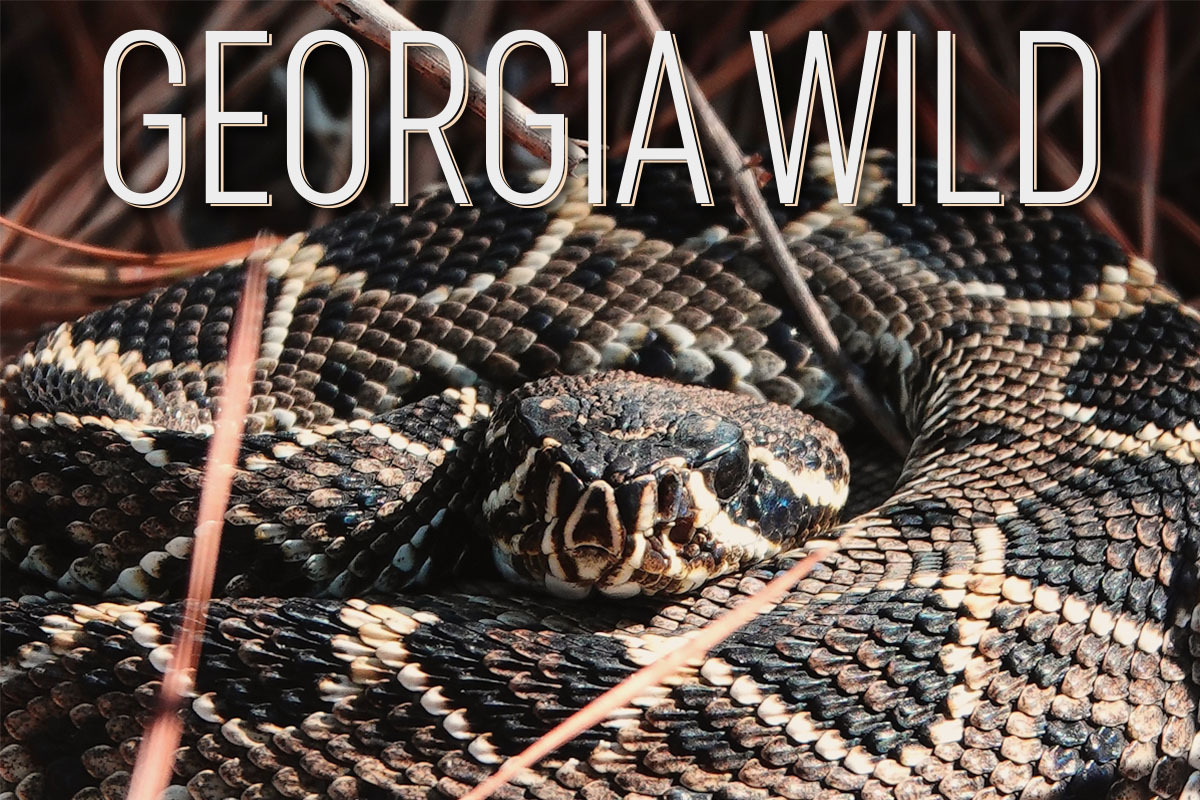
CREDIT: Georgia Wild masthead/eastern diamond-backed rattlesnake (Matthew Moore/DNR)
Top
|