IN THIS ISSUE
- Red squirrel sightings
- Red knot survives Erin
- Antennas up for bats, birds
- Why bluebirds aren't truly blue
- A cap for your feedback? Maybe
 Reported sightings can provide needed information on red squirrels in northeast Georgia. (Adobe Stock)
Seen a red squirrel in Georgia? Let us know.
DNR has teamed with the University of West Georgia’s Dr. Andrew Edelman and the U.S. Forest Service to document sightings of these red-hued, pint-sized cousins to gray squirrels.
Wildlife biologist Sam Holst said the goal is learning more about where red squirrels are in Georgia and what habitats they’re using. “We just don’t have a lot of data about them.”
The continent’s smallest squirrel ranges from the boreal forests of Canada and the northern U.S. south into the Rockies and Appalachians. In Georgia, red squirrels are found only in a northeastern slice of the state. They tend to favor woodlands of hemlock, pine and other conifers (thus the nickname “pine squirrel”). But they will use other forest habitats and, like gray squirrels, dine at your bird feeders.
Georgia’s 2025 State Wildlife Action Plan lists red squirrel as a species of greatest conservation need. Sightings can help researchers understand how habitat and climate changes, as well as the loss of hemlocks to invasive hemlock wooly adelgids, may affect southern populations.
Flyers have been posted at national forest kiosks, state parks and on social media. Report sightings – including photos, habitats, vocalization recordings, coordinates and any notes on behavior and habitat – by:
This is one case where “Squirrel!” is a worthwhile distraction.
ALSO WANTED: SPOTTED SKUNK SIGHTINGS
There's a BOLO statewide for eastern spotted skunks. Following a dramatic and little understood population decline, these once-common skunks are now rare.
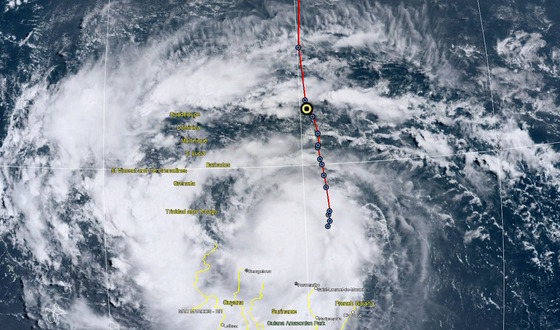 An overlay of monitoring data maps red knot LN5 meeting Erin last month.
Another migrating red knot has been tracked flying through a hurricane.
On Aug. 15, the shorebird known by its leg band code LN5 beelined south across the Atlantic and into Erin as the storm grew into a hurricane near the Lesser Antilles.
LN5’s flying slowed to as low as 20 mph compared to a 38 mph-average before plunging into Erin, according to Fletcher Smith, a senior wildlife biologist with DNR's Wildlife Conservation Section.
But the red knot made it through the storm’s strongest side, and apparently just in time. Erin exploded into a category 5 hurricane the next day.
LN5 landed in Suriname the evening of Aug. 16, completing a five-day, non-stop Arctic-to-South America flight of more than 3,800 miles. At last check the bird was in Coppenamemonding, a Western Hemisphere Shorebird Reserve Network site on the coast of the South American country.
Like last year’s similar tale of *H7, this storm survivor is part of a multipartner project tracking red knot populations that stopover in South Carolina and Georgia. In the process, the project is mapping the amazing and perilous migrations these threatened birds make twice a year.
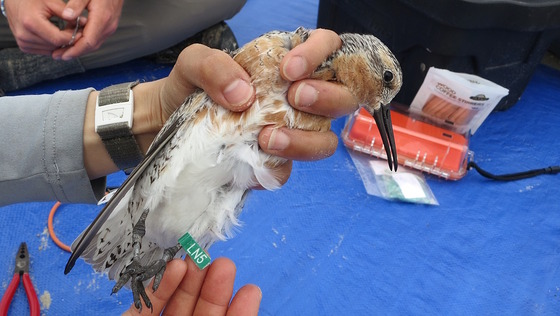 LN5 being fitted with a transmitter on South Carolina's Little Bull Island in May (S.C. DNR)
Follow tracked red knots and sign up for email updates. As of late August, LN5 was one of 11 satellite-tagged knots still transmitting location data.
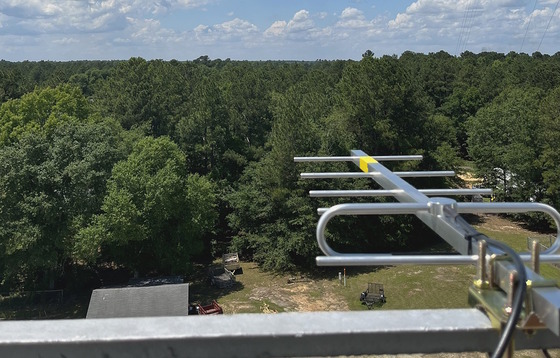 View from the fire tower in Sylvania where a Motus antenna was added (Sam Holst/DNR)
By SAM HOLST
Tracking wildlife moving through Georgia is easier with 15 more Motus sites statewide.
Motus (Latin for “motion”) uses automated radio telemetry to map the migrations of highly mobile animals such as birds, bats and butterflies. Because this system led by Birds Canada is a global collaboration, species can be tracked beyond state lines, national borders and even continents.
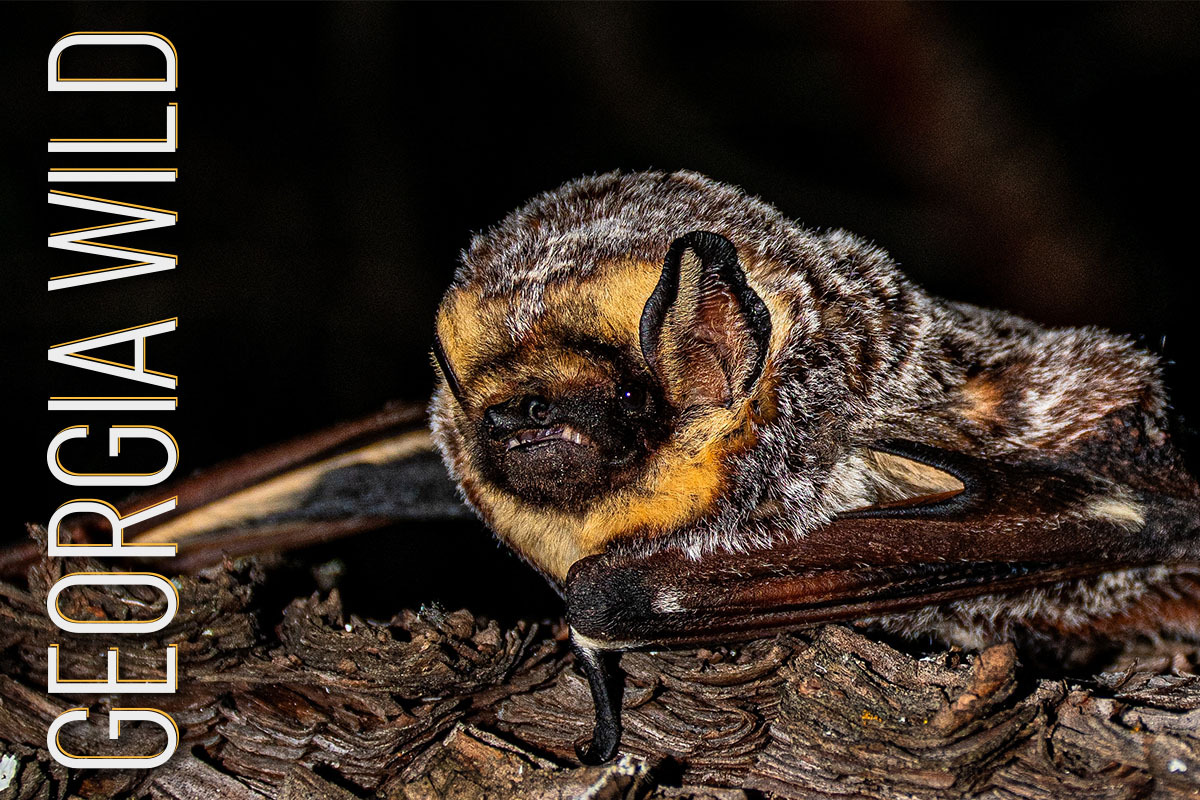
DNR and partners have used coastal Motus sites to explore where saltmarsh sparrows that winter in Georgia migrate to breed. But last year’s venture with American Bird Conservancy to install or upgrade stations on 15 Georgia Forestry Commission fire towers from Midway to Piney Mountain – basically doubling the number of Motus stations in the state – is focused on hoary and silver-haired bats.
DNR’s mammal team hopes this detection “fence” will shed light on the long-distance migration patterns of both species. Little is known about those journeys, especially in the Southeast. The data could help shape conservation decisions in areas the bats depend on during migration, whether they’re flying through or spending the winter here.
So far, staff haven’t been able to catch either species to attach the nano tags that each Motus receiver can pick up within a 10-mile radius. But while trapping efforts continue, the towers aren’t idle. They’re recording other tagged wildlife.
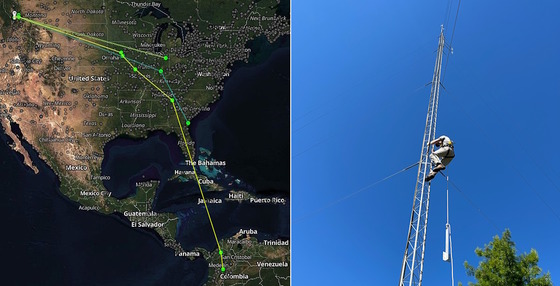 Motus track of nighthawk migration; right, installing an antenna (provided by Sam Holst/DNR)
Nearly 40 species have been detected moving through Georgia, including eastern whip-poor-wills migrating from Ontario to Mexico and common nighthawks migrating from Montana to South America. As part of the Motus collaborative, that data supports a range of bird projects.
Learn more, including what species Georgia stations are documenting.
Wildlife biologist Sam Holst leads the Motus project for DNR’s Wildlife Conservation Section.
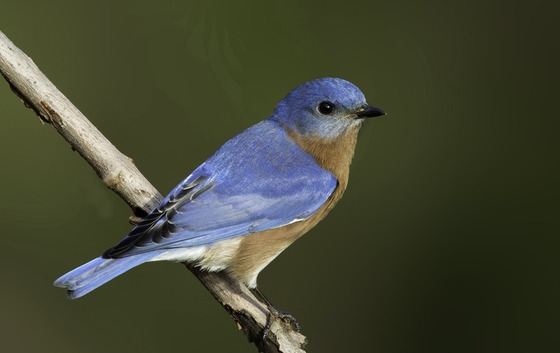 The blue humans see in bluebirds involves the way their feathers reflect light waves. (Ty Ivey/GNPA)
By TERRY W. JOHNSON
One spring morning a decade or so ago, I tried to photograph a pair of bluebirds bringing food to their hungry young inside a nesting box in my backyard.
I set my camera up early that morning at a safe distance from the box, hoping to take advantage of what photographers call the golden hour, that special time in early morning or late afternoon when the sunlight bathes everything with a golden hue.
As I watched the birds bringing tiny caterpillars to their voracious young, the return of the male was something to behold. During the few seconds it hesitated at the box’s entrance, the rich sunlight made the bird's feathers appear to almost glow.
But after photographing the bird several times, for some reason I recalled the time years before when I learned that a bluebird is not actually blue. It was like discovering that George Washington didn't cut down a cherry tree or handling a toad doesn't cause warts.
The bluebird’s feathers are actually grayish brown. The blue comes from something called schemochrome, or structural, color. Here’s how it works. …
Read Terry’s column to learn why we see blue when watching a bluebird.
Terry W. Johnson is a retired DNR program manager and executive director of TERN, friends group of the Wildlife Conservation Section. Check out past columns and his blog. Permission is required to reprint a column.
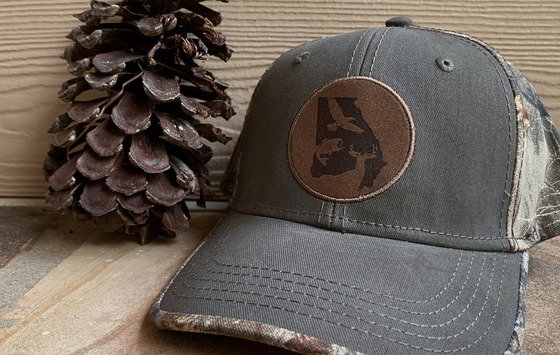 Hankering for a hat? Take the survey for a chance to claim one.
If you’re a veteran Georgia Wild subscriber, you know the drill.
About this time each year, we ask for your feedback on this newsletter. In return, we offer you the chance to win a cool DNR cap.
Just click the button below for the reader survey. It takes only about seven minutes to complete. At the end, you can add your email to a drawing for one of 10 hats.
But cap or not, you still win. Your comments help us improve Georgia Wild. Which means more of the wild news you enjoy arriving in your inbox each month.
Don’t delay on the survey. It closes Sept. 13. (If you win, we’ll email you by Sept. 19.)
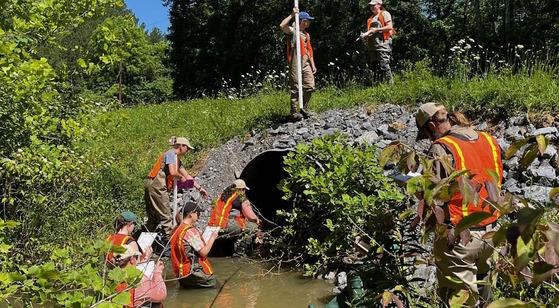 Checking a northwest Georgia culvert to see if it poses problems for fish migrating upstream (DNR)
Road culverts are a key to conserving federally threatened trispot darters. Crossings that don’t allow the fish to pass – such as a culvert where the lip is perched too high above the downstream channel – block the darters’ winter runs upstream into small creeks to reproduce. As part of an America the Beautiful Challenge grant, DNR and partners have worked in northwest Georgia to find problem culverts and replace those that benefit spawning habitats and stream health the most. The culvert crew includes the Southeast Aquatic Resources Partnership, The Nature Conservancy, Limestone Valley Resource Conservation and Development Council, Dalton State College and the University of North Georgia. For children: Download the free coloring book "How to Spot a Trispot.”
Southern hognose snakes, stout reptiles with upturned snouts and a tendency to play dead, are proposed for listing as threatened under the Endangered Species Act. These secretive snakes sometimes confused with the more common eastern hognose were once found in open-canopy, upland Coastal Plain forests from North Carolina to Mississippi but have become rare largely due to habitat loss and fragmentation.
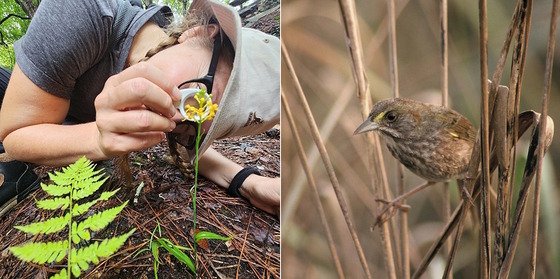 Joyce Klaus IDs a yellow-crested orchid; right, saltmarsh sparrow (Nathan Klaus, Todd Schneider/DNR)
Orchids and August? Yep, they go together. DNR senior wildlife biologist Nathan Klaus and his wife Joyce, a botanist, spotted state-tracked yellow crested orchid (Platanthera cristata) on public land in Upson County last month. Only a week later at a Taylor County wildlife management area, the pair found a known population of white-fringed bog orchid (Platanthera blephariglottis) in bloom and thriving, thanks to regular prescribed burns done by DNR.
In surveys across Georgia's coast, a Wildlife Conservation Section-led effort captured, assessed and released almost 800 seaside, saltmarsh and Nelson’s sparrows over the past two winters. The data will be used to help conserve these species – the number of saltmarsh sparrows plunged an estimated 80 percent during the last decade – but staff and partners are already using findings to map critical high-tide habitat used for roosting.
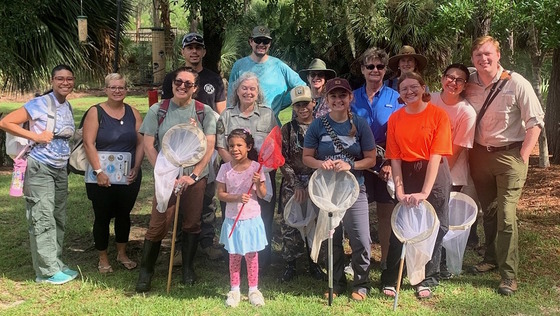 Ready, set, net: Bumblebee Atlas group in training at Skidaway Island State Park poses for a picture (DNR)
Busy describes DNR’s terrestrial invertebrate team. From Black Rock Mountain State Park in northeast Georgia to Skidaway Island on the coast, staff did Southeast Bumble Bee Atlas surveys and joined with Avery Young of the Xerces Society for Invertebrate Conservation to train others last month. (Bizzzy ... You got it, right?)
Upgrades to the interpretive trail on Ohoopee Dunes Wildlife Management Area include a refurbished deck that overlooks a sandhills pond. The nearly 2-mile trail wanders through unique sand dune ecosystems at the WMA near Swainsboro.
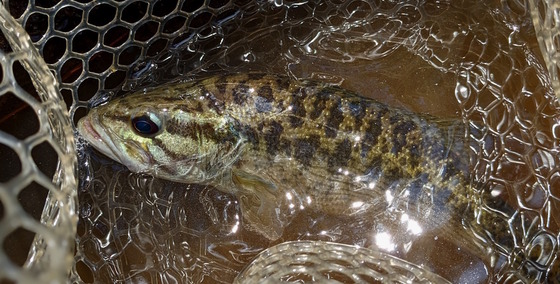 Altamaha bass, as well as Bartram's, are on record as a new species. (Ethan Dodd/DNR)
Quick hits:
Names in the news: DNR’s Law Enforcement Division recently named Game Warden 1st Class Hunter Rush its Game Warden of the Year, with Cpl. Zach Griffis receiving the runner-up James R. Darnell Award. Rush is assigned to Murray County and Fort Mountain State Park; Griffis works in Glynn County. Awards list.
WHAT YOU MISSED ...
In the previous Georgia Wild:
- Swallow-tailed kite swarms
- Epic migrations of ... insects?
- Crape myrtles and pollinators
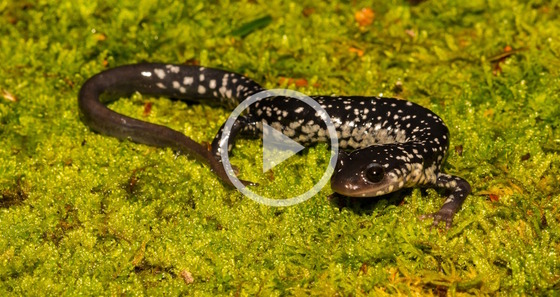 Northern slimy salamander (Adobe Stock)
"Meet the Northern Slimy Salamander," DNR
(audio) "Tracking Georgia's sea turtles is long, slow process that just might keep them alive," WABE-FM (90.1, Atlanta)
Summer snake sequel: copperheads with DNR's Daniel Sollenberger, DNR
"Florida deploys robot rabbits to control invasive pythons," CBS News
Dockside "dad" jokes with biologists, DNR
"Outdoors Beyond Barriers," DNR
"Georgia absorbs sea turtle monitoring cuts," Savannah Morning News
"Dalton rallies to save an endangered fish," Dalton Daily Citizen
"New bass species in Georgia, S.C.," Wired2Fish. Also: The Atlanta Journal-Constitution, (+audio) Georgia Public Broadcasting. Related: "50 fish, 50 states: Bartram’s bass," CoolGreenScience.
"Dozens turn out for snake-tacular gathering at library," Dawson County News
"Georgia bears out searching for food now," Columbus Ledger-Enquirer
"The 20-ton python purge," The Wildlife Society
"Florida tegu trap powered by AI and sunshine," The Palm Beach Post (Fla.)
"Tentacle bunny virus rebrands jackalopes in viral trend," The Wildlife Society
"Birding as tourism promotion continues to take flight," Forbes
"S.C. dolphins contain microplastics even before birth," The Wildlife Society
"New invasive pest spreading rapidly in Georgia," The Atlanta Journal-
Constitution
"Vogel State Park opens $4.6M visitor center," NowHabersham.com
 DNR's Berkeley Boone talks alligators and other native wildlife during Hunting and Fishing Night at Truist Park in Cobb County. As part of the Aug. 23 outreach teaming the Atlanta Braves, Realtree and DNR, The Battery Atlanta featured pre-game festivities including live wildlife, educational exhibits and interactive stations highlighting hunting, fishing and wildlife conservation in Georgia.
CREDIT: Georgia Wild masthead -- hoary bat (Adobe Stock)
Top
|