IN THIS ISSUE
- Swallow-tailed kite swarms
- Epic migrations of ... insects?
- Crape myrtles and pollinators
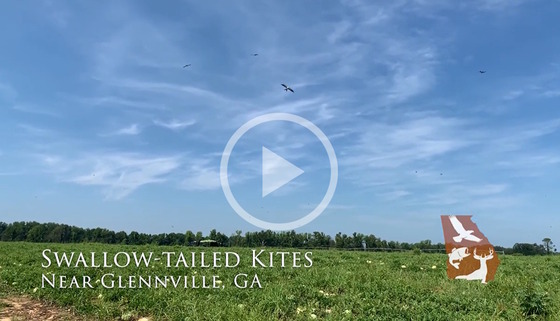 In a sun-scoured watermelon field near Glennville last week, workers moved slowly through a maze of plants, sand and heat, trailing sounds of talk and the bass throb of music on a radio as they stacked melons the size of soccer balls onto trailers and trucks.
But just above the men, a quieter harvest was taking place (watch).
More than 100 swallow-tailed kites swirled through the glaring blue-white sky. Heads down, eyes searching, the slim white-and-black birds hunted insects below. Most they caught in flight. All were eaten on the wing.
In this aerial ballet of predator and prey, the raptors swiveled their deep-forked tails to spur head-snapping turns. Tweaking the arc of long wings, they made quick grabs at insects or plunged into swoops, some that almost brushed tall weeds in the field.
From late July to mid-August, swallow-tailed kites often gather in groups to feed over south Georgia fields and other open areas before migrating to South America. Although the birds can show up farther north before flying south for winter, Georgia’s largest foraging aggregations are usually found in Tattnall and surrounding counties.
To learn where the kites are, check Georgia Birders Online and eBird for sightings or consult Birds Georgia and local Audubon Society chapters. Foraging usually peaks in late morning. But hotspots can change and kite numbers fluctuate day by day.
If you go, view wildlife responsibly. Stay off private land and clear of farming operations. Park safely. And be respectful to others.
Also see: Tracking swallow-tails with Avian Research and Conservation Institute.
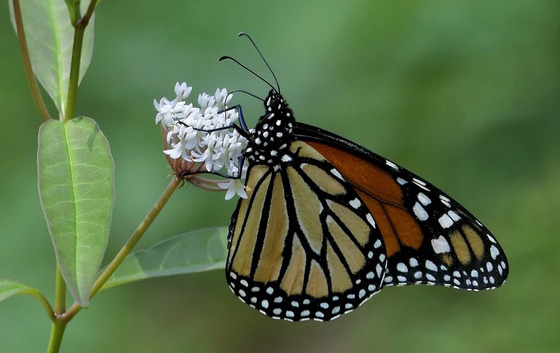 Monarch butterfly on aquatic milkweed (Linda May/DNR)
By ANNA YELLIN
What do North Atlantic right whales, red knots and monarch butterflies have in common?
It’s not habitat. Or size, obviously (adult right whales average about 55 tons; monarchs, half a gram). Neither is it natural history. These three vary from mammals that raise their young to insects that lay eggs, leave and never look back.
The answer is that each species is part of awe-inspiring, long-distance migrations along the Atlantic Coast. Georgia’s coastline is not only a fall flyway for migratory birds and a water route for right whales, it’s an aerial highway for insects migrating hundreds and even thousands of miles. Here’s how to catch this epic odyssey.
What to look for ...
Migrating insects are less in-your-face obvious than birds. They use coastal breezes and ride air currents. They’re small and easy to overlook. Also, migrating butterflies are not social butterflies: They fly solo. There is no known communication, unlike a flock of sandhill cranes heard overhead, and the number of migrating insects is a mystery.
The take-home is that you have to pay close attention. But the insects are there. There are exponentially more flying along our coastline than birds. During September and October, thousands can pass unnoticed in only a few hours.
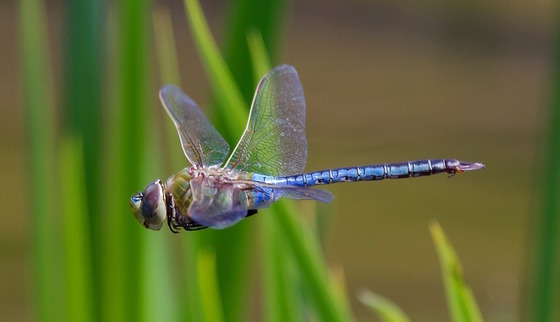 Common green darner (Adobe Stock)
Where to look ...
For butterflies, the ideal place is where dunes meet the sea. These areas offer protection from strong gusts and allow butterflies to save energy by riding gentle air currents. Native dune flora such as beggar ticks, verbena and silkgrass provide needed nectar. By day, butterflies may venture inland to more abundant flowering areas. At night, they light in trees along the way. Boardwalks that cross the dunes to reach the beach are great places to watch for them.
While monarchs are the best known butterfly migrants, others are fluttering down our coast and some even across our state. These include bright orange gulf fritillaries, yellow cloudless sulphurs and multicolored American ladies, painted ladies and long-tailed skippers. Monarchs have the longest journey, with the eastern population flying up to 3,000 miles in the fall to the Oyamel fir forests in Mexico.
For migrating dragonflies, freshwater or brackish marshy areas behind the dunes are ideal spots to watch. Instead of nectaring, dragonflies eat other insects to refuel during migration.
The most recognized of these skinny travelers is the common green darner. Like the monarch, common green darners migrate from as far north as Canada to overwinter as an adult. In America’s Gulf states or Mexico, the full cycle of this migration – like the monarch's – takes multiple generations to complete.
Lesser-known migratory dragonflies following our coastline include the wandering glider, spot-winged glider and Carolina saddlebags.
As summer wanes and school starts, some consider beach season over. But I argue it's the time for a migration vacation on the coast. Bird till noon, then go buggin’!
Anna Yellin is a wildlife biologist with DNR’s Wildlife Conservation Section.
BUG WATCH
Help monitor Georgia insects, those that migrate and those that don’t:
LANTERNFLY ALERT
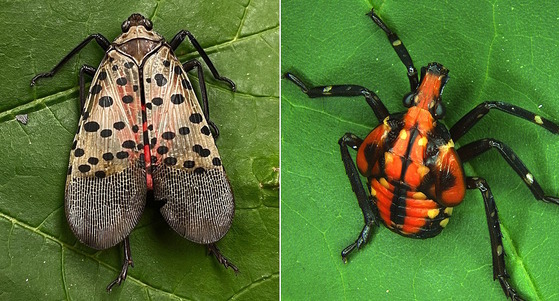 Spotted lanternflies in adult, left, and nymph stages (provided by UGA)
Sightings of spotted lanternfly sightings are on the rise in Georgia. This invasive pest is a growing concern for agriculture and natural habitats. Early detection is critical.
What to do: If you see one (here’s a guide), take a clear picture, kill it and report it.
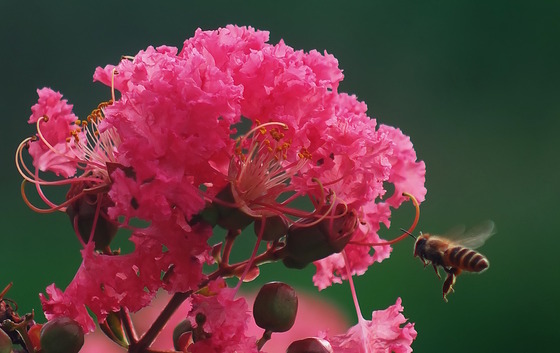 Crape myrtles have long been seen as more ornamental than helpful for wildlife (Adobe Stock)
By TERRY W. JOHNSON
The crape myrtle landed on North American shores at the port in Charleston, S.C., in 1790. During the more than two centuries since, this Asian import has become one of the most common ornamental trees planted in the South. For weeks now, crape myrtles have been blooming along city streets and in schoolyards, parks and backyards across Georgia.
Despite the plant’s popularity, however, most wildlife enthusiasts consider crape myrtles of little value to native wildlife. But some research suggests that these “lilacs of the South” may be more beneficial for some pollinators than thought. …
Read Terry’s column for insights into studies exploring crape myrtles and bees.
Terry W. Johnson is a retired DNR program manager and executive director of TERN, friends group of the Wildlife Conservation Section. Check out past columns and his blog. Permission is required to reprint a column.
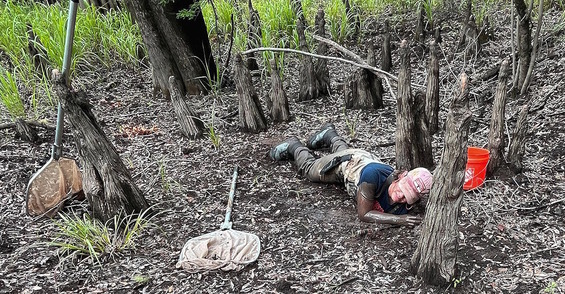 North Carolina Museum of Natural Sciences' Dr. Bronwyn Williams searches a crayfish burrow (Tiffany Penland/DNR)
It might have looked like crawdadding, but what DNR’s Freshwater Biodiversity Program and staff from Georgia Southern and West Liberty universities were doing recently near the Okefenokee Swamp was surveying for crayfishes. Too little is known about many native crustaceans here and in the Carolinas. A Competitive State Wildlife Grants project teaming the three states and including genetic analysis aims to answer questions about species’ distribution, habitats, taxonomy and life histories. The results will help conserve crayfishes listed as species of greatest conservation need in each state’s Wildlife Action Plan.
It’s here: Read and download the 2025-2026 Georgia Hunting and Fishing Regulations and Seasons guide online or pick up a copy at DNR Wildlife Resources Division offices or license vendors statewide.
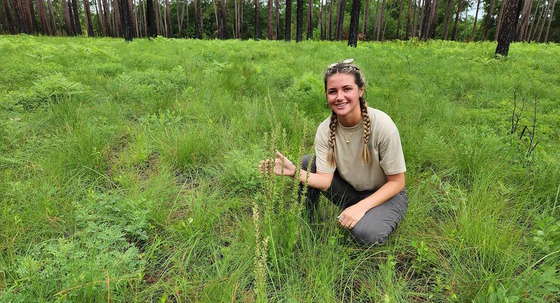 DNR's Audra Futch shows flowering American chaffseed (Phil Spivey/DNR)
American chaffseed is doing OK at Doerun Pitcherplant Bog. DNR found 110 of the endangered plants flowering on the wildlife management area near Moultrie, which is fitting since the cryptic, hard-to-spot Schwalbea americana favors longleaf pine stands with robust groundcover shaped by frequent burns – and Doerun has about 300 such acres, some of the richest groundcover in Georgia’s Coastal Plain.
Explore ways to increase the value of your land for you and wildlife at the 2025 Agroforestry and Wildlife Field Day. Set for Sept. 18 at the University of Georgia’s Westbrook Research Farm in Griffin, the event covers a deep lineup of expert-led topics varying from healthier quail coveys to improved forest stands. Register.
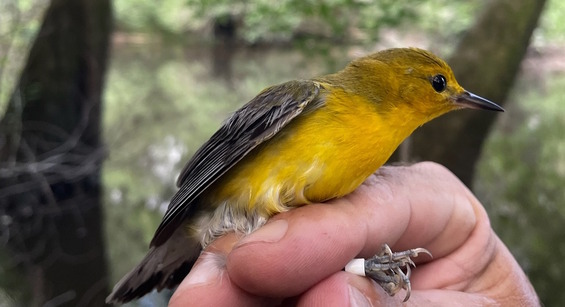 A prothonotary warbler banded on the Alapaha River (Joe Burnam/DNR)
Prothonotary warblers – the bright yellow bottomland birds with beady black eyes – enjoyed a solid breeding season using nest boxes along south Georgia’s Alapaha River, with 18 nests producing 30 chicks. But boxes lining the region’s Ochlockonee River flooded, yielding no nests, although DNR Wildlife Conservation Section biologists did see and hear prothonotaries in the area during surveys.
A mass banding on Brunswick Bird Island last month put ID leg bands on 750 royal tern chicks. The DNR-coordinated effort involving partner organizations and volunteers will yield insights for years to come, as evidenced by royal terns banded in Georgia seen in New Jersey and Peru and some banded in 2019 on the dredge spoil island ("Royal tern rodeo," July 2019) recorded returning there to breed.
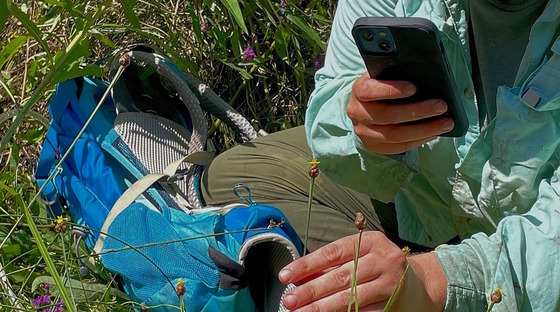 When sharing rare plant photos, don't include geotags or other sites specifics (Joe Kirsch/USFWS)
Quick hits:
-
With poaching posing a thorny threat to rare Georgia plant species, leave native plants in the wild and if you put photos on social media, skip the geotags and don’t share location details (poachers search posts for clues).
- A federally threatened green sea turtle weighing about 400 pounds died in June after being hit by a boat off St. Simons Island, a loss compounded by the fact the massive turtle had eggs and was prepared to nest.
- Registration has opened for the Georgia Prescribed Fire Council's annual meeting, Sept. 23 at Valdosta's Rainwater Conference Center.
- Of 27 red knots fitted with satellite transmitters in South Carolina this spring – part of a project involving DNR – 16 were tracked to Arctic breeding grounds and about 11 have since started migrating south. Receive updates.
- The just-announced Bird City Georgia initiative promotes cities, towns and counties statewide taking action to protect native birds and enhance the quality of life for people.
- Download free digital maps of U.S. Forest Service lands to explore trails, campgrounds and recreation areas near you.
- When barbecuing in bear country, be Bearwise and avoid unwanted visitors by cleaning up afterward and storing grills and smokers in a secure area.
Names in the news: Florida native James “Buddy” Powell, renowned for his conservation work with manatees as well as North Atlanta right whales and sea turtles, died July 19. “Buddy’s passion for marine research and his unwavering dedication made a lasting impact – not only on our mission, but on all of us who had the privilege of knowing him,” said Joe Handy, CEO of Clearwater Marine Aquarium. Powell served as chief zoological officer at the aquarium and executive director of its research institute. Wildlife Conservation Section Program Manager Dr. Bob Sargent co-authored a paper on the 2022 outbreak of highly pathogenic avian influenza in black vultures published in the Journal of Wildlife Diseases.
WHAT YOU MISSED ...
In the previous Georgia Wild:
- Mussel magic on video
- Red knot's wild journey
- Stories of plant champs
- Feeding tips for hummers
- Bald eagle nesting results
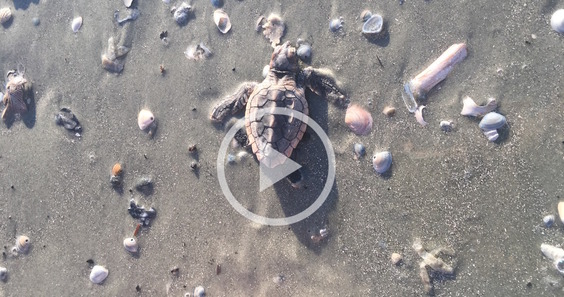 Loggerhead sea turtle hatchling (Sarah Martin/DNR)
Loggerhead hatchlings scurry to the surf, DNR
(audio) "Building Bird-friendly Cities with Tim Beatley," The Future of Conservation podcast, U.S. Fish and Wildlife Service/National Conservation Training Center
"Georgia's Nightlife is Glowing" (lightning bug surveys), DNR
Killdeer and chicks, Bryn Pipes, The Nature Conservancy in Georgia
DNR's Daniel Sollenberger celebrates World Snake Day, DNR
Game Warden 1st Class Cory Bohannon on safety in paddle sports, DNR
"Georgia shorebird, seabird colonies threatened by people, pets, rising tides," Savannah Morning News. Related: "DNR proposes change to 'Bird Island Rule,'" Georgia Public Broadcasting.
(+video) "Georgia's whole hog approach to battling invasive pigs," WAGA-TV (ch. 5, Atlanta) and others
"Sea turtle hatchlings in Georgia struggle to find ocean; massive interstate lights blamed," CNN. Also: The Current and others.
(+audio) "Property added to Panola Mountain State Park for conservation," WABE-FM (90.1, Atlanta)
(+video) "Invasive insect found in Fulton County; help track it in state,"WANF-TV (ch. 46, Atlanta)
"Invasive species near you? Find out with interactive map," Mental Floss
"Conservationists aim to ‘finish job’ of protecting Okefenokee," Georgia Recorder
"Endangered Appalachian mussel surviving but not thriving after storms," U.S. Fish and Wildlife Service
"Fishing groups push to postpone protections for endangered right whales," The Associated Press
(+video) "Behind the scenes: Catching smuggled animals at Atlanta airport," The Atlanta Journal-Constitution
"Backyard feeders reshaping Anna's hummingbirds," The Wildlife Society (study in Global Change Biology)
"Drones follow largest nesting site of threatened South American turtle," The Wildlife Society (study in Journal of Applied Ecology). Also: BBC Wildlife Magazine.
"Miami reptile community is getting more exotic," The Wildlife Society (study in Ecology and Evolution)
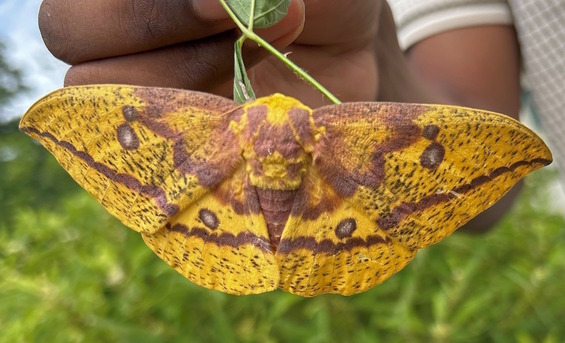 DNR's Amaad Blades shows an imperial moth found at DNR offices (Zack Brock/DNR)
Imperial moths are found from New England to the Florida Keys, yet they never fail to impress. Zack Brock, training manager for DNR's Wildlife Resources Division, spotted this one last month at DNR offices in Social Circle. Imperial moths sport wingspans of up to 7 inches. The big insects are mostly yellow, but dark blotching on their wings and bodies gives them the appearance of rotting leaves.
CREDIT: Georgia Wild masthead -- common green darner (Adobe Stock)
Top
|