IN THIS ISSUE
- An overlooked pollinator plant
- Report giant salamanders? Yes!
- Tortoise group reaches milestone
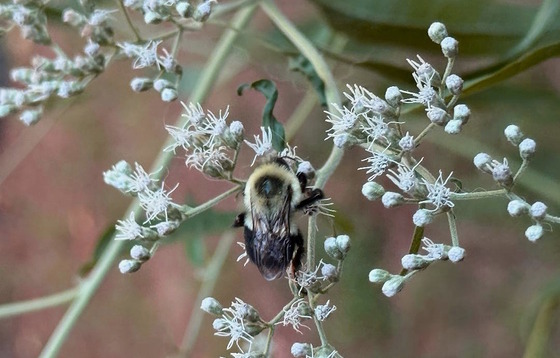 A bumblebee on boneset (Angela Dupree)
By TERRY W. JOHNSON
From late summer into early fall, one of our most important native pollinator plants switches into full bloom. And although this plant grows in plain sight, it is often unfamiliar to those of us who are trying to enhance our backyards for pollinators.
Which is unfortunate, because late boneset (Eupatorium serotinun) is a perennial wildflower that’s easy to grow and is a great seasonal source of pollen and nectar for bees, butterflies and many other pollinators. …
Read Terry’s column for more about late boneset, including planting tips.
Terry W. Johnson is a retired DNR program manager and executive director of TERN, friends group of the Wildlife Conservation Section. Check out past columns and his blog. Permission is required to reprint a column.
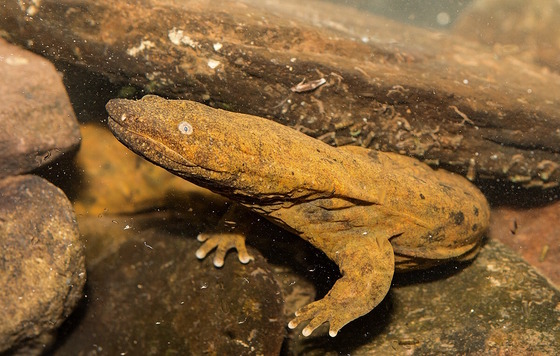 Eastern hellbender, one of five big salamanders Georgians are being asked to report (Adobe Stock)
DNR wildlife biologist Thomas Floyd is looking for giants.
Specifically, of the salamander kind.
“I’m hoping to get records of occurrences,” Floyd said of his work documenting reports of five giant salamander species found in Georgia. “The more eyes out there, the better.”
With that more-is-better approach, Floyd is asking the public to relay sightings of eastern hellbenders, northern mudpuppies and dwarf, Gulf Coast and Apalachicola waterdogs. The smallest of these, dwarf waterdogs, can reach 6 inches long. Hellbenders and mudpuppies can be a foot or longer.
Because of their size, secretive nature and – let’s be honest – sliminess, these salamanders are unfamiliar to many people and can seem frightening. But each is generally harmless and in need of conservation.
DNR’s Wildlife Conservation Section tracks each of these salamanders. Four, excluding Apalachicola waterdogs, are species of greatest conservation need in Georgia's State Wildlife Action Plan. The eastern hellbender also is proposed for Endangered Species Act listing.
Floyd is compiling sightings to help better understand the salamanders and their distribution within the river drainages where each is found. The Wildlife Action Plan rates Gulf Coast waterdogs and mudpuppies as “data deficient.” That means there’s a lack of information about both species and possibly the threats they face.
But all of these animals "are very reclusive," he said. "You don’t come across them often. But you do see them pop up on social media. Somebody fishing will catch one and ask, ‘What the heck is that?’”
Photographs and location details are needed to help ID species. Floyd also urged anglers to unhook and release any salamander they catch.
Sightings can be reported by email or calling DNR at (478) 994-1438.
AND THOSE OTHER BIG AMPHIBIANS?
Thomas Floyd's search does not include sirens or amphiumas, also large yet more common aquatic salamanders. But reports of Georgia's lesser, greater and dwarf sirens and one- and two-toed amphiumas ("True swamp creatures," October 2018) can be helpful. For example, one-toed amphiuma is also a State Wildlife Action Plan species of greatest conservation need.
Email reports with photos of these species to GaGiantSalamander@dnr.ga.gov. One ID tip: Sirens don’t have hind legs; amphiumas do but all of their legs are tiny.
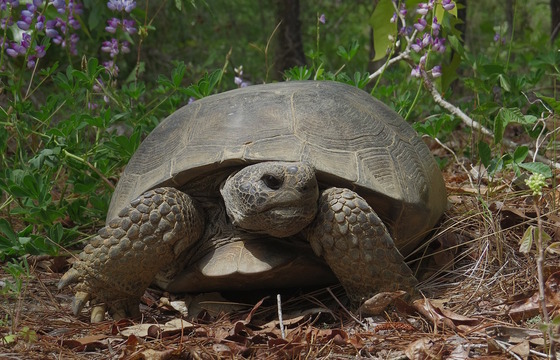 Conserving viable populations has given gopher tortoises a leg up in Georgia (Dirk J. Stevenson)
For Austin McKinney, signing a conservation easement with the USDA Natural Resources Conservation Service in August “seemed a good fit for what we’re trying to do.”
The easement covers 1,210 acres straddling the Turner/Crisp County line near Arabi. Family has owned the tract for years. McKinney, a Newnan homebuilder, has visited since he was a kid. The land is rich in groundcover, longleaf pine and outcrops of Altamaha grit.
It's also rich in gopher tortoises. More than 250 of them.
Because of that and the easement, the McKinney property proved a perfect fit for another distinction: the 65th viable gopher tortoise population permanently protected in Georgia.
No. 65 is a goal the Georgia Gopher Tortoise Conservation Initiative has pursued since its start in 2015. The benchmark was aimed at making sure these gentle, dome-shelled turtles that dig long burrows in sandy south Georgia survived for future generations. Reaching that mark is testament to the initiative’s work to keep tortoises in the state off the federal Endangered Species Act list.
“We’re incredibly proud of the success of these conservation efforts,” DNR Commissioner Walter Rabon said. “Avoiding federal listing not only helps protect wildlife, it also prevents potential economic impacts for our state.
"This collaborative approach has shown great promise as a model for successful wildlife conservation in the future.”
Over the past 10 years, the initiative’s membership has grown to nearly 30 agencies, conservation organizations, companies, foundations and private landowners. When the U.S. Fish and Wildlife Service decided in 2022 against federally listing tortoises in the eastern part of their range, partnerships were cited as one of the reasons why.
Conserving tortoises also benefits habitats and scores of species, some of them rare.
McKinney said his family has managed the tract “for exactly what this program is about for years.” Yet walking the land with biologists helped reveal the diversity of animals and plants. “You start realizing some of the things are extremely rare.”
“We’re fortunate to have the property and the ecosystems that support this wildlife," McKinney added. "… We take this seriously, and we’re looking forward to continuing to improve the (habitats).”
 Tortoise burrow on the McKinney tract and a map of the state's 65 protected populations (Erin Cork/DNR; DNR GIS)
65 TO SURVIVE
In 2015, only 36 of the 125 viable gopher tortoise populations known in Georgia were protected. Research suggested 65 were needed to ensure the tortoise’s long-term survival in the state. The minimum for a self-sustaining population of gopher tortoises is 250 adults.
QUOTABLE
“The Gopher Tortoise Conservation Initiative is a great example of the success that can be achieved when there is collaboration of state, federal, nonprofit and private funders. The expertise of DNR biologists ensures that the protected land will be restored and maintained for this keystone species and managed for the enjoyment of future generations.”
– Eleanor Ratchford, director, Knobloch Family Foundation
For other comments and a list of initiative partners, see this news release.
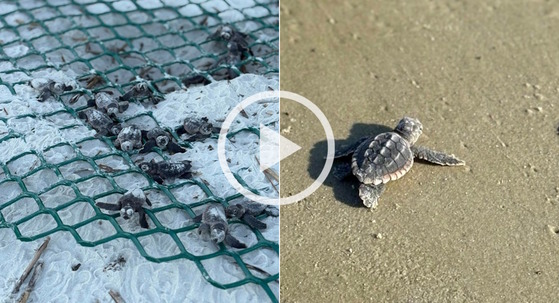 Watch loggerhead hatchlings emerge from a nest on Little Cumberland Island (Michele Parker Hunter)
Sea turtles nesting in Georgia had an above-average season with 1,911 nests. However, it was an underwhelming summer considering that computer modeling predicted about 4,000 nests. With hatching almost done, the hatch success rate is just over 50 percent. Jekyll Island leads with 74 percent while Ossabaw Island, ravaged by feral hogs raiding nests and 15-plus inches of rain in August that drowned scores more, has a state-low hatching rate of 30 percent. Nevertheless, the population of loggerhead sea turtles nesting on the state's coast continues to grow at about 4 percent a year.
The Georgia Sea Turtle Cooperative’s fall meeting caps the season for members who monitored nests on island beaches for months. As part of the wrap-up, cooperators are asked to contribute a line that, Walt Whitman-like, described their experiences. This year’s entries varied from “Finding a live hatchling in the nest is the best” to “I love fieldwork, but labwork has AC” and “I enjoyed the wonders of life as they swirled around.”
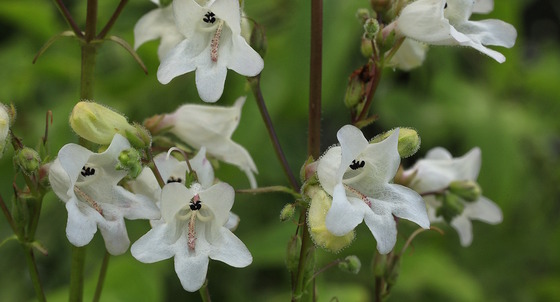 Many-flowered beardtongue in bloom (Alan Cressler)
With many native wildflowers and grasses flowering in fall, seed collection is in high gear. DNR’s Jacob Wilson and staff worked with the State Botanical Garden of Georgia and Georgia Native Seed Network staff to collect more than 700,000 seeds of many-flowered beardtongue (Penstemon multiflorus) at Alapaha River Wildlife Management Area near Ocilla. Some seed will go to a national program supporting native plant restoration and research, but the State Botanical Garden will grow most into plugs for use at seed donor sites supporting grassland restoration.
A new $19.5 million federal award will fund conservation easements and forest management to help protect and restore working forests in west Georgia. The nonprofit U.S. Endowment for Forestry and Communities said the funding from the USDA Natural Resources Conservation Service will conserve high-value forestland in the West Georgia Conservation Corridors project, reducing the need to federally list species and improving habitat connectivity. Related: Easement sign-ups open.
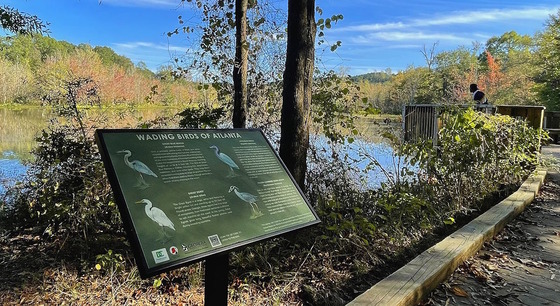 A grant-funded wildlife viewing sign at Constitution Lakes in Atlanta (Birds Georgia)
Educators and wildlife viewing leaders, these DNR grants are for you. First up is the annual $1,000 Conservation Teacher of the Year grant for a top K-5th grade Georgia teacher in life sciences. DNR's Wildlife Viewing Grants Program has also opened for a new round of proposals vying for awards of up to $5,000 for projects that help Georgians experience the state’s native wildlife and natural habitats.
Of the nearly 500 respondents to Georgia Wild’s annual reader survey, 97 percent agreed the newsletter informs them about conservation, 84 percent had told someone else about an item in Georgia Wild and more than eight-in-10 said they were spurred to learn more about a species or topic. Meanwhile, 10 readers ranging from LaFayette, Georgia, to La Grande, Oregon, were drawn to receive a DNR cap.
 Recent BirdCast migration report
Quick hits:
- Websites such as BirdWeather, which monitors bird vocalizations, and BirdCast, which banks on weather radar to picture nocturnal migration, offer amazing insights into fall migration.
- Georgia's third case of Chronic Wasting Disease, recently confirmed in Lanier County, has expanded the CWD management area from Lanier and Berrien counties to include Lowndes County.
- The first known death of an endangered whooping crane from bird flu has been confirmed in Wisconsin.
- Chagas disease, primarily transmitted by “kissing bugs,” is spreading in the South and should no longer be considered a foreign disease, researchers say.
- Earth’s 1,500th bat species has been discovered in Africa’s Equatorial Guinea.
- Catch the coming rush of fall leaf colors at gastateparks.org/LeafWatch.
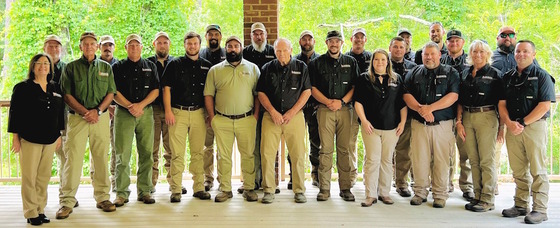 Game Management Section staff of DNR Wildlife Resources Division's Region 5
Names in the news: At the Georgia Prescribed Fire Council’s statewide meeting last month in Valdosta, DNR’s Game Management Region 5 took home the Mark Melvin Prescribed Burner of the Year Award. The Albany-based staff were praised for setting prescribed fire acreage records, promoting more growing-season burns and advancing their craft by using drones for aerial burning. Heather Brasell of Berrien County received the award for private landowners. A study by DNR Wildlife Conservation Section senior wildlife biologist Nathan Klaus and Kirk Stodola of the University of Illinois Urbana-Champaign found that birds generally avoided traditional food plots of clover and cereal crops in the southern Appalachians during breeding season. But high-priority conservation species that favor early successional habitats heavily used plots that had brushy edges. (More on the study, which also explored the role of flood plots in spreading invasive plants.) DNR’s Bobwhite Quail Initiative named Carroll County landowner John Denny its 2025 Wildlife Steward of the Year. Denny manages for wildlife with prescribed fire, pollinator plantings and early successional habitat, and shares his expertise by hosting field days and tours.
WHAT YOU MISSED ...
In the previous Georgia Wild:
- Red squirrel sightings
- Red knot survives Erin
- Antennas up for bats, birds
- Wait! Bluebirds aren't blue?
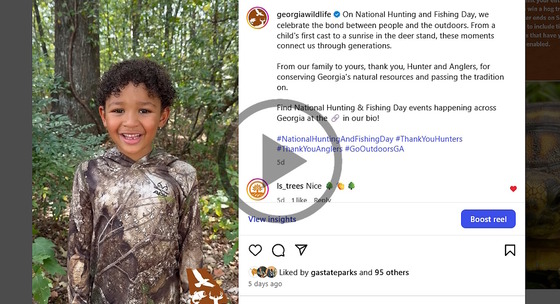 National Hunting and Fishing Day thank you, from our family to yours, DNR
(audio) "Remembering an Athenian who changed how we manage wildlife," WUGA-FM (91.7, 94.5, Athens)
"Rethinking our world through shorebird conservation," Abby Sterling, TEDxUGA
"Hundreds of glowing gator eyes in Georgia swamp," Fox Weather
"Humpback whales breach next to N.H. fishermen," Boston.com
"Georgia's state reptile just got some great news," WTOC-TV (ch. 11, Savannah). Also: Atlanta Journal-Constitution, Tifton Gazette, Grice Connect and others.
(+audio) "Two new bass species documented in Georgia," WABE-FM (90.1, Atlanta). Also: Savannah Morning News.
"Wisconsin sturgeon key restoration in Tennessee, Georgia," Milwaukee (Wisconsin) Journal Sentinel
"High-mast lights still shine at exit 42 despite permission to dim them," The Brunswick News
"DNR offers grant for top conservation teacher," Dalton Daily Citizen and others
"Millions of wings are flapping, heading south," WSBB-FM (95.5, Atlanta)
"Wildlife viewing grant applications open," WALB-TV (ch. 10, Albany) and others
"Sign-up for 2026 DNR Career Academy starts," WNEG-FM (93.1, Toccoa)
"Whale entanglements up sharply in 2024, NOAA says," National Fisherman
"Conservation, controversy and proposed changes to MMPA," The Wildlife Society
"Longer body means more female calves for baleen whale moms," Phys.org (study in Proceedings of the Royal Society B)
"Curious case of ‘Old Thom,’ an orca alone in the Atlantic," Smithsonian
"Researcher oversees AI project to halt tegus," WMNF-FM (88.5, Tampa, Fla.)
"Dietary breadth, ecological plasticity facilitate invasion potential in Argentine black and white tegu," Frontiers in Amphibian and Reptile Science
"Rescuing salamanders from hurricane destruction," The Wildlife Society
Top
|