|
|
The week brought historic rain and intense flash flooding to southeastern Wisconsin. Several rounds of torrential rain fell across much of the Milwaukee metro area late August 9 and early August 10, causing widespread flooding and damage. According to the National Weather Service, parts of Milwaukee and Waukesha counties were deluged with 10.0 to 13.0 inches of rain in less than 24 hours during the 1,000-year flood event. Portions of Ozaukee and Washington counties were also hard hit with 6.0 to 10.0 inches of rain recorded Saturday night into Sunday morning. The weekend flooding led to numerous water rescues, significant damage to homes and businesses, and closure of the Wisconsin State Fair.
Damage assessments are underway in Milwaukee and across the southeastern counties where many rivers remain in flood stage. The Governor declared a state of emergency August 11 in response to the unprecedented storm.
__________________________________
|
|
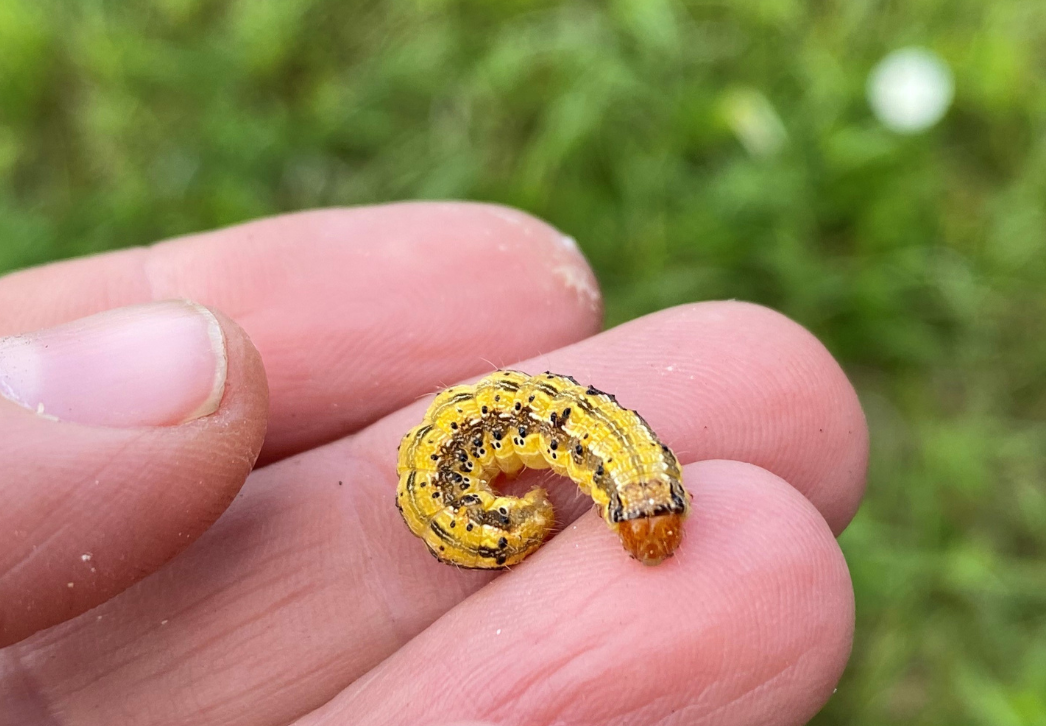
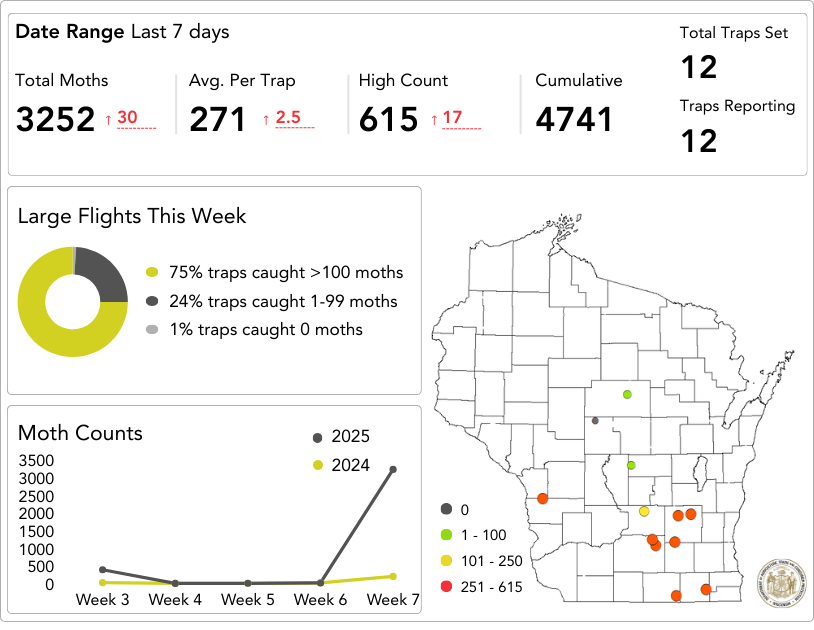
Late-season corn earworm moth migrations into Wisconsin increased markedly this week with the capture of 3,252 moths in 12 pheromone traps, up from only 30 moths the previous week. Locally heavy flights of 251 or more moths were reported from the Clinton (615), Burlington (524), Beaver Dam (348), Sun Prairie E (328 moths), Watertown (314 moths), Coon Valley (305 moths), Mayville (294 moths), and Sun Prairie N (284 moths) monitoring locations, while one other site in Columbia County collected 178 moths per trap. The three remaining sites reported fewer than 60 moths per trap.
A cumulative total of 4,741 moths have been captured as of August 14. The recent escalation in corn earworm activity signals that egg laying is intensifying and management programs should be underway for fresh market and processing sweet corn. Treatment schedules based on nightly corn earworm moth trap catches are available at 2025 Commercial Vegetable Production in Wisconsin (A3422 pg. 280). |
|
 __________________________________
|
|
|
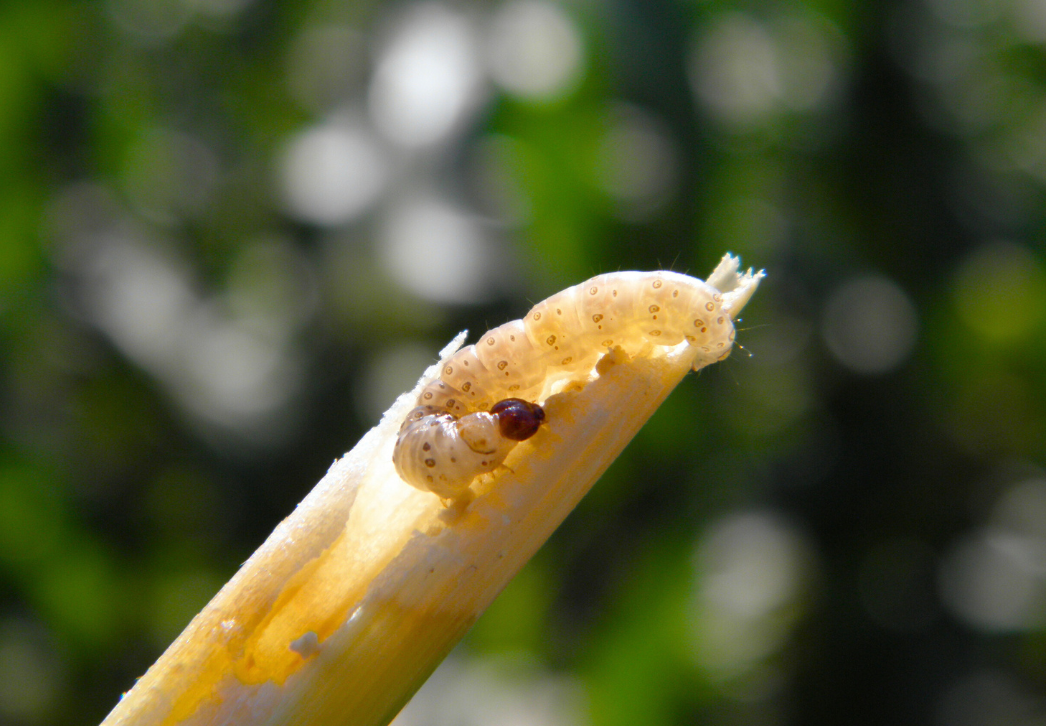
DATCP has a long history of conducting fall surveys for the European corn borer (ECB). Our experienced scouting team is skilled at recognizing signs of ECB and can help determine if larvae are damaging your fields, and the rate of infestation. The fall ECB survey starts September 2 and our program is looking for non-Bt corn fields to scout for larvae and damage. The goal of surveying both Bt and non-Bt fields is to gain a more accurate understanding of ECB pressure (particularly in non-Bt fields where populations are likely higher) and to determine areas of the state where ECB populations may be developing resistance to Cry Bt proteins. Non-Bt corn sites are most needed in Columbia, Dane, Dodge, Grant, Lafayette, and Rock counties, although all Wisconsin counties will be considered.
Corn growers, crop advisors, and Extension educators who have or know of non-Bt corn fields that could be assessed for ECB are asked to email krista.hamilton@wisconsin.gov with:
- Your name
- Phone number
- Field location (county, GPS coordinates, and description of field)
We are hoping to sample 40-50 non-Bt fields between September 2 and October 24. The survey is not destructive and involves examining 25 consecutive corn stalks for signs of ECB infestation and dissecting two stalks to count larvae. Fields that are relatively accessible from a roadside are preferred. Growers will be notified of the ECB population in their fields once the survey is complete.
|
|
 __________________________________
|
|
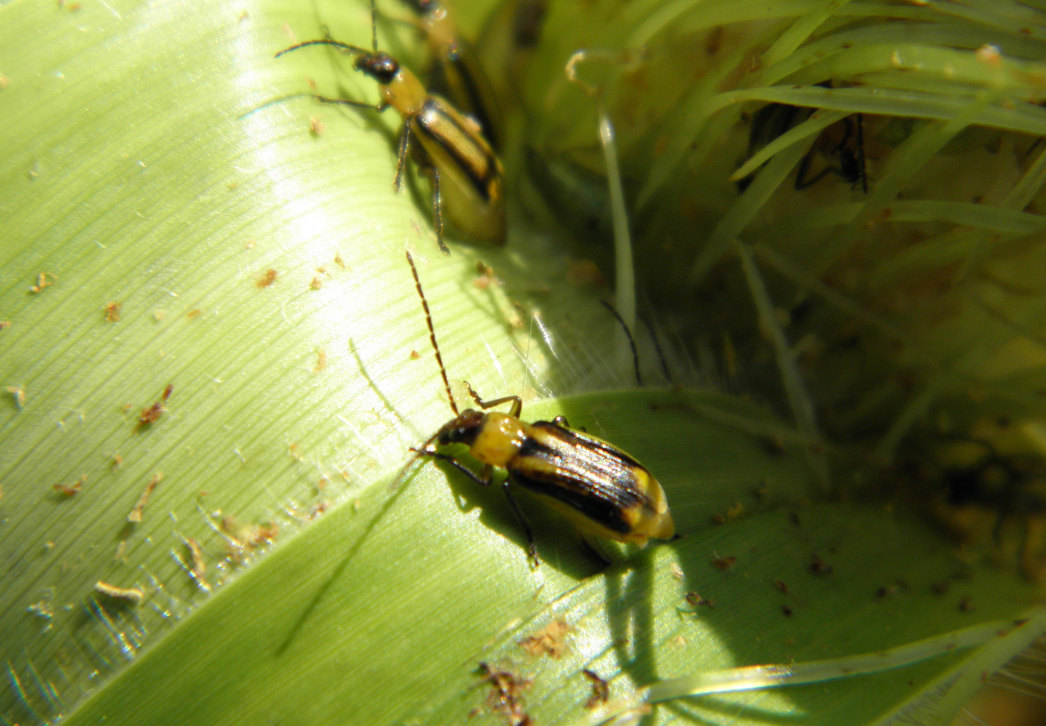
Pest Survey seasonal crop scouts continued counting beetles in corn fields this week as part of DATCP’s annual corn rootworm beetle survey. The survey has been conducted each August since 1971 and provides an estimate of current corn rootworm beetle pressure and a risk forecast to help corn producers make management decisions for the next planting season. Rootworm populations are determined by counting the number of northern, southern, and western corn rootworm beetles on 10 plants per field and calculating the average number of beetles per plant. An average count of 0.75 beetle per plant (all species) in a field indicates high beetle pressure and the potential for larval damage to corn roots the following year.
The survey has reached the halfway point and early results suggest that overall rootworm pressure may be moderate and similar to the levels recorded in 2024, although sampling is only partially complete and beetle emergence has not yet peaked in all areas of the state. Beetle counts in the 156 grain corn fields surveyed so far this month have been mostly below-threshold, with 95 fields averaging low counts of 0.0-0.4 beetles per plant and 36 sites having moderate beetle counts in the range of 0.5-0.7 per plant. Above-threshold averages of 0.75 or more beetles per plant have been observed at 25 of the sites in the last two weeks.
The usual hotspots for beetle pressure are primarily across the south-central and southeastern Wisconsin counties, which is normal and expected. The 2025 running average of 0.5 beetle per plant is equal to 0.5 beetle per plant at this time last season. There are still several counties in the central and northern parts of the state, and approximately 73 more fields left to sample, before the survey is finalized by the end of the month. |
|
 __________________________________
|
|
|
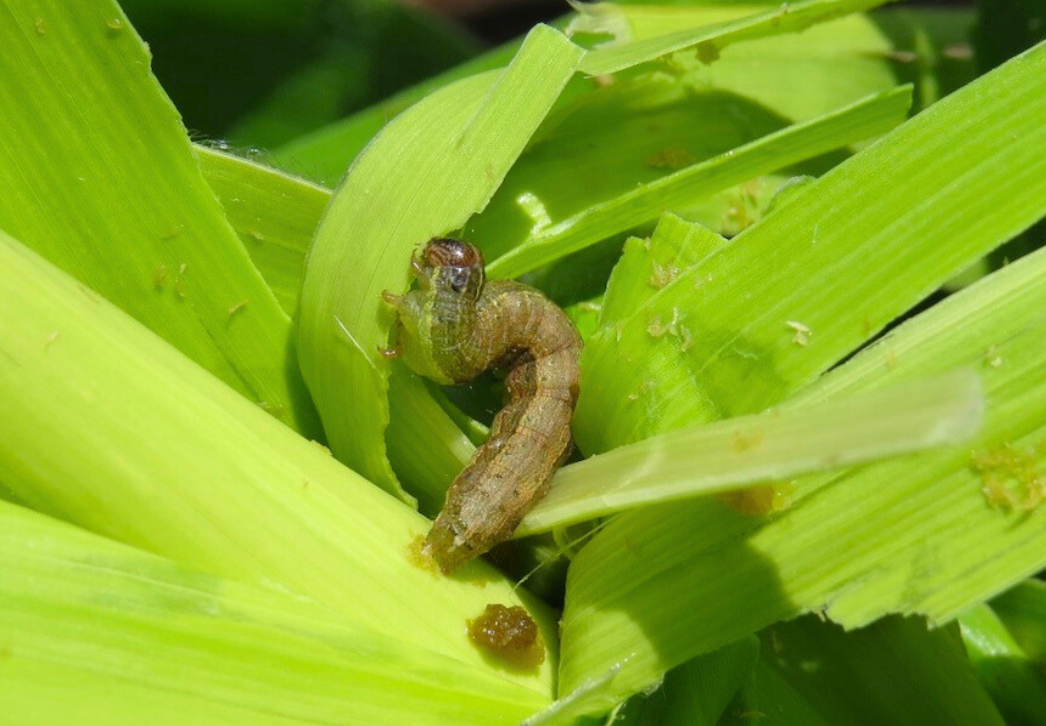
DATCP’s fall armyworm (FAW) trapping network is up and running and will continue for the next seven weeks, until September 18. The network begins much later in the season than the other six pest monitoring networks because FAW moths are migratory and typically do not appear in Wisconsin until August. In most years, FAW migrations arrive too late to cause much damage.
Although FAW historically has not been a major pest in Wisconsin and the upper Midwest, the changing climate and a recent outbreak across the eastern and southern U.S. in 2021 have brought new interest in tracking flights of this migratory insect. The goal is to provide advanced warning of potential late-season larval infestations in alfalfa, field corn, sweet corn, and pasture grasses.
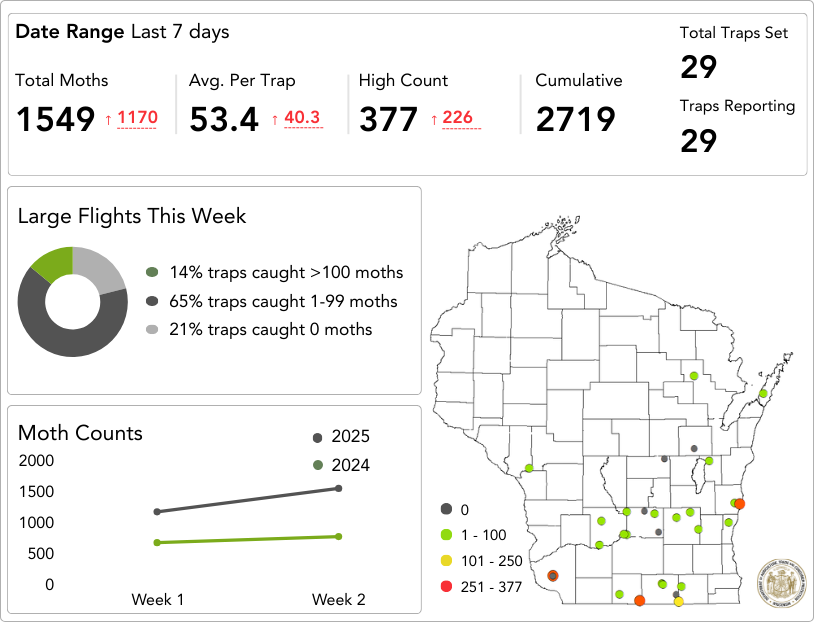
As of August 14, the 29 pheromone traps in 15 counties have captured 2,719 fall armyworm moths, or an average of 94 moths per trap. A total of 1,549 moths were collected this week (August 8-14), an increase from 1,170 moths the week before (August 1-7). Four sites registered seven-day counts of 100 or more moths and the highest individual weekly count was 377 moths in the trap near Brodhead in Green County. The recent moth activity suggests that significant migration flights are occurring, along with egg laying in late-planted corn fields.
For regional fall armyworm flight data extending across the northeastern U.S. and adjacent Canadian provinces, please review the Great Lakes and Maritimes Pest Monitoring Network (select FAW tab).
|
|
|
__________________________________
|
|
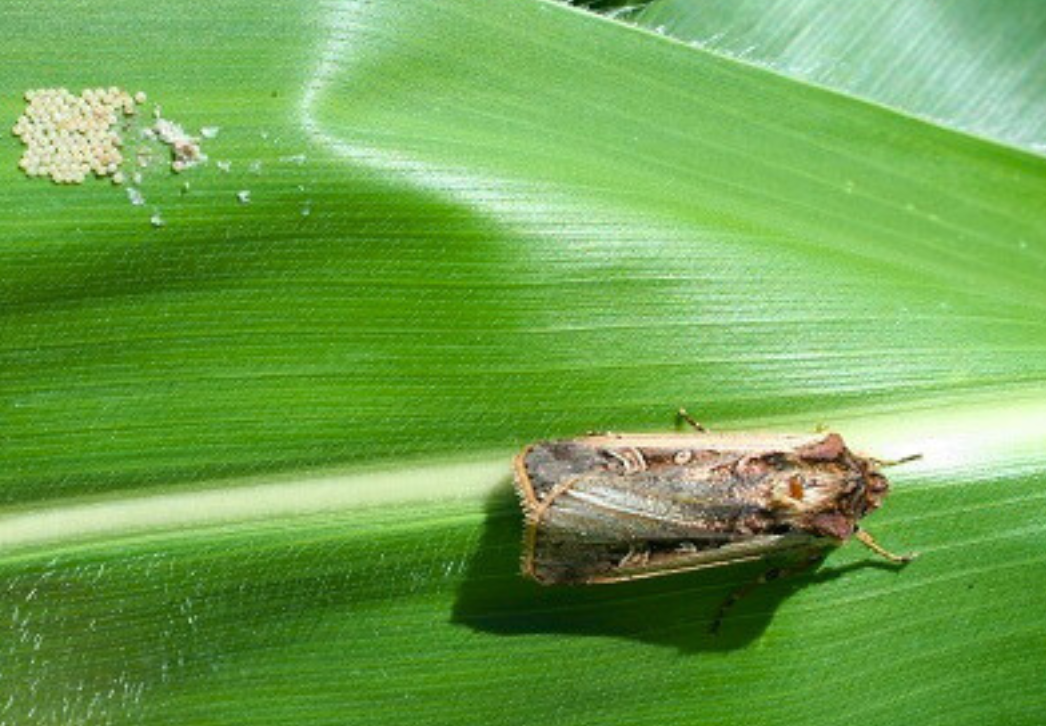
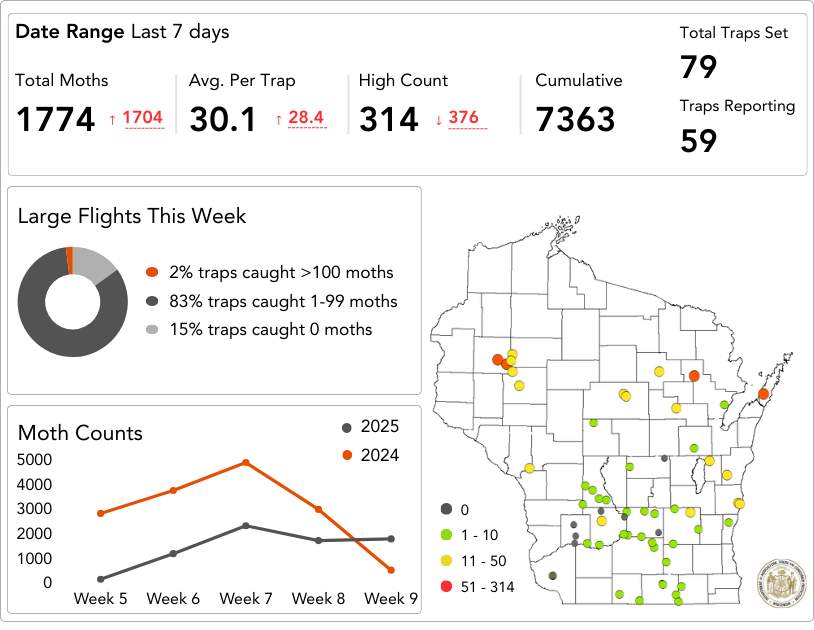
Preliminary results of the 21st annual western bean cutworm trapping survey show a cumulative state count of 7,363 moths in 79 traps, or an average of 93 moths per trap. This season’s current average moth catch is below last year’s all-time record high capture of 227 moths per trap (15,685 moths in 69 traps), although there is still one more week of monitoring left. Peak moth emergence has occurred statewide and trap counts across southern and central Wisconsin are expected to drop off sharply next week as the flight subsides.
For the week ending August 14, the total catch was 1,074 moths, a decrease from 1,704 moths August 1-7. This week’s high individual trap count was 314 moths near Cameron in Barron County where the flight just peaked, while no other monitoring locations reported catches above 100 moths per trap. Western bean cutworm trapping network participants are asked to continue reporting counts through August 21. |
|
|
__________________________________
|
|
|
|
|