|
|
Warm, seasonable conditions returned following last week’s cool weather pattern. Near- to above-normal temperatures prevailed as afternoon highs ranged from the upper 60s in the east to the around 90°F in the west. Showers and severe thunderstorms developed along a cold front on June 3, bringing torrential downpours and damaging wind gusts of 55-60 mph to southern Wisconsin. Heavy rain of 1.5-3.0 inches resulted in minor flooding in the southeastern region, but Tuesday’s storms delivered much-needed precipitation to emerging crops, lawns, orchards, and gardens.
Meanwhile, haze from Canadian wildfire smoke filled the sky as planting of field crops neared completion in most areas. Corn planting reached 93% complete at the start of the week, with 69% of the crop emerged throughout the state. Soybean planting was 90% complete by June 1, and 57% of soybean acres have emerged (USDA NASS).
__________________________________
|
|
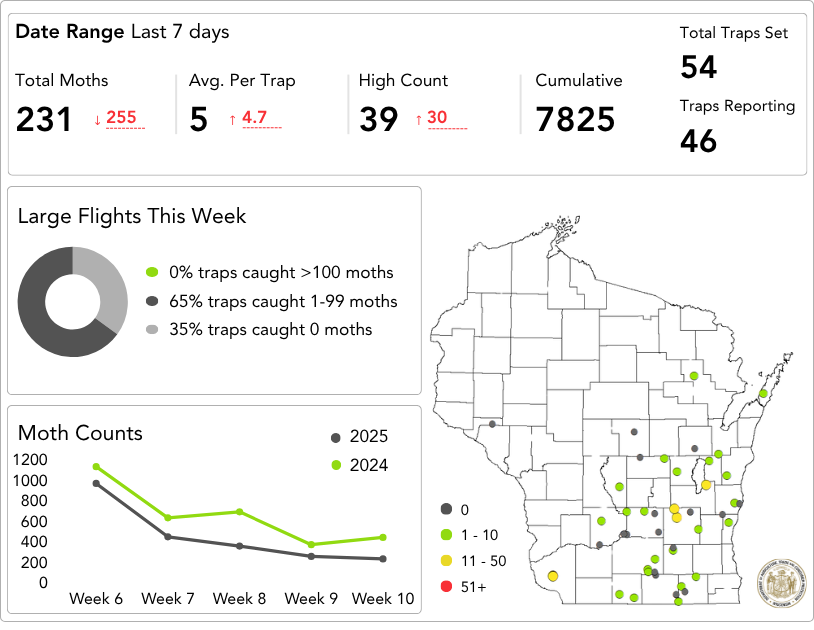
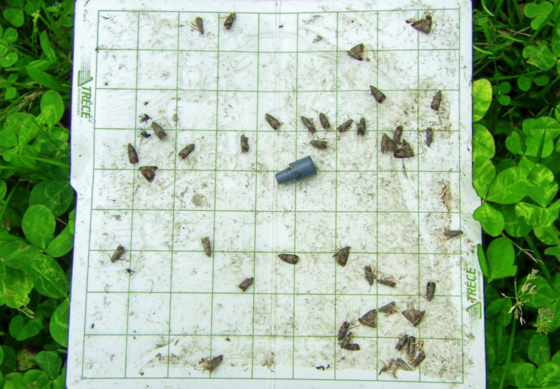
The True Armyworm Network has concluded its tenth week of monitoring moth flights. As shown in the dashboard below, pheromone traps captured 231 moths during the current reporting period and a cumulative total of 7,825 moths in 54 traps (average of 145 per trap) since trapping started April 1. The highest individual trap counts reported this spring have been in the southwest and south-central regions, in Dane, Grant, Green, and Jefferson counties. |
|
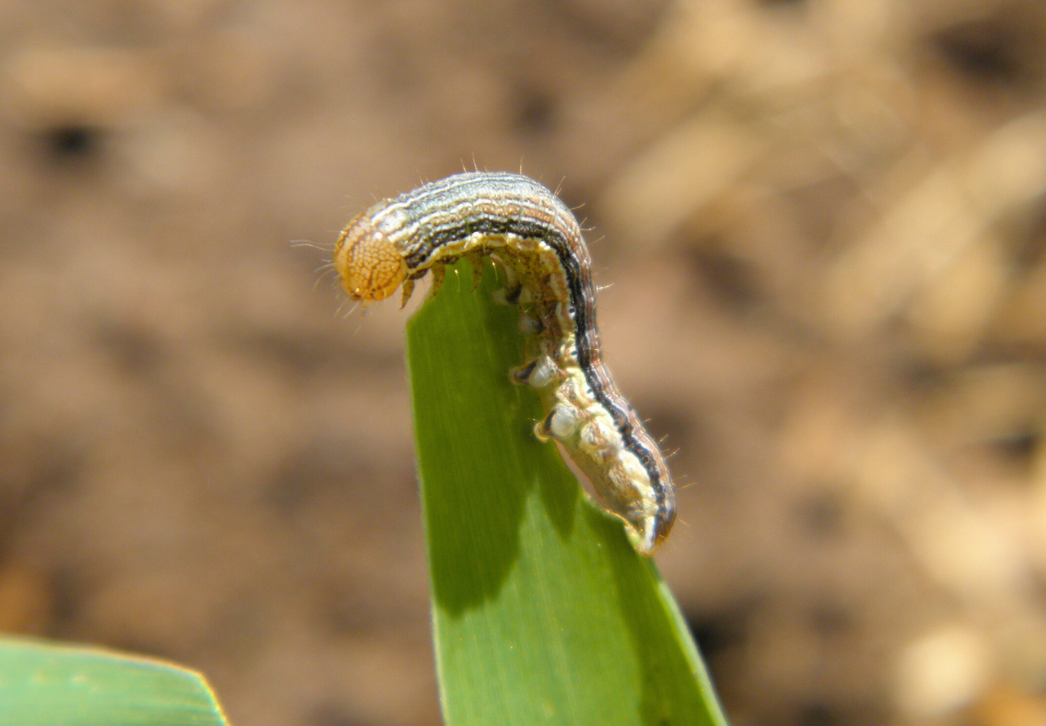
In addition to trap monitoring, alfalfa and wheat surveys conducted by DATCP across central and southeastern Wisconsin this week found low numbers of small true armyworm larvae in scattered fields. Sweep net counts were well below economic levels at 1.0-6.5 larvae per 100 sweeps and the caterpillars observed were less than one inch-long as of June 5.
While it is impossible to know if or where armyworm infestations will emerge based on trap data and recent sweep net counts, now is the time of year when first-generation armyworms are reaching the larger development stages when most feeding occurs. Severe damage to corn and small grains can appear seemingly overnight, making routine scouting and early detection of emerging problems particularly important through the end of the month. |
|
 __________________________________
|
|
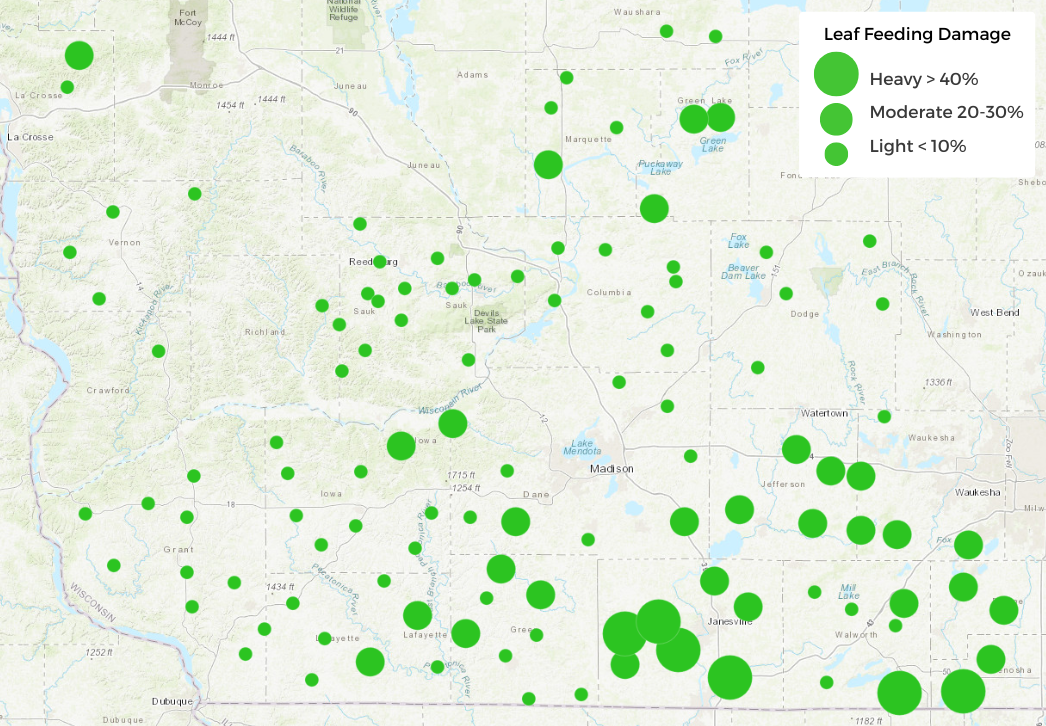
DATCP field specialists completed spring survey work in first-crop alfalfa this week. The survey measures levels of a variety of early-season pests, with emphasis on alfalfa weevil leaf feeding damage. Random sampling of 120 alfalfa fields primarily south of Highway 21 found light defoliation in 73 fields (61%) and moderate leaf feeding in 27 fields (22%). Heavy defoliation exceeding the 40% threshold was observed in 20 of the fields (17%). Counts of larvae in the surveyed fields ranged from 1.6-6.3 per sweep and averaged 3.3 per sweep. The accompanying map below shows where the fields with heaviest alfalfa weevil defoliation were recorded during the May 22-June 2 sampling period. |
|
  The first cutting of alfalfa hay began three weeks ago and is progressing ahead of the average pace this spring. According to USDA NASS, the harvest was 46% complete as of June 1, four days ahead of last year and three days ahead of the five-year average. Across the lower half of the state where the harvest of first-crop alfalfa is beyond the halfway point, the alfalfa weevil threat will subside as remaining acreage is cut in the next few days. By contrast, the alfalfa weevil feeding period is entering the most damaging phase in north-central and northeastern Wisconsin fields. Scouting for alfalfa weevil larvae and leaf tip feeding should be prioritized for uncut alfalfa north of Highway 10 and east of Highway 73 (Marshfield east to Green Bay and northward) in the week ahead.
|
|
 __________________________________
|
|
Spring codling moth flights resumed May 30-June 5, with a sharp increase in activity registered in apple orchards throughout the state. Nine of 23 cooperator sites reported high counts of five to 13 moths this week. Most southern and central monitoring locations (those not using mating disruption) have documented a sustained flight and biofix as of June 5.
For apple orchards with a history of high codling moth pressure that record large flights of 10 or more moths per week, a first larvicide application is recommended when 250 degree-days (modified base 50°F) accumulate after the biofix date. At this time of year, it takes approximately 14-21 calendar days for 250 degree-days to accumulate, depending on location.
In orchards where the spring codling moth flight has been inconsistent, growers may delay applications until 350 degree-days after the biofix, when approximately 60% egg hatch will be targeted by one application.
With the intermittent flights observed this spring, several cooperating orchards will likely wait until 350 degree days to apply a larvicide. A density of one trap per 2.5 acres, or one per five acres where blocks are uniform in size, shape, and topography, is suggested for accurate codling moth monitoring. |
|
 __________________________________
|
|
__________________________________ |
|
|
|