|
|
Another week of cool, cloudy weather with light rain slowed seasonal fieldwork. Average temperatures were well below normal for late May and although scattered showers developed mid-week, a few days of clear weather allowed for a limited amount of planting and weed control. Soybean planting reached 80% complete by Memorial Day and 42% of acres have emerged in the state, one day ahead of last year and two days ahead of the five-year average (USDA NASS). Corn planting is also in the final stretch with 85% of intended acres sown, and farmers are now shifting priorities to cutting hay.
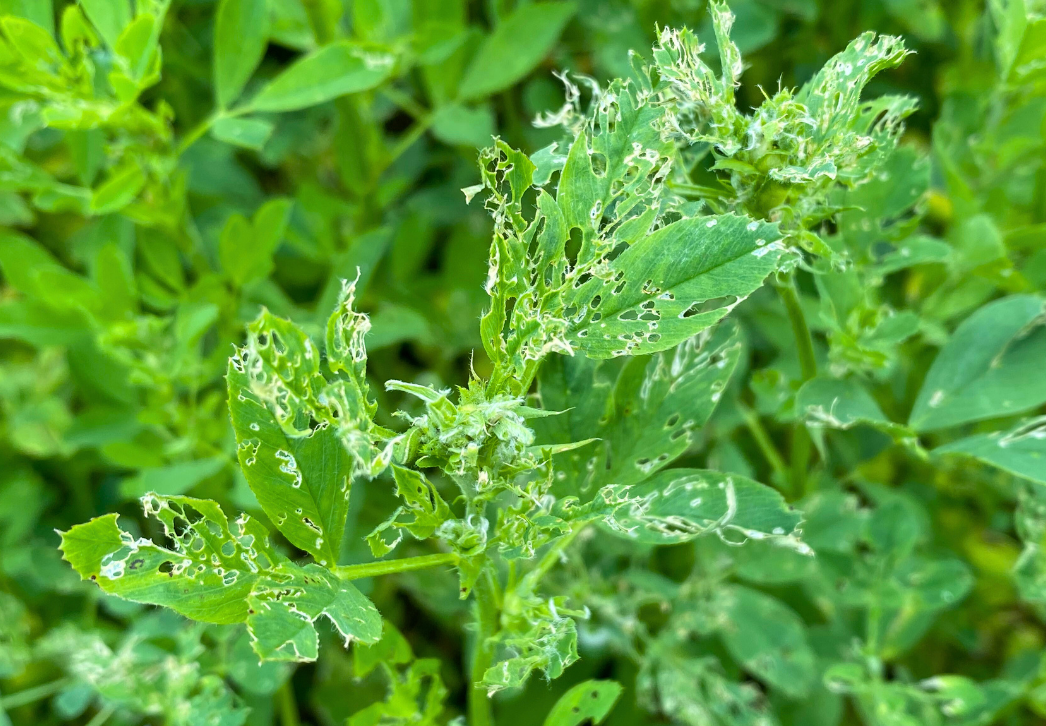
While the damp, overcast conditions delayed alfalfa harvesting schedules, alfalfa weevil larvae were not deterred, and their feeding damage has become more conspicuous in southern and central Wisconsin alfalfa fields. Cutting the first hay crop as soon as the weather permits will be important for avoiding serious damage by the larger late-stage weevil larvae.
__________________________________
|
|
Surveys to assess alfalfa pest populations and distribution were conducted in between rain showers this week. As the first alfalfa harvest ramps up, alfalfa weevil larvae have become common in alfalfa sweep net collections and feeding pressure has increased markedly in southern Wisconsin fields.
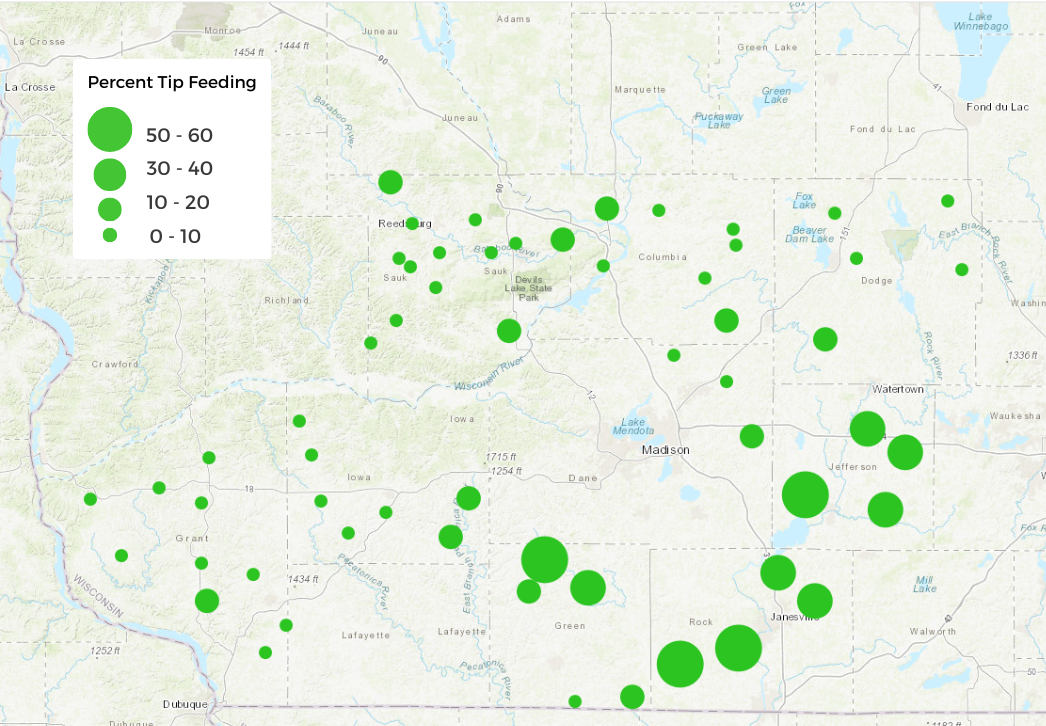
Sampling across Columbia, Dane, Dodge, Green, Iowa, Jefferson, Rock, and Sauk counties found mostly light to moderate leaf feeding (10-30%) by weevil larvae, though a few fields had heavier feeding at or above the 40% economic threshold. Of the 57 alfalfa fields surveyed May 22-28, four had heavy defoliation affecting 50-60% of stems, 18 had moderate feeding on an estimated 20-40% of stems, and 35 had light feeding on 0-10% of plants. Alfalfa fields with above-threshold leaf feeding (40-60%) were found in Green, Jefferson, and Rock counties, as shown in the map below. This week’s finding of heaviest feeding pressure in the south-central region aligns with the UW-Madison Alfalfa Weevil model forecast and signals that cutting the first crop should be prioritized for the next rain-free window.
In the week ahead, as more alfalfa acreage is harvested, it is important to note that feeding damage by alfalfa weevil and other pests may still occur under windrows if hay cannot be baled shortly after cutting. Alfalfa regrowth should be checked for signs of weevil injury four to five days after harvest, and until new growth of the second crop is established. The economic threshold for regrowth is reached if 50% of new stems or crown buds show damage and weevil larvae are still actively feeding in the field. |
|
 __________________________________
|
|
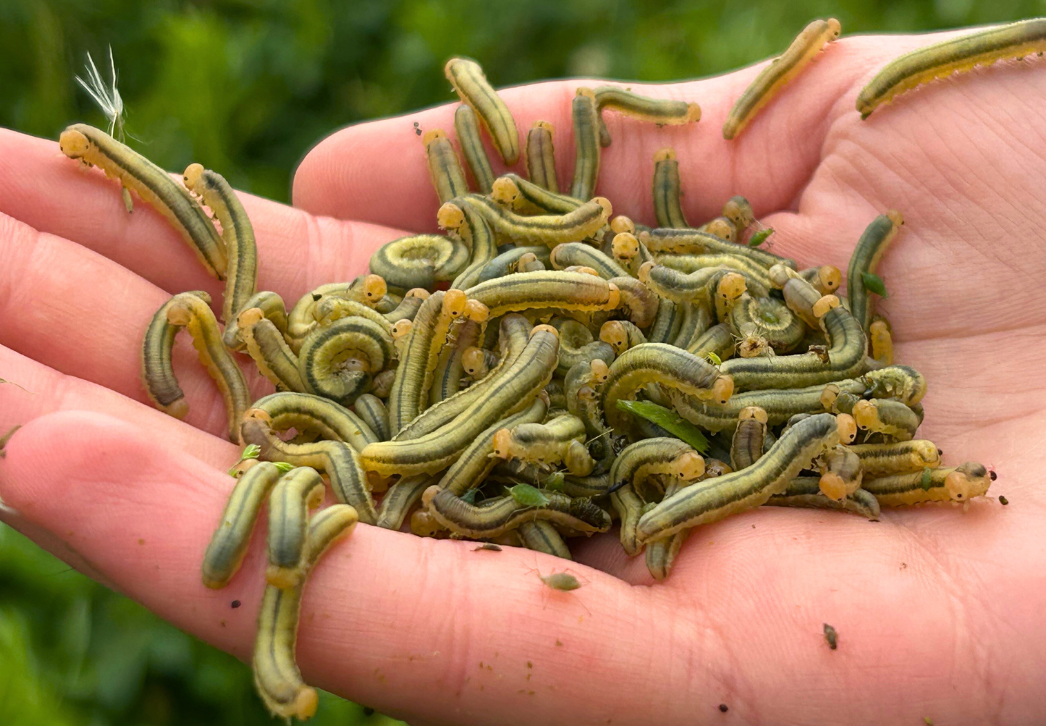
A highlight of this week’s alfalfa surveys was an anomalous high catch of grass sawfly larvae, shown in the photo above. Although grass sawflies are often found in alfalfa fields with grass growth, they usually occur in very low numbers. The surprising catch of 160 larvae per 10 sweeps was recorded in an alfalfa-grass mix field in Sauk County.
The significance of this observation is that sawfly larvae can easily be mistaken for true armyworm caterpillars when they collect in sweep nets. True armyworms are destructive and a handful similar to the one in the accompanying photo would be cause for concern, whereas grass sawfly larvae are harmless and pose no threat to alfalfa or small grains in Wisconsin. Their appearance serves as a reminder to carefully examine any striped larvae in sweep net contents to ensure accurate identification.
The simplest way to differentiate grass sawflies is by counting the prolegs (the fleshy legs on the abdomen). Sawfly larvae have six or more pairs of prolegs while armyworm caterpillars have five or fewer pairs of prolegs on the abdomen. If there’s any doubt, snap a photo and send it to Krista.Hamilton@wisconsin.gov or text (608) 220-7378 for verification. |
|
 __________________________________
|
|
__________________________________ |
|
|
|