|
|
A warm, drier weather pattern spurred fieldwork, gardening, and plant development in Wisconsin during the week ending May 15. Most of the state experienced several days of open weather for spring tillage and planting. Temperatures in La Crosse and several other western locations reached the 80s for five days in a row (May 11-15), making it the warmest streak since last September.
Wisconsin farmers capitalized on the favorable conditions and made double digit planting increases, led by corn (up 28 percentage points), oats (up 26 points), and soybeans (up 23 points). According to the USDA NASS, 44% of the state’s corn, 62% of oats, and 40% of soybeans have been planted. The week’s field activities included monitoring insect survey traps, sweeping alfalfa fields, and preparing for the spongy moth aerial treatment program tentatively scheduled to begin May 19.
__________________________________
|
|
|
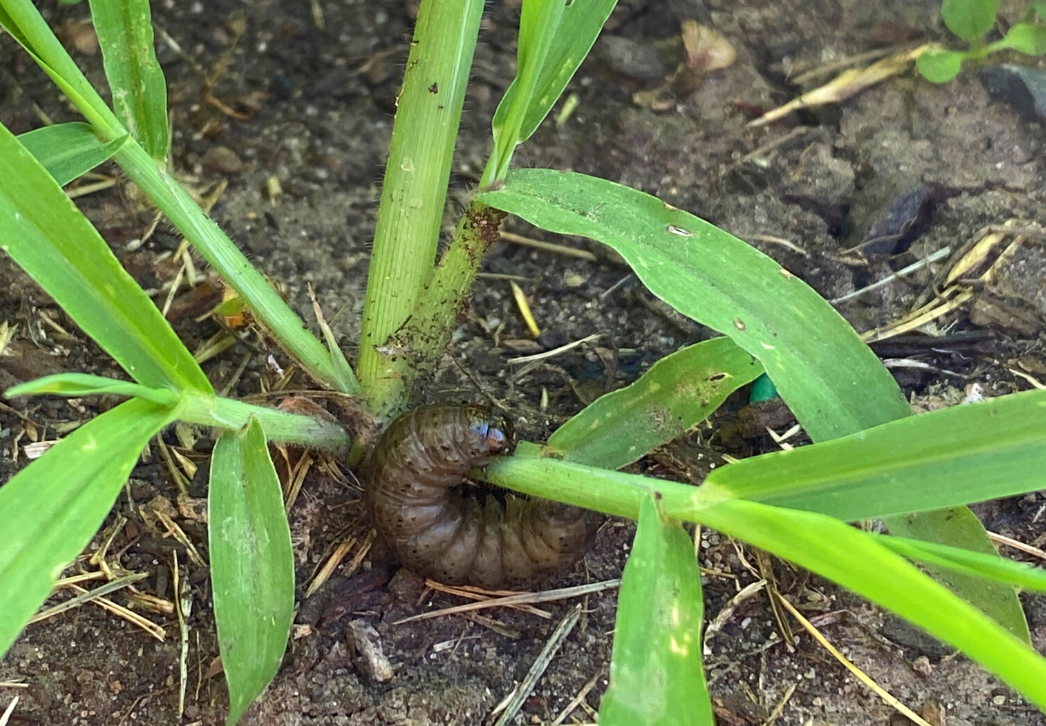
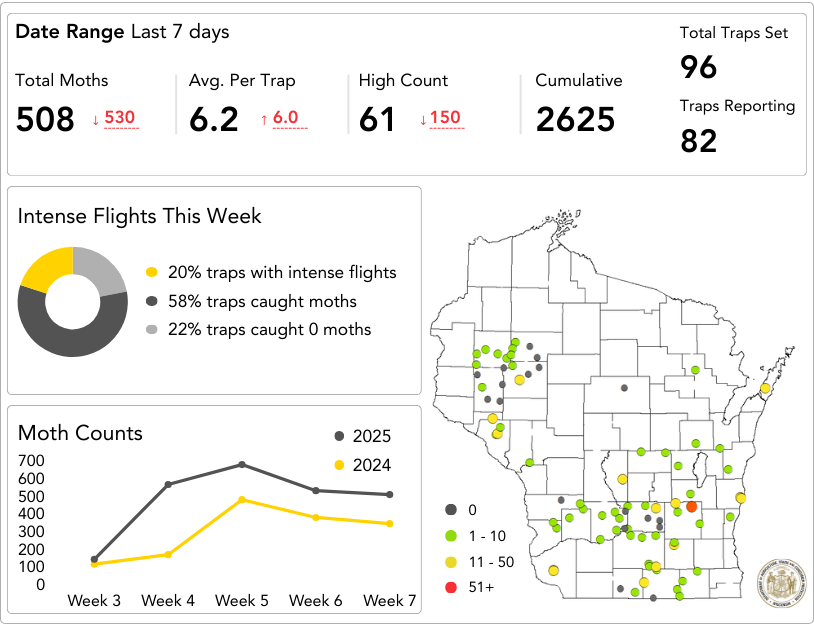
DATCP’s 2025 early-season moth monitoring networks are the largest in Pest Survey Program history thanks to many volunteer cooperators throughout the state. The 96 black cutworm traps and 53 true armyworm traps distributed across 35 counties are providing data that will help crop advisors and growers optimize the timing of field scouting for larvae and damage this spring. For black cutworm, the scouting window opens in the week ahead (May 18-24) in southern Wisconsin.
The Black Cutworm Monitoring Network has to date captured a cumulative total of 2,625 moths in 96 traps, or an average of 27 moths per trap. For context, this preliminary average count is below both the 10-year average of 37 moths per trap and the 72-per-trap average recorded in 2017, the last time serious black cutworm infestations developed in the state. It is also slightly lower than the 2024 count of 2,133 moths in 77 traps, or 28 moths per trap.
|
|
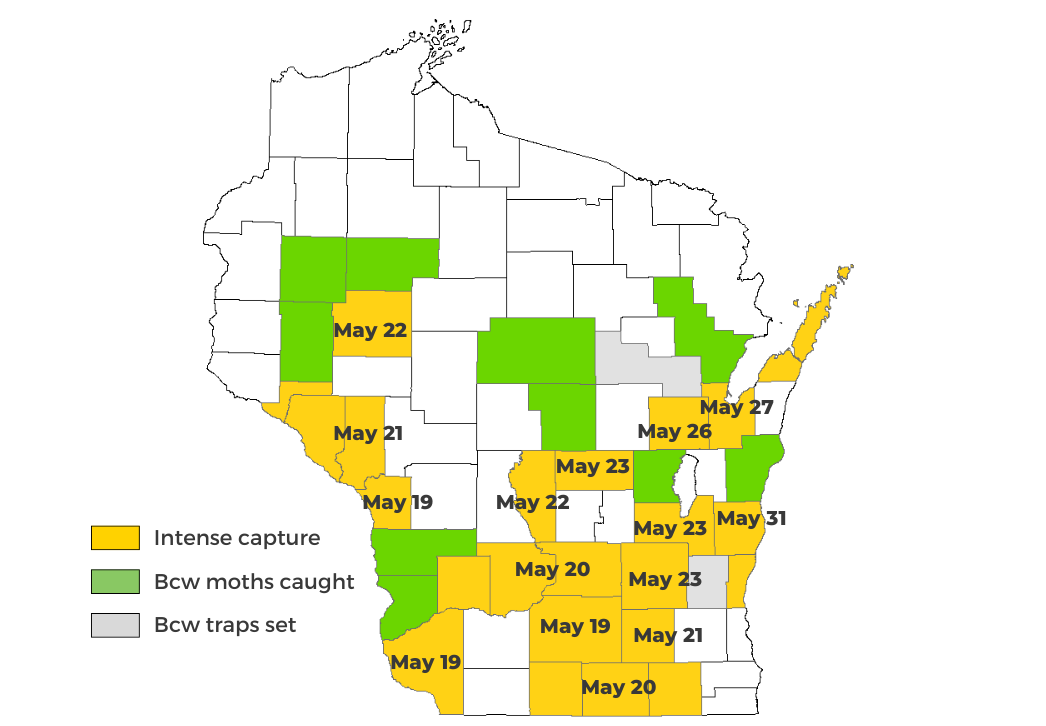
Nevertheless, there is potential every season for black cutworm infestations to develop in local fields and early detection is important. Based on intense moth captures in the state on April 16-22, it is estimated that larvae produced by moths arriving since mid-April will reach the destructive fourth-instar cutting stage of development in advanced areas of the state next week, May 18-24. The primary seedling corn damage window for black cutworm is expected to open May 19 across far southern Wisconsin and near La Crosse, May 23 at Hancock, May 27 near Green Bay, and May 31 at Sheboygan (refer to the forecast map below).
|
|
Crop consultants and growers are advised to begin inspecting corn (including Bt hybrids) for leaf pinholes and other signs of cutworm feeding during early-season stand assessments. Scouting a few days before estimated cutting dates is recommended. Recall that Bt hybrids and corn treated with seed-applied insecticides are at reduced risk of cutworm damage, but the larvae are still capable of cutting young plants. The economic threshold for black cutworm is reached if 3% of plants have been cut and larvae are still present in the field.
As mentioned in the previous issue of Field Notes, severe black cutworm infestations are infrequent in Wisconsin, and trap counts are not a reliable predictor of outbreaks. Scouting emerging corn should be prioritized in the next three weeks. Crop advisors and producers who observe black cutworm larvae or damage are asked to please report observations to DATCP Entomologist, Krista Hamilton, at Krista.Hamilton@wisconsin.gov.
|
|
 __________________________________
|
|
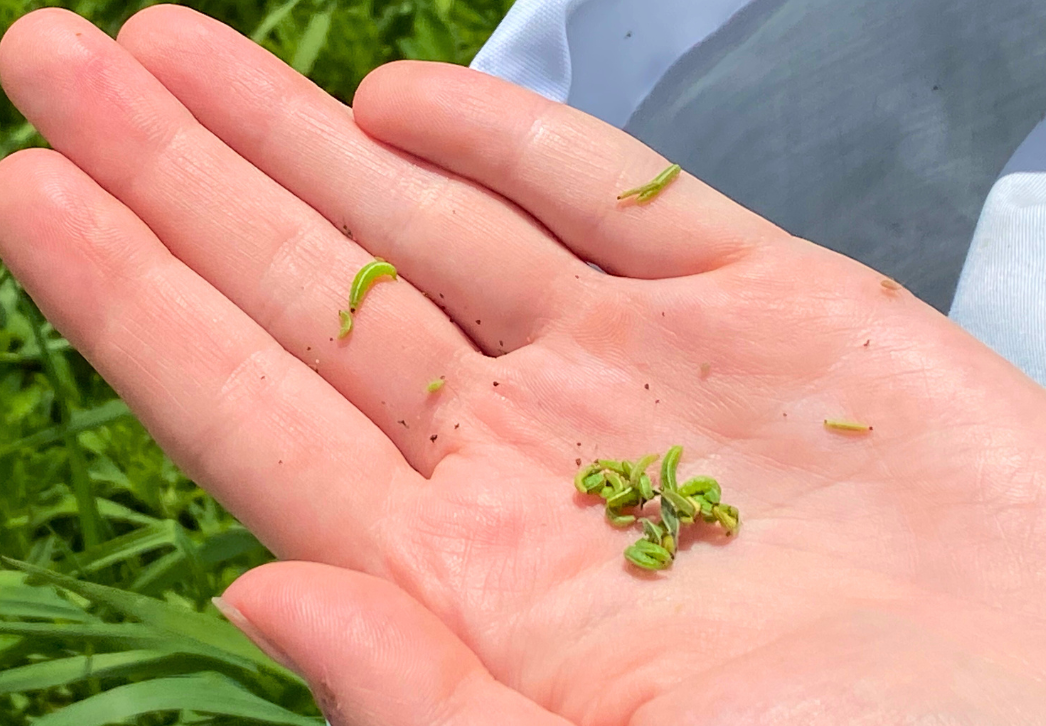
Alfalfa weevil larvae and their distinctive tip feeding injury are appearing on schedule in southern Wisconsin alfalfa fields. This early-season alfalfa pest characteristically hatches in May, develops through four larval stages (or instars), and completes the damaging larval phase of its life cycle by early June. The weevil feeding season in Wisconsin is brief and only extends for about four to five weeks, depending on spring temperatures.
As shown in the sine base 48°F column in DATCP's degree day table, alfalfa weevil degree days (gdds) throughout the state range widely from 182 at Crandon to 390 at Beloit. Accumulations across much of southern Wisconsin are adequate for larvae to have reached the intermediate second and third instars. Alfalfa tip feeding damage is becoming visible in southern fields and will be more pronounced next week as a greater proportion of the larvae reach the later third and fourth instars. In contrast, egg hatch has not yet started in central and northern Wisconsin.
Peak alfalfa weevil populations and tip feeding damage customarily occur in Wisconsin between 600 and 800 gdds. For the 2025 season, the last two weeks of May and into the first week of June (May 18-June 7) will be the most critical window for alfalfa weevil scouting and decision-making. A defoliation level of 40% of stems showing weevil feeding signals the larval population is high and early harvest would be beneficial. Sweep net sampling for alfalfa weevil larvae should be underway in areas of the state where 300 or more gdds have accumulated. As of May 15, this includes alfalfa acreage south of Highways 82 and 23. |
|
 __________________________________
|
|
|
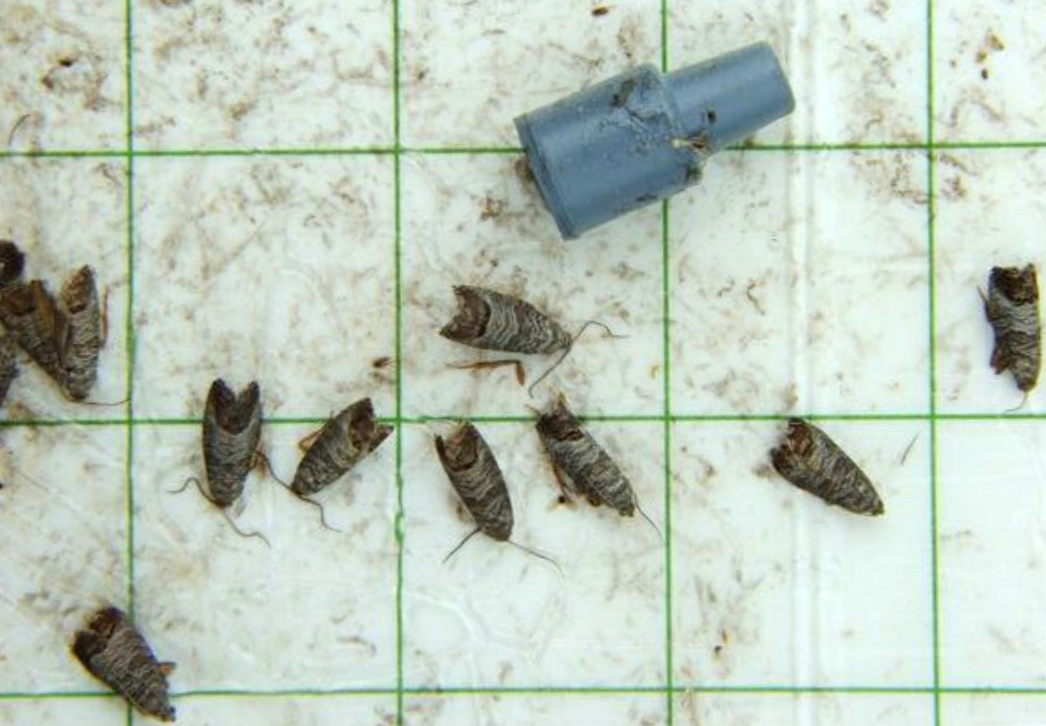
In Wisconsin orchards, apple trees are in bloom or at the petal-fall stage, and the spring emergence of codling moths has started. The first moths appeared in traps on the evening of May 12, and six of 22 cooperator sites recorded counts of one to five moths per trap this week, though none has set a clear biofix. The term “biofix” refers to the beginning of consistent moth flight and marks the starting point for counting degree days (base 50°F) to determine the most effective treatment timing for first-generation larvae. The biofix is indicated by either:
- One or more moths caught in traps on consecutive nights or
- A count that exceeds the threshold of five moths per trap per week
For example, if a codling moth pheromone trap catches two moths May 12, four moths May 13, and three moths May 14, the biofix could be May 13 or 14. Assign the biofix date for the warmest and calmest of the two nights. Alternatively, if a heavy flight of five or more moths occurs on a single night, assign the biofix date to that night and begin counting degree days.
Codling moths fly between 6-11 p.m. on warm nights with low wind speeds (< 5 mph) and no rain. Evening temperatures above 62°F are preferred for egg laying. If these specific conditions are not met, flights will be delayed. Apple growers in the DATCP Apple Pest Monitoring Network are advised to continue checking their traps daily until the “biofix” is established.
|
|
 __________________________________
|
|
__________________________________ |
|
|
|
|