|
|
A week of warm, mostly dry weather favored fieldwork across Wisconsin. Afternoon high temperatures in the 60s to lower 80s provided a sustained window of opportunity for spring tillage and planting, while improving conditions for emergence of corn, oats, and potatoes. Crop producers made planting gains, though progress statewide remained behind average. Potato planting was 55% complete as of May 4, nine days behind last year but nearly equal to the five-year average. Corn planting increased to 16% percent complete, two days behind last year’s pace and the five-year average
(USDA NASS).
In southern Wisconsin orchards, early apple tree varieties are in full bloom and pheromone traps have been set in anticipation of the first codling moth flight. Emergence of plum curculio weevils from overwintering sites is also beginning.
__________________________________
|
|
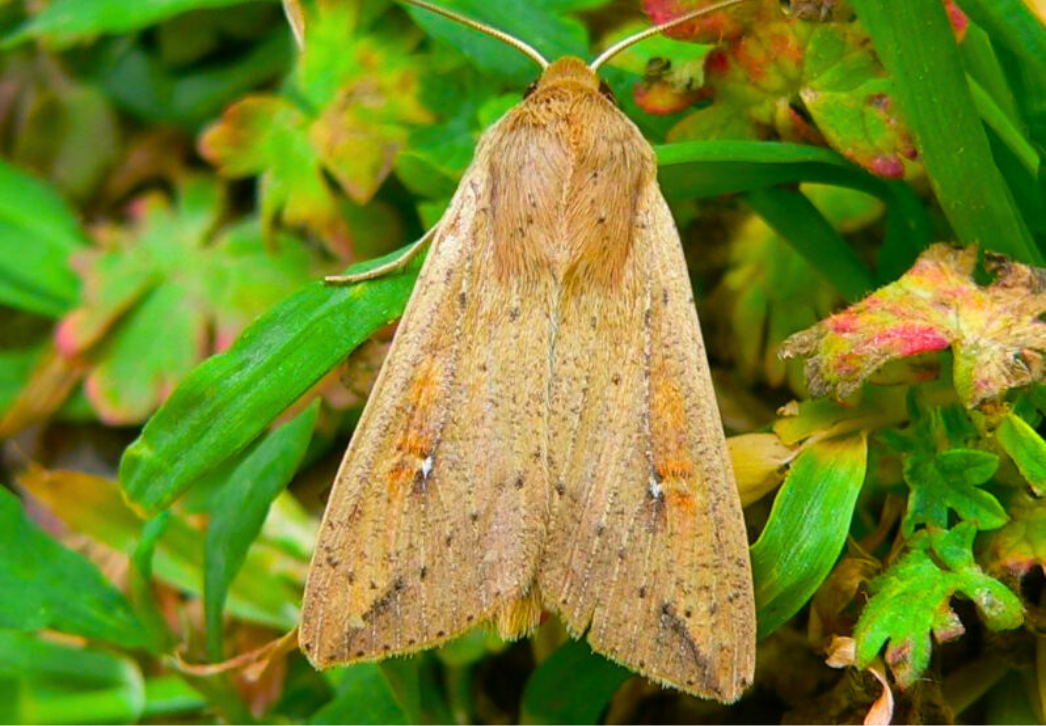
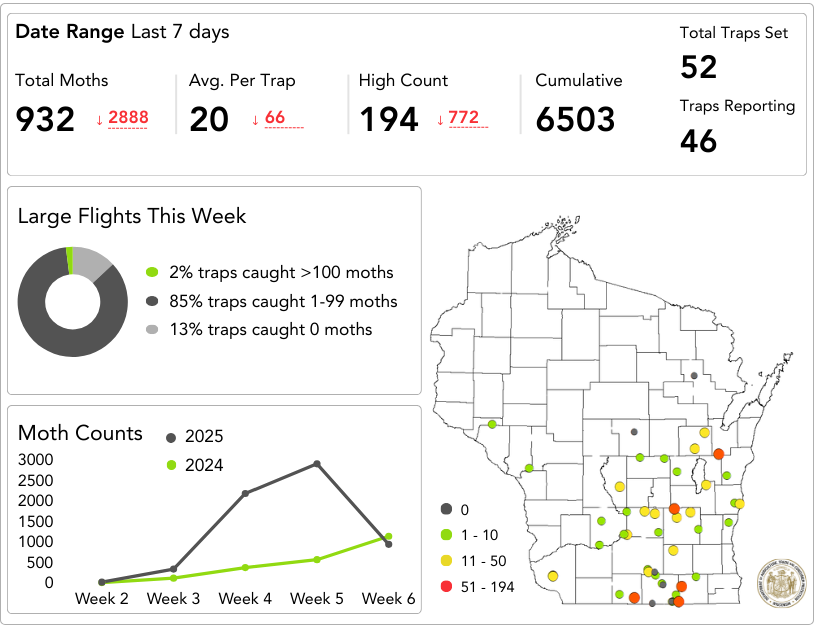
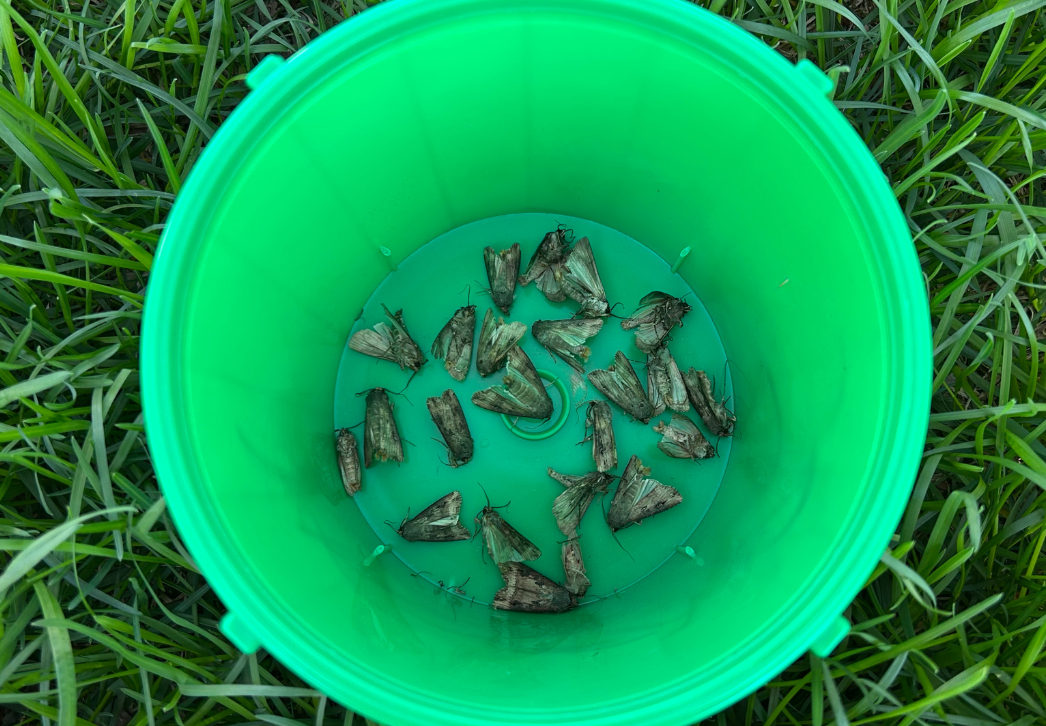
The true armyworm monitoring network documented a sharp drop in true armyworm flights for the week ending May 8. The weekly count was 932 moths in 46 traps (average of 20 per trap) which is a considerable decrease from last week’s 2,888 moths (average of 66 per trap). The individual high trap count fell from 772 moths to 194 moths, as did the number of sites with catches of 100 or more moths. Only one trapping site caught more than 100 moths this week in comparison to nine sites last week.
The 2025 true armyworm migration has brought high moth counts to several locations this spring. The cumulative count as of May 8 is 6,503 moths in 52 traps (average of 125 per trap). These flights may or may not produce infestations later this month and in June. Scouting for larvae in small grains, corn, and pastures approximately three weeks after a large flight is the only decisive way to know if armyworms are an active threat in fields. |
|
 __________________________________
|
|
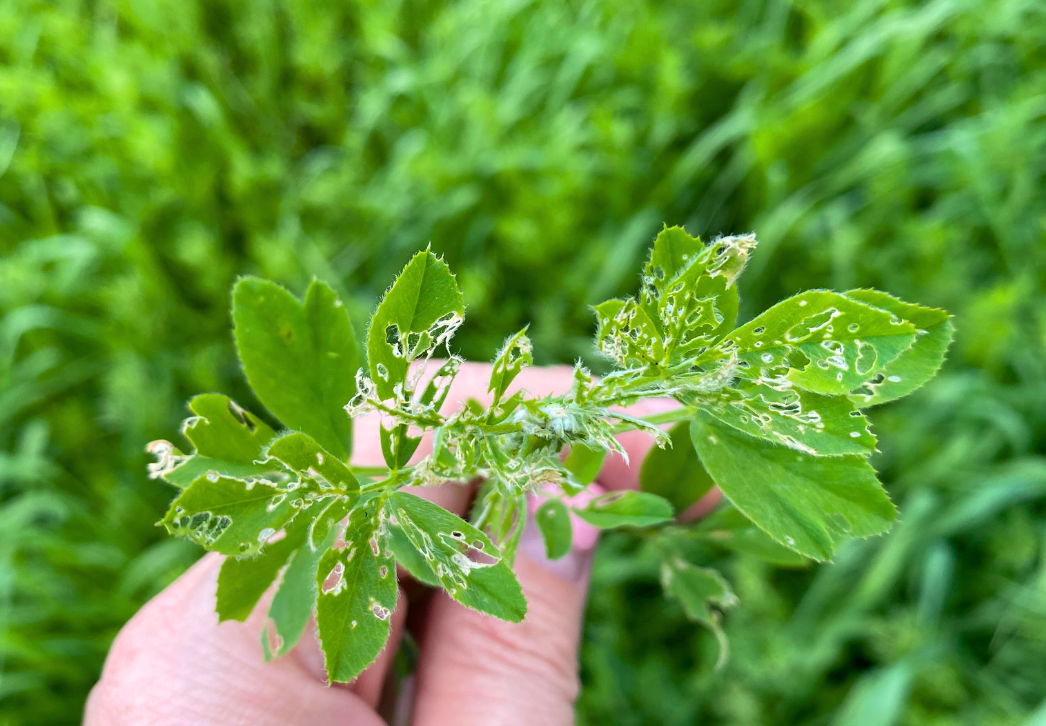
DATCP's alfalfa pest surveys began this week in southern and western Wisconsin. Insect levels are currently very low, as expected for early May. Sweep net collections yielded a few alfalfa weevil adults, pea aphids, tarnished plant bugs, and a variety of beneficial insects such as damsel bugs, lacewings, lady beetles, and parasitic wasps. A single alfalfa weevil larva was found in Monroe County, signaling that egg hatch is beginning.
The alfalfa weevil scouting season comes and goes quickly in Wisconsin. The two weeks from May 18 to June 1 will be the most critical for assessing weevil feeding. Early scouting can begin next week in southern areas. As a reminder, the threshold for alfalfa weevil is based on the percentage of plants across a field showing tip feeding injury, and not the number of larvae collected in sweep nets. As weevil feeding intensifies toward the end of May, 40% tip feeding fieldwide is the UW-Extension’s recommended threshold for making harvest and management decisions. |
|
 __________________________________
|
|
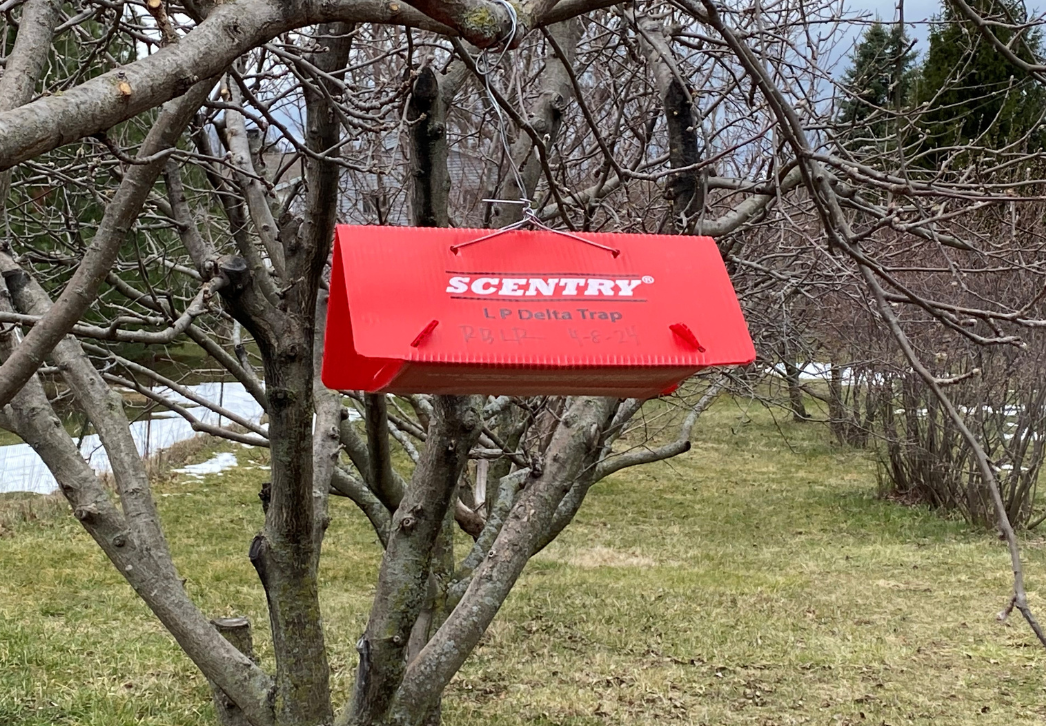
Reports from DATCP’s Apple Pest Monitoring Network indicate that the spring emergence of redbanded leafroller (RBLR) has been underway for four weeks. Although it may seem early, the first RBLR flight has likely peaked at a few southern Wisconsin orchard monitoring sites. This week’s average count of 47 moths per trap (range of 0-217 per trap) is the highest since moths started appearing in traps in mid-April. In eastern and northern orchards, trap counts are still low and the RBLR flight is just beginning. With egg laying well underway across southern areas, early signs of feeding by small leafroller larvae and other lepidopteran species (i.e., green fruitworm, spring cankerworm), should become noticeable in the next two weeks. Scouting for first and second-instar larvae, while they are actively feeding on leaf tissue, is the only reliable way to determine the need for management of spring lepidopterans at petal fall.
Apple growers are also reminded to set codling moth traps this week. The first of two codling moth flights begins in Wisconsin around petal fall or between 175-250 degree days (simple base 50ºF). According to the simple 50ºF column in DATCP's degree day table, the lower range of this threshold has been surpassed in warmer southern areas. Codling moth pheromone traps should be hung in the upper one-third of the tree canopy. The standard codling moth lures provided by DATCP need to be replaced after three to four weeks.
In addition to the codling moth, another insect pest soon appearing in orchards is the plum curculio. Emergence of adult weevils from overwintering sites and movement into the perimeter of the orchard begins between bloom and petal fall, on warm evenings when temperatures exceed 60°F. Monitoring for plum curculio is recommended beginning at petal fall. |
|
 __________________________________
|
|
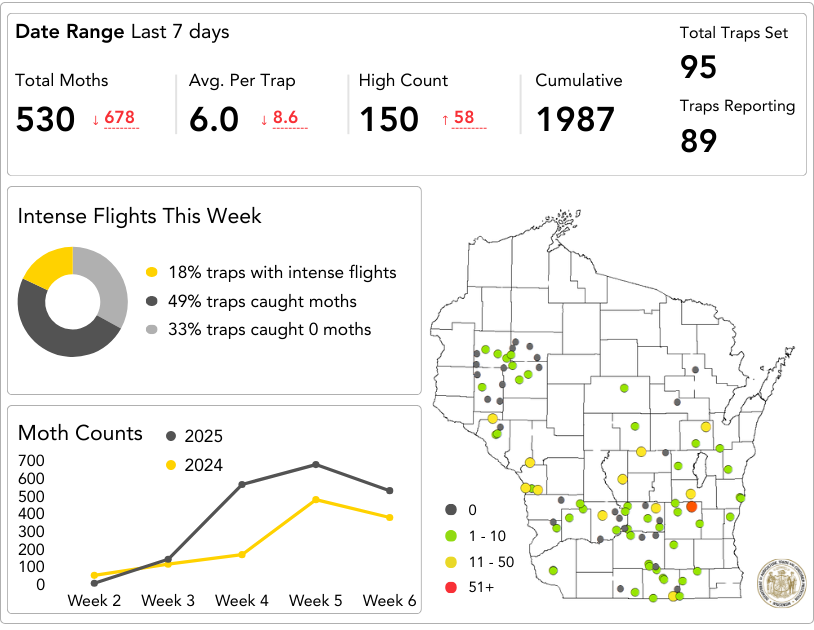
DATCP’s 95 black cutworm monitoring locations collected 530 moths this week, a decrease from last week’s count of 678 moths in 90 traps. The week’s highest count of 150 moths recorded in Dodge County was up from 58 moths the week before. Pheromone traps have captured a cumulative total of 1,987 moths since traps were set on April 1. Last season at this time, the total count was far lower at 378 moths.
Black cutworm flights are monitored in spring to forecast the primary damage window for seedling corn. The first intense flight of nine or more moths in two nights, as detected by pheromone traps, serves as the starting point for counting degree days (modified base 50°F). Accumulating 300 degree days after the biofix indicates that black cutworm larvae from eggs laid in April and early May have reached the fourth instar cutting stage and are large enough to sever newly emerged corn plants. |
|
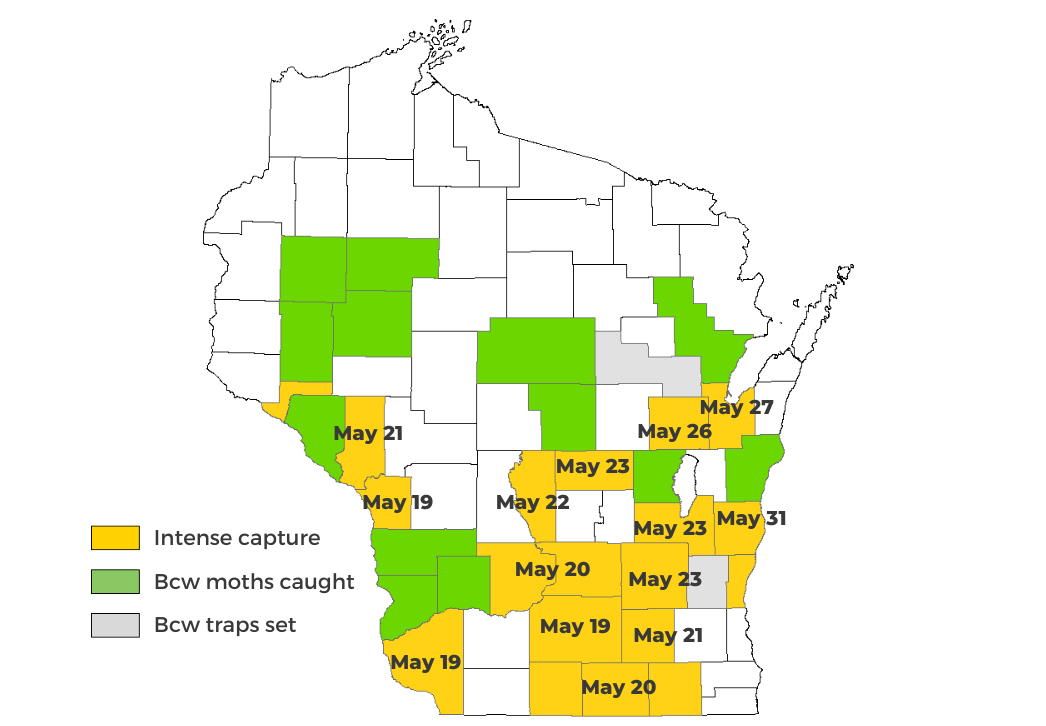
Based on intense captures April 16-23 and accumulating heat units, the primary black cutworm damage window is projected to open May 19 in advanced southern areas of the state. Note this opening date is a few days earlier than predicted in last week's issue. Corn growers in central and eastern Wisconsin can anticipate the start of the black cutworm damage season by May 19 near La Crosse, May 23 near Hancock, May 27 near Green Bay, and May 31 at Sheboygan (refer to the updated forecast map below). |
|
It is still too early to know if the moth flights over the last six weeks will produce localized cutworm problems. Damaging black cutworm infestations are uncommon in Wisconsin and several factors (e.g., heavy flights, weedy pre-plant conditions, wet soils, late planting, etc.) must converge to produce outbreaks. Scouting for pinholes in corn leaves and other early signs of black cutworm feeding can begin as soon as corn fields emerge, and efforts should increase as the projected earliest cutting date approaches.
|
|
 __________________________________
|
|
__________________________________ |
|
|
|
|