|
|
Unsettled weather with early-week storms continued to limit opportunities for spring planting and fieldwork in Wisconsin. Severe thunderstorms moved through the state on April 28, producing damaging winds, large hail, and several tornadoes. The National Weather Service confirmed reports of four tornadoes in Eau Claire County and two in Shawano County on Monday evening. After the storms passed, calm weather, with cooler temperatures prevailed, though light showers persisted throughout the week. Central Wisconsin potato growers accomplished some planting in between rains and spring tillage progressed as conditions allowed, but full scale fieldwork remained on hold as farmers await an extended period of dry, warm weather.
__________________________________
|
|
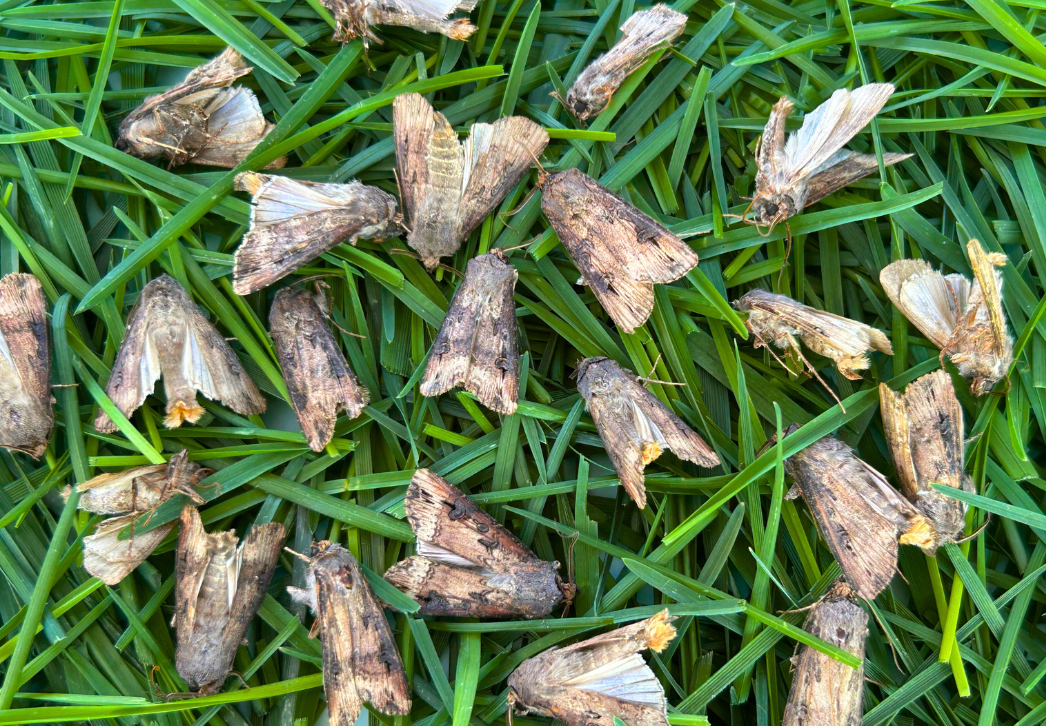
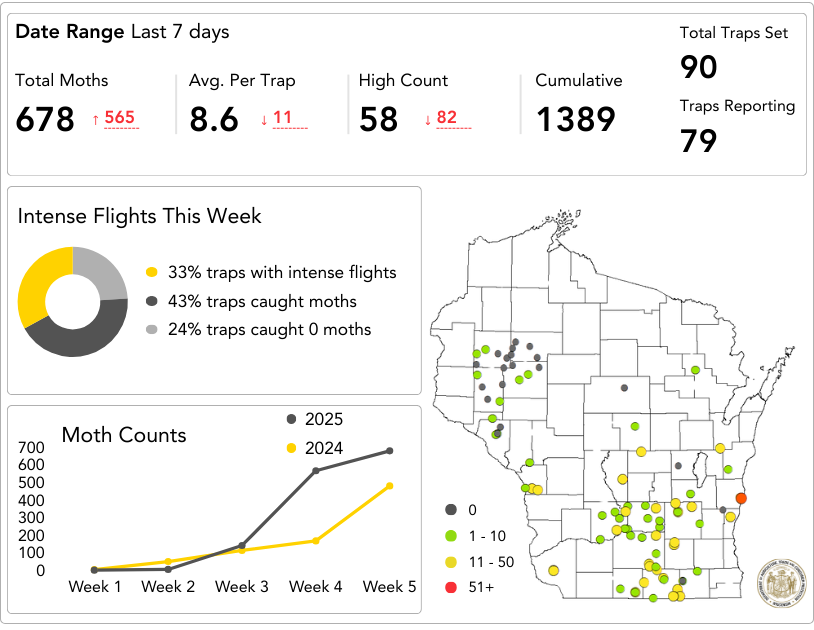
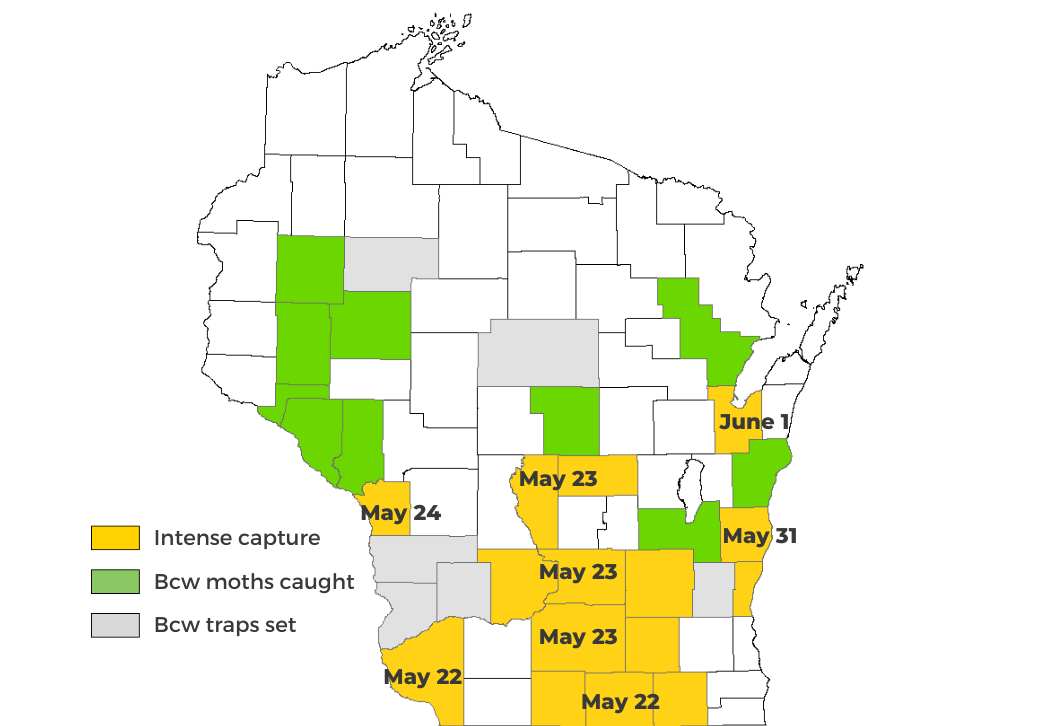
Black cutworm moths arrived in significant numbers again this week. DATCP’s network of 90 pheromone traps collected 678 moths during the April 25-May 1 reporting period, an increase from 565 moths the week before. Intense captures were documented at 26 of the sites. An intense capture of nine or more moths in two nights indicates a large flight has occurred and that a corresponding increase in cutworm egg laying can be expected. The first intense flight also marks the starting point (or biofix) for counting degree days to forecast the peak seedling corn damage window. From the date of an intense capture, an average of 300 degree days (modified base 50°F) is required for the black cutworm to develop from the egg stage to the damaging fourth-instar larval stage. |
|
As mentioned in last week's issue, the black cutworm migrates northward each spring from overwintering areas in the Gulf states. When appropriate weather systems occur, the moths can reach Wisconsin from Texas in only two days. The first moths of the 2025 season were recorded in traps on April 2 and the total cumulative count as of May 1 is 1,389 moths in 90 traps, or an average of 15 moths per trap. This five-week count marks the half-way point in the black cutworm trapping survey and is slightly higher than the 813 moths in 77 traps (average of 11 per trap) captured by the same time last year. A preliminary forecast of starting dates for the 2025 peak seedling corn damage window is provided in the map below. Please note these dates are subject to change if spring temperatures deviate significantly from 30-year normals in the next three weeks.
|
|
 __________________________________
|
|
Overwintered alfalfa weevil adults are resuming activity and the 10-day forecast calls for the start of spring egg laying in southern Wisconsin alfalfa fields. Although extreme cold temperatures in January and lack of snow cover may have caused higher-than-normal alfalfa weevil winter mortality and possibly lower larval populations this spring, it is still important to plan for sampling first-crop alfalfa in May.
DATCP’s alfalfa surveys are scheduled to begin the week of May 11-17 and crop advisors should likewise start checking fields for weevil larvae at that time, or as 300 degree days are reached across the state (refer to the sine base 48°F column in the degree day table). The earliest larvae are likely to emerge by May 7 in Grant and Rock counties. A map showing current alfalfa weevil degree day accumulations is available through the UW-Extension Vegetable Disease and Insect Forecasting Network (VDIFN) site. |
|
 __________________________________
|
|
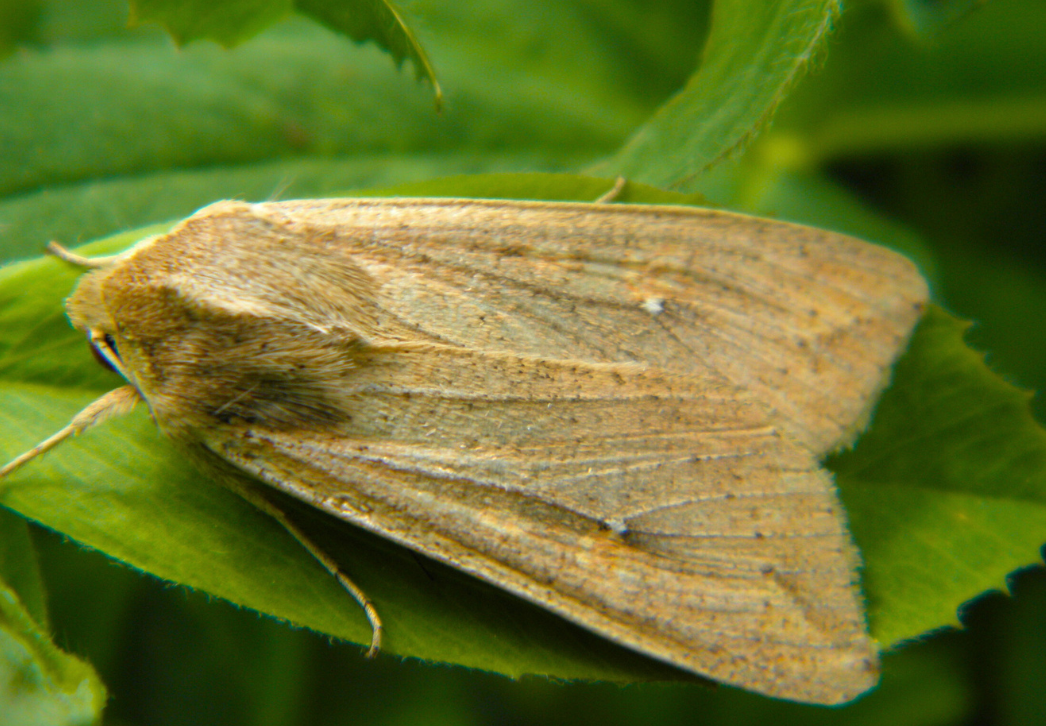
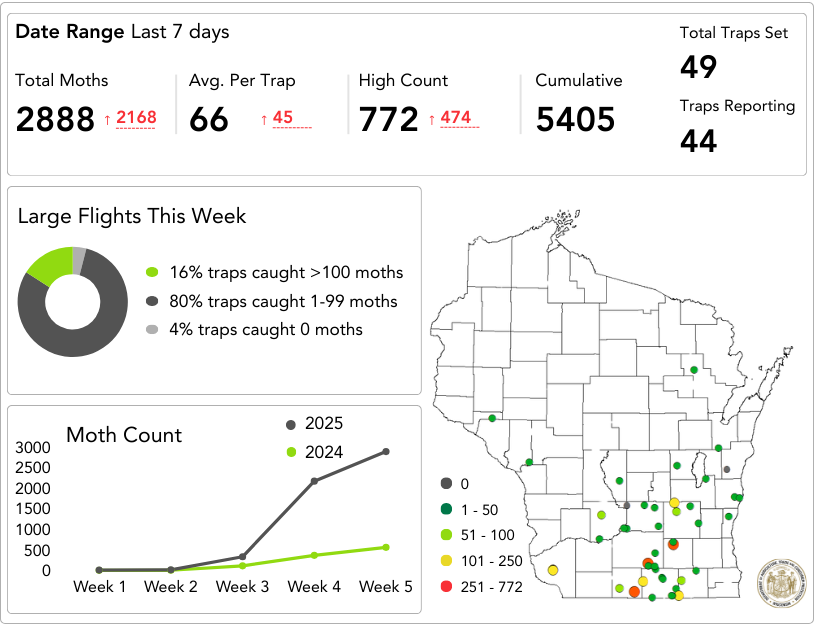
The spring migration of true armyworm moths from the southern U.S. into Wisconsin continued, with pheromone traps collecting another 2,888 moths during the week ending May 1. A few very high counts were reported from trappers, including 772 moths in the trap near Lake Mills in Jefferson County and 470 moths at Juda in Green County. Eight of the 49 traps in DATCP’s True Armyworm Monitoring Network captured 100 or more moths. To date, the cumulative total count is 5,405 moths in 49 traps, or an average of 110 moths per trap.
Extremely high armyworm counts like the one in Jefferson County are not unusual for this pest or cause for alarm. Recall that high pheromone trap counts do not reliably foreshadow field infestations and a definitive moth capture threshold does not exist for true armyworm. Instead, the trap counts indicate a large flight has occurred and that larvae will begin appearing in corn, small grains, and pastures in two or three weeks. DATCP surveys in alfalfa consistently find small armyworm larvae in sweep nets by early June and in the perimeter rows of field corn by mid-June. These first-generation larvae are rarely damaging in Wisconsin, though they can set the stage for later second-generation problems in July.
In short, it is impossible to know if or where infestations will develop based on trap counts (even remarkably high counts of nearly 800 moths). Scouting host crop fields approximately two or three weeks after large flights occur is the only decisive way to determine armyworm presence and the risk of outbreaks. |
|
 __________________________________
|
|
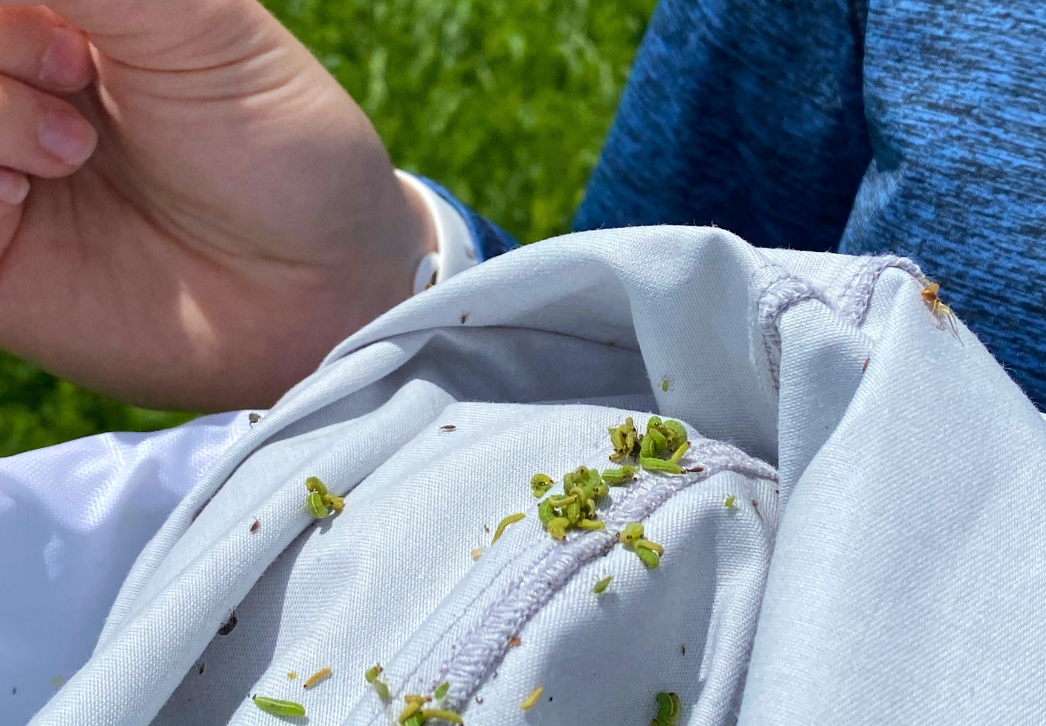
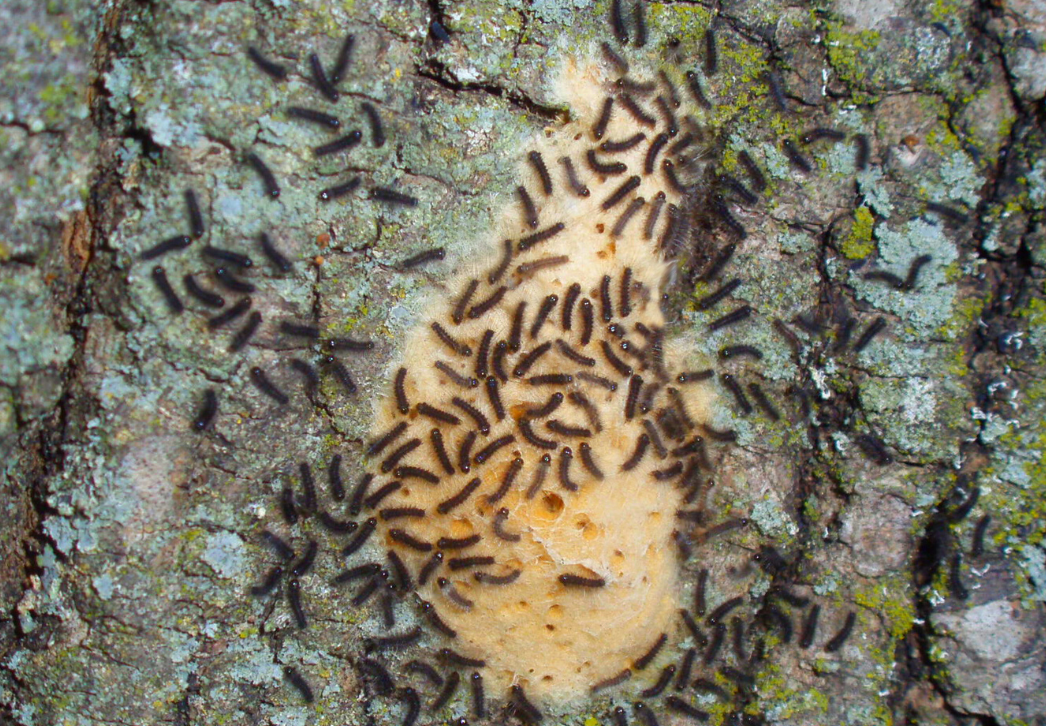
Preparations are underway for the annual spongy moth aerial spray season in western Wisconsin. DATCP relies on insect and tree phenology models, site observations, and BioSIM software to precisely time applications. BioSIM uses weather data and simulation models to project when spongy moth eggs will hatch and when larvae will reach an appropriate developmental stage for spray. DATCP staff confirmed spongy moth egg hatch in Dane and Buffalo counties this week, which is consistent with BioSIM estimates of beginning hatch. Spongy moth development forecasts for 2025 are about one week behind last year and two or three days behind the 40-year average.
DATCP plans to treat sites in eight western Wisconsin counties for spongy moth this year using the organic treatments Foray® 48B and SPLAT GM-O™. Control efforts will be focused in areas where populations are still isolated and low or starting to build. The following counties are scheduled for aerial treatments: Barron, Buffalo, Dunn, Grant, Lafayette, Pepin, Polk, and St. Croix. Maps of treatment areas are available at SMAerialSpray.wi.gov.
Annual spray treatments are part of the National Slow the Spread Program, an ongoing, long-term effort to slow the spread of spongy moth and delay the impacts associated with outbreaks. Wisconsin experienced its worst spongy moth outbreak on record in 2023 and 2024, with defoliation affecting nearly 373,000 and 334,000 acres, respectively. Although the 2025 populations are expected to continue a downward trajectory, DATCP’s spongy moth treatment program remains important for protecting the state’s trees and forests.
To receive information on treatment plans, visit SMAerialSpray.wi.gov, sign up for email updates, call the hotline at (800) 642-MOTH, or follow DATCP on Facebook and X. |
|
 __________________________________
|
|
|
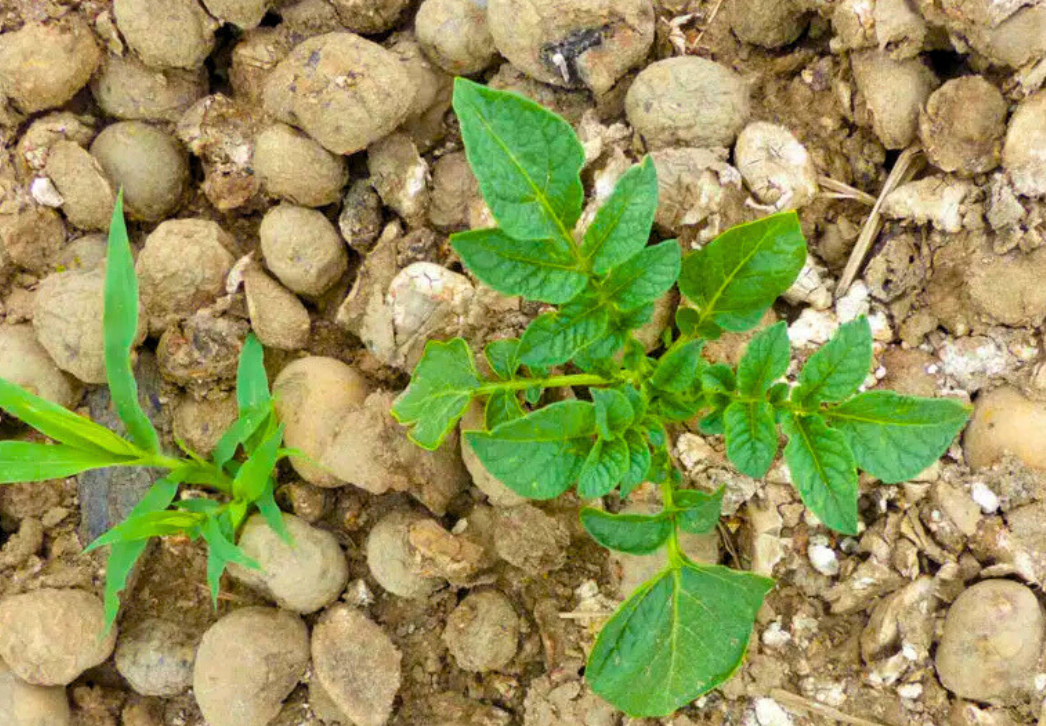
Potato cull piles represent a risk to surrounding potato acreage due to the pests and diseases that can overwinter and build up on the tubers or sprouted plants. Wisconsin potato producers are required to dispose of cull piles by May 20, 2025, in accordance with ATCP 21.15 Wis. Admin. Code. Cull piles are defined as waste piles of harvested potatoes, seed cutting slivers and waste, storage remnants, and sweepings. The purpose of this regulation is to prevent overwintered tubers from sprouting volunteer potato plants, which may provide an early-season inoculum source of the late blight pathogen, Phytophthora infestans. Eliminating cull piles is a critical component of late blight management that requires a community-wide effort. Compliance options for cull pile disposal include:
- Feeding potatoes to livestock so that they are completely consumed by May 20
- Spreading on fields and incorporating into the soil
- Depositing the cull potatoes in a licensed landfill with the written permission of the landfill operator
- Another method which the Wisconsin Department of Agriculture, Trade and Consumer Protection approves in writing
Growers seeking additional information should contact DATCP potato program coordinator Sara Ott at (608) 516-5486 or Sara.Ott@Wisconsin.gov.
__________________________________
|
|
__________________________________ |
|
|
|
|