|
|
Rain and scattered thunderstorms stalled spring fieldwork across the state this week. After a brief window of mostly dry weather allowed for a mid-April start to the planting season, several days of widespread showers temporarily paused most field activities. According to the USDA National Agricultural Statistics Service (NASS), Wisconsin farmers have had limited opportunity to prepare fields this month, with fewer than nine days of weather suitable for fieldwork reported for the period of April 1-21. Spring tillage was estimated as 15% complete statewide at the start of the week, four days behind last year and two days behind the average. Oat producers had seeded 17% of the state’s crop, one day behind both last year and the long-term average. Most of the planting progress made so far has been in the southwest and south-central areas where soils are drier due to lingering moderate drought (D1) following an open winter (18th driest on record for Wisconsin). By contrast, soil moisture is largely adequate in other areas of the state as a new growing season begins, and additional rain chances in the week ahead will likely continue to delay planting until May.
__________________________________
|
|
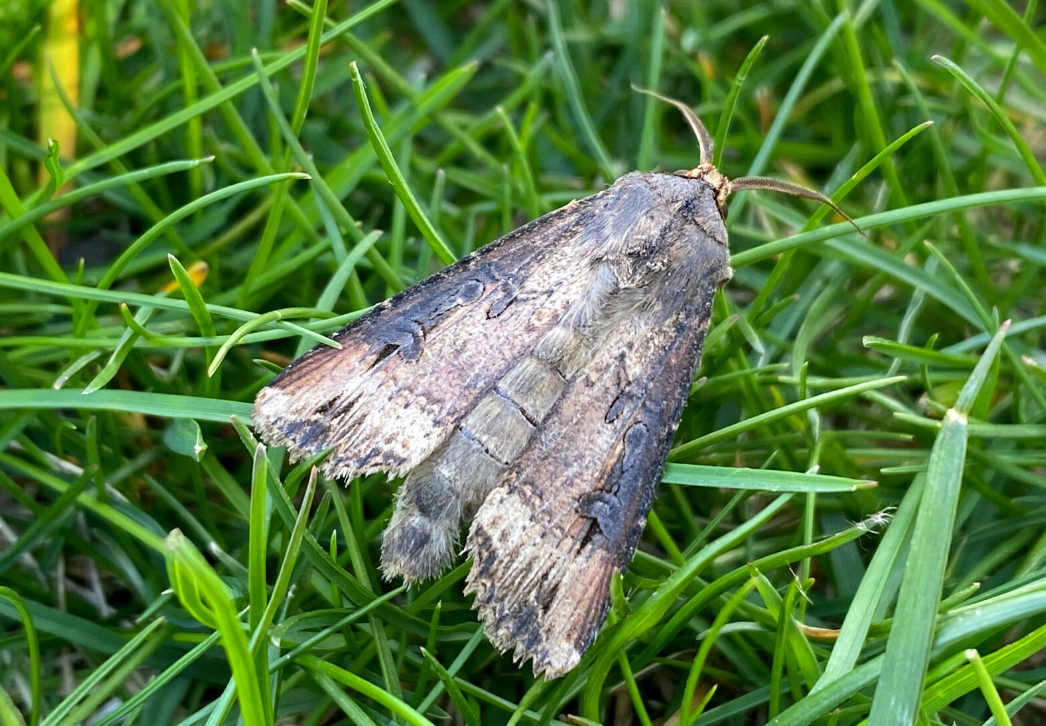
The early-season arrival of black cutworm moths into Wisconsin has been monitored by DATCP each spring for the last 25 years. The nocturnal moths migrate northward from overwintering areas in Texas and Mexico using low-level jet streams and reliably appear in Wisconsin by late March or early April. Ahead of the migration, the Pest Survey Program and a network of volunteer cooperators set pheromone traps to track arrival dates, estimate regional moth abundance, and determine the timing of significant or intense flights. Trap catch data are used in combination with accumulating growing degree-days to forecast when first-generation black cutworm larvae have reached critical feeding stages to damage newly emerged corn.
This season, the network of 63 survey traps set by DATCP staff and 34 cooperators have been collecting black cutworm moths since early April. The earliest Wisconsin catch of 2025 was registered on April 2 and first intense captures were recorded on April 16, in Dane and Sheboygan counties. An intense capture (usually defined as nine or more moths trapped in two nights) marks the biofix or starting point for counting black cutworm degree days. Larvae are typically large enough to cut seedling corn once 300 degree days (modified base 50°F) accumulate after the biofix.
As of April 24, the black cutworm monitoring network has collected a cumulative total of 711 moths in 63 traps, or an average of 11 per trap. This week’s count of 565 moths is a sharp increase from last week’s 141 moths, and 20 sites have now reported intense flights. Counts will be published each Thursday on our Black Cutworm Monitoring page and on the Great Lakes and Maritimes Pest Monitoring Network (GLMPMN) site. A forecast of the peak seedling corn damage window for Wisconsin will be issued next month. |
|
 __________________________________
|
|
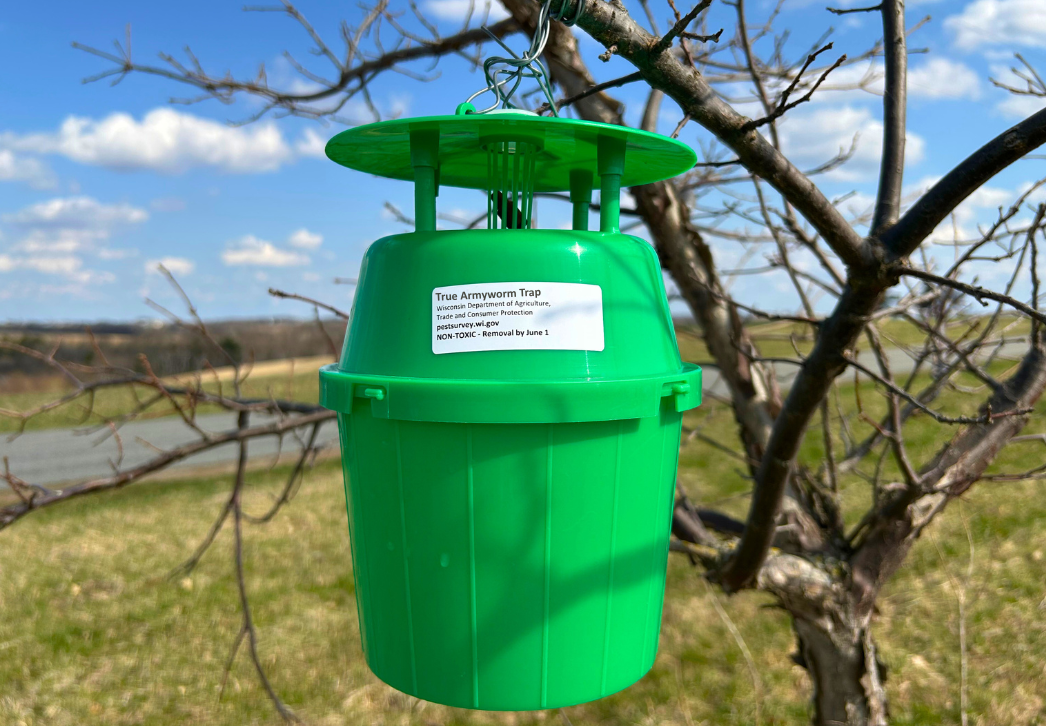
Similar to the black cutworm network, pheromone traps for true armyworm are set in Wisconsin in spring to monitor the arrival of moths into the state and to track local flights during the summer months. The migratory behavior of true armyworm makes it difficult to forecast where infestations will emerge in the state from year to year. Determining when moth flights are occurring in an area can help growers anticipate when the larvae might appear in their crops and inform targeted scouting windows.
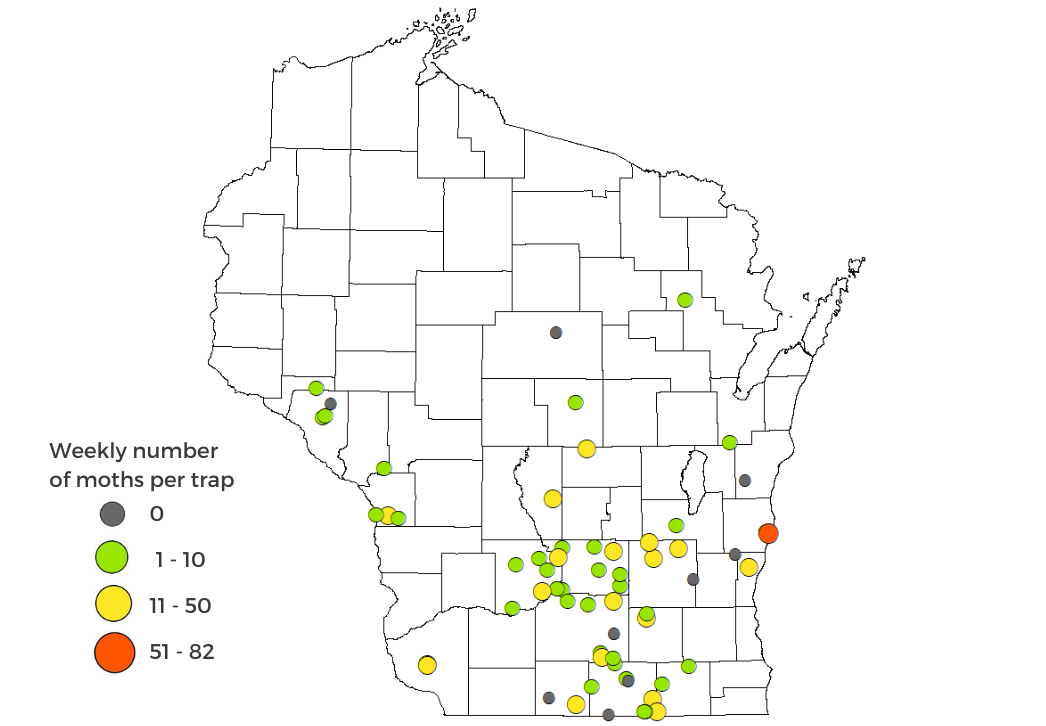
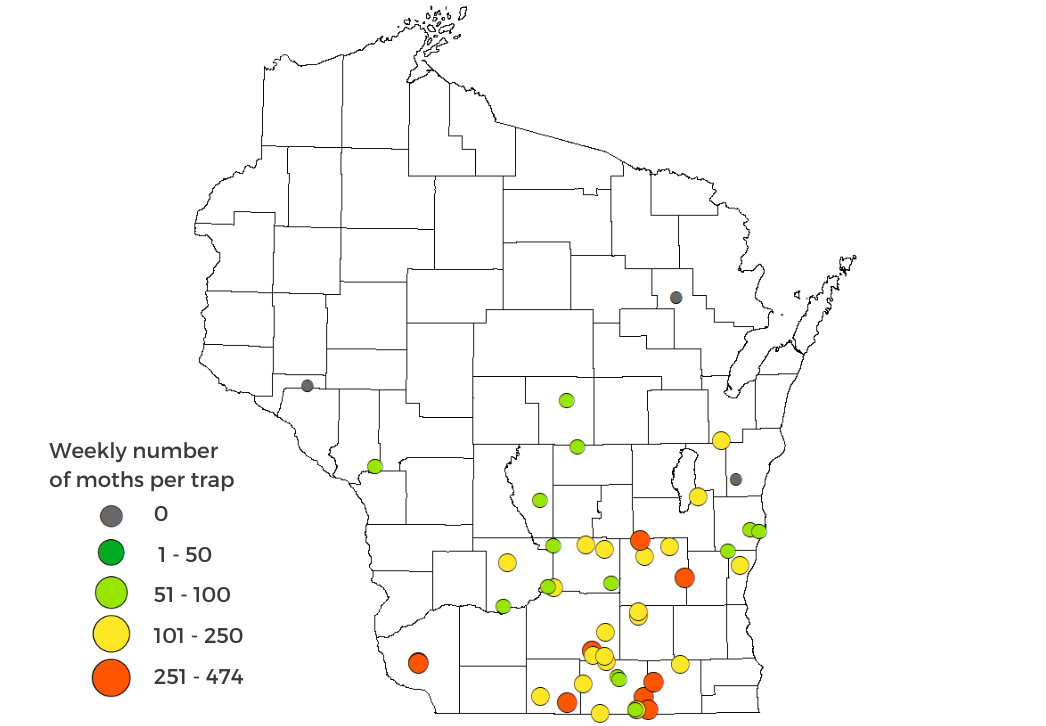
Based on this month’s trap data, true armyworm moths have been arriving in the state since early April and counts are rapidly increasing. Trap counts rose noticeably last week (April 11-16) when the network’s 48 traps collected a total of 330 moths. Another 2,168 moths were recorded this week (April 17-24), with seven of the traps capturing 100 or more moths. The site near Juda in Green County reported the week’s highest catch of 474 moths. As of April 24, the cumulative total true armyworm moth count is 2,517 moths in 48 traps, or an average of 52 moths per trap. |
|
|
It is important to note that the main function of pheromone traps is not to provide definitive data on true armyworm abundance or pressure, but to act as an indicator of moth flight activity and potential egg laying. Crop scouting is required two to three weeks after large flights are recorded to check for larvae and early signs of feeding damage. Also be aware that true armyworm trap counts are often much higher than black cutworm counts and comparing the two does not yield useful information. Instead, the recent marked increase in moth counts at Wisconsin's true armyworm monitoring sites signals that egg laying is occurring in small grains, pastures, and other available grass hosts. First-generation larvae should begin hatching by early to mid-May.
A summary of weekly true armyworm trap counts is provided on our True Armyworm Monitoring page. Thank you to the many cooperators who have volunteered to maintain pheromone traps this season.
Nearby states including Iowa, Indiana, and Minnesota also report true armyworm and black cutworm trap counts:
|
|
 __________________________________
|
|
|
For the 2025 growing season, an Insect Pest Text Alert service will again be available to Wisconsin crop producers and agricultural professionals. Coordinated by the Dr. Emily Bick Lab at UW-Madison, in collaboration with UW-Extension’s Laura Flandermeyer and DATCP’s Krista Hamilton, this service is designed to deliver concise, timely field and forage crop pest notifications and updates through text messaging. As part of this service, subscribers will receive:
- Scouting alerts based on field survey observations
- Pest updates throughout the growing season
- Useful resources for scouting and management
Text messaging will begin in May, and we expect to provide up to 15 short updates throughout the season. If you would like to receive our insect pest alerts directly to your cell phone, please click the “Sign Up Now” button below.
|
|
 __________________________________
|
|
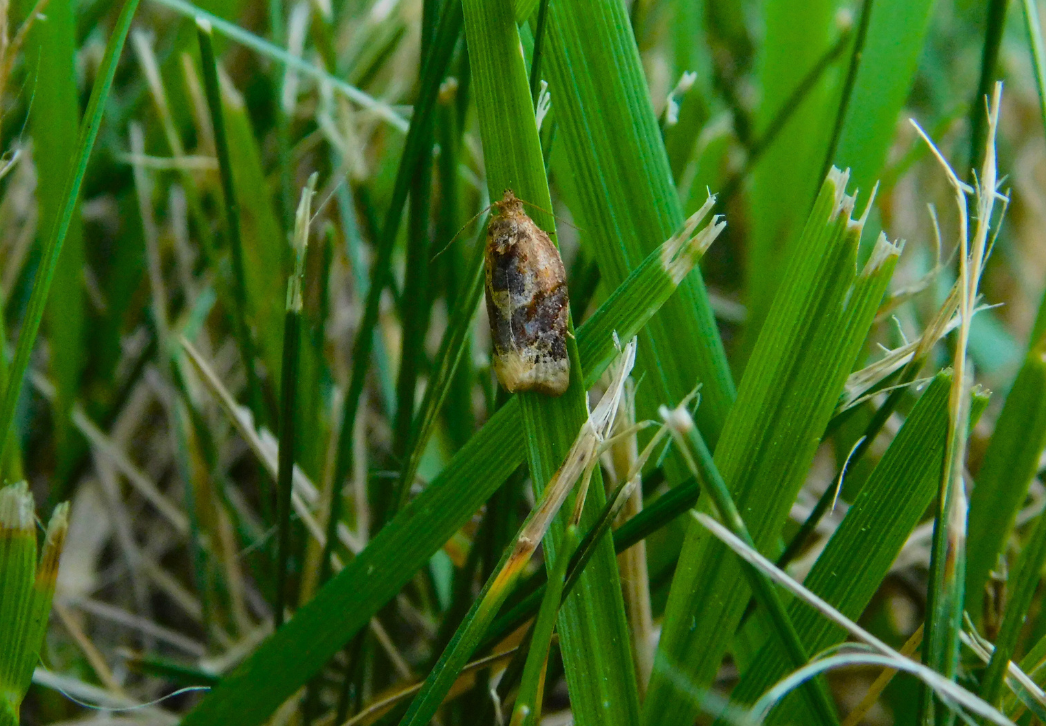
Although this week’s rainy weather has been less than ideal for planting, warming temperatures have brought out the earliest spring orchard pests, including the redbanded leafroller (RBLR). DATCP’s 25 apple pest network cooperators, representing 27 orchards from Burlington to Bayfield, have begun setting traps to monitor the seasonal activity of RBLR and various insect pests in their orchards. Most of our cooperators have been documenting insect activity and contributing data to our program for more than a decade. In fact, seven participants have been with our program for 15-20 years and another seven are beginning their 27th year of insect monitoring!
To date, minimal orchard insect activity has been observed. Redbanded leafroller traps counts have been low, ranging from four to 77 moths per trap at reporting locations. However, the first RBLR flight of the season peaks early at 200 degree days (base 45°F) and this event should occur within the next two weeks across southern and central Wisconsin. As a reminder, there are three RBLR flights each season in Wisconsin. Trap counts of RBLR and five other economically important insects will be posted on DATCP’s Apple Orchard Pests page each Thursday from today through August 31.
In addition, the recent wet conditions with mild temperatures in the 60s and low 70s have been favorable for the apple scab fungus. The fungus overwinters in diseased leaves on the orchard floor and requires a period of warm weather in spring for the ascospores to mature (usually referred to as primary inoculum). Once mature, the ascospores are ejected from the leaves to infect current growth. With almost daily rain chances in the forecast over the next week, apple scab infection periods are expected. The NEWA Apple Scab Model is a tool available to apple growers to help with decision-making and timing fungicide applications to control primary apple scab infections. |
|
 __________________________________
|
|
|
|
|