|
Developmental Disabilities Newsletter
MAY 2026 EDITION
|
|
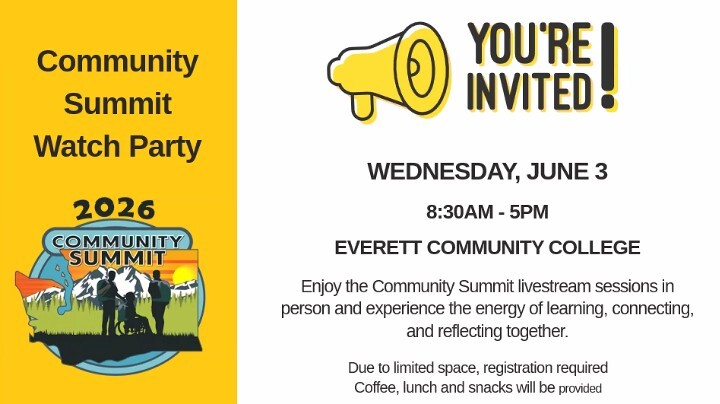
 Community Summit Watch Party
Snohomish County is excited to host our first local Community Summit Watch Party, and we invite you to join us for this shared day of learning, connection, and community!
Participants will be able to experience the virtual conference together rather than watching alone. We will have three rooms available, giving attendees the chance to choose which session they would like to view during each time block. Throughout the day, we will also make space to reflect, share ideas, and build relationships with one another.
During the Watch Party, participants will have opportunities to:
- Watch Community Summit sessions together in a supportive, shared space
- Hear insights from both local and national presenters
- Join interactive activities and group conversations that deepen learning
- Meet and build relationships with others committed to inclusion and advocacy
- Strengthen connections within our local community
The event is free, and light refreshments and lunch will be provided. Space is limited, so please complete the brief registration request form. If approved, you’ll receive a follow‑up email with the official registration link and details. You can register by completing the registration request form.
We hope you’ll join us for this meaningful and engaging day!
If you have any questions, feel free to reach out to our team at ddinfo@snoco.org.
-
When: Wednesday, June 3, 2026
-
Time: 8:30 am to 5:00 pm
-
Where: Everett Community College
- Check our Events page for more information, and you can check back regularly for the most up‑to‑date details about the watch party.
Currently Accepting Job Foundation and School to Work Applications
Attention 2028 Grads – Job Foundation is a program designed to help students and their team seamlessly move into their final year in Transition. A job coach will observe the student through a discovery process and compile the information in a report that is shared with the student’s team. The report includes recommendations including actionable next steps needed for success. Job Foundation is available to students in their second to last year of Transition (ages 19 to 20 years old) and who are eligible with Developmental Disabilities Community Services (DDCS). Students who participate in Job Foundation can segue into School to Work (S2W) in their final year of Transition.
Attention 2027 Grads – Applications for School to Work (S2W) are now open. This is an opportunity for your student to access the vital resources they will need once they graduate. The S2W team will help explore opportunities for employment and the goal is to be employed before the student graduates, creating a smooth transition from “School to Work”. Students who want to work, are enrolled in Developmental Disabilities Administration (DDA), have SSI, have selected a first and second Employment Provider of their choice (aligned with current provider capacity) and are 20-22 years old will qualify. This team provides a network of people who are invested is the student success and who will provide ongoing support during school and after graduation as long as needed. Please note, if you have participated in Job Foundation, you do not need to fill out a separate application for S2W. If you completed a Job Foundation application but were unable to participate due to not meeting the eligibility criteria with DDA but have since become eligible before your third year of Transition, you do not need to fill out another application.
Reimagine DSHS is PAUSED
Last week, DSHS Secretary Angela Ramirez shared the decision to reunite developmental disabilities services under the Developmental Disabilities Administration. This includes Developmental Disability Community Services, State Operated Community Residential services and Residential Habilitation Centers. To read the detail about this decision, see the DSHS bulletin.
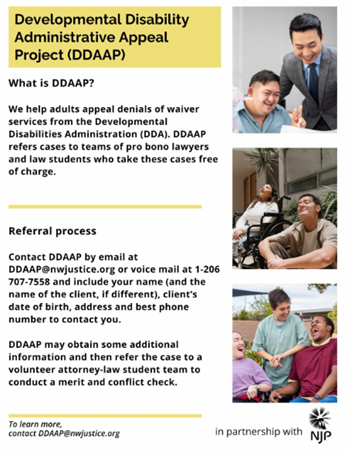
Developmental Disability Administrative Appeal Project (DDAAP)
What is DDAAP?
We help adults appeal denials of waiver services from the Developmental Disabilities Administration (DDA). DDAAP refers cases to teams of pro bono lawyers and law students who take these cases free of charge.
Referral process
Contact DDAAP by email at DDAAP@nwjustice.org or voice mail at 1.206.707.7558 and include your name (and name of the client, if different), client’s date of birth, address and best phone number to contact you.
DDAAP may obtain some additional information and then refer the case to a volunteer attorney-law student team to conduct a merit and conflict check.
To learn more, contact DDAAP@nwjustice.org
May is Mental Health Awareness Month
Mental Health Awareness Month was established in 1949 to increase awareness of the importance of mental health and wellness in Americans’ lives and to celebrate recovery from mental illness. Throughout the month, various national, state and local organizations aim to eradicate stigma, extent support, and advocate for policies that prioritize the well-being of individuals and families affected by mental health (National Alliance on Mental Health).
The Substance Abuse and Mental Health Services Administration (SAMHSA) has recognized Mental Health Awareness Month (MHAM) every May. This month is dedicated to increased awareness about the vital role mental health plays in our overall health and well-being and provide resources and information to support individuals and communities who may need mental health support.
It can be challenging to meet the needs of youth, including youth and adults with developmental disabilities, and for parents and caregivers. If you have a loved one who is served by Developmental Disabilities Administration (DDA), reach out to your case manager with any questions about mental health supports and services. If your loved one is school age, you can also reach out to your school’s counselor. Also, don’t forget your need for support as a parent, guardian, or caregiver of an individual with developmental disabilities. Here are some additional resources:
Anyone can call the Volunteers of America Care Crisis Line at 1-800-584-3678. This service if 24/7 and free. They can connect you to a mental health provider.
Access information from the Snohomish County Behavioral Health Children and Youth Programs
Find information from Kids’ Mental Health Washington and supporting the behavioral health needs of Washington kids, youth and families
The Center of Parent Excellence (COPE). This is intended to provide a pathway for Washington State parents who are accessing and navigating the children’s behavioral health system to have peer support to ease their journey, whenever possible. Support is provided by A Common Voice, a statewide, family-run nonprofit organization that provides advocacy and support for families whose children have intensive behavioral health needs.
If you are a Washington State parent/caregiver of a child/youth who may benefit from assistance accessing and navigating behavioral health services, please contact Lauren, lauren@acommonvoice.org, Phone: 253-732-3264
Learn more about the C.O.P.E. Project
Native and Strong Lifeline – a suicide & crisis line now open: call 988 and press 4.
Calls are answered by Native crisis counselors who are Tribal members and descendants closely tied to their communities. They are fully trained in crisis intervention and support, with special emphasis on cultural and traditional practices related to healing. The Native and Strong Lifeline offers a new way of healing that centers the lived experiences, traditions, and wisdom of Native people. The Native and Strong Lifeline is confidential, free, and available 24/7.
When to contact: Contact the Native and Strong Lifeline if you or a loved one is experiencing Thoughts of suicide; Mental health crisis; Substance use concerns; Any other kind of emotional distress
Read about the Native and Strong Lifeline
Visit the 988 Lifeline website
Learn about the Washington State Tribal Prevention System
Find information about the Washington Indian Behavioral Health Hub
Learn more about SAMHSA and to access the Mental Health Awareness Month toolkit
You are Not Alone
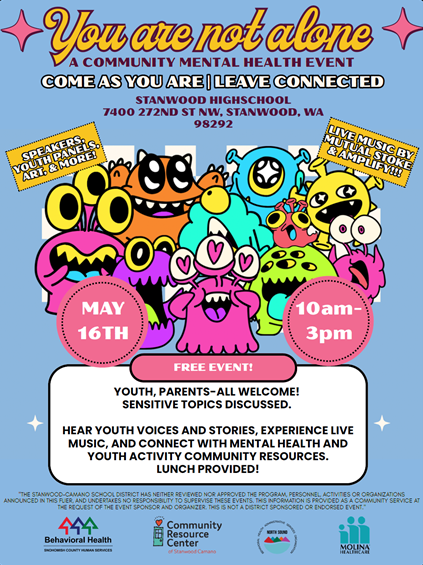
This year's You are Not Alone event will be held at Stanwood High School on Saturday, May 16, 2026 from 10:00 am to 3:00 pm. This is a free event for youth planned in partnership with youth and the Stanwood Camano Community Resource Center. “You Are Not Alone” will feature a variety of resources, activities, live music, and workshops.
Workshops that cover topics such as recognizing warning signs, suicide-prevention strategies, and more; and resources and information on where to seek support and services, and practical guidance on where to turn in times of need.
May is Asian American Native Hawaiian and Pacific Islander Month
This month is also dedicated to recognizing the contributions, culture, and influences Asian, Native Hawaiian and Pacific Islander communities have made throughout the United States of America. These contributions include the work done on the transcontinental railroad, instituting Asian American civil rights movement, and influencing food, fashion, music and language (City of Marysville). Asian American, Native Hawaiian and Pacific Islanders are the fastest growing racial group in our country and make up 12.7% of Snohomish County’s population. May is an opportunity to celebrate the culture, histories, and contributions of one of the most culturally and linguistically diverse groups in the United States.
For many Asian American, Native Hawaiian and Pacific Islanders with developmental disabilities and their families, it can be challenging to navigate stigma associated with disability that could exist in different communities. Also, when English is not the primary language, a lack of interpreters, translation services, and lack of cultural responsiveness can create major barriers to utilizing services for family members with disabilities.
Ways the Snohomish County community can support the Asian American, Native Hawaiian and Pacific Islanders and improve access to services include:
- Provide culturally relevant resources on how to have conversations about disability with their families and in their community.
- Train healthcare and social service workers to be culturally responsive when interacting with this very diverse racial group.
- Make handouts and readings accessible by using plain language and offering pamphlets in the person’s desired language.
- Conduct more research on the unique struggles of disabled Asian Americans, Native Hawaiian, and Pacific Islanders as a product of both disability and Asian American, Native Hawaiian and Pacific Islanders identities.
- Snohomish County Council is also celebrating the heritage and culture of Asian American and Pacific Islander in Snohomish County.
Here are some resources:
View the Asian Americans with Disabilities Resource Guide (2022)
Learn more about the University of Hawaii Center on Disability Studies, which supports underrepresented communities including people with disabilities, their families, Native Hawaiians, Pacific Islanders, and other underserved groups.
Read 'Disabled, Asian American, and Proud' by Sydney Tran and Kathleen Bogart (Psychology Today on July 27, 2022)
Asian Service Center (ASC) empowers and supports members of Asian and other underserved communities through culturally and linguistically appropriate services and programs. ASC is based in Snohomish County, with an office in Edmonds, WA. To learn more, visit the Asian Service Center website. Contact: Robert Ha (Robert.Ha@AsianServiceCenterWA.org / 206-227-7698)
The Korean Community Service Center (KCSC) works to support Korean immigrants and the wider Asian community by helping them overcome economic, health, and language barriers so they can fully participate and thrive. To learn more, visit the Korean Community Service Center website.
Washington Residents Can Add Developmental Disability Designation to Driver License or ID
Washington residents now have the option to add a developmental disability designation to their driver license or ID card, a voluntary step designed to improve communication and safety during interactions with first responders.
The designation can be added to the Department of Licensing (DOL) system and, if the individual chooses, printed directly on the physical card. Law enforcement can view the designation through the DOL system, while medical personnel can only see it if it appears on the card itself.
Individuals or families may request the designation if they believe it will help first responders better understand communication needs or behaviors during emergencies or stressful situations. No medical documentation is required.
Residents can add or remove the designation by submitting a request form by mail or by visiting a driver licensing office. If the symbol is printed on the card, DOL will issue a new card once the request is processed.
More information and the request form are available on the Washington State Department of Licensing’s disability and medical designation page.
Join the Snohomish County Developmental Disabilities Advisory Board!
Are you passionate about helping to create a community where people with intellectual and developmental disabilities and their families are respected, valued, and fully engaged? Snohomish County’s Developmental Disabilities Advisory Board is now accepting applications for new members.
As a board member, you will:
- Learn about issues related to people with intellectual and developmental disabilities and their families.
- Share ideas about what makes our community a great place to live.
- Connect with others who are excited about making a difference and change in the community.
- Provide recommendations on how County money could be spent.
- Share ideas on County Programs that support individuals and families with developmental disabilities.
The Board meets on the 4th Tuesday of each month, 4:00 pm to 6:00 pm (meetings are hybrid – attend in Everett or join via Zoom).
|
|
Helpful Websites
Click on the links below to view websites.
|
|
Transition Network: May 6 DDCS Intake and Eligibility Training
We will welcome Shane Lucey, Intake and Eligibility Supervisor with DDCS. Shane will review the application process, and the steps from intake to eligibility. He will also cover essential eligibility criteria. This will be a two-hour training and is intended for school psychologists, educators, administrators, and any other interested professionals who support children, youth, and young adults with Intellectual and Developmental Disabilities.
-
When: Wednesday, May 6, 2026
-
Time: 7:00 am to 9:00 am
-
Where: Zoom – join the May Transition Network via Zoom by viewing the May Transition Network agenda.
- Two Clock Hours Available for Purchase in partnership with NWESD 189. Registration and attendance for clock hours will be addressed at the training.
Front Door Events
-
When: Thursday, May 14, 2026
-
Time: 5:00 pm to 7:30 pm
-
Who: Everett Public Schools
-
Where: Community Resource Center: 3900 Broadway, Everett, WA. 98201
- View event PDF flyer in your preferred language: Arabic, Chinese, English, Russian, Spanish, Ukrainian, Vietnamese
You are Not Alone
-
When: Saturday, May 16, 2026
-
Time: 10:00 am to 3:00 pm
-
Where: Stanwood High School (7400 272nd St. NW., Stanwood, WA. 98292)
- Workshops that cover topics such as recognizing warning signs, suicide-prevention strategies, and more; and resources and information on where to seek support and services, and practical guidance on where to turn in times of need.
- Find more information here
King County Developmental Disabilities 2026 Resource Fair
The resource fair is for people with intellectual and developmental disabilities and delays, their families, caregivers, and service providers.
SAVE THE DATE: Virtual Community Summit
-
When: Wednesday, June 3, 2026
-
Time: 9:00 am to 4:00 pm
- Stay up to date with information on speakers, schedules, registration, and more by visiting the Community Summit 2026 Event page.
- Snohomish County Developmental Disabilities is hosting a Community Summit Watch Party for community members and partners. Registration information is now available on our Events page, and you can check back regularly for the most up‑to‑date details about the watch party.
|
|
Club Independence
- Meets the first Wednesday of the month from 6:30 pm to 7:30 pm via Zoom, September to June.
- January 8 – Clothing: Find your Style
- February 5 – Choices for Independence
- March 5 – Dating and Relationships
- April 2 – Guest host
- May 7 – Conversation Games
- June 4 – Summer Connection
- A monthly group that The Arc of Snohomish County facilitates and is a place for young adult self-advocates to discuss topics for successful independent
- For information contact Brandi Piecora – Brandi@arcsno.org/425-258-2459 x113
- Learn more about Club Independence
Transition Clubs
- The Arc of Snohomish County facilitates monthly clubs in partnership with local school districts and community.
- Transition Clubs use the Charting the Life Course tool in order to teach participants and practice the skills for Self-Determination, Self-Awareness and Self-Advocacy.
- If you are interested in partnering with The Arc for the 2024/2025 school year, please contact: Jessie Moore – Jessie@arcsno.org/425-258-2459 x109
- Learn more about Transition Club
|
|
Edmonds College: Pursuit Lab – College and Career Prep for Students with Disabilities
- The Pursuit Lab is a pre-employment transition service for students transitioning out of high school or looking for jobs/careers
-
Pursuit Spring session began April 13, 2026.
- Program Requirements: Must be 14-22 years old to receive these services; Must have (had) a documented disability (IEP, 504, medical diagnosed or signed up for accommodation with SSD (services for students with disabilities); Must be an enrolled student in the K-12 system or in a transitional program or an enrolled student at a post-secondary institution; *students must be able to manage themselves independently in group settings to attend in person classes
- Contact Pursuit Director, dianaro@edmonds.edu to find out more information or call 425-640-1684.
- Learn more Pursuit Lab
Trade School Guide for Students with Disabilities
|
|
Dementia Friends WA
- Dementia Friends is a global movement changing the way people think, act, and talk about dementia.
- We offer free, 60-minute information sessions to anyone in the community who would like to attend.
- At these sessions, we share information about dementia, communication tips, ways to take action, resources and support that are available.
- We have adapted versions of our materials, and one adaptation is for the IDD community. The focus is dementia and IDD.
-
Upcoming Events:
- Learn more about Dementia Friends WA
Washington Medical Legal Partnership/Seattle Children’s Hospital: Your child with Disabilities is Turning 18
- On-Demand classes for parents and caregivers of youths in their late teens who will need ongoing support as adults or help with legal decision making. Classes include Supported decision-making; Durable power of attorney; Legal guardianship; and Conservatorship.
- Access videos of the presentations (also available in Spanish and Vietnamese)
- Watch the presentation videos (available in English, Spanish and Vietnamese)
|
|
-
Zooming Advocates - May your Advocacy Forces be with you
- Monday, May 4, 2026, 5:00 pm – 6:00 pm
- Presented by the Arc of Snohomish County
- Get additional information here
- For questions or to ask for accommodations contact: Leigh Spruce Leigh@arcsno.org / 425-258-2459 Ext 103
-
Zooming Advocates - Advocating When You're Feeling Stuck
- Monday, June 1, 2026, 5:00 pm – 6:00 pm
- Presented by the Arc of Snohomish County
- Get additional information here
- For questions or to ask for accommodations contact: Leigh Spruce Leigh@arcsno.org / 425-258-2459 Ext 103
- Self-Advocacy & Leadership Workshop via Zoom
- Thursday, July 9, 2026, 5:00 pm – 7:00 pm
- Topic: Own My Story
- Get additional information here
- Registration Required - register here
- Self-Advocacy & Leadership Workshop via Zoom
- Thursday, July 23, 2026, 5:00 pm – 7:00 pm
- Topic: My Choices, My Power
- Get additional information here
- Registration Required - register here
- Join the Snohomish County Developmental Disabilities Advisory Board!
- The Board meets on the 4th Tuesday of each month, 4:00 pm to 6:00 pm (meetings are hybrid – attend in Everett or join via Zoom).
- Are you passionate about helping to create a community where people with intellectual and developmental disabilities and their families are respected, valued, and fully engaged? Snohomish County’s Developmental Disabilities Advisory Board is now accepting applications for new members.
- As a board member, you will:
- Learn about issues related to people with intellectual and developmental disabilities and their families.
- Share ideas about what makes our community a great place to live.
- Connect with others who are excited about making a difference and change in the community.
- Provide recommendations on how County money could be spent.
- Share ideas on County Programs that support individuals and families with developmental disabilities.
- Apply online: https://snohomishcountywa.gov/3339/Apply
- For questions or accommodations, please contact: Trisa Harris – 425-388-7332, Trisa.Harris@snoco.org or ddinfo@snoco.org
- Developmental Disabilities Advisory Board Recruitment Flier: English / Spanish
|
|
Northwest Access Fund: Navigating SSI Applications
- Bring your questions! Monthly classes are led by a Certified Benefits Planner and provide an overview of the SSI application process. Get tips and strategies for the application and redetermination process and leave with a clear idea of the next steps to take.
- These classes are recorded and shared with the people who registered.
- CLASSES ARE HELD EVERY THIRD WEDNESDAY OF THE MONTH
- How to Make a Budget and Save – Tuesday, May 5, 2026 at 12:00 pm via Zoom – register here
- How to Apply for a Northwest Access Fund Loan – Thursday, May 14, 2026 at 12:00 pm via Zoom – register here
- How to Build Credit, Manage Debt & Identify Scams – Tuesday, May 19, 2026 at 12:00 pm via Zoom – register here
- How to Apply for SSI/SSDI Benefits for Adults – Tuesday, May 26, 2026 at 12:00 pm via Zoom – register here
- Find more information here
Outreach Materials for those Facing Barriers
- The Supplemental Security Income (SSI) program offers monthly financial assistance to individuals aged 65 or older, or those with disabilities or blindness, who have limited income and resources. SSI aids in covering essential expenses such as rent, food, clothing, and medicine. In 2026, the basic monthly payments are $994 for individuals and $1,491 for couples.
Guidance for Helping Others Apply for Social Security
-
Did you Know? Social Security provides information for those who are helping young adults, and their families navigate the Social Security Application process? Whether you help a family member or friend or help someone through a group or organization, there is a Third-Party Disability Application Video Series for you. These videos offer detailed guidance for people who help claimants file a disability application, whether online or with paper forms. Specifically, the series focuses on the required forms and steps needed to file a complete third-party disability application.
-
The four-part video series includes:
-
Video 1: “Helping Others Apply for Social Security Disability Insurance Benefits”
- Video 2: “The Application Package” – The application package for filing a disability application online on someone’s behalf.
- Video 3: “Additional Information & Forms” – Additional information and forms for filing a disability application online on someone’s behalf.
- Video 4: “Tips & Best Practices” – Tips and best practices for filing a disability application online on someone’s behalf.
- Watch the videos and explore more information
|
|
Arc of Snohomish Events (virtual setting)
- Virtual 3-part Helping Parent and IEP Parent Partner Volunteer Training
- Monday, May 4, 11, and 18, 2026, 6:30 pm to 8:00 pm
- Get additional information here
- Register here
- Special Education Space
- Monday, May 13, 2026, 11:00 am to 12:00 pm via Zoom
- Wednesday, June 10, 2026, 11:00 am to 12:00 pm via Zoom
- Get additional information here
- Register here
- Social Security Benefits while Working
- Monday, May 20, 2026, 11:30 am to 12:30 pm
- Presentation by Ruth Daugherty, Northwest Access Fund
- Get additional information here
- Register here
- Understanding Adult Family Homes for People with IDD
- Tuesday, May 21, 2026, 6:00 pm to 7:30 pm
- Presentation by Brian Borton, DDA
- Get additional information here
- Register here
- View Arc's Event Calendar
Wise Webinar Series (virtual setting and geared towards Employment)
|
|
Transition Network: May 6 DDCS Intake and Eligibility Training
The Snohomish County Transition Network Presents our annual Developmental Disabilities Community Services Intake and Eligibility Training, Wednesday, May 6, 2026 from 7-9 am via Zoom.
We will welcome Shane Lucey, Intake and Eligibility Supervisor with DDCS. Shane will review the application process, and the steps from intake to eligibility. He will also cover essential eligibility criteria. This will be a two-hour training and is intended for school psychologists, educators, administrators, and any other interested professionals who support children, youth, and young adults with Intellectual and Developmental Disabilities.
Two Clock Hours Available for Purchase in partnership with NWESD 189. Registration and attendance for clock hours will be addressed at the training. To join the May Transition Network, view the May Transition Network agenda.
Front Door Events
- Everett Public Schools – Thursday, May 14, 2026 from 5:00 pm to 7:30 pm
Job Foundation Application: Accepting 2028 Grad Cohort Applications Now!
School to Work Application: Accepting 2027 Grad Cohort Applications Now!
- Learn more about School to Work and how it works.
- Please note, if you have participated in Job Foundation, you do not need to fill out a separate application for School to Work. If you completed a Job Foundation application but were unable to participate due to not meeting the eligibility criteria with Developmental Disabilities Community Services (DDCS) (formally Developmental Disabilities Administration (DDA)) but have since become eligible before your third year of Transition, you do not need to fill out another application.
Empowering your Transition to Life After High School
The Washington State Rehabilitation Council has collaborated with the agencies named within this resource to support the development and publication of the Washington Transition Partnership Map. This resource provides a high-level summary to help individuals and families learn about and connect to transition services for which they may be eligible as students plan for their transition from high school. Additionally, it serves as a valuable tool for disability support resources and agencies to establish meaningful connections with transition services, thereby supporting individuals with disabilities in securing and maintaining employment. It is not intended to include all transition resources, many of which are available through local counties.
Transition Supports and Services: Summary for Students, Families and Caregivers
The Office of the Superintendent of Public Instruction developed a resource is to support students and families to learn more about how the Individualized Education Program (IEP) Transition Plan and aligned High School and Beyond Plan (HSBP) support a student to be ready for their goals for post-secondary goals. Employment providers, community members, and other agency providers can benefit in their work with supporting students and families.
Find more information here.
School-Based Behavioral Health Services
The Northwest Educational Service District (NWESD) is a licensed Behavioral Health Agency that provides school-based outpatient mental health treatment services in partnership with participating school districts. Services are accessible at specific locations and to the students directly served by that school. Student-clients receive a mental health assessment and individualized treatment to meet their mental health goals. Treatment is provided for most diagnoses including anxiety, depression, PTSD, ADHD and other common youth mental health conditions. Their therapists are trained in and utilize evidence-based treatment modalities appropriate for the student-clients. These services comply with applicable health care law. Students under 13 must have consent and participation in treatment by their parent/guardians. Students 13 and over may access services independently, however, coordination and participation with parents/guardians is always strongly encouraged. For more information contact Natalie Gustafson, ngustafson@nwesd.org or go here.
Mental Health Professionals are located in Arlington, Granite Falls (Telehealth), Lakewood, Marysville (Telehealth), Snohomish, Stanwood-Camano, Sultan. Contact your school district for more questions and/or if you don’t see your district listed.
|
|
Everett Transit Free Youth Transit Pass
SNOTRAC
- Snotrac works with the public and decision-makers to create and connect affordable, age- and ability-friendly communities for all people.
- Learn more about Snotrac transportation services.
|
|

Click on the links below to quickly access one of the many helpful DD webpages!
|
|
|
If you have any questions, comments, concerns or topic/content ideas for this Developmental Disabilities Newsletter, please email us at ddinfo@snoco.org
To be removed from this distribution list, please email ddinfo@snoco.org and include your full name and email address.
|
|
|
|
|