Temporary permitting system closure & new system launch
Plumbing and gas piping permitting services will be temporarily closed from Wednesday, November 26 at 4PM through Tuesday, December 9 while Public Health—Seattle & King County’s Plumbing & Gas Piping Program transitions to a new permitting system, called the Public Health Permit Center.
What is NOT available during the temporary permitting system closure?
During the temporary permitting system closure, customers will NOT be able to:
- Submit applications for new permits or plan reviews
- View and change account details in the Environmental Health Portal
- Make payments or request refunds
What is available during the temporary closure?
-
Plumbing inspections for existing permits will continue at a reduced capacity. Due to possible delays in recording inspection results into the new permitting system, please be sure to keep a hardcopy of all inspection reports at the project site from November 26 through the end of the year for reference by inspection staff.
-
Engagement and support for existing permits and plans (e.g. email communications) will continue at a reduced capacity. Follow-up actions may be limited, and you may experience delays in communication with Public Health staff.
When do permitting services reopen?
Once the new system is live on Wednesday, December 10, you will be able to register for a Public Health Permit Center account. Note that you need to create an account in the Public Health Permit Center with the same email address you used in the old system to access the data from the old system.
Updated resources
As part of the new permitting system transition, a few of our most popular guidance documents have been updated. See the updated documents and description of changes below:
-
Occupancy & Use – Clarified some existing policies, created new sections for re-pipe projects, green roofs, living walls, and Pollution Control Units (PCU’s), removed heat pump water heater section, raised ‘Large or Complex’ fixture count threshold from (10) to (20) fixtures, various text and clerical updates.
-
Plumbing Design Guidance – Revised material matrix requirements related to fabricated SS fittings, clarified Appendix M submittal requirements, added notations regarding trap primers and expansion/contraction notes, added backflow prevention notes to commercial kitchen connection matrices, various text and clerical updates.
-
Schedule A – Added links to new guidance documents described in this month’s featured article (decision trees, fixture lists, permit types). Note that some of the links in this document will not be accessible until December 10 when the new system goes live.
These updated guidance documents will be posted on our Plumbing and gas piping applications and permits webpage once the new system launches on December 10.
Training opportunity: December 10
Assistant Chief Plumbing Inspector Dave Price and Plan Reviewer Nick Flusher will be giving a presentation to the Seattle ASPE chapter during their regular monthly meeting on December 10. The presentation will be an introduction to the new permitting system, covering new permit types, fixture lists, and a live demonstration showing how to pull a permit in the Public Health Permit Center.
Please register at the Seattle ASPE website to attend. Space may be limited.
Legacy billing to end in 2026
At the beginning of 2025, new rates went into effect for the plumbing & gas program. Being the first rate change in many years, it was a substantial increase. Because of that, we decided to allow projects submitted prior to 1/1/2025 to continue to be billed at the rate in effect at the time of application so those projects could be closed out without a significant financial impact. As of 1/1/2026, that grace period is ending. All projects, regardless of application date, will be billed at the plan review rate in effect at the time of invoicing.
Although required by the Plumbing Code, our jurisdiction has historically not required permits for ‘like-for-like' water heater replacements. To comply with existing code requirements and help to prevent the improper installation of water heaters having ever evolving technology, Public Health is set to begin requiring permits for any type of water heater installation, including replacements. A water heater (or domestic boiler) replacement by itself does not trigger plan review. The vast majority of water heater installations will only require an over-the-counter permit.
If you or your firm are involved in the installation/replacement of water heaters or domestic water boilers, we would love to hear your thoughts on the appropriate timing of this shift in policy.
Please consider participating in this short survey to provide feedback.
Once the new permitting system is live on December 10, you will see changes to plumbing permit types and fixtures.
Fixtures
As described in our August newsletter, the types of fixtures that are expected to be listed on a plumbing permit will be expanding slightly. Fixture options will be sorted into four basic categories (listed in the order shown in the online permit application):
Fixtures within each of the four categories are listed alphabetically in the new system. If you are looking for a particular item and don’t see it in the ‘Fixtures’ category, it may be listed in one of the other categories (Equipment, Accessory, or Miscellaneous).
We will post an expanded fixture list in PDF and excel form on our website and in our December 10 newsletter.
Permits
Additionally, the permit types we offer will be expanding to better cater to our diverse range of customers and project types. In our current online portal, you have (4) options when you apply for a plumbing or gas permit (plumbing, gas piping, medical gas, backflow assembly).
Once the Public Health Permit Center (the new system) launches, you will be able to select from (25) distinctly different permit types, with variations for most depending on whether or not plan review is required.
List of plumbing and gas permit types in the new system:
-
01 Plumbing – Installed by Homeowner
-
02a Plumbing (by Contractor) - Single Family and Townhouse w/Plan Review
-
02b Plumbing (by Contractor) - Single Family and Townhouse w/o Plan Review
-
03a. Plumbing (by Contractor) - Multi-Family with Plan Review
-
03b. Plumbing (by Contractor) - Multi-Family - without Plan Review
-
04a. Plumbing (by Contractor) - Small Commercial with Plan Review
-
04b. Plumbing (by Contractor) - Small Commercial - without Plan Review
-
05a. Plumbing (by Contractor) - Large Commercial with Plan Review
-
05b. Plumbing (by Contractor) - Large Commercial - without Plan Review
-
06. Plumbing - Installed by Business Owner or Lessee
-
07. Plumbing - Temporary Installation
-
08. Plumbing - Demolition or Removal
-
11a. Alternate Water System - Residential - with Plan Review
-
12a. Alternate Water System - Commercial - with Plan Review
-
21. Natural Gas - Installed by Homeowner
-
22a. Natural Gas (by Contractor) - Residential - with Plan Review
-
22b. Natural Gas (by Contractor) – Residential - without Plan Review
-
23a. Natural Gas (by Contractor) - Commercial - with Plan Review
-
23b. Natural Gas (by Contractor) – Commercial - without Plan Review
-
24. Natural Gas - Installed by Business Owner or Lessee
-
25. Natural Gas – Temporary Installation
-
26. Natural Gas – Demolition or Removal
-
31. Propane (LPG) - by Homeowner
-
32a. Propane/LPG (by Contractor) - Residential - with Plan Review
-
32b. Propane/LPG (by Contractor) - Residential - without Plan Review
-
33a. Propane/LPG (by Contractor) - Commercial - with Plan Review
-
33b. Propane/LPG (by Contractor) - Commercial - without Plan Review
-
34. Propane (LPG) - by Business Owner or Lessee
-
35. Propane (LPG) – Temporary Installation
-
36. Propane/LPG Demolition
-
51a. Medical or Dental Gas - With Plan Review
-
51b. Medical or Dental Gas - Without Plan Review
-
52a. Laboratory Gas - With Plan Review
We will post a description of permit types on our website and in our December 10 newsletter.
Guidance: How is the permit list organized?
-
Lowercase ‘a’ suffix: Project includes plan review.
-
Due to differences in payment processing and intake procedures, different permit types had to be created for plan review projects versus non-plan review projects.
-
If only a plan review option is available, it means that project type always requires plan review.
-
Lowercase ‘b’ suffix: Applications for over-the-counter permits (no plan review)
-
Note: you will use the non-plan review application (suffix b) if the work you are applying for is already being plan reviewed under another permit type (i.e. natural gas piping that is shown on plumbing plans and being reviewed as part of the plumbing permit).
-
No letter suffix: Permit type is not likely to require plan review under any circumstance.
-
Permit types are numbered so they can be alphabetically displayed and arranged into similar categories
Finding permits in the Public Health Permit Center
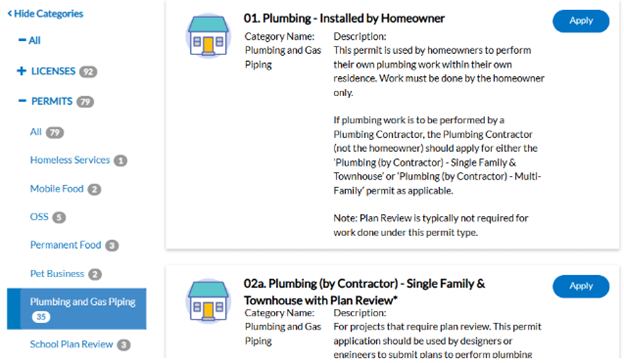
Because of the number of permit types available, the most efficient way to find a particular permit is to search for Plumbing and Gas Piping permits by category in the permit center. The below image is what you’ll see in the application section of the new system when you search by categories (see Categories on the left hand side).
How to know which permit type is right
As seen in the above image, each permit application includes a description of the type of project to which it applies. This could be based on information such as occupancy type, project size (based on fixture count), or the entity responsible for installing the work. These separate permit types were created to better tailor the specific application to the type of work being done.
‘Decision Trees’ for each general permit category are listed below and are also linked on our website to help advise permit applicants which type of permit they need to apply for. If the wrong type of permit is applied for, or the scope of work changes such that the work falls into a different category, the applicant will be asked to cancel the incorrect permit and reapply using the correct application. If there is an instance where an over-the-counter permit is obtained and the project is later determined to require plan review, the plan review sequence can be added to the permit without a new permit application being submitted.
We will post the decision trees on our website and in our December 10 newsletter.
Improving our work with insights from data
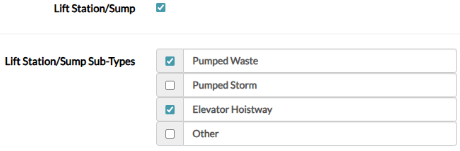
Along with the different permit types, Public Health will be leveraging the software capabilities of the new system to further our ability to collect project data. This collected data will allow us to more easily generate reports in the future to help guide future work and staffing priorities. Some examples may include “How many residential projects were permitted last year?” or “How many projects included a parking garage?” or “What percentage of projects were installed by the homeowner?”, etc. To aid in this effort, there are a number of project and system descriptions listed on the application that will need to be filled in as part of the application process. In the example below, the project includes a sanitary lift station for both garage drainage and an elevator hoistway, so the associated boxes are checked:
There are several similar sections on the applications pertaining to material uses, system configurations, etc. that might seem daunting at first glance. We will be collecting feedback on the new application process after an initial adjustment period. Future revisions to permit applications and the application process should be relatively easy to implement based on customer feedback.
Please be on the lookout for a special newsletter edition on December 10th that will include links to the updated resources and additional information about registration for the new system. Thank you for your patience as we work toward a successful transition!
If you have any comments or questions about these or any other topics related to plumbing and gas inspections or permitting, please feel free to reach out to us at: planreviewinfo@kingcounty.gov.
|