Always quick to insist that he is not actually retiring, Chief Plumbing Inspector Steve Hart will be leaving service with Public Health in mid-September. Steve has set a new standard for what it means to be a leader in the industry. His legacy includes the tremendous achievement of establishing a plan review program within the Plumbing and Gas program. Throughout his tenure as Chief, he has tirelessly prepared and delivered training sessions for a wide range of trade groups and entities, spending countless hours of his own personal time doing so. Steve is also actively involved in a number of Boards, Working Groups, and Technical Advisory Groups at the local, State, and National levels.
Steve is an avid fly fisherman and intends to spend much more time along local riverbanks passing the time in tranquil reflection. He is not likely to stay out of industry activities completely, however. There is a good chance you will still see him around at industry events and providing much-needed training to tradespeople in all different phases of their careers.
New Role – Eric Gilbreath is Special Duty Chief Plumbing Inspector
Congratulations to Eric Gilbreath as he transitioned to his new Special Duty Assignment of Chief Plumbing Inspector on August 16th. Eric has been with Public Health’s Plumbing and Gas Program as a Senior Plumbing Inspector for 7 years and a Plumbing Inspector for 3 years. Prior to Public Health, he worked for 17 years as a licensed plumber. Eric has been active in Local 32 leadership and is currently involved in the International Association of Plumbing & Mechanical Officials (IAPMO) and Seattle/King County Building Trades Council. Eric will overlap with Steve Hart, our current Chief Plumbing Inspector, before Steve leaves Public Health in mid-September.
Retirement – Inspector Tracy Belvill retiring in September
After a long and enduring career in Public Health, Plumbing Inspector Tracy Belvill will be retiring at the end of September. A second-generation plumber, Tracy is one relatively few women in the industry, and she has been upheld as a mentor by many. She began her career with Public Health in 1999 and was a union plumber prior to that, encompassing an amazing 40-year career in the plumbing industry. Tracy loves fly fishing and plans to tour around in her camper van with her canine companion, Poppy, for some well-deserved relaxation and exploration post-retirement.
Update - New Permitting System Coming in September October
The implementation of the Environmental Health Services Division’s transition to a new permitting system has been postponed until October (specific date TBA). The new system will be called the Public Health Permit Center. This online services portal will include plumbing and gas piping permitting, a plan review submittal interface, online inspection requests, and more. Once it launches, the Permit Center will replace the current Environmental Health Services Portal. We’ll provide additional information, including the actual date of the new system’s launch, in future communications. You can learn more about this transition on our webpage: kingcounty.gov/PublicHealthPermits.
Note that our staff will be conducting training for the new system in late August, and we will have reduced availability during that time, which will impact inspection response time and other services. Please plan accordingly.
In our June newsletter, we briefly described the types of fixtures that should be listed on a plumbing or gas permit. This article focuses on plumbing permits and the types of fixtures that will need to be listed on plumbing permits once Public Health’s new permitting system is up and running in October.
Overview: What is changing?
Once the Public Health Permit Center becomes operational, some items that were previously exempt from plumbing permits will no longer be exempt. For example – hose bibbs were specifically excluded from permit fees in previous versions of the King County Code (KCC), but this exception was removed as part of the recent update to the plumbing fee related portions of the KCC (16.32.080).
Why is this change happening?
The underlying reason for this shift has to do with the Public Health Plumbing & Gas business model. The program operates under what is referred to as a “Fee for Service” model, meaning that the fees charged for services need to cover the cost of providing those services. When an inspector has a reason to look at a particular item as part of a code compliance check, the only way to compensate the inspector for that time is to collect a fee on the permit for that item.
What are the new fixtures that will need to be listed on plumbing permits?
Below is a list of the specific fixtures that do not currently need to be listed on plumbing permits but will have to be added when the new permitting system is operational. Note that the reason an inspector might need to look at these items during an inspection is noted in the “Rationale” column.
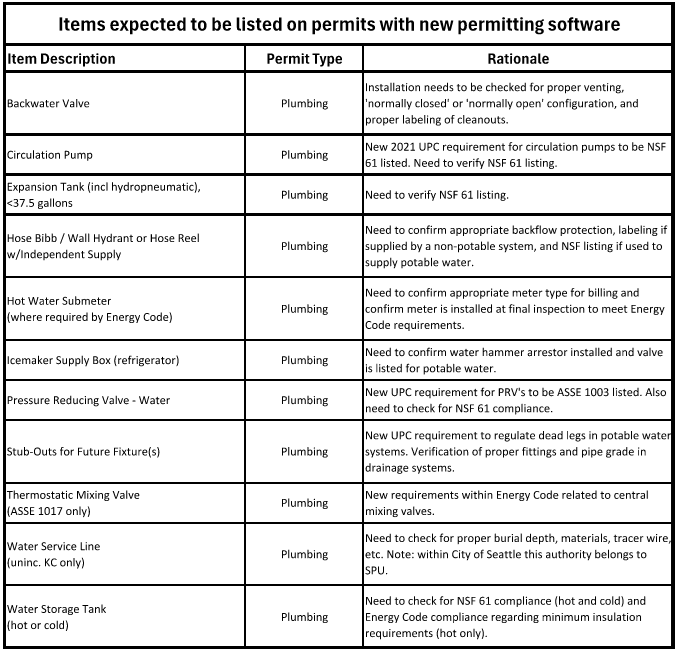
If you have concerns about remembering which fixtures mentioned in this article need to be added to future permits, have no fear. The updated permit applications built into the new permitting software will have them all listed for you, which is a welcome advancement from our current permit applications. For any outlying fixture types that we didn’t have the forethought to add to the actual application, there will be a new guidance document posted on our website that outlines not only the specific fixtures, but general guidance for the types of fixtures to list on a permit based on installation considerations.
-
Water Service Lines – Although water service lines are not generally installed within the footprint of a building, they are required to comply with all applicable plumbing code requirements. Within the City of Seattle, Seattle Public Utilities takes responsibility for inspecting the water service lines to ensure the installation meets minimum code requirements. In Unincorporated King County, this responsibility falls to the plumbing inspector.
-
Expansion Tanks – The Plumbing and Gas program inspects expansion tanks less than 37.5 gallons. Larger expansion tanks are regulated by the local Boiler & Pressure Vessel codes and are inspected by that authoritative entity.
-
Hose Reels – If a hose reel is installed and supplied from a nearby hose bibb, only the hose bibb needs to be listed on the permit. A specific hose reel would need to be listed only if it is supplied from its own dedicated water supply connection that is not a hose bibb or has otherwise not been captured somewhere on the permit.
Future Guidance Updates
The more astute folks reading this may have recognized by now that the increase in the number of listed fixtures on permits may have other implications beyond adding to the total permit fee. Our current Occupancy and Use guidance document uses a discretionary threshold of (10) fixtures as a potential trigger for plan review (see below).
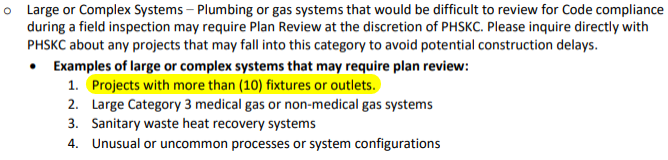
Within the new permitting system, there will also be a fixture count-based trigger that will determine when a project is considered “Large” versus “Small” from a permitting standpoint (more on that in a future article). Our inspection staff understand that just because you list more fixture types on a permit, that does not necessarily make the project more complex. It is our intent to modify existing guidance documents as necessary to adjust the fixture count ‘trigger’ as needed so that plan review only comes into play for the same relative project complexity that is used currently. In other words, instead of considering plan review for projects with more than (10) fixtures or outlets, that number will likely be raised to (15) or (20) fixtures to account for these additional items being listed on plumbing permits within the new system.
If you have any comments or questions about this or any other topic related to plumbing and gas inspections or permitting, please feel free to reach out to us at: planreviewinfo@kingcounty.gov.
|