New Permitting System Coming in September
Public Health’s Environmental Health Services Division is transitioning to a new permitting system in September 2025. The new system will be called the Public Health Permit Center. This online services portal will include plumbing and gas piping permitting, a plan review submittal interface, online inspection requests, and more. Once it launches, the Permit Center will replace the current Environmental Health Services Portal. We’ll provide additional information in future newsletters. You can learn more about this transition on our webpage: kingcounty.gov/PublicHealthPermits.
Long Time Permit Technician Retiring: Susan Felchin
One of our most senior and well-respected permit technicians is moving on to a well-deserved retirement on June 30. Susan Felchlin has had an outstanding career in public service. She is so well-liked that many of her more frequent customers feel comfortable reaching out to her directly when they have permitting questions. Susan has been instrumental in both supporting the permit technician leadership and helping to train new permit technicians that are just being introduced to the role.
Susan’s impact has been felt outside of the permit technician group as well with many public health employees turning to her for advice and expertise in handling complicated permitting issues. We wish her the best in this new chapter. She will be missed.
A common issue our inspectors find is that permit holders need to adjust their permits for a project. There’s a wide range of reasons for this. We often find corrections are needed for:
- Number of fixtures
- Project address
- Number of permits
This article aims to help permit applicants avoid these common mistakes which can cause inspections to be postponed or construction delayed.
Verifying fixture count
Our permit applications are fairly limited in the number of fixture types listed. This is to limit the number of pages contained in the application. With updated permitting software coming, and an ongoing transition to electronic permitting more generally, future applications will be more comprehensive.
In the meantime, it is important to know that you may be installing items on your project that are considered ‘fixtures’ and are subject to the ‘per-fixture’ permit fee but are not explicitly listed as options on the permit. Examples may include specialty items such as dog wash basins or autoclaves, or more common items such as booster pumps and bidets.
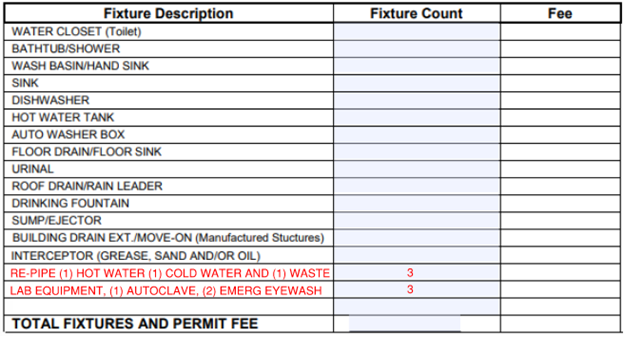
As a rule of thumb, most items that require a piped water, waste, or gas connection should be listed on a permit. These can be itemized in the rows on the application dedicated to miscellaneous items. If more space is needed, similar component types may be combined on a single row as shown in the image below.
 Providing an accurate, complete address
When obtaining a permit for an accessory structure or tenant space, it is important to include the complete address on the permit application. This may include a unit number, space number, classroom number, or similar description of where the work is happening. In a large building with multiple wings, you may be asked to note the specific wing or room number where the work is occurring.
If the work site is expansive, it is helpful to note where on the site the work is occurring (i.e. “Southeast corner of parcel near existing deli”). If the official address has not yet been issued due to a pending lot division, provide a description that will allow the inspector to find the work site and provide adequate signage on site. When construction ends and official addresses are issued, it is the responsibility of the permit applicant to update the addresses on the permit(s) prior to the permit being finaled.
Getting the right number of permits
For residential projects, unless the project includes a Group R1 or R2 occupancy building such as a hotel or apartment building, you will typically be required to obtain a separate permit for each dwelling unit. This applies to all permit types needed for the project. If the project includes both plumbing and gas piping, you may need multiple gas permits and multiple plumbing permits. For example, if you are working on a project with a single family home, an attached dwelling unit, and a detached dwelling unit, you will need to purchase (3) separate permits of each applicable permit type. See the examples below for additional information.
  For non-residential projects, a separate permit is generally required per building or tenant space. If you are working on a multi-level tenant improvement, a single permit should be purchased for the entire project. This limits the number of trips our inspectors need to make to the site and provides a more holistic understanding of the scope of work taking place which improves the efficiency of both inspections and plan review.
If you are working on multiple projects within the same building and each project has a distinctly separate project team and schedule, then separate permits may be drawn for each project. Note that artificially partitioning a project into separate permits to benefit a project schedule or avoid plan review may unintentionally lead to the project being placed on hold during construction while a plan review is conducted and could void active permits.
We aim to support permit applicants in understanding and preventing these common errors to enable a smooth inspection and construction process.
If you have questions about your permit(s), you can send an inquiry to planreviewinfo@kingcounty.gov or contact the plumbing inspector in your area for assistance.
|