Submit Your District 4 Grant Interest Form (Due June 8), Legislative Session Recap, Budget Q&A, and More!
King County, Washington sent this bulletin at 05/30/2025 12:24 PM PDT
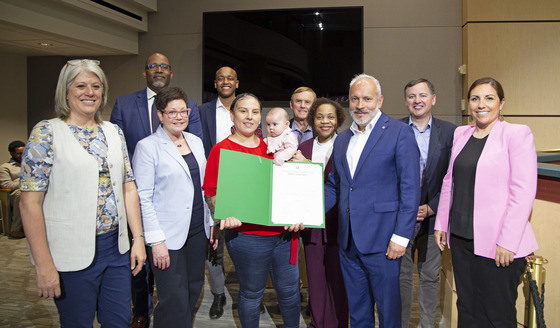
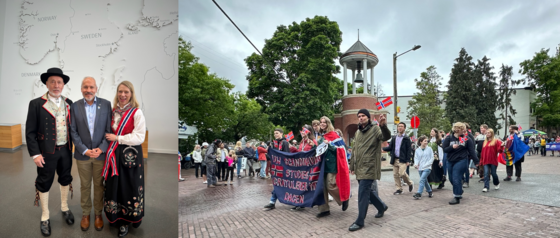
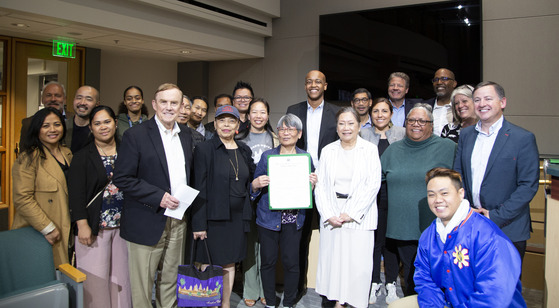
Group photo with AANHPI community leaders and my council colleagues.
|



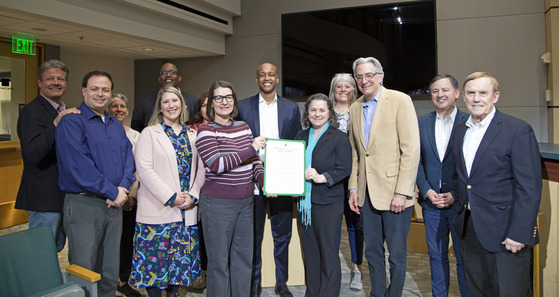 |
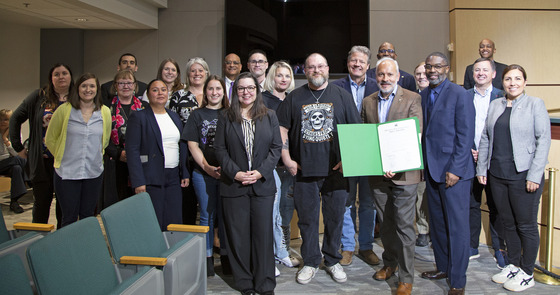
Group photo with leaders and advocates of the Jewish American community. Note, I am not in this photo as I was feeling under the weather but was present remotely.
Celebrating Jewish American Heritage Month
The King County Council recognized May as Jewish American Heritage Month. At the council, we celebrated the profound impact and lasting contributions that Jewish Americans have made to our nation’s history and culture. In a time with rising antisemitism worldwide, and recent history of antisemitism in our own region, it is critical that we take every opportunity to reaffirm our commitment to fostering a safe and inclusive King County where we exemplify the Jewish value of “tikkun olam” or working to repair the world.
Legislative Session Updates
The 2025 Legislative Session ended on April 27, concluding a 105-day term. King County’s priorities, identified in the county’s legislative agenda, spanned a wide range of issues including revenue options, funding for public health clinics, strengthening access to behavioral health care, enhancing public safety, investing in housing and homelessness services, and mitigating the climate crisis. The below chart includes a select list of bills related to those priorities. Outcome of Select Bills in the 2025 Legislative Session
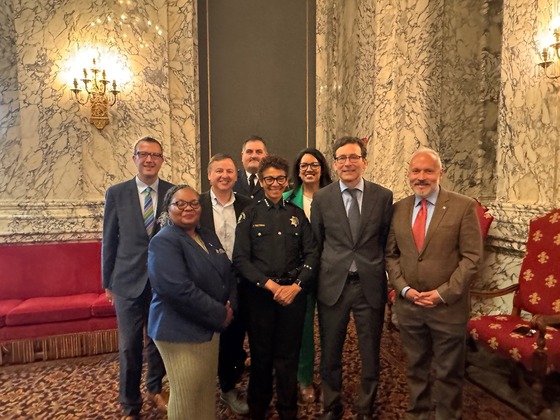
Pictured in Olympia after a bill signing with leaders including, King County State Relations Director Joe McDermott, Representative Debra Entenman, Councilmember Rod Dembowski, King County Sheriff Patty Cole-Tindall, Representative Kristine Reeves, and Governor Bob Ferguson.
If you’ve read my newsletters over these past months, you know that the county anticipates a shortfall in the general fund, and that a large portion of the general fund – nearly 71% – goes toward paying for public safety and criminal legal system services. HB 2015, signed by Governor Ferguson on May 20, may provide King County with a tool to address much if not all of the anticipated shortfall. HB 2015 grants local legislative entities, such as a county or city council, the authority to approve a sales tax of 1/10th of 1 cent, representing 0.1%, for activities relating to the criminal legal system. These activities may include providing domestic violence support services, diversion and re-entry programs, reducing engagement with the system, and community outreach and mental health crisis response. It also creates a state-administered grant program to hire, retain, and train law enforcement officers, including recruiting officers from the community in which they will work, and de-escalation, crisis intervention, and trauma-informed training. While analysis is ongoing, this bill could provide needed support for these services and address much of the anticipated general fund shortfall. However, this bill is not without its challenges. First, it is not a solution to count on long-term since it doesn’t address the structural problem of revenue growth being limited to a level well below what is needed to keep up with expenses over time. Second, it also exacerbates the regressive nature of our current tax structure by increasing our dependence on the sales tax. I will continue working with my colleagues and the Executive, who has indicated her interest in advancing a proposal for council’s consideration on this matter. If you would like to learn more about how the county’s priorities fared in Olympia, the Committee of the Whole received a briefing on the state legislative session at our May 27 meeting. This briefing begins at the 1 hour and 2 minute mark of the committee meeting. County Updates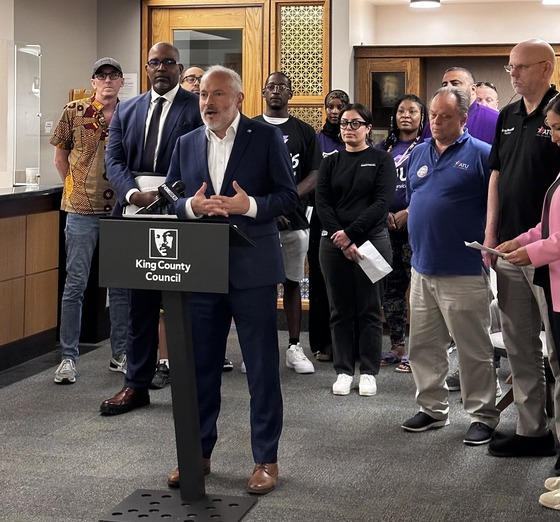
|

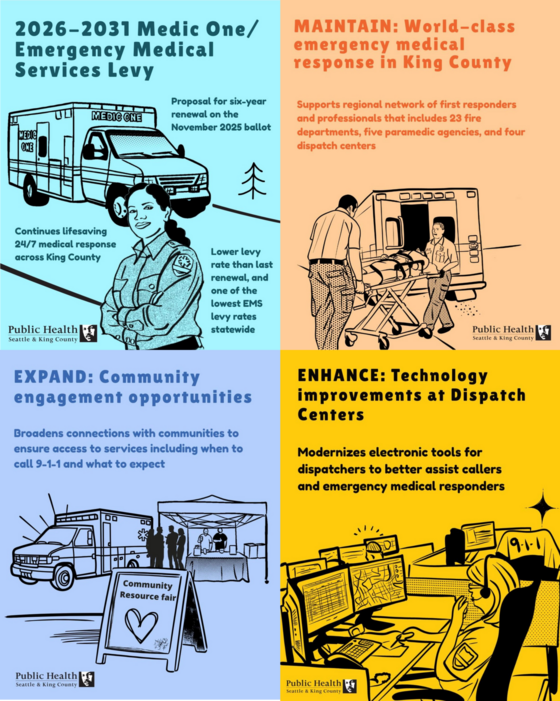 |
Source: https://www.instagram.com/kcmedicone/
Upcoming Emergency Medical Services Levy Renewal
King County Council is currently considering the renewal of our regional Emergency Medical Services (EMS) Levy. King County’s EMS system is globally recognized for its strong medical outcomes. The system is mainly funded through a countywide, voter-approved EMS levy, which will expire on December 31, 2025. To ensure continued service, leaders and experts from across the County have collaborated to draft a strategic plan and financing plan that Council will review and approve before it is placed before voters for their consideration later this year. I voted to advance this measure out of our budget committee, and we anticipate final action on this proposal by the full council next month.
Through this process, I am very interested to learn how we can maintain the current level of services, prepare ourselves for possible cuts at the federal level, and better integrate EMS with other crisis response services throughout our county.
Advocating for Our Unhoused Neighbors
Over the past several weeks, the Trump administration added troubling requirements to a variety of federal grants that have already been awarded to King County and other jurisdictions, including resources dedicated to essential services like housing and transit. These grant conditions – related to immigration, health care, and diversity, equity, and inclusion – violate federal law, conflict with local laws and values, and would force commitment to terms that could expose King County to severe financial penalties for noncompliance.
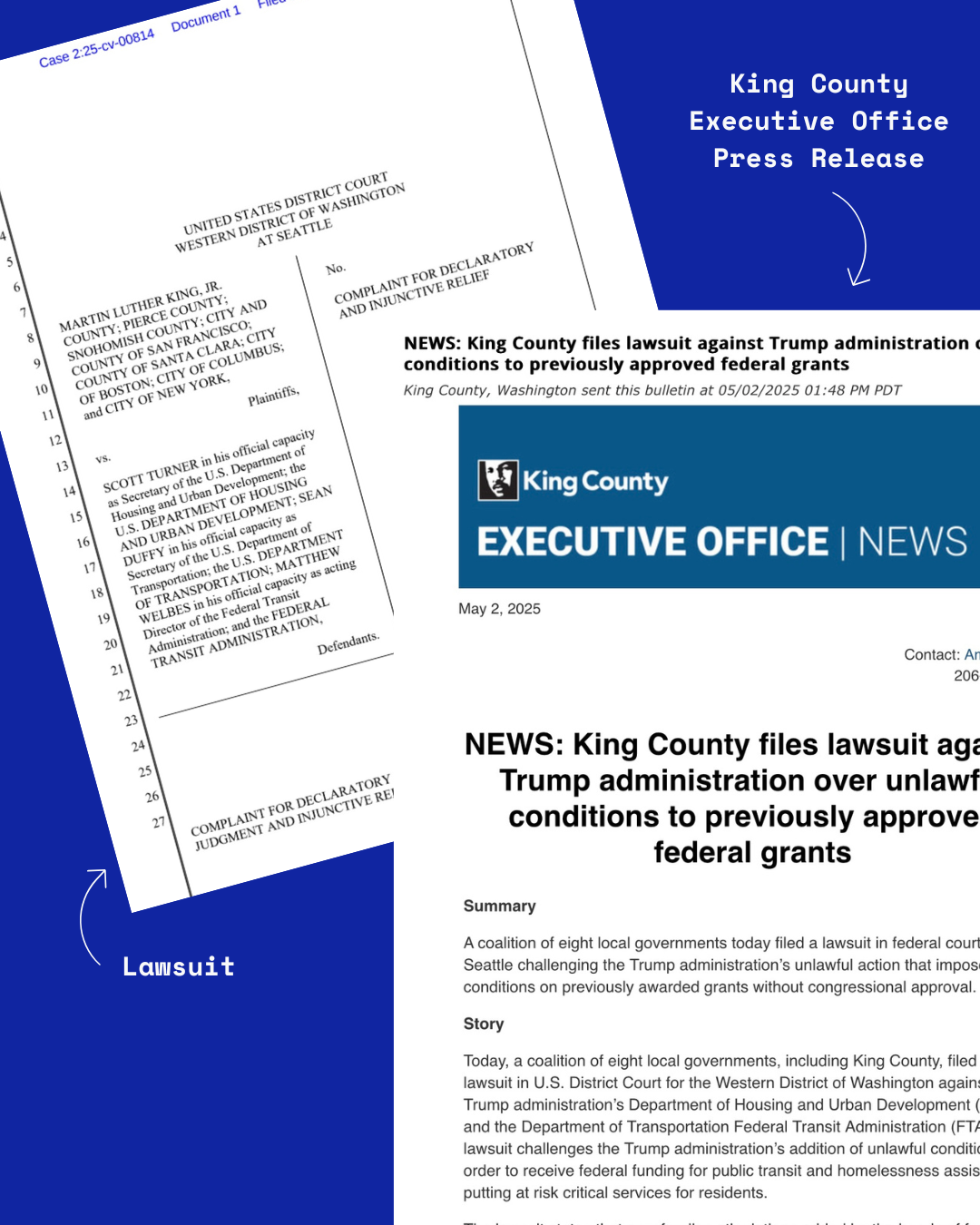 |
Click on image to access full lawsuit.
In response, King County and other jurisdictions have filed a lawsuit challenging these unlawful attempts to impose new conditions on previously awarded grants. The lawsuit argues that these new grant conditions are an example of executive overreach without Congressional approval. Earlier this month, the County received favorable news when the federal court issued a temporary restraining order granting relief from this attempt to change these requirements. You can read the judicial ruling here. While this is an important victory for the county, it is only a preliminary ruling, and the legal proceedings will continue for at least several months.
At the May 15 Governing Board meeting of the King County Regional Homelessness Authority (KCRHA), the Board unanimously voted for KCRHA to join alongside King County and other jurisdictions nationwide in the lawsuit. KCRHA did in fact join the lawsuit.
I appreciate the diligent work of legal staff who helped secure the temporary restraining order. While the court case remains ongoing, this decision alleviates the immediate risk of losing the federal funding needed to provide comprehensive, and compassionate services to our residents.
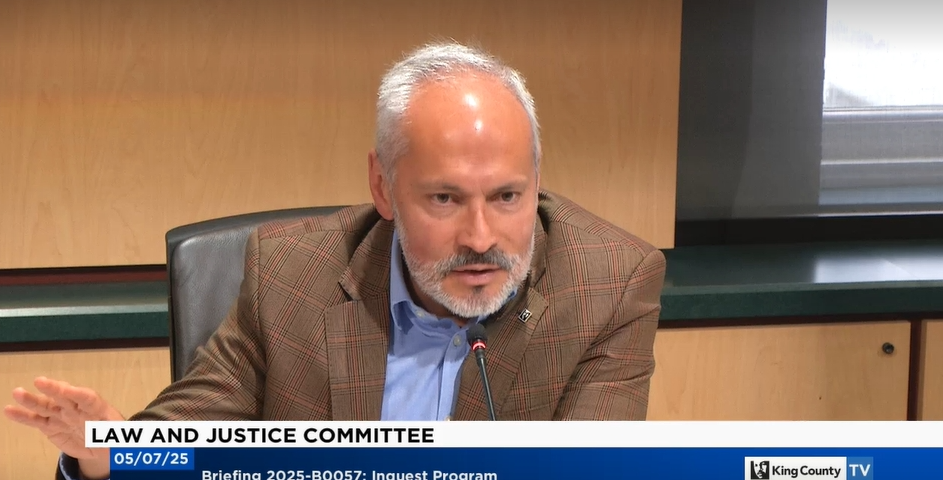
Law and Justice Committee
On May 7, the Law and Justice Committee met to take up several important issues. First, the Committee voted to confirm the appointment of Adrien Leavitt to the King County Public Defense Advisory Board, which was later approved by the full Council. After that, the committee took up three briefings. The first briefing covered a report on the Civil Asset Forfeiture Program of the King County Sheriff’s Office by the King County Auditor. Next, we heard from the Department of Public Defense on their 2024 Annual Report, highlighting how the Department has responded to workforce challenges and increased workloads. Finally, we heard from staff of the Executive and the Prosecuting Attorney’s Office on the revamped Inquest Program including program history and strategies to address concerns about the potential interaction of the inquest process and possible pursuit of criminal charges of involved parties. See recording of this meeting below.
The next meeting of this committee will be Wednesday, June 4th at 9:30 a.m.
|
 |
Regional Transit Committee
On May 21, I chaired the Regional Transit Committee, which heard two informative briefings. The first focused on King County Metro’s Free Youth Fare and youth ridership. The second briefing provided an update on Metro’s Service Recovery Plan, ridership recovery, and restructures. The Service Recovery Plan, which outlines a Council-approved path to restoring service following the pandemic, guides Metro’s approach in reevaluating service. View the recording of this meeting below.
|
Puget Sound Regional Council General Assembly
On May 22, I attended the Puget Sound Regional Council’s (PSRC) annual General Assembly meeting. The PSRC General Assembly includes all Mayors, Executives, and Councilmembers of member jurisdictions and meets annually. At this year’s meeting, we adopted the Fiscal Year 2026-2027 Biennial Budget and Work Program, the Regional Safety Action Plan, and elected officers. Additionally, we heard a presentation on Regional Roadway Safety. The agenda and meeting recording is available here.
 |
Reminder to Pay Your Bus Fare
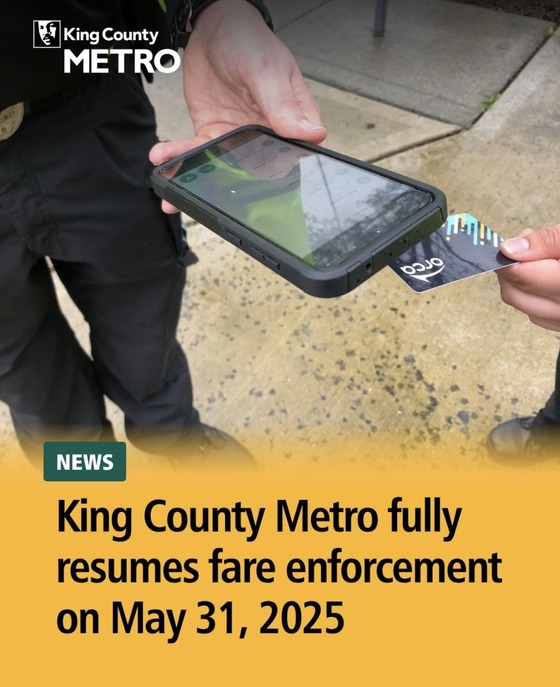
At the end of March, King County Metro resumed fare enforcement. You may have noticed Fare Enforcement Officers asking riders on buses and streetcars to provide proof of fare payment. If a rider is unable to do so, officers provide a friendly, verbal reminder and give them information on the various fare programs that make riding transit more accessible and affordable.
Please be aware that starting on May 31, this process will change. Instead of verbal reminders, riders who do not have valid proof of payment will receive a written warning. Riders can receive two of these written warnings without consequence. For third and subsequent citations, a fine or an alternative resolution will be imposed.
|
Call For Public Input
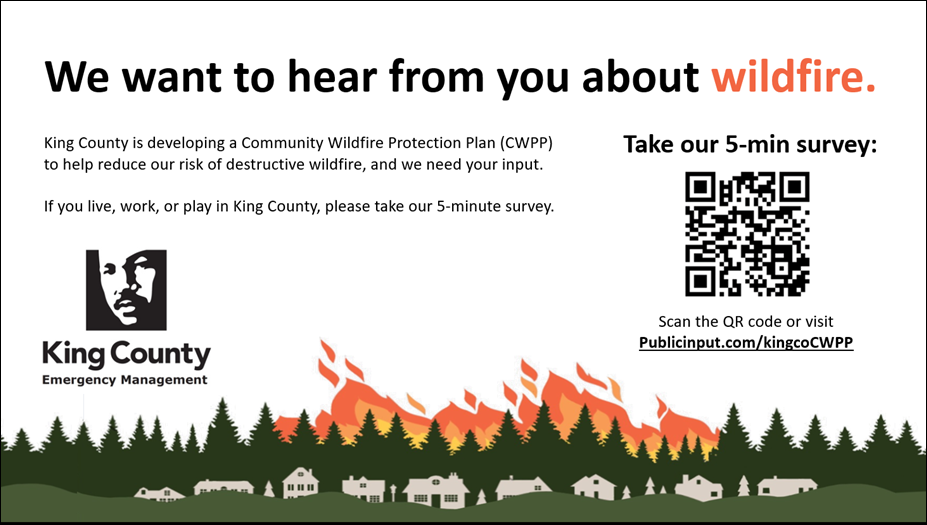
King County Emergency Management is developing the County’s first Community Wildfire Protection Plan (CWPP). As wildfires begin to be more frequent in our state, your input is crucial for this new county program. If you live anywhere in King County, please consider responding to a short 5-minute survey.
|
In the Community
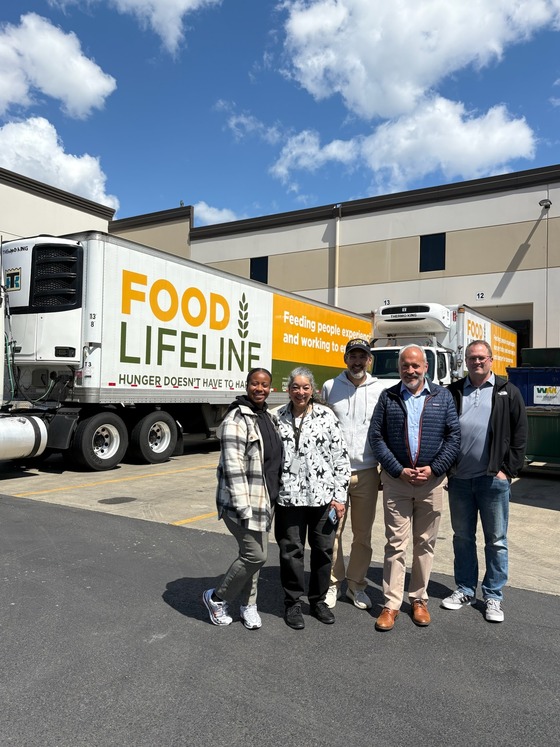 |
I am pictured above with Food Lifeline staff members (from left to right): Alicya Pearson, Pascha Scott, Aaron Czyzewski, and Ryan Scott.
Fighting Food Insecurity
I had a great visit to the Food Lifeline Hunger Solutions Center earlier this month and was honored to learn from the Food Lifeline team about the innovative partnerships and programs in place to support those experiencing food insecurity in King County and throughout Washington State. I was troubled, however, to learn about funding reductions for essential hunger services at both the state and federal levels and will continue to look for ways to support hunger relief in our region.
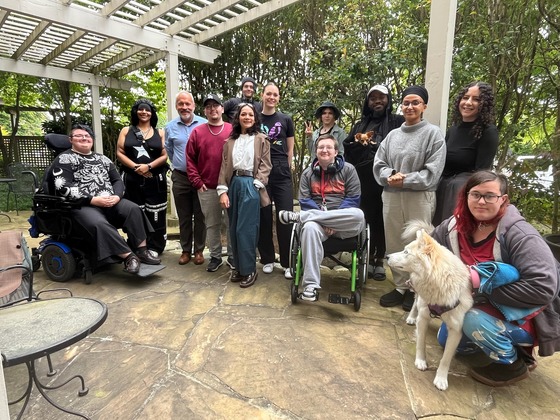 |
Pictured with youth advocates and staff members of the Mockingbird Society.
Connecting with Youth
I deeply appreciated the opportunity to meet with local youth advocates from the Mockingbird Society earlier this month. The young people spoke to the need to increase youth-focused spaces, where youth and young adults can access trauma-informed care and connect with peer support.
Many of the young people generously shared personal stories about their own experiences with homelessness in King County. I am committed to continuing to work to lift up the voices of young people in our county and ensure that we use existing programs like the Crisis Care Centers Initiative and Best Starts for Kids to support our young people to grow into healthy, thriving adults.
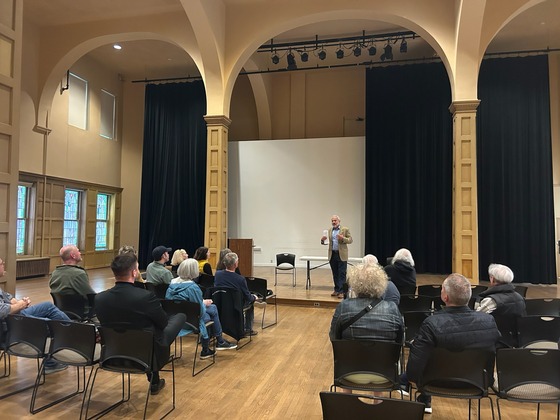 |
Addressing community members at the Good Shepherd Center.
Wallingford Community Council Meeting
This month, I joined the Wallingford Community Council at their May meeting in the Good Shepherd Center. I shared my priorities and work at the Council, heard from attendees about topics that matter to them, and answered questions about transit, housing, the County budget, and more. It was wonderful to get to connect with so many residents – thank you for inviting me to join you!
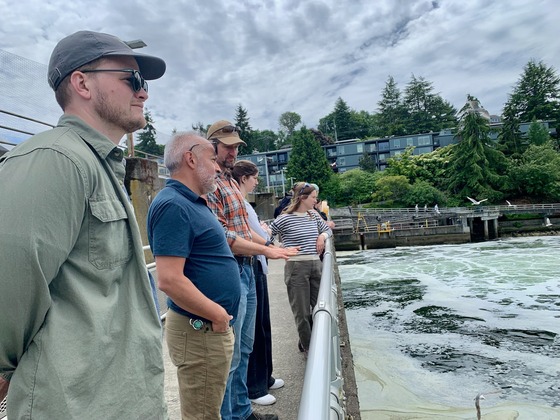 |
Pictured from left to right: Lucas Hall, me, Jason Mulvihill-Kuntz, Clara Manahan with my staff, and Mary Ramirez.
Learning about Salmon at the Ballard Locks
While I have been visiting the Ballard Locks for many years, I had a more focused visit earlier this month to learn about salmon recovery efforts at the Locks, which are included in the Lake Washington/Cedar/Sammamish Watershed (Water Resource Inventory Area - WRIA 8). Salmon that hatch in the watershed’s rivers and streams swim out to sea as juveniles and return as adults to spawn. Traveling through the Locks and the Ship Canal, these salmon experience physiological stress from elevated water temperatures and must avoid predators that gather near the Locks. They must also navigate the fish ladder, which is viewed as increasingly out of date and does not include modern elements that may contribute to improved migration success. The Army Corps of Engineers oversees the Ballard Locks, and a variety of local partners are engaged in work there including WRIA 8, the state’s Department of Fish and Wildlife, and local nonprofit organizations including Long Live the Kings. The engagement of so many different partners raise complicated questions about jurisdiction and responsibility for overall functioning. It’s easy to see the many important roles that this beloved spot plays in the health of our environment, economy, and local community, and I will continue exploring how the county may support these efforts.
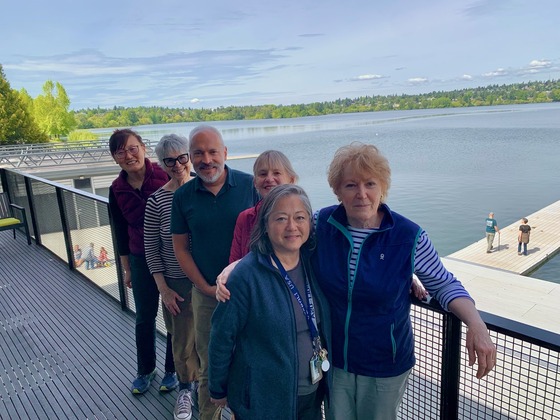 |
Pictured from left to right: Bibianna Cha, Anne Martin, me, Alex O’Reilly, Tami Oki, and Wendy Caldwell.
Visiting with Green Lake Crew at the Green Lake Community Boathouse
On a beautiful day late this month, I visited with members of Green Lake Crew to hear more about STEM to Stern and see the beautiful Green Lake Community Boathouse. Since 1948, Green Lake Crew has brought together people to learn, practice, and compete in the sport of rowing. Through STEM to Stern, they are introducing local middle school students to rowing and pairing it with STEM learning, including lessons in engineering, tessellations, and buoyancy. For many of these kids, this represents their first ever rowing experience. With summer right around the corner, consider whether you’d like to learn more about Green Lake Crew and STEM to Stern.
Harborview Abuse and Trauma Center Open House
Our district 4 team member Jessie was honored to attend the open house for the Harborview Abuse and Trauma Center (HATC) and see the beautiful new clinic. Speakers at the event included staff, former clients, and leadership from Harborview Medical Center who spoke about the deep impact HATC has had on our state.
For over 50 years, HATC has offered comprehensive services for those affected by abuse and trauma. These services include:
- 24/7 medical and forensic care for sexual assault and child abuse survivors through the Harborview Emergency Department.
- Sexual Assault Nurse Examiner (SANE) program, offering expert forensic and psychosocial care at various UW Medicine locations.
- Therapy services for children, families, and adults, providing tailored psychosocial treatments and evidence-based therapies such as trauma-specific cognitive behavioral therapy (CBT) and behavior management therapy.
- The Foster Care Assessment Program (FCAP) evaluates foster children to identify barriers to reunification or adoption, addressing emotional, behavioral, and educational challenges, as well as concerns related to parents’ substance abuse and psychiatric issues.
I am deeply grateful to HATC and other providers for the incredible services that they provide to individuals and families who have experienced this harm and will continue to look for ways to support this essential work.
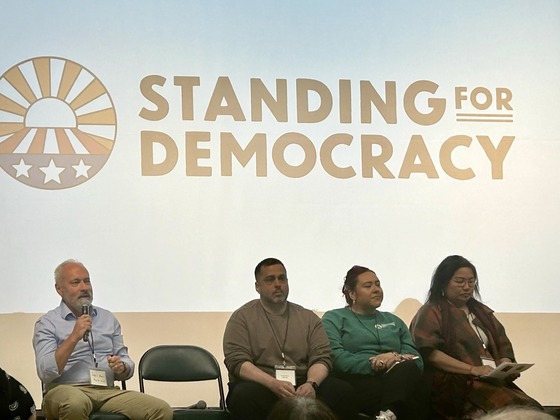 |
Pictured from left to right: me, Executive Director Imraan Siddiqi of Council on American-Islamic Relations (CAIR) Washington, Executive Director Brenda Rodriguez Lopez of Washington Immigrant Solidarity Network (WAISN), and Sina Sam of Khmer Anti-Deportation Advocacy Group.
Standing with the Immigrant Community
This month I had the privilege of participating in Standing for Democracy’s Resistance to Deportation conference focused on immigrant rights, alongside nonprofit organizations and advocates in our community. We engaged in an informative discussion about effective ways immigrant rights organizations can share information, updates, and legal resources back to the immigrant community. We also identified areas where state and local governments can continue to play a role in ensuring the rights of immigrants and refugees in our communities can be protected. In a time when the civil and human rights of individuals are increasingly being infringed upon, I was honored to engage with community leaders on how we can mobilize and stand together.
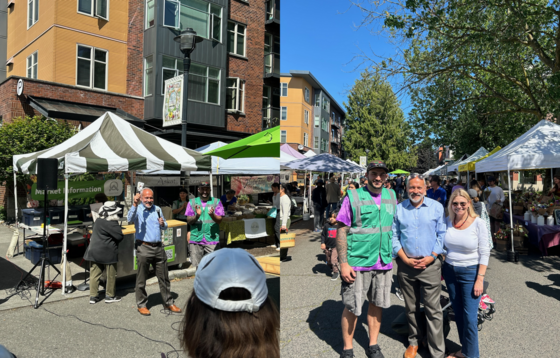 |
Pictured on right-hand photo with Executive Director Matt Kelly of the Queen Anne Farmers Market and my wife Tyler Crone.
Season Opening Bell Ringing at the Queen Anne Farmers Market
My family and I have been frequent patrons of the Queen Anne Farmers Market (QAFM) over the years, and I was very excited to join them this past Thursday to welcome residents and ring the bell to signal the opening of the Market’s summer season! The Queen Anne Farmers Market takes place every Thursday from May 29th through October 9th and features a variety of local farmers and local food producers. Beyond food, they foster community – welcoming a non-profit partner at each market to spread awareness, teaching youth how to engage with market vendors, and creating a real community hub for the entire neighborhood. Supporting our local farmers and local food systems is more important than ever, as it supports biodiversity of agricultural lands, minimizes the greenhouse gas emissions associated with transporting food, and connects each of us with the people who help put food on our tables. I’d like to extend my gratitude to Matt Kelly, Queen Anne Farmers Market’s Executive Director, and his broad base of volunteers, for all the work they do to support this farmers market. It was a pleasure to join you, and I’ll be back soon!
Budget 104: Questions and Answers
This month brings us to the final edition of the ongoing budget series shared through my newsletters. My hope for this series was to inform, educate, and offer transparency on the underlying structure and important considerations for our county budget. Next month, I’ll provide information on the Executive’s omnibus budget proposal, which will be transmitted to Council at the end of May and will propose adjustments to the current budget that goes through the end of 2025. I believe it is important for residents to know how the county collects tax dollars, where your tax dollars go, and how they are being invested to better our region for ourselves and those who come after us.
Last month, I asked you to submit your lingering questions on the budget. Below you’ll find five questions raised by constituents that I selected to include here. Of course, if your specific question was not included, please send it in as my inbox is always open and available to you.
Thank you to those who have been engaging with this content, whether you are reading it through my newsletters, connecting with my office via email, or stopping by my Brewing Conversations with Jorge sessions. Now, let’s get into the Q and A.
Question One

The 1% property tax growth cap applies to the total amount collected by the taxing district via property taxes in the prior year, not the property taxes paid by an individual parcel. The tax amount that you as a property owner pay is based on more than just the value of your property, and is influenced by other factors such as:
- Where you live and how much other homes in your area are worth,
- The presence of commercial properties in the taxing district and changes in their valuation, and
- Voter approved fees, usually known as levies, to support services such as schools, parks, water districts, emergency medical service and fire/rescue, among others.
As explained by the Washington State Department of Revenue, our state uses a budget-based property tax system, which means the property tax amount to be collected from each parcel is determined by a levy rate. This levy rate is calculated by dividing the total budget of the taxing district by the total value of the property within the taxing district, resulting in a rate that is expressed as a cent (or dollar) amount per $1,000 assessed value. This rate may be affected by changes in the assessed value of properties in your area, as well as whether commercial properties are included in the taxing district. In general, when property values increase faster than the levy amount or when commercial properties are present, especially if their value rises, then residential property tax rates tend to fall. However, it is important to note that voter approved levies are not subject to this cap. It is for these reasons that property taxes may increase even when the property value has remained unchanged or has decreased.
There are 165 local taxing districts in King County, and breakdowns of the levies that affect your specific property taxes and where those dollars go can be found in your specific tax bill. If you are interested in seeing where your own property tax dollars go, you can use the eReal Property tool offered by the King County Assessor’s office.
|
Question Two
With numerous updates and changes coming from the current federal administration, King County staff are closely monitoring updates and communicating with our federal delegation about the projected impact of federal budget cuts and policy changes. This is essential to ensuring that we can quickly identify potential funding gaps or programs that may be at risk of elimination all together. Please see my last newsletter, in which we looked at the real and possible challenges affecting our efforts to provide homelessness services.
King County is also taking legal action to prevent many of these proposed cuts from being implemented at all. This includes filing the lawsuit regarding the federal administration’s recent attempt to impose new conditions on already awarded federal grants that I spoke to above, as well as another challenging an executive order that sought to end funding to jurisdictions (like King County) that choose not to use local resources for immigration enforcement. I believe that challenging in court the attempts by the current federal administration to coerce and harm King County through unlawful actions effectively pushes back on them and shows commitment to our values.
Question Three
Since House Bill 2015 was signed into law by Governor Bob Ferguson on May 19, King County has the authority to consider whether to use this tool to raise revenue for eligible uses. State law requires that revenue generated by the 0.1% sales tax be used for activities related to the criminal legal system and may include efforts such as support services for survivors of domestic violence, programs that reduce involvement in the criminal legal system such as diversion and re-entry, community outreach, and mental health crisis response. The Executive has indicated that she is interested in forwarding a proposal to the County Council for consideration.
This option provides the county with a needed tool to address challenges in the upcoming and future budgets. Addressing the pressure in this section of the budget not only supports the county’s duty to public safety but also reduces risk to other areas of the budget paid for by the general fund. However, this option is not without its challenges. It does not solve the problem of the existing structural gap so it’s not a long-term solution, and it’s an inherently regressive tax. I firmly believe in the importance of solving the structural gap in our revenue sources and aiming for more stable solutions.
Question Four
 |
King County relies on levies to fund services that meet local needs and carry forward local values, and they are an important way for the public to show their will by either supporting or rejecting policy proposals. Voter approval is also necessary due to requirements imposed by state law on revenue raised through property taxes. Proposals to raise revenue from voter-approved levies can only be used for the purposes approved by voters and are limited to a period of up to six years. For instance, the Best Starts for Kids levy has been before voters twice – first in 2015, then again in 2021. Meanwhile, the Veterans and Human Services levy was first proposed to and approved by voters in 2005 and again in 2011. In 2017, voters were asked to consider, and subsequently approved, a levy expanded to include older adults in the Veterans, Seniors, and Human Services levy, which was reapproved by voters in 2023. The requirement that voter-approved property tax levies be time-limited is included in state law (RCW 84.55.050), ensuring that voters have oversight of these efforts and allowing local governments to reassess and adjust their approach over time.
Examples of levies that you may be familiar with are:
Asking you, the voter, for approval is a way the county can maintain transparency in the ways your money is being used, keep you informed on why the levy is needed, and allows for the public to have a say on whether a levy is approved or renewed before the county can legally collect revenue.
|
Question Five
If you are reading this, you are already involved by being informed. Here is a list of opportunities available to continue your participation with the 2026-2027 King County Budget process:
- Tune into our Budget and Fiscal Management committee meetings on the second and fourth Wednesdays of each month at 9:30 AM on King County TV.
- Access past meeting recordings, minutes, agendas, and meeting materials on the King County Clerk of the Council page. Please note that items before the year 2000 may not be available online. If you need to access those materials, you can submit a Public Records Request or reach out to our King County Clerks at clerk.council@kingcounty.gov.
- Provide public comment! This is always available to you as a tool to voice your concerns and input. Please note that your comment should be based on current agenda items for the meeting you are attending. For other non-agenda items, you can attend a full council meeting on the 4th Tuesday of the month, when you can speak to any topic county related. You can also send me an email.
- Follow the King County Council on your preferred social platform: Instagram, Facebook, YouTube, and X (Twitter).
- Follow me on your preferred social platform for updates: Instagram, Facebook, and X (Twitter).
- Lastly, share this information with your neighbors and friends to spread the word.
Grants and Resources

Supporting Families
Best Starts for Kids’ Investing Early Together: Community-Based Parenting Supports, Home-Based Services, and Universal Developmental Screening & Promotion request for proposals supports expecting parents, families, caregivers, babies, and very young children during their critical development years. Investing Early services are relationship-centered and community-led, so we look to the community for direction, to determine strengths and needs, assess opportunities, identify priorities, and provide customized programming.
Applications are now open for anyone interested. Please submit your applications by Friday, June 20 at 2 pm.
|
For additional county grant and funding opportunities, visit the Grants and Funding Opportunities page on my King County Council website
Improving Language Access for Residents
One of the Council’s responsibilities is making sure that information about our work is easy to find and understand. This can be especially difficult for residents who prefer communicating in a language other than English or need materials in a format other than spoken word or written documents.
King County’s Language Access for Limited English-Speaking Populations plan directs each department and branch to make our work more accessible. One way we’re doing this county-wide is by offering language translation on the King County website. The language access function is located in the upper right corner, represented by a globe and the name of the language currently selected for the site. To change this selected language, simply click on the icon and choose your preferred language. Here’s where this is located using my webpage as an example:
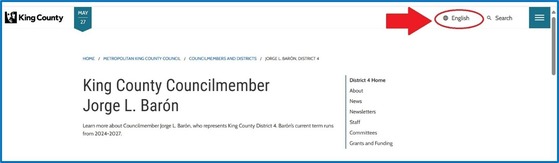
Since most of the Council’s work happens in committee meetings and direct conversations, we are focusing on improving availability in those settings. This includes interpretation for spoken language and translation for written materials and is one way we are reflecting the County’s equity and social justice values.
Here’s how to use these language access resources:
-
If you would like interpretation at a council committee meeting – Please submit a request to Tera Chea, Equity and Social Justice Coordinator (chea2@kingcounty.gov), at least three business days in advance of the meeting with the following information:
- The language(s) needed,
- The name and date of the committee meeting, and
- The number of people needing interpretation (in-person or virtually).
Early requests help us find an interpreter for the meeting.
-
If you would like translation services – We can provide translation of written Council materials upon request. Please contact Tera Chea, Equity and Social Justice Coordinator (chea2@kingcounty.gov), with the following information:
- Include any materials you need translated, preferably in the original written format and as attachments (word document, text, pdf, etc.),
- Language(s) into which you’d like the materials to be translated, and
- An approximate date when you’d like the translated materials.
- If you would like interpretation services for a conversation with me – Just let me know when you reach out with a meeting request or as soon as possible. Letting me know early helps me work with our Council staff to find an interpreter.
Looking forward, we are working to expand our language access services, including options to meet in real-time or short-notice requests.
|
|