|
Where mission
and heart meet behavioral health, from the very start. |
|
Can’t access the links? Add “lnks.gd” to the allowlist of your content blocking software. |
|
Welcome to the May 2025 issue of Prenatal - 5: Grow & Thrive - HCA’s monthly newsletter about our behavioral health work in the early years of life. We hope that this newsletter helps build shared awareness of HCA’s efforts in this area and provides a centralized place to stay up to date on what’s new and happening.
In honor of Maternal Mental Month, this is a special, extended edition! Get cozy and keep reading to learn more about various programs and initiatives across Washington that support perinatal mental health.
|
|
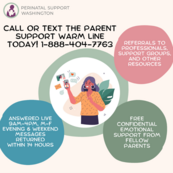
Perinatal Support Washington’s Warm Line offers free telephone and text support for new parents, parents-to-be, their family members, and the providers who serve them. The line is for anyone in the perinatal period (from trying to conceive to 2 years postpartum). The Warm Line provides access to culturally-matched, trauma-informed emotional support, information, wellness planning and personalized referrals to mental health resources. The Warm Line has a dedicated Spanish line, provides interpreters for other languages, and has a dad specialist who supports dads too.
The line is staffed by parents who have experienced and recovered from a variety of perinatal mental health challenges, such as postpartum depression, anxiety, OCD, perinatal loss, NICU, birth trauma, or professionals with specialized training. We also offer ongoing peer support past the 1st phone call for any parents who want it, generally up to 3 months or longer.
For parents who need help finding a therapist, want to join a support group, or just need a listening ear as they navigate the emotional turmoil of the perinatal period, the Warm Line is here. Parents can call or text at 1-888-404-7763 or request a call online, knowing they are never alone. Providers can call to reach out for information or refer a client via our online referral form.
“I am deeply grateful that the warm line exists and that I was able to connect quickly. I really appreciated the listening, resources, and kind support. It made a huge difference in a very difficult time in my life, and I will recommend it to every new parent I possibly can. Thank you.” -Eva, Seattle
|
First Steps is a Washington Apple Health (Medicaid) program that helps low-income pregnant individuals get the health and social services they may need and covers a variety of services for pregnant individuals and their infants. One of the enhanced pregnancy programs covered under First Steps is Maternity Support Services (MSS).
MSS provides preventive health and education services to help an individual have a healthy pregnancy and a healthy baby. Individuals can receive MSS through the First Steps Program if they are pregnant or up to 60 days postpartum and receiving Apple Health. Services can be provided virtually, in the provider’s office, in the family’s home, or in a community setting.
MSS is designed to provide whole-person care, including behavioral health.
-
Services are provided by a team that includes behavioral health specialists, in addition to nurses, dietitians, and optional community health workers.
-
A behavioral health specialist can provide brief counseling and interventions, as well as education, case management, and referrals to needed services through MSS.
-
The MSS program requires screening individuals for mental health and substance use disorder needs, in addition to physical, social, and economic needs.
-
MSS aims to increase postpartum mood disorder screening and decrease substance use during pregnancy, along with goals around prenatal care, family planning, and infant health.
|
|
The Perinatal Psychiatry Consultation Line (Perinatal PCL, previously PAL for Moms) is a free perinatal psychiatry consultation line available to any provider in Washington State wanting consultation, recommendations, and referrals to community resources from a UW psychiatrist with expertise in perinatal mental health.
Providers can call about any mental health-related questions for patients who are pregnant, planning pregnancy, in the first year postpartum, or who have pregnancy-related complications (e.g. pregnancy loss, infertility). Topics may include depression, anxiety, or other psychiatric disorders; co-occurring substance use disorders; adjustment to pregnancy loss, complications, or difficult life events; risks of psychiatric medications; and non-medication treatments. Consultations are free and available on demand, and providers receive written recommendations after the consultation.
“I was blown away by the quick response time, care and attention of the providers, and the amazing input and advice I received to support my patient. I will definitely be using the line again, and I have recommended it to other providers and shared the resources with other patients as well!” -Provider who used the Perinatal PCL
To get connected, call 877-725-4666 during business hours (9 a.m. to 5 p.m., Monday - Friday) or email ppcl@uw.edu.
Learn more on the Perinatal PCL webpage or subscribe to the Perinatal PCL monthly newsletter to stay in the loop!
|
|
|
Although screening for mental health needs is key to early detection during pregnancy and after birth, it is not universally implemented, with only 50 – 60% of women receiving a screening during their prenatal and postnatal visits. Screening can start the conversation about mental health supporting early identification and access to treatment when needed, resulting in recovery and improved outcomes.
-
The first obstetric visit
-
At 24-28 weeks during pregnancy
-
At the 4th trimester visit
-
At all pediatric well child visits during the first year postpartum
There are several frequently used screening tools that are available for medical, support workers and behavioral health professionals to utilize:
-
Edinburgh screening tool (EPDS) used for identifying anxiety, depression, and suicidality.
-
Patient Health Questionnaire–9 (PHQ-9) used for identifying depression.
-
General Anxiety Disorder 7 Screen (GAD-7) used for anxiety.
Health Care Authority (HCA) covers screening providing to clients enrolled in Apple Health (Medicaid) for depression and anxiety during pregnancy through postpartum as component perinatal and pediatric care. When a screening indicates potential concerns, providers should support access to additional services, including referrals for mental health assessment and treatment.
|
|
A word from our partners at First Step Family Support Center
The 2023 Washington State Maternal Mortality Review Panel report brought attention to a sobering reality: mental and behavioral health conditions—especially suicide and overdose—are the leading underlying causes of preventable pregnancy-related deaths in our state. The report also revealed stark disparities, with pregnancy-associated death rates for American Indian and Alaska Native individuals over eight times higher than for white populations.
For many providers and community organizations, this confirmed what they’ve long known—new families are struggling, and frontline providers need more tools to help.
At First Step Family Support Center, we have spent decades walking alongside pregnant and parenting families, offering services and support throughout Clallam and Jefferson counties. We also convene the Clallam/Jefferson Perinatal Mental Health Task Force, where we’ve heard firsthand the need for better mental health resources for providers and families.
In our search for practical tools, we discovered NC MATTERS, a collaboration in North Carolina that created thoughtful, accessible mental health toolkits for perinatal care. Their work inspired us.
With generous support from NC MATTERS and in collaboration with Washington State Perinatal Collaborative, the PERC Center, Perinatal Support Washington, the Department of Children, Youth, and Families, the Department of Health, and the Health Care Authority, we are excited to announce the upcoming launch of:
Navigating the Journey: Tools for Mental Wellness for Every Step
This Washington-specific toolkit series will offer:
-
Guidance on perinatal anxiety, ADHD, suicide risk, and sleep
-
Screening, assessment, and treatment support for providers
-
Washington-based resources for families and clinicians
We can’t wait to share these tools with you—designed to help providers offer compassionate, informed care, and to support families through every step of the perinatal journey.
Stay tuned for more updates!
The Washington State Perinatal Collaborative (WSPC), through its Maternal Mental Health Taskforce and in partnership with the Health Care Authority (HCA), is launching a set of projects aimed at improving access to perinatal mental health care for Medicaid clients statewide.
We aim to better understand and address gaps in care through several coordinated efforts:
-
Workforce Survey: A statewide survey will gather insights from mental health providers who work with pregnant and postpartum clients to better understand their needs and barriers.
-
Community Conversations: Multiple focus groups with clients and providers, offering valuable perspectives on real-world challenges and care experiences.
-
Postpartum Coverage Awareness: Develop outreach materials to increase awareness that families have 12 months of Medicaid coverage after birth.
-
MSS Behavioral Health Survey: Explore the role of behavioral health providers in Maternity Support Services (MSS), helping us identify ways to enhance care.
Each of these projects brings us closer to building a stronger, more equitable perinatal mental health system.
Stay informed! Sign up for the WSPC newsletter to learn more about our work and receive updates on this project and other maternal health initiatives.
|
|
In 2023, Apple Health (Medicaid) covered 47% of pregnancies in Washington. Perinatal mental health disorders such as depression and anxiety affect at least 1 in 5 birthing people and 1 in 10 births partners. These conditions are among the most common complications of pregnancy and postpartum, yet they are often underdiagnosed. As the state behavioral health authority and Apple Health (Medicaid) covering almost half the births in Washington state, the Health Care Authority (HCA) holds a unique role in impacting perinatal mental health access.
Leveraging the First Steps Database (FSDB), a WSIRB approved research project, HCA is reviewing Medicaid data and vital records (e.g., live birth and fetal death certificates) to gain an important look at the current state of perinatal mental health service use during pregnancy and postpartum. While Medicaid claims data provides key information on initiation of care, reported diagnosis, and service utilization for perinatal persons, vital records are essential for focusing in on the perinatal period using pregnancy outcomes not captured or incompletely capture in claims/encounters. For program and projects that focus on mental health services and treatment during the perinatal period, FSDB and researchers are a crucial resource to improve identification of mental health treatment need throughout pregnancy development.
Results from the FSDB analysis will look at:
-
Initiation of mental health services during the pregnancy and postpartum;
-
Demographics of perinatal individuals engaging in mental health services;
-
Volume of mental health services received;
-
Types of care received; and
-
Reported diagnosis.
HCA, in collaboration with the Washington State Perinatal Collaborative (WSPC)’s Maternal Mental Health Taskforce, plan to use this data to inform areas of focus for increasing awareness, improving policies, and collaboration with sister state agencies for the benefit of improving the mental wellbeing and access to care for perinatal people.
|
|
|
You can find earlier editions of this newsletter on our IECMH webpage, under IECMH updates.
Prenatal – 5: Grow & Thrive is also a spin-off newsletter of HCA’s Prenatal – 25: Thrive newsletter, which focuses on behavioral health for the entire age span of pregnancy to early adulthood. If you missed it, check out the most recent edition of the P-25 Thrive newsletter.
|
|
Did someone forward you this email? Subscribe to get the Prenatal – 5: Grow and Thrive e-newsletter each month.
If you have any questions about this newsletter, please email us.
|
|
|
|
|