|
Having trouble viewing this email? View it as a Web page.
 Funding opportunities
  Apply for Ecology streamflow restoration grants by February 29
State and local agencies, Tribal governments, and nonprofit organizations in Washington can apply for competitive streamflow restoration grants from Ecology's Water Resources Program. The funding can be used for water right acquisition projects, water storage, improvements to riparian and fish habitat, and more. The program expects to send offer letters in September 2024.
To learn if your project is eligible:
To apply:
- Watch a recorded webinar on best practices for your application, including information about Secure Access Washington (SAW) and Ecology's Administration of Grants & Loans (EAGL), scoring criteria, and cultural resources.
- Apply for a SAW account if you don't already have one.
- Through SAW, submit a completed application in EAGL by 5 p.m. Pacific on Thursday, Feb. 29.
EPA grant to provide Technical Assistance to Brownfields Revolving Loan Fund Grant Recipients: Apply by March 1
EPA is awarding one $3 million grant to a technical assistance provider to support current and potential Brownfields Revolving Loan Fund (RLF) grant recipients. The awardee will provide RLF-specific technical assistance that focuses on the unique complexities of EPA Brownfield RLF Grants with the goal of increasing the capacity of Brownfield RLF Programs nationwide.
Apply through Grants.gov by Friday, March 1 by 8:59 p.m. Pacific.
Apply for Ecology's Remedial Action Grants by March 6
Funding is available to local governments in Washington to clean up contaminated sites and provide safe drinking water to their communities. For details, see our Jan. 16 special announcement or visit these webpages:
Applications accepted until 4 p.m. Pacific on Wednesday, March 6.
Apply for Ecology's Affordable Housing Cleanup Grants by March 6
Funding is available to public, private, and nonprofit entities in Washington that are cleaning up contaminated sites under Ecology's supervision when affordable housing will be the end use. The grant program requires the property that is redeveloped as affordable housing to maintain that use for 30 years.
For details, see our Jan. 16 special announcement or visit the Affordable Housing Cleanup Grants webpage.
Applications accepted until 4 p.m. Pacific on Wednesday, March 6.
 Head outside, Washington! (but apply for these grants first)
Grants are available from Washington's Recreation Conservation Office (RCO) for building parks, trails, ball fields, and boat moorage, and conserving working farms and forests. It's easier for smaller and underserved communities to compete now, too.
Choose your adventure below and find recorded webinars under each grant's "Application Schedule." While you're there, check the due dates carefully: most applications are due Wednesday, May 1 but some require comprehensive plans as soon as Friday, March 1. Read RCO's news release. Learn more.
Building affordable housing capacity with federal grants: apply by March 25
If your organization is a Community Development Corporation, Community Housing Development Organization, rural local government, or Tribe, you can apply for a grant up to $3.5 million from the U.S. Department of Housing and Development (HUD). Their Rural Capacity Building program has funding to strengthen your organization's infrastructure and management, so you can engage more with your community and increase affordable housing capacity. FAQs. Learn more.
Apply through Grants.gov by 8:59 p.m. Pacific, Monday, March 25.
 Environmental & Climate Justice

3rd annual science contest for youth: Register by March 1
High school students in Washington can compete in a unique contest from the Washington Tracking Network. Their projects will make a difference for their community and could net accolades and expert mentoring. Students can choose one or more of three contest tracks (Health science, Science communication, or Program and policy design) and the project must include:
- Washington Tracking Network (WTN) data,
- An equity focus or analysis,
- Clear communication and data visualization, and
- A reflection on the project process itself.
Register for Youth Science Contest by Friday, March 1.
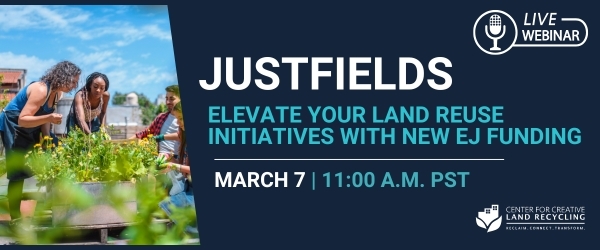 Webinar March 7: New environmental justice funding from EPA
An upcoming webinar by EPA and Center for Creative Land Recycling can help communities facing environmental justice concerns snag their share of $3 billion in grants from EPA’s Environmental and Climate Justice Program.
This webinar will highlight:
- Available and upcoming funding opportunities;
- Eligible activities relevant to land reuse;
- CERCLA 104(k) and 128(a) limitations that may be addressed by this funding; and
- Information about layering your financial opportunities to maximize project success.
Register for Justfields webinar on Thursday, March 7 at 11 a.m. Pacific.
Grants for community change: Apply by November 21
Community-based nonprofit organizations, local governments, federally recognized Tribes, and higher education institutions are invited to apply for grants that help disadvantaged communities manage environmental and climate justice challenges. Two billion is available from EPA's Community Change Grants Program for projects that reduce pollution and build climate resilience and capacity in the community.
Apply through Grants.gov by 8:59 p.m. Pacific on Thursday, November 21, 2024.
 Training & Technical Resources
Webinar February 21: Renewable energy on contaminated sites
Some states like Massachusetts, New Jersey, and Illinois are reaping the benefits of successful renewable energy projects on contaminated sites because they put large-scale programs into place. This EPA webinar shares best practices from about 60 renewable energy programs in more than 12 states so your community can do it, too.
Webinar February 22: No-cost Targeted Brownfields Assessments
In this newsletter, we keep linking to EPA's Targeted Brownfields Assessment (TBA) program below because it's a great deal: no-cost technical assistance provided by EPA contractors for brownfield assessment activities, such as Phase I and Phase II environmental site assessments.
Center for Creative Land Recyling (CCLR) encourages you to apply for a TBA, too. Register for their February 22 webinar to hear case studies about other communities that benefitted from this program. A recording will be available but live presentations are always a great time to ask questions.
Register for CCLR webinar on Thursday, Feb. 22, 11 a.m.–12:15 p.m. Pacific.
__________
EPA's Targeted Brownfields Assessment (TBA) program promotes the cleanup and redevelopment of brownfields by helping states, Tribes, municipalities, other government entities, and nonprofit organizations minimize the uncertainties of contamination often associated with brownfields. Unlike grants, TBAs are an EPA service, and the assessments are conducted by an EPA contractor. A TBA may encompass one or more of three activities:
- “All appropriate inquiries” assessment (Phase I), which includes a background and historical investigation, and a site inspection.
- Full site assessment (Phase II), including sampling activities to identify areas of contamination and types and concentrations of contaminants.
- Determining how much more investigation is needed and/or establishing cleanup options and cost estimates based on planned uses after redevelopment.
No application deadlines for this service. Learn more about TABs in Region 10.
Webinar February 26: Developing affordable and workforce housing on former brownfield sites
EPA is hosting an overview of environmental considerations when you're redeveloping brownfield sites for housing. They'll explore the role of public-private-partnerships and review some of the major funding resources for supporting development of workforce and affordable housing.
Register for webinar on Monday, Feb. 26 at 10 a.m.-11:30 a.m. Pacific.
Webinar financial series for Tribes
Tribal-specific funding is featured in a 4-part webinar series from the Council of Development Finance Agencies (CDFA). The next one on April 23 will spotlight finance programs and strategies for increasing access to capital and creating successful small businesses. Learn more.
- All webinars 11 a.m.–12:30 p.m. Pacific.
-
Register for April 23, July 9, and Oct. 15 even if you can't attend. Registrants can access recordings later (and most likely the Feb. 13 webinar, too).
Applying for an EPA grant or managing one right now? Check out these training webinars in March.
EPA Grants Webinars is a good source of training webinars from the Office of Grants and Debarment. These three caught our eye:
1. Competition process | Register | Tuesday, March 26| 10–11 a.m. Pacific. Learn how to find and apply for competitive EPA grants and hear an overview of the entire competition process.
2. Procurement, subawards, and participant support costs | Register | Wednesday, March 27 | 8:30–9:30 a.m. Pacific. Learn about regulations, requirements, and best practices.
3. New EPA Davis-Bacon Grant term and condition | Register | Thursday, March 28 | 9:30–10:30 a.m. Pacific. Learn about the new term and condition required for certain programs that involve construction activities.
Technical expertise from KSU and CCLR help max your dollars
EPA's technical service providers can help you make the most of your brownfields funding:
-
Serving Tribes: Kansas State University's Technical Assistance Brownfields (KSU TAB)
-
Serving EPA Regions 9 and 10: Center for Creative Land Recycling (CCLR).
Check out their websites for resources and webinars that help you imagine a new life for your brownfields (and get there).
 Bring home the benefits of local food
If your community has been impacted by a Superfund site, you may be eligible for technical assistance from EPA programs that makes healthier food more accessible. Communities are exploring ways local foods can help them revitalize their downtowns and create "walkable, healthy, and economically vibrant neighborhoods."
-
Three opportunities for pilot workshops are available in 2024 from EPA's Superfund and Local Foods, Local Places programs. There's no formal call for applications: contact your community's Superfund Coordinator for how to apply.
-
Download a toolkit and editable templates you can tailor to suit your community's needs. The toolkit has step-by-step instructions for planning and hosting community workshops, and the templates for an agenda, invitation, and presentations will save you time.
Since the "Local Food, Local Places" program launched in 2014, EPA has partnered with 137 communities, including Alaska's Anchorage and Palmer; Idaho's Lapwai (Nez Perce Tribe) and Nampa; Oregon's City of Cottage Grove; and Washington's Skyway Neighborhood in King County.
Watch a 4-minute video, check out success stories for inspiration, then contact your Superfund Coordinator to apply.

We extended our 2-minute survey through Thursday, Feb. 29 because we want to know what might stop you from cleaning up or redeveloping your brownfields. Already took the survey but have more to say? Great, we're listening!
Your responses will remain anonymous, and we'll summarize results and our next steps in the coming months. Read the IACC story in our December newsletter for more information.
Thank you! Oscar & the Washington State Brownfields team
|

Contact us if you have a brownfield project!
|