|
DCYF is proud to announce that MaLea Lindsey has accepted the Home Visiting and Policy Analyst position. MaLea will start in the role on Aug. 1.
MaLea Lindsey uses she/her pronouns. She lives and works on the traditional tribal lands of Spokane and Coeur d’ Alene tribes. She was born and raised in Spokane’s Hillyard community. She has earned a BA degree in psychology from Eastern Washington University and an MS in Human Services from Capella University.
MaLea is a lifelong learner and has been trained in Brene’ Brown’s Dare to Lead, is endorsed as an Infant Family Specialist by the Washington Association of Infant Mental Health, and most recently has finished the Project Coordinator certification, and is working towards her Project Management certification through the South Puget Sound Community College.
MaLea has worked in prevention services since 2006. Her career began as a preschool teacher, after that, she moved to Early Head Start as a Family Service Coordinator first in the classroom and then as a home visitor. After that, she moved to the Early Supports for Infants and Toddlers (ESIT) program with Spokane Regional Health District where she was a Family Resources Coordinator and Program Coordinator. For the last 3 1/2 years she has been working as an Accountability and Quality Improvement Specialist with the DCYF ESIT program.
She is passionate about supporting children and their families and believes that the DCYF and communities across Washington can work together to make changes for a bright future. MaLea values living BIG (boundaries, integrity, and generosity). As Brené Brown says, Living BIG is about saying “Yes, I am going to be generous in my assumptions and intentions while standing in my integrity and being very clear about what is acceptable and what is not acceptable."
Welcome MaLea!
Our next office hours will be Aug 15, 2024, 3 p.m. Join here for our first semi-annual HVSA Training and Learning Supports Overview.
Information is geared to Supervisors and Program Managers and a recording of the presentation will be available afterwards.
Highly recommended for Supervisors and LIA Leadership new to the HVSA!
Space is Still Available!
Annual Supervisor FAN for Supervisors and Program Managers
This virtual, one time per year offering takes place over a period of 8 months and includes Level 1 (4 session) and Level 2 (2 session) trainings, as well as six months of virtual mentoring in pairs. Maximum # Participants is 12-15.
Tu, Sep 10, 2024, 9-12:15
We, Sep 11, 2024, 1-4:15
Tu, Sep 17, 2024, 1-4:15
Th, Sep 19, 2024, 1-4:15
To learn more, or to sign up, please reach out to Nina Evers at nina.evers@dcyf.wa.gov or by phone at 360.522.0982.
The Barnard Center for Infant and Early Childhood Mental Health is hosting Virtual Child-Parent Psychotherapy (CPP) Open Houses this August and September.
To register for the open house and to learn more about becoming a CPP provider in your community, click here.
The Washington Department of Children Youth and Families (DCYF) is conducting an analysis of contracted services provided across the state in support development of a service framework for families experiencing child welfare systems involvement. DCYF is partnering with Public Consulting Group (PCG) to capture your voice. By sharing your voice, you’ll be able to impact future families’ experiences throughout the state.
These sessions will focus on: Combined In-Home Services, Intensive Family Preservation, Professional Services, Psychiatric/Psychological Services, Family Time Services, Network Administrator, Independent Living Services, LifeSet, Home Visiting Services, Parent Child Assistance Program (PCAP) and services accessed by existing JR youth. Because of your experience as a service provider holding contracts of services listed above, you will be invited to participate in one of two listening sessions in August (dates forthcoming). Your experiences are critical for furthering change within DCYF and will influence systemic improvements, positively impacting children, youth and families across Washington. PCG will host two virtual listening sessions to identify systemic barriers as well understanding how historical, cultural, and/or social factors contribute to service delivery across the state.
The project is called Assessing and Describing Practice Transitions Among Evidence-Based Home Visiting Programs in Response to the COVID-19 Public Health Emergency (ADAPT-HV) and participation will be about 7 months, likely beginning in early fall of 2024. Selected LIAs and home visiting programs will work with researchers to design, adapt, and test practices in a rapid-cycle learning format. During the study, program staff, including home visitors and administrators, and caregivers will participate in a series of focus groups and complete several short, online questionnaires. For more detailed information about the phases of the study, please see the information sheet.
The study team is seeking nominations of MIECHV-funded local implementing agencies or home visiting programs that are currently implementing one or more of the following types of practices:
-
Informal contacts: Communications or exchanges of information between a home visitor and family (caregiver) that occur outside of what the agency and/or home visiting model defines as formal, scheduled home visits.
-
Virtual child engagement: Methods or approaches used by home visitors to promote and maintain child interest and involvement during virtual home visits. (To be eligible for the virtual child engagement study, a site must be conducting virtual visits or willing to conduct virtual visits during the study period.)
-
Coaching: Practices used by home visitors to support caregiver-led, child-directed skills or activities through verbal guidance or direction. This is in contrast to other approaches such as modeling strategies, in which the home visitor demonstrates skills or activities while families observe.
Sites that are implementing one of these strategies in a formal or systematic manner are ideal candidates for this study, although sites in all stages of implementation are eligible. Study sites will receive an honorarium of $1,500 for their participation and caregivers who participate in a focus group will receive an honorarium of $40.
ADAPT-HV is funded by the Health Resources and Services Administration (HRSA), in collaboration with the Office of Planning, Research, and Evaluation (OPRE) in the Administration for Children and Families (ACF). The study team is led by staff from The Policy & Research Group in partnership with Mathematica.
If you would like to be a potential study site, please email dcyf.homevisiting@dcyf.wa.govwith put the name of the study in the subject line and provide the following information by Friday, August 9:
- Site name and location
- Type of practice implemented
- Brief description of how the practice is being implemented
- Other details on site’s suitability for participation, if known
- Recent research, evaluation, or continuous quality improvement experience
- Interest in participating
HVSA Aligned Measure: Breastfeeding
Breastfeeding can benefit babies and caregivers in many ways. Close physical contact helps create a bond between baby and caregiver,1 and breastmilk provides baby with good nutrition and substances that may prevent diseases and infections.2,3 Research shows that the longer a baby is breastfed or fed breastmilk, when possible, the greater the benefits will be.4
The breastfeeding measure reports the percent of infants (among caregivers who enrolled in home visiting prenatally or became pregnant while enrolled) who were fed any amount of breastmilk at 6 months of age. Children need to have reached 6 to 12 months of age within the reporting period to be included in this measure. For detailed information on the measure, visit: HVSA Breastfeeding Overview.
What are we measuring?
 When to ask:
Collect once when the infant is between 6 and 12 months old.
 Measure production details:
Calculate: The percentage of infants aged 6-12 months who were breastfed any amount at 6 months of age.
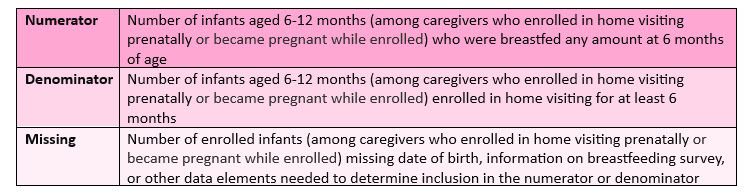 Required Data Elements: (1) Family Enrollment Date, (2) Family Exit Date (if applicable), (3) Child Due Date, (4) Child DOB, (5) Breastfeeding Survey Date, (6) Did the child receive any amount of breastmilk at 6 months of age, and (7) Was the child unable to receive breastmilk due to a medical reason?
Visit Tracker Users:
- If you asked about breastfeeding before the child was 6 months old and indicated in Visit Tracker that the child was never breastfed or was weaned before 6 months, it is not required to ask about breastfeeding again when the child is between 6 and 12 months old, the home visitor may ask again based on their own discretion.
- If you asked about breastfeeding before the child was 6 months old and the child was still receiving breastmilk at that time, the question MUST be asked again when the child is between 6 and 12 months old in order to determine if they continued receiving breastmilk once they turned 6 months of age.
Note:
- In addition to breastmilk fed directly from the caregiver to the infant, breastfeeding also includes feeding the infant pumped or expressed breast milk.
- The measure captures if the index child received breastmilk in any amount at 6 months of age, not if the child was continuously or exclusively breastfed for 6 months.
How to enter data:
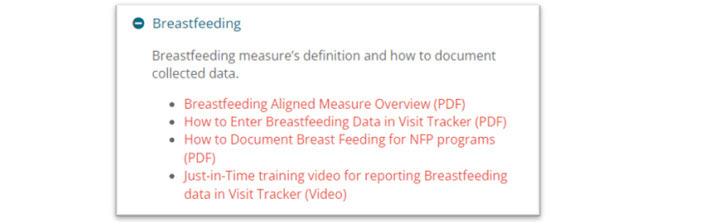
Instructions to enter data are now available for programs on DCYF's Data Collection & Reporting Page. Please refer to the HVSA Aligned Measures section for instructions on how to document the breastfeeding measure.
 Resources for families:
- Lactation, Breastfeeding & Chestfeeding
- Lactation Support
- WIC: Breastfeeding Support
State agencies announce first recipients of Centers of Excellence for Perinatal Substance Use certification
The Washington State Department of Health (DOH), Washington State Hospital Association (WSHA), and the Washington State Health Care Authority (HCA) are pleased to announce the first Center of Excellence for Perinatal Substance Use certification recipients. The University of Washington Medical Center – Northwest of Seattle, Providence Sacred Heart Medical Center of Spokane, and Providence Holy Family Hospital of Spokane are the first birthing hospitals to receive this award.
Click here for the full story.
Each month, DCYF ESIT Tribal Program Consultant Brian Frisina will provide a key topic to help support us all in getting to know our Tribal Nations partners better.
This month’s topic is:
Indigenous civil rights documentary FISH WAR
“The right of taking fish at usual and accustomed grounds and stations is further secured to said Indians in common with all citizens of the Territory, and of erecting temporary houses for the purpose of curing, together with the privilege of hunting and gathering roots and berries on open and unclaimed lands …” — Article 5, Treaty of Point Elliott, 1855
The life and legacy of Salmon Warrior
Billy Frank, Jr. was a tireless advocate for Indian treaty rights and environmental stewardship, whose activism paved the way for the “Bolt decision,” which reaffirmed tribal Co-management of salmon resources in the state of Washington:
Fish War - Seattle International Film Festival 2024 Trailer
In 1974, a conservative federal judge upheld Indigenous fishing rights in Washington, ending violent clashes with law enforcement and laying the foundation for environmental stewardship in this locally produced activism documentary (1:59):
Read more about the Indigenous civil rights documentary FISH WAR premiere at Seattle International Film Festival:
Sources
-
Treaty of Point Elliott, 1855, Governor's Office of Indian Affairs, Ratified Mar. 8, 1859, Proclaimed Apr. 11, 1859. Access Washington.
-
Salmon Warrior, The life and legacy of Salmon Warrior, Copyright © 2024.
-
Indigenous civil rights documentary FISH WAR to premiere at SIFF, posted April 17, 2024, Copyright © 2024 Northwest Treaty Tribes.
-
Fish War - Seattle International Film Festival 2024 Trailer, posted to YouTube by SIFF News, April 17, 2024.
A Kids Book About Emotions
A Kids Book About Emotions by Nakita (she/her), art director, designer, illustrator: Emotions? emotions... EMOOOOTIONS! We all have them, they’re all different, and they’re rarely simple. This book helps kids explore the complexities of their emotions with stories, questions, and coloring activities made for self-expression. What color do you feel like today?
|
The More You Know
Why and How to Celebrate Disability Pride Month
Disability Pride Month happens every July to mark the ADA’s anniversary, which was passed on July 26, 1990. The first celebration was a Disability Pride Day that took place in Boston in 1990. Chicago hosted the first Disability Pride Parade in 2004. Now there are events nationwide empowering people with disabilities to take pride in who they are. Here’s more about the history of Disability Pride Month and the story behind the flag.
The History of Disability Pride Month:
Everything to Know About the Disability Pride Flag and Disability Pride Month:
News
‘Unprecedented’: WA transfers 43 men in juvenile detention to adult prison, The Seattle Times
New youth transitional care facility opens in Burien: The Lake Burien Transitional Care Facility opened Wednesday, offering a fitting care setting for teens with developmental disabilities and complex care needs. For parents and caretakers of teens with developmental disabilities like autism spectrum disorder, there are very few options when behavioral problems spiral to the point of crisis.
Meet the state senator leading efforts to return land to tribal nations. Mary Kunesh, the first Native woman to serve in the Minnesota state Senate, is applying a lifetime of wisdom to the landback movement. Grist >
|
Technology in Home Visiting: Explore some innovative ways home visiting programs are using technology to strengthen their services.
|
|