|
LGBT+LOVE by Jahla Brown, DCYF ESIT Partnership & Collaboration Specialist
“If I wait for someone else to validate my existence, it will mean that I’m shortchanging myself.”
–Zanele Muholi, South African artist and visual activist working in photography, video, and installation.
Please note that there will be no issue of the ESIT Weekly sent out Fri., June 21, in observance of Juneteenth (Wed., June 19). The ESIT Weekly will resume its regular schedule on Fri., June 28.
Thank you!
 |
Juneteenth, also known as Emancipation Day or Freedom Day, commemorates the emancipation of enslaved African Americans in the United States. The holiday dates to June 19, 1865, when Union General Gordon Granger arrived in Galveston, Texas, and announced that all enslaved people were free, more than two years after President Abraham Lincoln's Emancipation Proclamation had taken effect. The delay was due to the slow spread of information and the resistance of slaveholders. Juneteenth has since evolved into a celebration of African American culture and a reminder of the long struggle for civil rights and equality.
The importance of Juneteenth lies in its recognition of the end of the enslavement of people and the resilience and contributions of African Americans. It serves as a time to reflect on the injustices of the past and the ongoing challenges faced by the Black community. Juneteenth is celebrated in a variety of ways, including parades, cultural events, educational programs, and family gatherings, all aimed at honoring African American history and fostering a sense of unity and pride. The holiday has gained increased recognition in recent years, with more states and institutions acknowledging its significance and promoting its observance.
Resources
Events
“Since time immemorial, Indian tribal Holy Men have gone into the high places, lakes, and isolated sanctuaries to pray, receive guidance from the Spirits, and train younger people in the ceremonies that constitute the spiritual life of the tribal community.”
- Vine Deloria Jr., author, theologian, historian, and activist for Native American rights. Excerpt from Sacred Lands and Religious Freedom by Vine Deloria, Jr.
Each week, DCYF ESIT Tribal Program Consultant, Brian Frisina, provides a key topic to help us get to know our Tribal Nation Partners better.
This week’s term is:
What is a Sacred Site?
Sacrosanct or Something Else?
To the Western ear, “sacred” may be synonymous with “sacrosanct” — inviolably holy — but to an indigenous culture, a place labeled as “sacred” may instead mean something spiritually alive, culturally essential, or simply deserving of respect. This Western conception of and emphasis on “sacredness” often leads indigenous groups to accept the label, however ill-fitting it may be, because protection efforts might otherwise be ignored. A place that is just “spiritual” or “culturally important” rather than “sacred” may not be deemed by those outside the community as important enough to protect.
Learn more in depth about efforts to define Sacred Sites:
NARF Launches New Sacred Places Project
To strengthen protections for Native Peoples’ sacred places in the United States, the Native American Rights Fund (NARF) has launched a new Sacred Places project, entitled Sacred Places Protection: Fulfilling U.S. Religious Freedom Promises to Native Peoples. “Since its inception, NARF has worked to protect Native sacred sites, lands, and the free expression of Native religion. Native Peoples in the U.S. have long relied on tribal sovereignty, treaties, and religious freedom law to protect sacred places,” said NARF Staff Attorney Brett Lee Shelton. “What we’re finding is sacred place protection needs rethinking in courts, and NARF’s Sacred Places Protection Project aims to begin that re-envisioning process.”
The three-year project will identify failings to protect Native sacred places in existing law and policy and suggest solutions grounded in Indigenous knowledge and developed by Native culture bearers. Existing laws, policies, and sacred places protections all use language not centered in Indigenous thinking.
Read More About Some of NARF’s Work to Protect Sacred Sites:
World Peace and Prayer Day was founded in 1996 in the Black Hills of South Dakota by Chief Arvol Looking Horse, 19th generation keeper of the sacred White Buffalo Calf Pipe of the Sioux Nation. Arvol Looking Horse was led by a vision to honor sacred sites and to invite all nations and all faiths to do the same, to heal our relationship with our mother, the Earth. World Peace and Prayer Day is held annually on the summer solstice, June 21st, a powerful day to pray for peace among all living beings. Learn more about World Peace & Peace Day.
Chief Looking Horse believes that this day of collective prayer will create an energy shift to heal the earth and achieve a universal consciousness toward obtaining peace. He believes that it is time all people understand Mother Earth is the Source of life, not a resource. Listen to the words of wisdom of Chief Looking Horse (watch time 11:18):
Sources

The ESIT State Leadership Team is excited to welcome our new ESIT Data Coordinator, Teanne Stangel. Teanne will be supporting the Data Systems and Analysis Team (DSAT), specifically our DMS/ACORN Help Desk.
Teanne started her career as a preschool teacher and spent ten years working in various roles within Early Learning before moving to K-12 and focusing on Special Education data management. An opportunity to serve as Birth-to-Three Transition Coordinator for Spokane Public Schools merged those two worlds, offering her a first glimpse into ESIT and the many varied ways this team provides vital support for children and families.
She lives in Spokane with her husband Nick and their dog and cat (Cleo and Amadeus). They love to share time with their son, Casey (23), and daughter, Tia (21), who both also live in Spokane. She enjoys backpacking through the Cabinet Wilderness, retro arcade games, and hobby-hopping.
Welcome, Teanne! We're so glad you're part of the team!
|

How to Access ACORN Training and Webinar Posted
Are you struggling with creating your SAW (Secure Access Washington) account and accessing ACORN? On ESIT's ACORN Data Management System page, we have made a step-by-step training resource and recorded webinar version available. Please take a moment to review these resources prior to contacting the Help Desk:
ACORN Office Hours
The ACORN Office Hours are an opportunity for ACORN Users to connect with the DSAT and PCG teams to ask questions and receive technical assistance. ACORN Office Hours are scheduled every Friday from 9 a.m. - 10 a.m. PST. You can join the Microsoft Teams Meeting using this link:
Meeting ID: 214 221 472 407
Passcode: 35ZAs6
Topics for the upcoming weeks are:
- June 21 | Navigation Pathway
- July 5 | No Office Hours
During our Office Hours, we will ask “How To” questions. Please submit your questions by Thursday to ESIT Data Systems and Analysis Manager, Kim Hopkins, at kim.hopkins@dcyf.wa.gov.
If you would like to report bugs or glitches, please submit these here.
If you would like to submit ideas for improvements and changes, please submit these here.
|
The Introductory Modules launched for all new ESIT Professionals in November 2020 along with updated content and structure for the live training. Since then, we have been collecting and analyzing feedback from participants and making small adjustments.
It’s now time to bring in your voices to do a full review of the content and make necessary updates. Without you, the training won’t reflect the needs of Washington’s diverse providers new to ESIT and our unique ways of partnering with families and meeting requirements.
Who
ESIT Professionals of every type! Therapists, educators, intake coordinators, etc. If you are an ESIT Professional, your perspective is needed.
What
This group will focus on learning content, engagement and activities, structure, and materials for the initial required training.
How
There are three levels of participation to choose from. Let us know what you are able to commit to.
Click the link below to learn more about the design team and submit your interest:
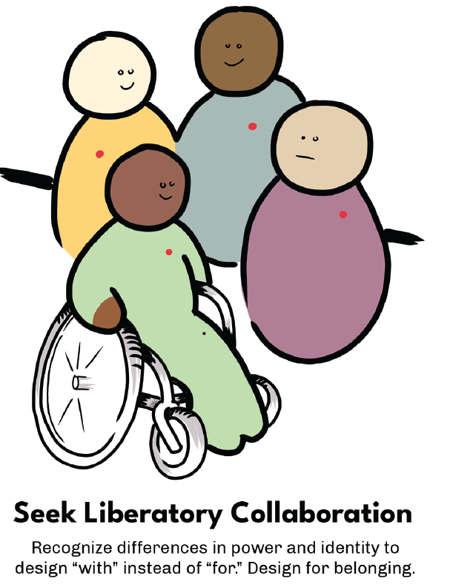
We look forward to working with you as we seek to practice this key Liberatory Design mindset:
"Seek Liberatory Collaboration: Recognize differences in power and identity to design with instead of "for." Design for belonging." -Liberatory Design, Mindsets and Modes to Design for Equity
Questions?
Please contact Adrienne O'Brien, at adrienne.obrien@dcyf.wa.gov, or call (360) 972-4602.

Save the Date: July Combined PIE-SICC Meeting
You are invited to ESIT's upcoming July combined Parent Institute for Engagement & State Interagency Coordinating Council Meeting, which will be hosted in-Person!
|
Wed., July 17| 9 a.m. – 3 p.m.
Stevens County Sheriff’s Training Room
425 N Hwy, Colville, WA 99114
Online option will also be available.
(Meeting link & agenda TBA.)
For Review
The draft April meeting minutes and meeting materials have been posted to ESIT's SICC Meetings page for review. If there are needed edits to the April meeting minutes, please email Will Moncrease Jr.
SICC Direct List
If you would like your email added to the SICC direct email list to receive the agenda and meeting materials in advance of upcoming SICC meetings, email Will Moncrease Jr., with the subject: Add me to SICC DL.
Questions?
Please contact DCYF ESIT Partnership & Collaboration Manager, Will Moncrease, Jr., at will.moncrease@dcyf.wa.gov.

Starting July 1, 2024, the Three Pronged Approach (TPA) will be the required protocol to gather information for vision and hearing as a part of the creation of the present level of development (PLOD) in every initial IFSP and annual review.
What is the TPA?
Developed by the Washington Sensory Disabilities Services (WSDS), the TPA is a comprehensive protocol to identify risks factors for a child’s vision and hearing to lead to possible referral for medical evaluation and/or to Blind/Low Vision and/or Deaf/Hard of Hearing Providers.
The protocol includes tools to:
- review medical records and interview parents,
- identify developmental skills related to vision and hearing, and
- observe physical and behavioral characteristics.
Training is Available
Training modules on conducting the TPA are available now in the DCYF Training Portal for all ESIT Professionals. If you have questions, please contact your regional DCYF/ESIT Technical Assistance Specialist: Diana Golovkin at Diana.Golovkin@dcyf.wa.gov, Michelle Baker at Michelle.Baker@dcyf.wa.gov, or Iris Dunaway Dunaway@Iris.Dunaway@dcyf.wa.gov.
|

Apply to be on the SICC
The Washington State Department of Children, Youth, and Families (DCYF) is recruiting members for the State Interagency Coordinating Council (SICC)!
Currently 1 open position to be filled:
Below are the requirements:
- Parent of an infant, toddler, or child with a disability aged twelve or younger, who has knowledge of, or experience with, programs for infants, toddlers, and children with disabilities.
Apply on the Governor's website, and under 'Board Information,' select Infants and Toddlers with Disabilities and Their Families, State Interagency Coordinating Council:
Apply for SICC Sub-Committees
The SICC Data, Finance, Personnel & Training, Public Policy, and Service Delivery Committees are accepting applications from qualified and interested individuals:
If you have any questions, please contact DCYF ESIT Partnership & Collaboration Manager, Will Moncrease, Jr., at will.moncrease@dcyf.wa.gov.
|
 |

My name is Chia-Cheng Lee. I am a speech language pathologist at Akin/Childhaven. I am conducting a research study in collaboration with School of Rehabilitation Sciences, Moravian University. We are interested in learning more about the experiences, perceptions, and support needs of Mandarin-speaking, first-generation immigrant parents of children with communication delays.
See attached flyers for more information:
Questions? Contact Dr. Chia-Cheng Lee, at chiachenglee2020@gmail.com, or call (206) 536-0706.
|

Emergency Broadband Benefit Funds Available
The WA Office of Broadband has funds available to assist families with internet costs. More details on this benefit and how to apply are located here.
Discounted Internet Service Available to Low-Income Households
The federal Affordable Connectivity Program offers eligible households a high-speed internet plan for no more than $30 per month. More details on this program and how to apply are located here.
Digital Navigation Toolkit Available
Digital Health Navigators are individuals who address the whole digital inclusion process - connectivity, devices, and digital skills - to support community members and provide access to healthcare. The National Consortium of Telehealth Resource Centers (NCTRC) has released a new toolkit that provides helpful resource links relating to digital navigation.
|

Workshops offered by the Infant Early Childhood Mental Health (IECMH) Workforce Collaborative are free for professionals who serve or support children prenatal to five and their families enrolled in Apple Health (Medicaid).
- IECMH Clinical Workshops are designed for clinical professionals involved in mental health assessment and diagnosis for children birth to five.
-
IECMH Community Workshops are intended for all professionals who support the social-emotional well-being of babies, toddlers, preschoolers, and their families, as well as expecting families.
For more information visit:
CEUs and/or STARS hours are provided for most workshops.
Questions? Contact admin@wa-aimh.org.
|
For more updates, subscribe directly to these great newsletters:
|